
by Miguel E. Rodriguez
DIRECTOR: Tim Fehlbaum
CAST: Peter Sarsgaard, John Magaro, Ben Chaplin, Leonie Benesch
MY RATING: 10/10
ROTTEN TOMATOMETER: 93% Certified Fresh
PLOT: During the 1972 Summer Olympics in Munich, Germany, the ABC Sports broadcasting team must adapt to providing live coverage of Israeli athletes being held hostage by a terrorist group.
Two of my absolute favorite true-life movies (United 93 [2006], Bloody Sunday [2002]) happen to be from the same director, Paul Greengrass. Watching Tim Fehlbaum’s film September 5 felt at times like I was watching a Paul Greengrass film, and I can offer no higher compliment than that. From the moment the first gunshots are heard coming from the Olympic village in Munich in the wee morning hours of September 5, 1972, this movie never lets up on the tension. Over the next 24 hours, we will follow the ABC Sports broadcasting team as the managers and crew work through a tangle of journalistic ethics and operational logistics to report on the biggest news story of their lives while maintaining objectivity and their obligation to the truth, and ALSO keeping the safety of the victims and their families in mind.
The four major characters are legendary ABC Sports executive Roone Arledge (Peter Sarsgaard); a then-unknown control-room functionary, Geoffrey Mason (John Magaro), who was in the right place at the wrong time; ABC Sports producer Marvin Bader (Ben Chaplin); and German-to-English translator Marianne Gebhardt (Leonie Benesch), who is probably an amalgam of several different people who were most likely present during the actual events of the film.
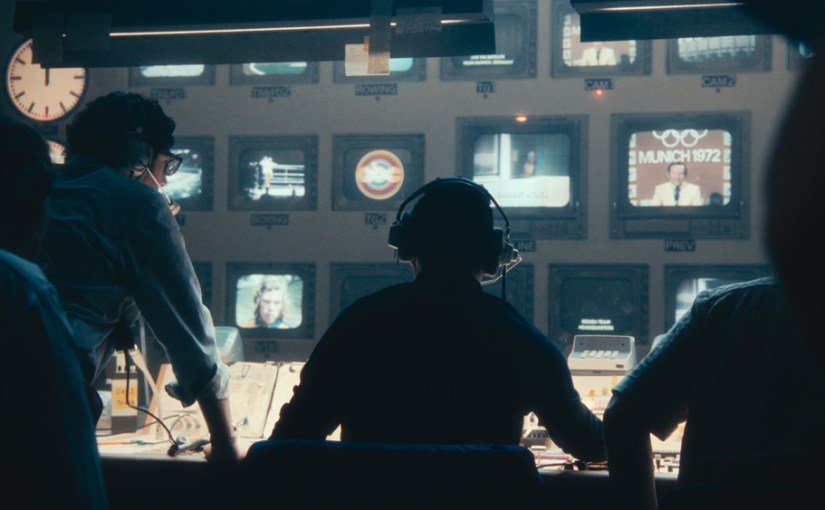
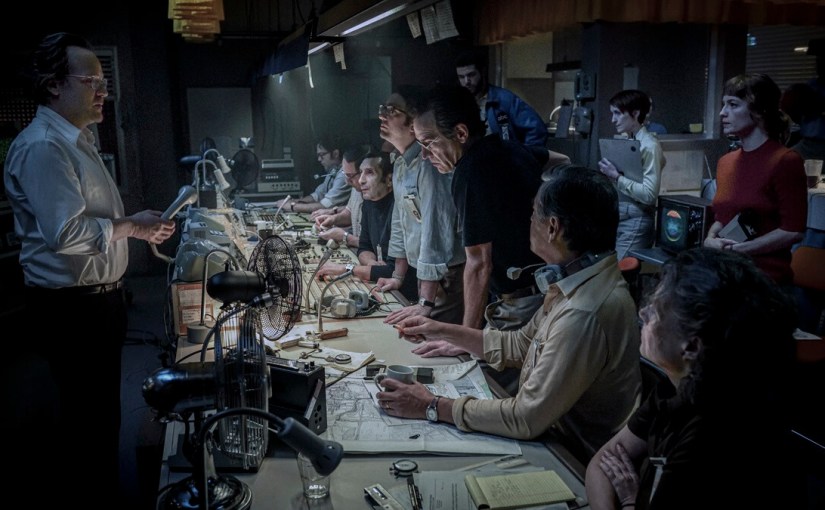
One of the masterstrokes of September 5 is how it rachets up the tension by staying inside the claustrophobic control room and connected offices for the entire film, minus the opening and closing shots showing Geoff arriving for work and leaving the next morning. Anything showing us the outside world is only visible on the banks of television monitors in front of them, which leads to much confusion towards the end of the film as reports of the Israeli hostages being freed begin circulating, but no one can actually see what the hell is going on. This is one of the ways the film reminded me of some of the best scenes in United 93 when the people responsible for making the most crucial decisions of their lives were limited by what they could see and hear on the news.
I have never worked in a TV studio, but this movie carries a palpable authenticity that made me believe everything I was seeing. I never knew, for example, that chyrons (those small captions on the bottom of a TV screen during the news) were analog back in 1972. Whenever a new development occurs, the control room has to call up a woman in a completely separate room/mini-studio so she can manually place individual letters onto a physical message board, then get behind a camera and shoot the image so it can be superimposed back in the main control room. Exhausting!
Peter Jennings is reporting remotely across the street from the Israeli apartments, but he cannot be heard live from his radio into the audio feed for the TV signal. So, some random dude takes a phone handset, unscrews it, solders some wires, clamps it all together in front of a microphone, and presto, now Jennings is live. The whole operation is put together with spit and baling wire. It feels like it’s a miracle that anything was televised at all.
The other conflicts presented to us are no less important. Marianne, a German woman, is drafted into helping with the translation, but first she must endure some brief accusations from Marvin. The fact these Olympics are being held in Munich less than thirty years after the end of World War II is something many people are still coming to terms with. He asks her if her parents knew about the concentration camps. She stares for a second and gives the best answer possible: “But I am not them.” After that, she earns the complete trust of the entire staff.
The subtext of the German guilt over World War II is bubbling just beneath the surface for the entire film. A German maintenance worker won’t release replacement cables to a French tech until Marianne talks him into it. It is theorized at one point that German military forces could possibly end the hostage situation within minutes, but the German military is constitutionally forbidden to operate within the Olympic village, for obvious reasons. Roone Arledge watches Mark Spitz win yet another gold medal, and instead of going to a closeup of Spitz, he instructs the cameraman to cut to the face of the German swimmer who lost. Someone asks him, “Do you really want to bring politics into this?” And he replies, “It’s not about politics, it’s about emotions.”
Which brings in the other major point of retelling this story in this way. There is a point where ABC’s cameras have great shots of the building, the balcony, and the entire complex, and they are broadcasting live (the first time the Olympics had been broadcast live, by the way). Someone spots German policemen – non-military – getting into position with sniper rifles. Marianne hears chatter on the police band about an operation getting the green light. The press is ordered out of the area, but ABC’s cameras continue to broadcast live. Someone notices that a TV appears to be on inside the apartment where the hostages are being held. Geoff suddenly asks a reasonable question: “Are the terrorists seeing this?” Minutes later, German police storm the ABC control room and demand the cameras be turned off, pointing a gun at the crew at one point. The cameras get turned off and a furious Arledge kicks the Germans out of the building, but the point is made. Minutes later, the operation is called off.
“They should’ve cut the electricity to the apartment, it’s not up to us to double-check on them,” says Marv. But Geoff makes a point: “Marv, it’s not okay if we made it worse.” The fine line between the freedom of the press and general public safety could not be more elegantly portrayed than it is here. Earlier in the film, just as the cameras have been set up with shots of the balcony of the apartment, someone asks, “Black September [the terrorist group responsible], they know the whole world is watching, right? …if they shoot someone on live television, whose story is that? Is it ours, or is it theirs?”
It seems like an easy question to answer: “Public safety comes first.” But who gets to decide what’s in the public’s best interest? Those policemen who burst into the control room and shut the cameras off at gunpoint? Perhaps it should be left to each newsperson’s individual conscience, but can that always be trusted? These are questions I am not qualified to answer, but I appreciate films like September 5 because they have enough faith in the viewer to pose those questions and then refrain from providing a tidy answer. It’s one of those rare thrillers that tells a crackling good story and also asks some big, relevant questions that you may not even think about until you’re driving to work the next day.
One of the last things we hear is Marianne talking to Geoff, who had sent her to the German airport where the hostages were supposed to have been flown out of Germany. “I was there with hundreds of people, we stared into the night. We were waiting for something to happen because we wanted to take a picture of it.” While that’s a rather bleak way of describing a profession that has given us some compelling images that have swayed the world’s opinion on vitally important matters, perhaps it’s also a way to caution those who would exploit situations, like the paparazzi who chased Princess Di into that tunnel.
 2 UNPAID MOVIE CRITICS!!!!