NEXT GOAL WINS (United Kingdom, 2023)

by Miguel E. Rodriguez

DIRECTOR: Taika Waititi
CAST: Michael Fassbender, Oscar Kightley, Kaimana, David Fane
MY RATING: 9/10
ROTTEN TOMATOMETER: 41%

PLOT: In 2011, the literal world’s-worst soccer team from American Samoa gets a new coach one month before the next World Cup qualifiers.


In all the best ways imaginable, Next Goal Wins is a throwback to those countless formulaic sports movies of yore, from The Bad News Bears to Little Giants to Cool Runnings to The Mighty Ducks and beyond, right down to some of the songs used on the soundtrack. The underdog formula is nearly as old as film itself, and there have been many, many bad attempts at using it.  Where Next Goal Wins succeeds is in making the audience really care about the players and the coach before the big match.

Apparently, that’s not easy to do.  The list of films that get this basic concept wrong is long and undistinguished, from badly-thought-out sequels (Rocky V, Major League: Back to the Minors) to original concepts that crashed and burned (The Air Up There, The Babe).  In fact, there have been so many BAD sports films that I initially didn’t want to see Next Goal Wins.  But it’s from a director I admire, New Zealander Taika Waititi (Jojo Rabbit, Thor: Ragnarok), and the trailers made it look mildly interesting with its exotic setting in American Samoa.

After watching it, I am once again compelled to repeat Roger Ebert’s axiom: “It’s not what a movie is about, it’s how it is about it.”  The formula may be old, but Next Goal Wins executes it beautifully, like a textbook sliding tackle.

The story begins with a flashback to when the American Samoan national football team – that’s “soccer” to us Yanks – legendarily lost 31-0 to Australia in the first round of the 2001 World Cup qualifiers.  (The device for this flashback is a charming narration from Taika Waititi himself, playing a Samoan priest…or preacher…it’s not quite clear, but it’s pretty funny.)  Flash forward to 2011 when a down-on-his-luck soccer coach Thomas Rongen (Michael Fassbender) is given a take-it-or-leave-it offer to coach the American Samoan team…a team which, by the way, had never scored a single goal since its inception.  The existing coaching staff, along with the team’s devoted fans, are so beaten down by disappointment and defeat that they don’t even necessarily want a win.  They’ll take just a single goal in official competition.

(I should mention here that before you think this is going to be another “white savior” movie, I assure you, it’s not. In fact, one of the characters brings up that very question, and the team ultimately rises and falls based on how they incorporate their own attitudes and customs rather than in utilizing new methods from their new Caucasian coach. This is key.)

What happens next is predictable to anyone who has ever seen Major League.  We meet the team members, a squad of misfits that includes an oversized goalie, a guy who looks like a reject from the old Geico caveman commercials, and a transgender player who spends most of her time on the practice field standing alone and playing with her hair.  Tradition says that the goalie must redeem himself, the caveman guy will reveal hitherto-unknown skills, and the transgender player will rise to the occasion when it counts.

Does all of this happen?  Well, yes and no.  I don’t want to reveal too much, because a lot of the pleasure in this film is watching how it toys with cliches, turning some of them slightly sideways while fully embracing others.  …okay, I’ll reveal one example.  Remember the overweight goalie?  You’ve probably seen him in the trailer, where the coach tells him to go around instead of jumping over him during a drill.  In another, less-inspired film, he would somehow save the day during the climactic match.  Nope.  He’s replaced about halfway through the movie with the ORIGINAL goalie from ten years earlier, the one who allowed 31 goals against Australia.  (But, as another team member points out, he did make 60 saves in that same game.)  Now this guy has something to prove.

Predictably, everything leads up to the first qualifier against Tonga.  We’re never given much info about this team other than they are the opponents and are therefore two-dimensional douchebags.  They insult the Samoan team unnecessarily and taunt the transgender player at a pre-game mixer.  Formulaic, yes, but it fits neatly into the mold of this movie, and I’m willing to let it slide.  There’s even a revelatory discovery halfway through the match that blindsided me and imparted even more emotional weight to the entire movie.  Don’t let anyone spoil it for you.

After looking at the critical comments regarding Next Goal Wins, it seems like this is just going to be one of those movies that either works for you, or it doesn’t.  One critic calls it “deeply irritating” because it follows the underdog sports movie formula in lockstep.  Well, yes, but it does it so well and with enough variations on that theme that I forgive its predictability.  Another critic says the film “doesn’t seem nearly as challenging or risky as most of what Waititi has given us before.”  Well, geez, what were you expecting, Slap Shot crossed with Jojo Rabbit?  Other critics make that same complaint, that the film suffers relative to Waititi’s previous films.  Well, wouldn’t it be fairer to judge the movie itself instead of comparing it to his earlier work?  Or is that just me?

Next Goal Wins was just a great time at the movies.  It may not unlock the secrets of the universe, but I had more fun than I expected.  I can’t ask for much more than that.

(P.S. For those of you keeping score, my girlfriend cried twice.  Do with that information what you will.)
LIGHTYEAR

By Marc S. Sanders

It’s kind of neat to see the evolution of a classic film character when you are a fully aware adult.  In 1995, I had no idea what the term Pixar meant, or knew the impact it would have with the Disney brand as a whole or on the cinematic landscape.  Pixar is now as pioneering as Skywalker Sound or Industrial Light and Magic.  There’s Pixar, and then there’s everything else.  Back in ’95, I was age 23, and my intuition never perked up that I was watching a touchstone character like Buzz Lightyear who would become as grand today as Batman and Elvis turned out to be in an ever-changing pop culture lexicon. Buzz Lightyear is by far one of the company’s most inventive creations.

Jump to nearly thirty years later, with four Toy Story adventures, and endless amounts of merchandising the Space Ranger has been primed for a more personal adventure beyond the imagination of a young child possessing an action figure in his playroom.  Lightyear tells of the adventure that leant to merchandising of the toy depicted in the Toy Story fictional world.  (Try not to think too hardly on that description.)

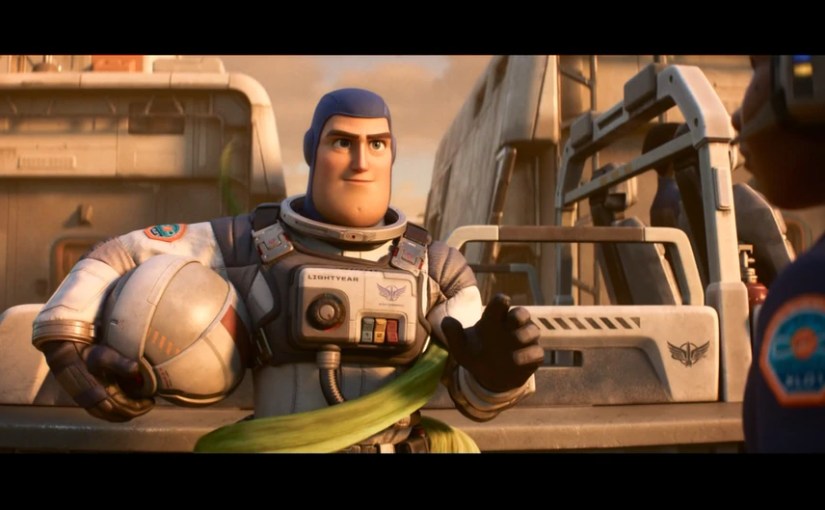
Buzz Lightyear (Chris Evans) is the eminent Space Ranger of Star Command, out to explore strange new worlds and seek out new life and– STOP! That’s another franchise.  When Captain Lightyear comes upon an unchartered planet, complications in unexpected science fiction adventure ensue.  Buzz and the small colony living on his global spaceship are marooned on this planet with no immediate solution for getting off and returning to Earth, 4.2 billion light years away.  Buzz makes it his mission to uncover a new kind of resource fuel that will eventually help the colony make its eventual return home.  Yet, with each experimental try, the minutes he spends in his super speed orbits around the planet equate to years for the colony who have set up habitation below.  His comrades on the ground below continue to age while Buzz does not.

I needed help with this picture.  My wife had to explain the staple lesson that usually comes with each Pixar film that I just didn’t catch while watching Lightyear.  I don’t think I’m spoiling anything, but the film reminds us to accept the hand dealt to us and appreciate what has come even if we never expected or planned on the circumstances in the first place.  It’s a good lesson.  I guess I just wish Lightyear made it a little clearer.  There’s a lot of mud on the windshield that I needed to wipe away before I realized what the message was about.

Maybe I was not fair with this film.  Tim Allen was not invited back to lend his recognizable voiceover to the character.  I guess Pixar is insistent that he’s reserved only for the toy version of the character.  Chris Evans is fine, mind you, and he doesn’t overdo it.  Yet, I could not help but think Tim Allen would have been just as capable and even more entitled to voice the role yet again.

Perhaps I was thinking that if Pixar wanted to go in another animated direction with the character, it just seemed completely fruitless.  How different could Lightyear be from the Toy Story films if the animated design is pretty similar in every frame?  Honestly, it doesn’t look like a new kind of device.  So that was a problem for me, as well.  It wasn’t inventive enough.  Maybe it’s time for a live action version of the space traveler.  Imagine Chris Evans wearing a live action and tactile version of the famous astronaut costume with the colorful buttons.  I still say that could work, and it’s what Disney/Pixar should have considered.

Maybe I’m getting bored with the time travel motif.  Isn’t everyone doing that these days?  Doesn’t it also seem like all our heroes are meeting their future selves and struggling to understand their current predicament?  Lightyear hinges on these story developments, and when the moments arrive my eyes rolled in the back of my head.  Time travel stories are very tricky for me to appreciate.  Often, the narrative paints itself into a corner, unable to explain itself back correctly.  Only two films that come to mind have worked their way out of it almost seamlessly – Back To The Future and 12 Monkeys.

So, while I love the lesson that Lightyear offers, the standard carbon copy plot outline left me unfocused at times.

The voiceover cast is well done with Keke Palmer, Taika Waititi and James Brolin.  The animation is gorgeous, most especially when Buzz is piloting his super jet around the planet’s sun. The atmosphere of the planet is fun when it becomes a nuisance with giant flying insects and vines that come alive to entangle the characters at any given moment.

Science Fiction can go to infinity and beyond with the directions it can take.  There is absolutely no limit.  With today’s technology in filmmaking and the endless resources that Disney provides, why didn’t the filmmakers try a little harder with Lightyear? Again, a live action interpretation would have allowed it to stand apart from the character’s prior Toy adventures, and some different avenues in space exploration would have opened a leaner and more entertaining story.  If Star Trek can do it, Lightyear can do it too.

I think Pixar tried to go the route of Christopher Nolan, by way of Interstellar.  However, Lightyear is designed for people of all ages where the brain of the show is in reminding us how to carry ourselves through life, and not to uncover the twists that a brilliant filmmaker like Nolan has become recognized for.  I didn’t want to resolve a puzzle in fictional science.  Lightyear is trying too hard to be to be brainy and thus we get distracted from its “The More You Know” lesson in self-effacement.

THOR: LOVE AND THUNDER

By Marc S. Sanders

Taika Waititi’s Thor: Love And Thunder doesn’t just operate as a standard Marvel Super Hero movie.  I think it encapsulates what moviegoers treasure when watching a film, and that consists of a gamut of emotions with the opportunity to absorb the best in sight and sound.  Even if we are watching a guy fly through the skies with a cape that’ll be marketed into a million toys and t-shirts, sight and sound are nothing without brains behind a script.  It’s fortunate that a director like Waititi always works with that in mind.  Marvel overseer Kevin Feige knows how to recruit talent behind the camera and you just can’t go wrong with the architect of a spoof on the surface, yet an all too horrifyingly real film underneath, like the widely acclaimed Jo Jo Rabbit.

I’ve always laid claim to the fact that movies largely recognized as “tear jerkers” like Steel Magnolias and Terms Of Endearment are actually comedies first, and then dramatic sob stories second.  I’m serious about that observation.  Why?  Because if a film is going to go to great lengths to risk the outcome of one of its main characters, then it must get its audience to embrace and deeply love that person first.  The best avenue to that approach is to outrageously laugh and cheer that character on ahead of what’s to come.  Taika Waititi’s second film to center on the God of Thunder does just that.  The best reward I got from Thor: Love And Thunder is that I laughed quite often (as the trailers imply), but I also teetered on tears as well.  Good fantasy storytelling will incorporate an all too real conflict with its protagonists and then introduce the strange and unusual as an escape.  The best example may be The Wizard Of Oz, and the simple set up of Dorothy and the risk of her perishing with her dog Toto in a threating tornado.  More recently, I also think about Guillermo Del Toro’s Pan’s Labyrinth centering on a young girl in early twentieth century war torn Europe.  Again, Waititi’s coming of age during Nazi occupation opus, Jo Jo Rabbit, follows this formula as well.  Without spoiling too much from Thor’s latest adventure, Waititi presents an all too real and unforgiving circumstance for one of the film’s characters and then segues into his delightfully and never too weird assortment of settings and characters.

It’d be easy to think that by what may be the sixth or seventh time we’ve seen Chris Hemsworth in the garb of this character that anything inventive would have been exhausted by now.  Not so.  A new dimension in storytelling arrives midway through the film that presents a different crisis for the proud God.  Hemsworth really approaches it beautifully.  It was reminiscent of Christopher Reeve in the original Superman, actually.

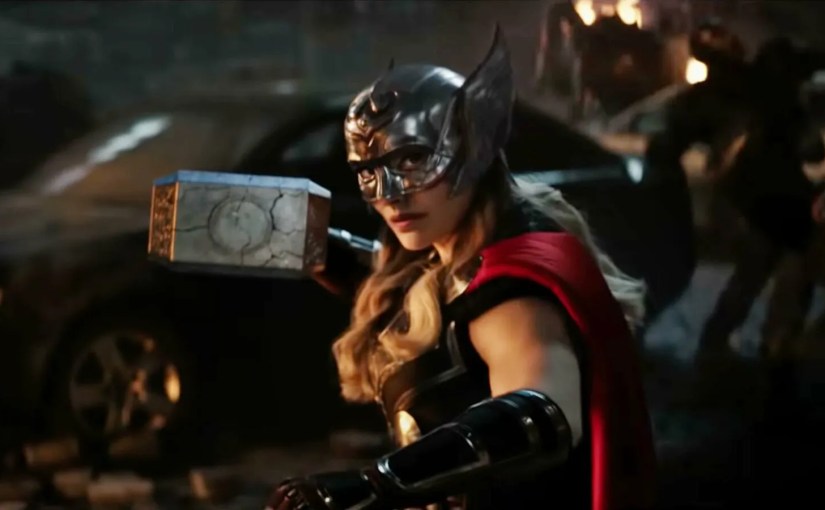
A supporting cast of return players work well together, particularly Natalie Portman, who is given a much more fleshed out and well considered character arc than her two previous Thor films. (Early on, Marvel Studios was notorious for not writing good female characters in any of their pictures.  They were just presented as glamorous damsels in distress. Thankfully, that’s well behind them by now.)  Portman returns as the on again/off again love interest, Dr. Jane Foster, for Thor.  Even better though, Jane actually becomes Thor!!!!! (No spoiler there.  Just look at the trailer or marketing poster.)  There’s great on-screen interaction with Portman and Hemsworth, even when it’s a montage of past dating episodes like in ridiculous Halloween costumes or having a domestic squabble as any typical married couple might have.  Hollywood should reunite these two for a romantic comedy in the vein of Rob Reiner/Nora Ephron material.  Chris Hemsworth is a much better partner than Ashton Kutcher ever was in a past Natalie Portman film.  Put Chris Hemsworth together with Natalie Portman again and they could become as adoring as Tom Hanks and Meg Ryan did.

By the time the fourth movie comes, does it really matter who the villain is played by?  Well, when you are writing a smart script amid ridiculous visuals like Taika Waititi is known for, the answer is yes.  This film surprisingly opens on a downer prologue that necessitates good dramatic acting amid silly CGI and garishly loud costumes.  It’s fortunate that Christian Bale, who regularly performs on a method level comparable to Daniel Day Lewis, was available to portray the scrawny, pale and scarred Gorr The God Butcher.  Bale puts all his talents into what could’ve been a throwaway role like, say a Ghostbusters bad guy.  (Can anyone tell me who actually played Gozar in the 1984 film????)  This is another notch in Bale’s repertoire of outstanding credits that should not be overlooked.  You can sympathize with Gorr, as well as be frightened of him.  There’s much range in this character on the same level as the Thanos villain from earlier Marvel films.

Russell Crowe has a fun appearance as the God known as Zeus.  He looks over the top ridiculous and he works in antics that seem like they came out of episodes of Who’s Line Is It Anyway?  Put it this way, I haven’t forgotten how Crowe walks down a staircase yet.  If Russell Crowe is anything of an educated performance artist, then when he was getting sized up in wardrobe, I’m sure the wheels were turning and he was considering what tics could work for that of a God drowning proudly in his own vanity.

Tessa Thompson and Taika Waititi are thankfully back, respectively as Valkyrie, King of the fishing/tourist destination New Asgard, and the simply innocent rock guy buddy, Korg.  The Guardians Of The Galaxy are here too.  It’s a fun bit of material they have to play with.

In another director/screenwriter’s hands, any Thor film would likely get boring with its standard formal Shakespearean like vocabulary and artificial CGI.  Isn’t that an ongoing problem with CGI anyway?  So often it looks to fake.  Because Taika Waititi opts for bright colors and odd shapes and sizes of setting and background characters, nothing could look artificial, because the fantasy is always acknowledged as over the top by the very characters occupying the space.  A glass castle of pinks and purples that resembles gigantic glass Mary Jane bongs or science lab beakers is accepted in a Thor film, just as much as munchkin size, owl like creatures with small beaks are a terrorizing army in flying jet skis with mounted laser guns.  Mix in a blaring rock soundtrack and Waititi hits the notes where it’s okay to laugh at the silliness of it all. In other moments, he’ll invite his audience back in from recess to take in what’s hard and difficult to live with and endure.  Again, Waititi pleasantly surprised me with the balancing act of outrageous comedy against crushing drama when he made Jo Jo Rabbit.  The blend works so well here in not so typical Marvel fashion.

Thor: Love And Thunder left me thinking that it is the best of the superhero’s four films.  It’s measure of laughs and choked up drama kept engaged and I appreciated the experience.  Remember, I recalled Steel Magnolias and Terms Of Endearment in this write up.  If you don’t take that comparison lightly, then hopefully you’ll have the same experience I did with this installment of the Marvel franchise.

PS: Hats off to the trailers for not incorporating everything the film has to offer.  Within the first fifteen minutes of the movie, I was actually taken aback by an element I never considered or expected.  It only enhanced my perspective of the film.

PSS: Anyone that knows me, knows that I love Guns N Roses.  Consider me a born-again fan.  Particularly Sweet Child O’ Mine will always be one of my most favorite songs.  This film reminded me that it was the first song my daughter heard the day after she was born, when I sang it to her in the hospital room. 

THOR: RAGNORöK

By Marc S. Sanders

Thor’s third adventure in the Marvel Cinematic Universe, subtitled Ragnarök, is altogether fun, silly and primarily very campy. Sure, Cate Blanchett looks wickedly theatric as Thor’s evil older sibling Hera, but even she is not taking any of this too seriously.

There’s not much to evaluate within this film. Chris Hemsworth and Tom Hiddleston return as brothers at odds, Thor & Loki, and get sidetracked on a gladiator battle planet where they encounter a lighter, more tender and funnier Hulk care of Mark Ruffalo. The camp also comes to the forefront by way of Jeff Goldblum as the Gamemaster, a role obviously engineered to cater to his dialect idiosyncrasies.

The film is lots of neon colors of CGI and set piece junk helmed by director Taika Waititi. I commend Marvel Studios for recruiting these (at the time) unheard of directors with insightful visions. While most every Marvel film to date has its own unique appearance, Thor: Ragnarök is a balance of the prior Thor films, banking on the humorous success of the Guardians Of The Galaxy films.

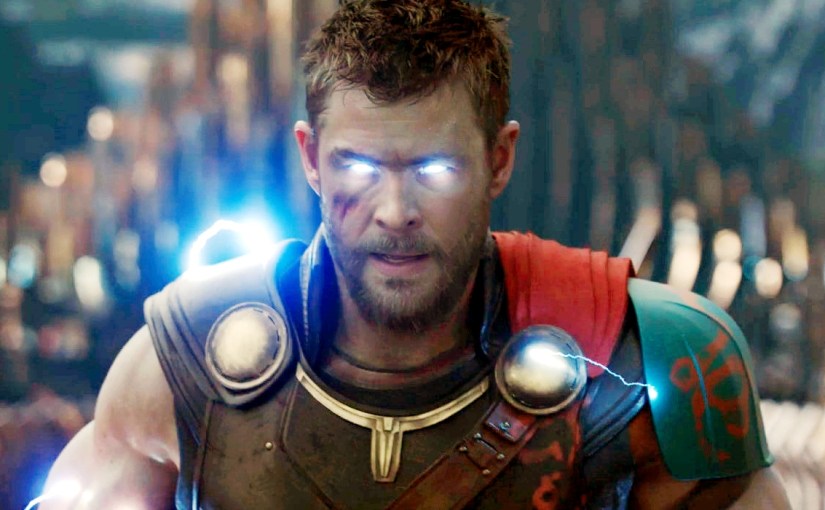
The gem this film offers is combining Led Zeppelin’s “Immigrant Song” with a fierce lightening powered one eyed Thor to fend off a few baddies. Compliments also to a bad ass, and sometimes drunk, Tessa Thompson as the Asgardian known as Valkyrie.

A favorite moment is an encounter with Benedict Cumberbatch as Dr. Strange. Good editing and direction offer an inspired Three Stooges routine where Thor is unexpectedly thrust about down a staircase or through a room. Plays like a great cartoon short.

Ragnarök has some shocking moments in its ending, but the weight of drama or story is none too burdensome.

It’s nothing special of a film, but it is amusing and gleeful, especially when Thor is forced to a chair while Willy Wonka’s “Pure Imagination” plays like annoying elevator music. That is sure to make the God Of Thunder irritable, and we the audience only gain from it.

Thor: Ragnarök is really a fun family movie of adventure, good character design and laughs.