INSIDE MAN

By Marc S. Sanders

The abundance of Spike Lee’s films offer a message as quickly as the film begins.  Then they set out to demonstrate what Lee is talking about in the scripts he writes and/or directs and what is presented on screen for the next two or three hours.  BlacKKKlansman (a favorite of mine) and especially Do The Right Thing are perfect examples.  Lee is direct and hardly ever ambiguous.  Inside Man is an exception.  

This Spike Lee Joint is having a bit of fun with the director’s own take on the staple bank robbery found in so many films.  By the time the film is over, and all the cards are on the table, you realize the audacity of this caper is as unique as Sidney Lumet’s Dog Day Afternoon or Michael Mann’s Heat.  With a screenplay by Russel Gerwitz, Spike Lee is proudly vague until he finally reaches his conclusions during the third act of the piece.  It’s unusual.  It’s out there and it’s a stretch, but the math of the heist seems to add up.  Still, knowing what I know now, I do wish there was a little more focus on some characters that lend to the film’s twist. Then again, maybe that would have implied too much.

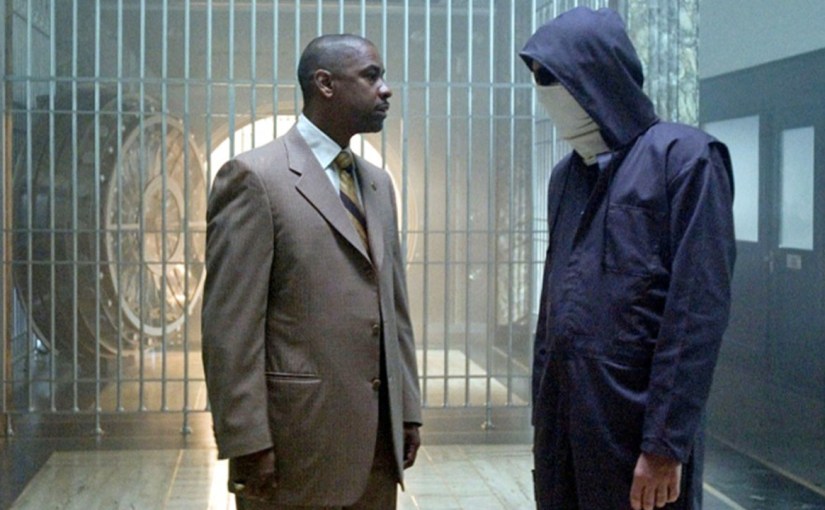
Four people wearing sunglasses, caps and painters’ uniforms take a well trafficked New York City bank branch hostage, complete with the entire staff and around thirty customers who are in the lobby.  The ringleader is played by a mostly concealed Clive Owen.  You might not see his face too often in the film, but you’ll be grateful he’s the bad guy in charge.

Denzel Washington is Detective Keith Frazier, and with his partner Bill Mitchell (Chewetel Ejiofor), they are on the scene attempting to diffuse the situation. The police captain right next to them is John Darius (Willem Dafoe).  Ejiofor and Dafoe are good as expected, though their roles are routine elements for these kinds of movies.  Washington has the kinetic pace that audiences are familiar with as he tries to outthink the bank robbers.  His character is labeled with a checkered reputation as he’s suspected of stealing drug money.  That element really goes nowhere.

Another party comes into the fold with Jodie Foster as a well-tailored and confident “fixer” hired by the bank’s president (Christopher Plummer).  To get these two actors together in a film along with Washington?  Well, that begs for repeat viewing.  Unfortunately, I didn’t see much point to the Foster character.  Upon hearing the news of the robbery, Plummer’s character clandestinely employs Foster to contain the situation so that a particular item in a safe deposit box remain untouched.  She arrives on the scene, exchanges dialogue with Washington that does not add up to much.  She surveys the hostages being held and then exits the story, until the epilogue.  As welcome as it is to see Jodie Foster, I can’t imagine what was gained from the context of her role, which does nothing to advance the story.

Inside Man always kept me interested and guessing.  The structure of Gerwitz’ script jumps ahead at times to show the detectives interrogating each hostage with suspicion after the incident is over.  So, I always wanted to know how it ever came to that shift in direction.  Plus, what happened to the bank robbers, and what precisely had Christopher Plummer so concerned about one particular branch robbery that he had to reach out for special services from Jodie Foster’s character? 

The answers arrive, and I can swallow the explanations.  Yet, the wrap up actually involves additional characters who hardly say a word or appear on screen earlier in the film.  Because they are briskly glossed over, it did not give me complete satisfaction.  I like the twist a lot.  It just needed a more solid foundation.

Inside Man is of those rare films that Spike Lee is invested simply for the fun.  The quick cuts and bustling New York atmosphere work well.  I love the opening credits to the movie; kind of his own spin on what Lumet did with Dog Day…  Lee has a good villain and appealing heroes. Other than few shortcomings, this is a solid crime drama.  

Often, Spike Lee positions himself on a platform that endorses a cause for the African American populace, or he brings attention to social wrongs in world history.  He is one of the best at what he does with his filmmaking approach.  Ironically, a message and a comeuppance arrive with Inside Man, but for a different demographic.  It might not be as hard hitting or thought provoking as other Spike Lee Joints, but it is appreciated.  

DO THE RIGHT THING

By Marc S. Sanders

inally, after 30 years, I’ve caught up to a film that has eluded me, Spike Lee’s masterpiece Do The Right Thing. Here is a film from 1989 that really could have been made in 2019. At the very least, it should be rereleased in the theatres. We desperately need this film right now.

My view of Spike Lee has gradually changed over just the last year. It must be due to the current political and socioeconomic climate. I’ve become terribly sensitive to what I see in the news these days.

Following seeing BlacKkKlansman and now this film, Lee really is aware of how low humanity can go. Do The Right Thing offers just a little push that leads to an endless fall, however.

Lee’s film was shot on location in the Bedford-Stuyvesant neighborhood in Brooklyn. The story takes place on a day where the heat wave has reached a record high, so the predominantly black community has turned on the fire hydrant and Sal’s Pizzeria is open for business. Sal is played by Danny Aiello in an Oscar nominated performance. The main character that everyone knows is Mookie, Sal’s trusted delivery guy, played by Spike Lee. Mookie is well aware of Sal’s mild prejudices towards his customers; mild compared to Pino’s blatant racism (John Turturro), Sal’s older son who works for him along with Vito, the other son.

The film is a day in the life when it appears the same daily routines occur yet again. Mookie delivers pizzas while getting chastised by his son’s mother (Rosie Perez’ debut) for not making more of himself. The middle age men sit on the corner talking about anything random. The kids roam up and down the street goofing off and teasing. Da Mayor (Ossie Davis) seems a little crazy even if we can recognize a life of experience as he’s sipping on a bottle while trying to charm Mother Sister (Davis’ real life wife Ruby Dee) who stays perched on her window sill, and Radio Raheem (Bill Nunn) and Buggin Out (Giancarlo Esposito) are on their own mission to make sure black celebrities appear on Sal’s wall along with the Italian Americans, and “Fight The Power” is rightfully blasting on the boom box.

Each scene in the film plays like a vignette and Lee often times will be as direct as possible with his characters to honestly show what they stand for, whether they are racist or intrusive or even naively annoying. The heat index is nicely displayed through the random commentary from the local DJ portrayed by Samuel L Jackson, and it’s easy to grasp that the temperature serves as a threatening metaphor for what we fear will eventually happen. Our communal mentality is about to boil over.

I easily saw the still controversial ending coming. What’s sad is that it is no longer surprising in today’s era. It’s probably one of the best endings to a film that I’ve ever seen. That’s a bold statement but having watched the film just a week ago, I’ve repeatedly had an internal argument with myself. Who is right? Who is justified? Who is wrong? Why do these activities continue to happen? If I’m still turning this film over in my head after a week, then I can’t deny the impact Spike Lee accomplished. I’m angry. I’m annoyed. I’m sad. Don’t get me wrong. I was also entertained with the film. It’s a great script and a great cast.

Beyond the messages of Do The Right Thing, the film is an assortment of bright colors in costumes and backdrops within the neighborhood. Bedford-Stuyvesant really looks like a beautiful area. It looks clean and the residents really never appear terribly intimidating. Lee finds qualities in all his characters to like, even Pico the most racist of all. Mookie even tries to make a point to Pico about just how racist he seems. It’s a great conversation about the status quo of a black celebrity vs simply another “N-word” who walks into Sal’s for a slice of pizza. I found charm among most of the various conversations in the film. So much so that I said to myself, this is a film that truly could be adapted into a musical or a stage play. There’s so much to tell and so many ways to say it. I wouldn’t be surprised if Lee likely had a hundred more pages of dialogue and a dozen more characters that never made it into the final product.

In 1989, and all the years thereafter, I dismissed this film. I never cared for Lee’s commentary during public interviews. I can’t stand his response to certain issues, and admittedly I just do not like hip hop and rap music. I also may have naively thought that Spike’s viewpoints were a little over the top. I still do, at times. Nevertheless, I was blind, Reader. I truly was.

There’s a terrible truth to Do The Right Thing. A frightening truth. We are very, very far out of reach of racial harmony.

We learn best, only when we fall. Spike Lee’s film shows the shortcomings of the human spirit. Spike Lee’s film makes you think and debate. You have no choice but to question a moral compass.

Whether you have already seen it or not, watch Do The Right Thing today. More importantly, watch it with your children.

BLACKKKLANSMAN

By Marc S. Sanders

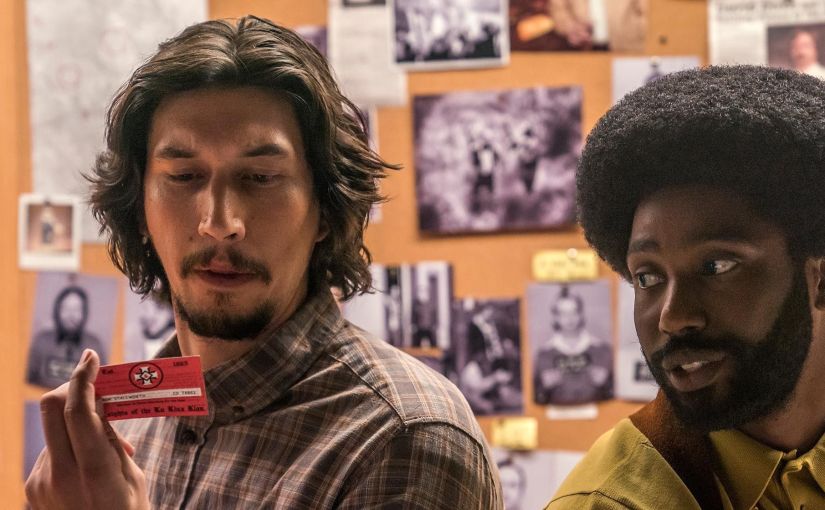
Spike Lee has finally received a Best Director Oscar nomination for his film BlacKkKlansman. It is based on the book by Ron Stallworth. In the 1970s, Stallworth was the only black police officer in the Colorado Springs police department. He was always ready to face the backlash and criticism for his afro and skin color. He also orchestrated an infiltration of the Ku Klux Klan while developing a trust with their Grand Wizard and eventual Presidential candidate David Duke.

John David Washington (son of Denzel) portrays Stallworth with high intelligence, instinct and even tolerance to stay focused on the end goal of incriminating Klan members out to do more than just march. Stallworth partners up with Flipp Zimmerman, a Jewish cop who will make his presence as Stallworth among the ranks of the Klan. Call it a Cyrano set up. Stallworth does the talking over the phone. Flipp stands in their presence.

I’ve usually been hot and cold on Spike Lee. Forgive me but when a “Spike Lee Joint” debuts in theatres, my subconscious immediately expects a very biased and unfair viewpoint of racial tensions in America. I don’t care for Lee’s outspoken statements in the media at times and I shake my head at some of his misguided actions. That’s another conversation that I welcome to have with anyone at another time. However, Lee takes a very aware and balanced approach here. The film opens with Alec Baldwin as an evil messenger of hate attempting to record a sermon for his disciples. Lee films Baldwin very disturbingly among different color hues and jittery close ups and wide angles. It’s nauseating and it should be.

Then Stallworth’s story begins and he is assigned to go undercover at a former Black Panther member’s (played by Corey Hawkins, who I loved in the revival of 24) speaking event on a college campus. The police expect this will be an orchestration of violence among the black community but Stallworth sees it is anything but that. Lee commits a beautiful filmmaking effort as he shows the faces of black people listening to the speech in spotlights as Hawkins continues on. These are college students simply looking for a way to never succumb to anyone who considers them inferior. The speaker does hold the white man accountable, yes, and I don’t care for that as I’m a white man with no instinct of superiority. Therefore, don’t lump me in with a small sect of misguided people, please. Still, the scene is effective and relatable. America has its ugly histories and America is not settling for insensible and uncaring treatment of its people either.

From here, the film takes on a more linear story as Stallworth and Zimmerman build their case.

Lee offers good debates among his cast of characters. Stallworth becomes attracted to an activist named Patrice, played very well by Laura Harrier. Here’s hoping to a long, successful career for her. Patrice believes the police are the enemy and even questions if Stallworth will remain a police officer following this case. Stallworth takes pride in being a cop. Black Life vs Law Enforcement.

Stallworth and Zimmerman bear witness to the mentality of the Klan. Over and over the Klan members suspect Zimmerman of his Judaism. He denies it and goes to great lengths to disprove his heritage and yet the Klan continues to question him, despite some high level members truly believing his guise of white supreme devotion. White Supremicists vs. Judaica & Black Life.

Lee has offered a powerful film that left my wife and I up until two in the morning discussing its dynamics; discussing how many things have changed for the good since the 50s; discussing how many have gotten better, have gotten worse and how some things have sadly resurfaced in recent years.

BlacKkKlansman reminds me that Lee is truly an accomplished filmmaker. Beyond his messages and viewpoints, Lee knows how to edit a scene and offer inventive camera angles and direction. He’s a prize student of film, now a teacher. This latest effort is a reminder of how Lee’s production of Malcolm X in 1991 was robbed of recognition at the Academy Awards, a true injustice.

BlacKkKlansman is Spike Lee’s best film since Malcolm X and one of the best films of 2018.