By Marc S. Sanders
Without question, what would become the absolute most prophetic film ever made is Sidney Lumet’s biting, satirical masterpiece called Network with its script from Paddy Chayefsky.
Network works on all cylinders because it was released following a shedding of maybe the last of pure American innocence. The country had finally pulled out of a losing war in Vietnam. Our President Nixon was shamed out of office. Happy housewife programs like The Donna Reed Show and Leave It To Beaver were behind us. The outright, prejudiced Archie Bunker was who Americans were tuning in to each week. There was even an incident of a newscaster, named Christine Chubbuck, who shot herself dead on live television. Looking back, today in 2022, it all seems inevitable that we would arrive at where we are now; where we are always seeking some semblance of showmanship and we’ll get our own brand of infamy no matter how desperate we become.
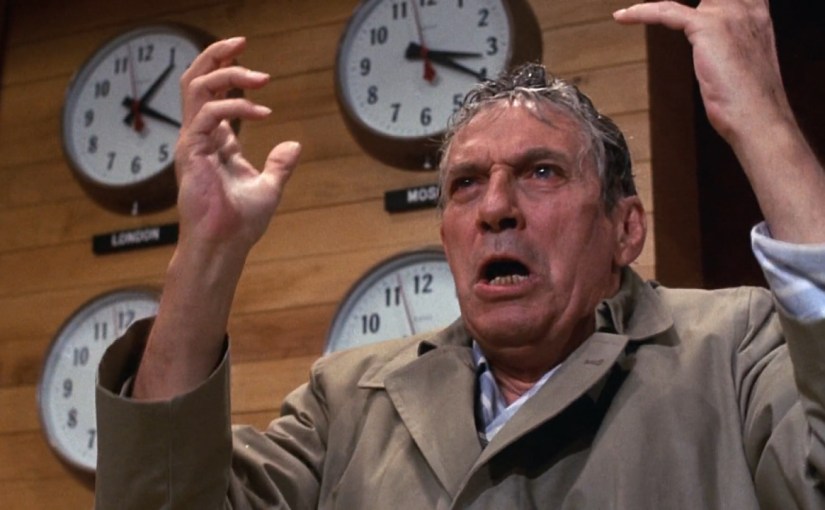
Chayefsky’s script focuses on the fictional network of UBS in present day, 1976. Well known newscaster Howard Beale (Peter Finch) announces on air that the following week will be his last broadcast as the network has opted to let him go due to poor ratings. So, he entices his viewers to tune in when he will kill himself live on the air. It’s a hilarious scene actually due to the ignorance of everyone else in the studio. The director is flirting with his assistant. Another crew member is eating a sandwich. No one is even paying attention to the centerpiece they have on the air. Howard Beale has been taken for a granted as a has been for so long, it really doesn’t matter what he has to say as long as he’s reading the cue cards. Who’d ever announce on live television in front of millions of viewers that he was intending to kill himself?
Max Schumacher (William Holden), the head of the news division, takes his friend into hiding from the media frenzy suddenly created. Yet, the next night and after much convincing, Beale is permitted to go on the air again, and make a statement to undo whatever outlandish damage this has all become. Instead, he decries that life is bull shit. Max, fed up with the corporate tugs of war already, opts to leave him on and ironically a new opportunity presents itself. Beale’s moment of insanity and his gradual mental breakdown might be real, but man, this could also pull the UBS news division out its ratings slump and bring it ahead of CBS, NBC and ABC.
The young and energetic Diana Christensen (Faye Dunaway) in the entertainment division, works her way into the news division and takes over its programming from Max. She convinces the corporate honchos like Frank Hackett (Robert Duvall) to use Beale as a ratings appeal. The entire company eventually understands what Diana foresees could actually work when a rain-soaked Beale storms on to the studio set urging his viewers to shout out their windows that they are “mad as hell, and I’m not going to take this anymore.” Now, the evening news consists of sections featuring Howard’s ranting and ramblings, as well as Sybil The Soothsayer and other such nonsense, most notably a new program from an actual terrorist group known as The Ecumenical Liberation Army.
From there, the detritus of what UBS commits to for lead ratings night after night only validates that television is not about morals and objectivity in the industry of news reporting. A slight telling moment has Beale come to Max with an old black and white photograph of them posing with the likes of Edward R Murrow and Walter Cronkite. They reflect joyfully on the memories, but now they are just memories. These kinds of men of the airwaves no longer exist. Beale is now a jester to the masses who tune in for his mad man speeches labeled as “news.”
Long before the buffoonery of out of touch Presidential Candidates and over opinionated newscasters who lacked any merit or research to uphold their viewpoints, Chayefsky and Lumet were nervy enough to actually believe moviegoers would buy this satire.
No matter the medium, satire is maybe the riskiest category of entertainment. Someone is going to be pissed off and offended. Others won’t believe this could ever be possible. In elementary school, I remember reading a short story that proposed cutting down on overpopulation by having people eat their young. You know what? After much discussion with fellow classmates at the time, the idea had some logic to it. Recently, Adam McKay wrote and directed a film called Don’t Look Up that presented a what if scenario to the inevitable end of the world by means of an incoming comet crashing down into Earth. Unlike Network, some of the elements in that film didn’t work for me. So, satire is a crap shoot.
Had I seen Network when it was first released, I wonder what I would have thought. Would I have bought all of its absurdity? I believe I saw it before reality television became such a novelty and ever since that first time watching, I truly accepted the logic that comes across the decision makers at the UBS network. Corporate functionality, no matter the industry, relies on monies. Nothing else matters. UBS quickly learns that image can be spared. Money is what keeps everyone happy and afloat. If the performance of the company falters, changes need to be made; no matter how desperate those actions may appear to be.
So, Howard Beale becomes a sensation for the UBS network and he is at least besting or tying with top rated shows like All In The Family and Little House On The Prairie. Yet, Howard is also a mentally ill raving lunatic who needs treatment. What happens when he declares something to the public that is detrimental to the corporate future of UBS, its top one percent, and its shareholders. You can’t censor a lunatic with reason. Ned Beatty as Arthur Jensen, the all-powerful, emperor like CEO, delivers a commanding scene that is one for the ages in response. He truly deserved his sole career Oscar nomination here…all for one scene perfectly staged in a dimly lit board room with his giant stature poised behind rows of green banker lamps. He turns Beale into his own prophesized pawn. Now, that may satisfy the man at the top of the pyramid, but at the end of the day, what about the ratings?????
Chayefsky’s script is one of the greatest ever written. Not only are the satirical ideas so clearly drawn, but the dialogue is biting with truth in its sarcasm and wit. When Diana suggests giving The Ecumenical Liberation Army its own weekly program depicting real life footage of their massacres and kidnappings across the country, a staffer retorts “What do you wanna call it? The Mao Tse Tung Hour?” When Beale asks the god like image of Arthur Jensen “Why me?”, the response is simply “Because you’re on television, Dummy!”
Maybe we thought the limit of influence stopped with television. The script for Network felt sure of that. Yet, we’ve graduated from the simplicity of television and we’ve entered the age of the internet. Suicides and violence, pornography, slander, opinions and viewpoints can all easily be conjured up by the devices we use to access the internet and we can slant our own news stories in our own way. News is no longer reported with an objective, omnipotent narration. It’s dramatized. I may be a resident in Florida but if someone captures a live on-going police car chase happening on the freeways of Los Angeles, it’s brought to my attention for the thrill of the story. From a news perspective how is a car chase on the other side of the country relevant to me? I don’t know the drivers or what motivated them. I don’t live there. So, it’s not going to affect my commute home. Yet, my local news station finds it imperative to show it to me. No matter the heights of insanity a subject may be, if it’s watchable with a ratings potential, I can rely on my local journalists to bring it to me fast and immediate with zoom in close ups and hi definition. They’ll even replay it for me in slow motion a hundred times, just to stretch the story until the commercial break.
Network also explores the corporate obsession America entered into by the mid-70s. Chayefsky uses the Diana Christensen character as a departure from the wholesome Donna Reed image. Women are working in the offices now. They are beautiful, smart, strong and assured. Yet, have they also lost their humanity? Has this happened to only women? Diana uses her edge to sleep with her mentor, Max, a much older married man of 26 years. The aging Max surrenders to his libido but is it worth it? Diana is too quick in bed and while she’s love making, she’s orgasming to the latest ratings poll from her wunderkind, Howard Beale. Chayefsky demonstrates how maddening corporate America has become by sucking any emotion of love, loss, happiness and sadness that people are heretically born with. It’s as if a cancer has killed whatever natural stimuli people were gifted with, and he’s not wrong. People don’t work 9 to 5 jobs any more. They work 12 to 12. When they are not working, they are enhancing their “social status” by means of social media.
Network is one of the greatest films ever made. Lumet and Chayefsky put everything on display in its no holds barred honesty. Still, the performances must be recognized. This film has one of the greatest casts ever assembled. Dunaway is magnificent as the young woman with the drive to turn the television industry on its ear. She deserved her Oscar. Robert Duvall never received enough credit as the unforgiving corporate lackey resting just under the top while making sure profit is provided before anything else. William Holden was already in his golden years of film acting by this time. With Beatrice Straight, playing his wife (in her brief but Oscar winning role), they represent an honorable profession and household that is now long gone. His character is fired twice within the first hour of the film by the modern corporate mentality, and then he’s resigned to write a tired book about his journalistic accomplishments because there is simply nothing left to do. He’s a dinosaur in the modern age of television and business. Peter Finch was the first to win a posthumous Oscar for his turn as Howard Beale. If this character were real and was televised as the film demonstrates, I can’t deny that I would buy into his raving rhetoric. I’d have no idea what he’s talking about. I wouldn’t care, but I would tune in later in the week when John Belushi would mimic him on Saturday Night Live.
With each viewing of Network, you find something new to relate with every time. The reason is that it stays consistent with the evolution of our planetary function. Even in this age of Covid where stories are never consistent yet always hyped for dramatic impact, there is something to nod at and understand from the messages of Network. It could be a world war, a new president, an assassination, a school shooting, a police chase, a riot or a pandemic. Network had already considered the response to any topic that’s ever been the top story.
Network is one of the most important films ever made.


 2 UNPAID MOVIE CRITICS!!!!