BEFORE THE DEVIL KNOWS YOU’RE DEAD

By Marc S. Sanders

When it comes to crime – New York crime – few directors come as close as Sidney Lumet to make an audience feel the authenticity of its trappings.  Maybe only Martin Scorsese can stand next to Lumet.  Either with crime on the streets (Dog Day Afternoon, Serpico) or within the courtrooms (Find Me Guilty, 12 Angry Men), or both (Night Falls On Manhattan), Sidney Lumet hones directly upon how the plans should operate and when everything should unfold or derail.  

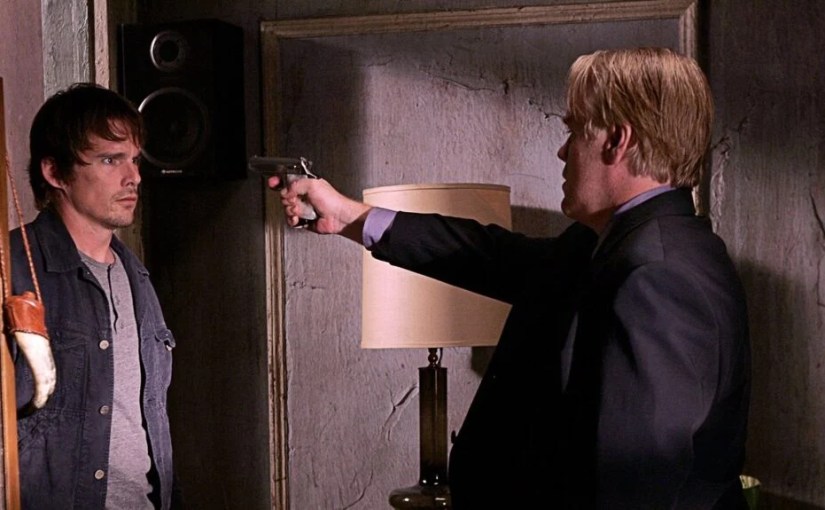
With the last picture before his death, Before The Devil Knows You’re Dead zeroes in on crime within an educated Irish family nucleus.  Andrew (Phillip Seymour Hoffman) has it laid out perfectly for his younger brother Hank (Ethan Hawke) to commit the perfect robbery. No one will get hurt and the insurance company will cover any loss.  The approximate take is around six hundred thousand. These guys carry their own desperate reasons for even considering such an idea, but Andy knows nothing can go wrong.  Hank has some trepidation though, because the target is mom and dad’s jewelry store.

Kelly Masterson’s script shows how quickly everything comes undone with bloodshed and unaccounted for details that could lead straight back to the two brothers.  It’s all told through three different perspectives – Andy, Hank and their father Charles played by Albert Finney.  Often, Lumet will return to the very same scene you saw moments earlier to show two sides of a phone call or in what direction one character goes versus that of another following a particular action that has occurred.  The timeline even jumps back in time a few days to show the direct perspective of any of these three particular characters ahead of showpiece scene – the robbery. Charles was retaking his driver’s license test. Elsewhere, Hank was struggling to pay spousal and child support with an angry ex-wife (Amy Ryan). Andrew was scheming and committing other clandestine acts both at work and in his free time.

However, Masterson’s script weaves all of these side details into how much more complicated this botched robbery becomes in the aftermath. All of what they commit following the robbery compounds into potentially making it worse for everyone involved.

Some of the breadcrumbs don’t carry enough water at times though. You might have to tolerate the characters being more intuitive than they likely should be.  Andrew leaves a business card with a side character.  When the film circles back to this item, it seems a little too easy for someone else to get wise about what has transpired.  I just chose to go with it.

Marisa Tomei is also part of the cast, caught in a love triangle as Andy’s wife and Hank’s mistress.  Tomei is really good, lending some authenticity with unscrupulous nudity in scenes with both Hoffman and Hawke.  This storyline serves as character exposition and only briefly scrapes against the crime drama at play.  It could have been excised from the film, but because the dialogue and scenario is written and performed so well, it effectively held my attention.

Albert Finney is magnificent as the patriarch owner of the store.  Simply his devastated, echoey breathing and the way he fumbles to put his eyeglasses on to learn more about what has occurred is absolutely genuine.  A late middle-aged man discovering horrible truths.  Finney plays it beautifully.  That being said, I wish the film offered more backstory to his character.  There are few hints suggesting how he regarded Andy as the first born who needed be thrown to the wolves and learn to fend for himself.  Contrarily, Hank is the younger and more disappointing son.  Yet, the script is short on material that further explores the relationship between the father and his sons.  I felt the film demanded more because Charles is quite significant to the conclusion of the story, which carries an unexpectedly abrupt ending.  

The acting and assembly of time and perspective are so finely tuned by the whole cast under Lumet’s direction.  Still, Before The Devil Knows You’re Dead needed another twenty to thirty minutes of storytelling.  One character runs out of frame with an unfinished storyline.  Another, seems too hasty in making a final decision with an easy convenience.

Don’t get me wrong.  I strongly recommend this last effort from Sidney Lumet.  It’s a unique crime yarn with an especially conniving Phillip Seymour Hoffman doing some of his best work.  The set up had me riveted and I couldn’t wait to see how all these terrible scenarios were going to fix themselves or make things horribly worse.

THE WIZ

By Marc S. Sanders

It always surprised me that Sidney Lumet is the credited director of The Wiz, the black cultured musical interpretation of L Frank Baum’s celebrated fantasy The Wizard Of Oz.  Now that I’ve seen it with adult eyes and a tremendous appreciation for the director, it’s template makes sense knowing that I’m looking through the lens of Lumet.  Dorothy might arrive in the land of Oz, but Oz sure looks like a journey through the five boroughs of New York City, and of course Sidney Lumet is one of the all-time great storytellers of what happens within one of the greatest cities in the world.

With electrifying music penned by Quincy Jones and a screenplay by Joel Schumacher, The Wiz follows the step-by-step moments of the beloved tale.  However, everything looks like a new invention. 

Diana Ross was a sensation at the time this film was in the making and she campaigned so hard for the role of Dorothy that the script modified the age of the character to 24, thus allowing a thirty-something to convincingly play the role of an unsure kindergarten teacher with an opportunity to move on to high school academics.  On a snowy Thanksgiving night, our heroine is cast off in a twisting blizzard, landing in the Munchkinland of Oz.  Toto, a gray schnauzer, has accompanied her.  These munchkins are graffiti figures who come alive out of the concrete walls of a Harlem basketball court and neighborhood park.  It’s a brilliant invention of set design that deviates from the familiar.  The Wiz opts to maintain an urban theme.

Michael Jackson is the Scarecrow, though made of paper garbage, not straw.  A peanut butter cup wrapper enhances his nose.  He’s heckled by street guys garbed in crow likenesses when Dorothy comes upon him.  Lumet maintained a 70’s vibe to this film to fall in line with Jones’ music.  All of this design works, including the cartoon like cabs that ritually appear and abandon the characters as they embark on the Yellow Brick Road with the Chrysler Building rising in the distance.

The Tin Man is portrayed by Nipsey Russell.  He’s discovered in an amusement park junkyard where he’s crafted out of rickety old junk.  Terrific makeup here.  Ted Ross breaks out of the lion shelled statue famously erected outside of the New York Public Library.  Within the land of this Oz, a New York flavor answers for all of Baum’s familiar creations. 

Not everything works so well in The Wiz.  I’m impressed among these great talents of black entertainment that Lena Horne is cast as the Good Witch Of The South, but her one true moment at the end of the film is wasted with baby angels floating in the background of a very false looking starry backdrop.  Lena Horne is shown for the briefest of moments as Dorothy crash lands in Oz but then does not come back until the end of the film.  She sings a message to Dororthy about believing in herself.  It’s an awful moment and drains a lot of the energy from the film. Cheesy and awkward.

The course of the movie is invested so well by hundreds of costumed extras along with Diana Ross and Michael Jackson.  Nipsey Russell keeps up just fine. Ted Ross could have done more as he transferred from the live stage to this film.  His portrayal is not a standout from what Burt Lahr did with the role of the Cowardly Lion.  Diana Ross with Jackson are the leaders with nonstop energy, though.  Michael Jackson’s performance is clumsy but falls beautifully in line with all of the music.  His physical prowess in dance is part of what made him a star.  Diana Ross does not stop.  She never looks out of breath, and she puts such gusto into leading this company of musical performers.  It’s such a joy to watch both of them strut to Ease On Down The Road and Everybody Rejoice/Brand New Day.  These are two of the best and most memorable songs in the picture because of what Diana Ross does on screen with the numbers.  I especially love Brand New Day.  I’m hearing it now in my head as I write and fondly recall the wide shots that Lumet devotes to the enormous feats of choreography.  May be the best scene in the film.

Lest I forget Mabel King, as Evillene – this story’s Wicked Witch.  She is not introduced until after the great Wiz orders the four travelers to kill her.  When she does arrive, in her home based “Sweat Shop” it’s an amazing moment.  Mabel King is best known as Raj and Dee’s strict mother on the TV show What’s Happening!!!  Growing up, I’ve always been a fan and Mabel King is a sensational performer.  Her vocals give off such power and demand during her song Don’t Nobody Bring Me No Bad News.  Evillene marches down the stage in her puffed-up costume wear of glittered red with a large updo to command her little Winkees.  She certainly hijacks the picture from Diana Ross and Michael Jackson.  This is a performance that is Oscar worthy.  An absolute scene stealer.

As for The Wiz himself, it is Richard Pryor.  He’s cute in what was supposedly his first film where he donned his familiar mustache.  He’s silly but not so much fun.  Sometimes he’s just garbling like he forgot his lines and does his Richard Pryor schtick that he’d later rely on in The Toy and Superman III.  What impresses me is the costume choice for the character.  He’s eventually revealed to be the phony Wiz who operated the giant intimidating head, and he’s dressed like a literal homeless person from the streets of Harlem. 

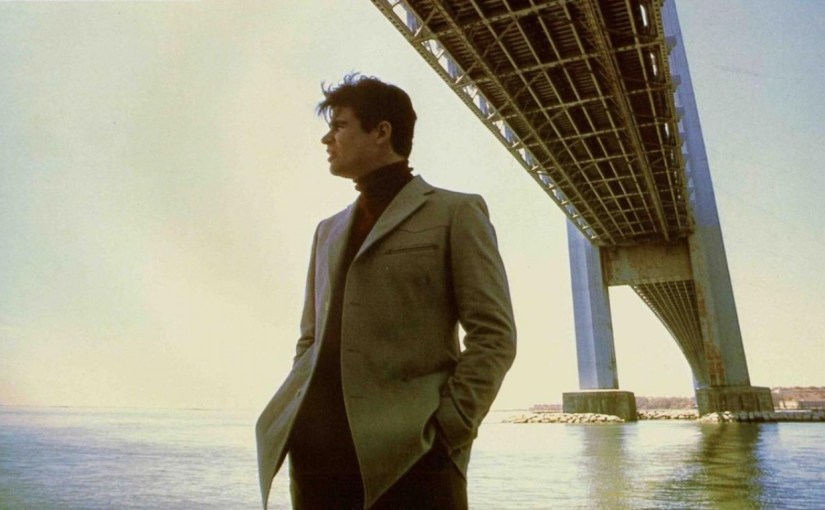
Sidney Lumet worked with Jones and Schumacher to help us envision a modern New York as a world of urban, but colorful, fantasy.  The Yellow Brick Road goes down into the subway tunnels for some threatening moments of suspense as well as through an old amusement park, maybe located in Coney Island.  The Emerald City appears on the other side of the Verrazano Bridge, and it is Manhattan lit up in green.  The centre of the city is Lincoln Center where the inhabitants dance in red, yellow and green depending on the traffic light raised high above the famous circular fountains.  I believe the mysterious Wiz is located at the top of one of the Twin Towers.  Lumet used what he knew and applied a colorful brush of fantasy over the entire Metropolitan area.  I say it is brilliant.  Familiar like it should be, but still a fresh idea as Dorothy leaves her home of Harlem for the more extravagant of locales where she seeks out the famous Wiz hoping for a way home.

A Broadway and touring stage company of The Wiz is performing currently and I hope not too much of what is featured in this film has been washed over. 

The Wiz is dated to a disco era but most of the songbook still works with high energy and passion.  A strong appreciation remains, and maybe that’s because L Frank Baum’s original story is so timeless.  This cast along with Quincy Jones and Sidney Lumet, plus creative inventions in makeup from Stan Winston still hold up.  You’ll tap your foot if you turn this soundtrack on your radio or you opt to take in the visuals of this kaleidoscope of color and sound on your flat screen.

THE PAWNBROKER (1964)

by Miguel E. Rodriguez

DIRECTOR: Sidney Lumet
CAST: Rod Steiger, Geraldine Fitzgerald, Brock Peters, Jaime Sánchez
MY RATING: 7/10
ROTTEN TOMATOMETER: 86%

PLOT: A Jewish pawnbroker, victim of Nazi persecution, loses all faith in his fellow man until he realizes too late the tragedy of his actions.


One of my favorite books about movies is Making Movies by Sidney Lumet, in which the legendary director explains in detail the moviemaking process from script selection through the preview screening and ancillary rights distribution.  He uses, of course, the movies from his own career as examples, from 12 Angry Men through Guilty as Sin (the book was first published in 1995).  One of the films he brings up many times is one I had not heard of when I picked up the book for the first time: The Pawnbroker, from 1964, starring Rod Steiger.  After reading the book many times, I found myself obsessed with finding and watching this, to me, unknown film.

For a long time, it remained a kind of missing link in Lumet’s filmography.  It wasn’t available on home video, and it wasn’t streaming anywhere.  In 2008, it was selected for preservation by the National Film Registry, and the New York Times calls it one of the 1,000 best films ever made.  Lumet is one of my favorite directors.  I was desperate to see this movie.

Some time ago, I finally found a (relatively) cheap copy on Blu Ray, and I sat down and pushed PLAY with anticipation.  I mention all of this because I believe I inadvertently made myself a victim of my expectations.  The film that unfolded was not quite as hard-hitting as I had hoped, even though the story is deep and dark.  Perhaps I am too jaded as a modern filmgoer, with so many other Holocaust-related films under my belt, to fully appreciate this intensely acted character study of a man in crisis.  I can see myself changing my opinion of this movie at some point in the future, maybe when I’m a little older.  For now, in my opinion, The Pawnbroker is a well-crafted film, thoughtfully written, but a little too heavy-handed for its own good.

Sol Nazerman (Rod Steiger) is the aging Jewish owner of a pawn shop in New York City…I’m not familiar with the specific neighborhood, but I wanna say somewhere in the Bronx, or maybe Queens.  He and his Puerto Rican employee, Jesus Ortiz (Jaime Sánchez), run the shop with maximum efficiency and minimal customer interaction.  (Hey, look at that, a guy named Jesus with a Jewish boss, I only just now got that…)  Sol is not interested in the backstories of these desperate folks who bring in radios and candlesticks and school trophies in exchange for a couple of bucks each.  “Here’s your money, get out.”  Jesus, on the other hand, is a bundle of energy who sincerely wants to learn the trade and earn some money so he can get out of the 2-room apartment he shares with his mother.  Sol tolerates Jesus the same way a parent tolerates a hyperactive child.

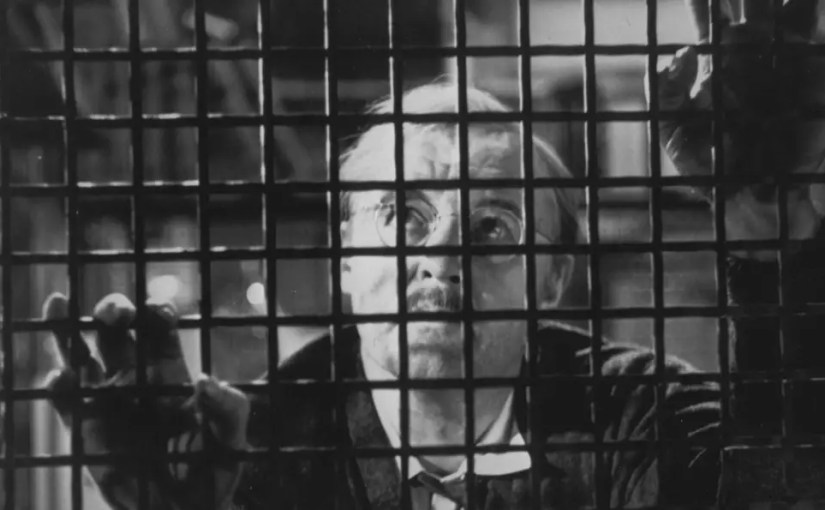
Lumet and his production designer, Richard Sylbert, are very careful to show Sol’s store as nothing but a series of cages and bars.  We learn the reason for this as we see a series of flashbacks from Sol’s past: he was a Holocaust survivor.  (There’s a brilliant scene where Jesus asks Sol what those numbers on his arm are.  “Is that a secret society or something?  What do I do to join?”  Sol’s one-line answer is one of the best things in the script, followed later in the film by a monologue about clinging to a “bearded legend” that showcases Steiger’s talent to the nth degree, but feels a tad over-dramatic.)

Sol’s tragic past is the fuel that runs the engine of the film because it’s made him the man he is today: someone who doesn’t believe in anything anymore, not God, science, art, anything at all…except for one thing: money.  “Next to the speed of light, which Einstein says is the only absolute in the universe, second only to that, I rank money!”  While this sentiment seems as if it would feed into a racist stereotype, Sol never overtly occupies that space.  He is just a man who has seen too much and wants nothing except to get by.

There are suggestions that he is experiencing survivor’s guilt.  In his shop is a tear-a-day calendar showing September 29th.  When Jesus wants to rip it for the next day, Sol stops him.  Later, someone asks him if it’s an anniversary of something.  He says it is: “The day I didn’t die.”  That was the day he was powerless to stop a tragedy, and he should have died, but didn’t.  But he doesn’t frame it as a dramatic act.  I found that a marvelously layered response.  (There is another “suggestion” of his guilt in a monologue by a much older man, but that’s another one of the movie’s heavy-handed moments, so the less said about that, the better.)

There is also a suggestion that Sol is accepting payoffs from a local slum lord to launder money through his pawn shop.  A man comes by, says he needs money to repaint the building, Sol writes the man a check for $5,000, and the man gives him $5,000 in cash.  Why does Sol willingly acquiesce to this process of aiding and abetting a criminal?  I think it’s because he has learned to survive no matter the cost.  In one of his increasingly disturbing flashbacks to his days in the Nazi concentration camp, we watch as a man frantically attempts to scale a fence.  There’s no real hope of escape, but he tries anyway.  The guards don’t shoot him, but watch almost in bemusement.  One of them finally calls for another guard with a German shepherd.  And just yards away, Sol and other prisoners watch helplessly as the man is torn apart.  (Presumably, anyway.)

I haven’t even mentioned the social worker who comes by one day to solicit donations for a youth center, the local thugs (former friends of Jesus) who reek of foreshadowing, the slum lord himself (Brock Peters, playing totally against type as an amoral crook), or Jesus’s hooker girlfriend who knows how desperate Jesus is to get some money of his own and boldly offers her body to Sol in exchange for some cash.  Her act of desperation (featuring the first waist-up female nudity in a post-Code Hollywood film) only triggers more flashbacks for poor Sol. [HA! Jesus has a girlfriend who’s a prostitute…I only just got that one, too…]

By the end of the movie, events conspire that trigger even more feelings of guilt for Sol so that the film ends with him wandering out of his store and into the inner-city jungle with his hands bloody and his head bowed.  Has he realized the error of his ways, of his tendency to reject any kind of human connection?  Certainly his last act seems to demonstrate his remorse, but…has he really changed?  It’s said that, to figure out what a movie is about, look at how the main character changes from beginning to end.  Maybe I’m naïve, maybe I’ve been lucky enough in my life not to have experienced anything remotely resembling the tragedy of Sol’s life, but I felt nothing except mild shock at the end of The Pawnbroker, not because of any realizations about Sol’s character, but because of the events of the plot.  I don’t think that means the same thing as character development.  So, ultimately, I couldn’t really say what this movie is about beyond the ability of a fine director and a courageous actor to show the details of a man wounded so grievously in his past that he can barely tolerate mankind in the present.  Yes, we see the error of his ways…but does he?  You tell me.

MURDER ON THE ORIENT EXPRESS (1974)

By Marc S. Sanders

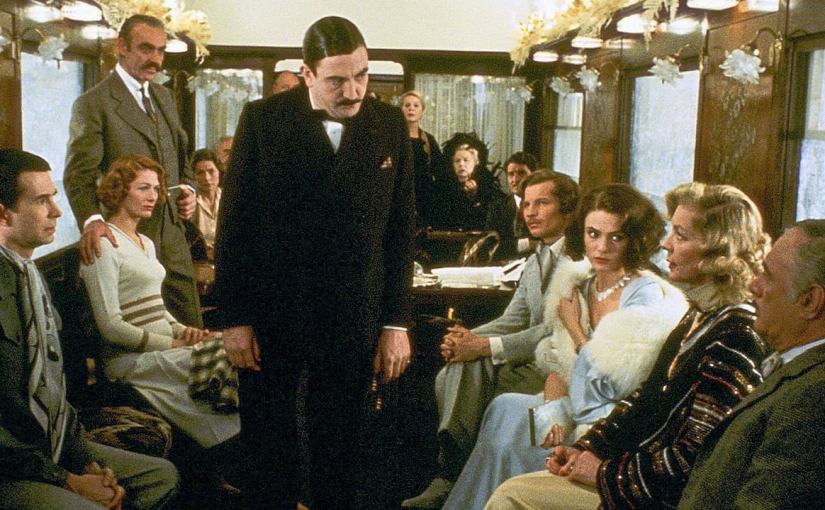
When considering Sidney Lumet’s admirable body of work, many would likely connect him with covering corruption within police precincts and the legal jargon of courtrooms.  Fortunately, on occasion, he experimented outside of those genres, and we are all the better cinematic viewers because we were treated to an all-star cast, devouring up the scenery in an adaptation of Agatha Christie’s celebrated mystery Murder On The Orient Express.

Lumet abandons his penchant for the metropolitan jungles of conflicted souls and high stakes drama to offer up a deliciously fun who done it, with Albert Finney gleefully playing the oddball, mustached Belgian (not French) detective, Hercule Poirot.  Despite a cast that features Sean Connery, Lauren Bacall, Jacqueline Bisset, Vanessa Redgrave, Martin Balsam, Richard Widmark, Michael York, John Gielgud, Anthony Perkins, and an Oscar winning performance from Ingrid Bergman, it is Albert Finney who makes the film wonderfully delightful.  His stature that seemingly hides his neck within his stout torso, along with a shoe polished, flattened hairstyle and a thick, echoing dialect tempo are an absolute combination of pleasure.  He makes the glossary of Tim Burton’s bizarre characters seem rather straightlaced.

He’s strange, but funny.  Before the expected murder gets underway, we observe an unrecognizable Finney performing Poirot’s nightly routines, including applying cream to his hands and unique mustache, as well as donning a kind of strap beneath his nose to keep his signature trait in its proper shape.  Batman maintains care of his cowl.  This crime fighter must preserve his facial hair.  It’s completely normal for Hercule.  While these mundane tasks of his are executed, the great inspector is also alert to several rumblings and bustles going on in the nearby cabins aboard the famous train in the title. Lumet ensures we see how smart and observant Mr. Finney chooses to portray Poirot; unique, and instinctively wise without limits.

An impolite and bossy man named Ratchett (Widmark) is discovered dead with multiple stab wounds to the chest.  It doesn’t make much sense considering the other passengers should all be complete strangers to one another.  Or are they?  Each one has an alibi, and their respective personalities couldn’t be more different.  Who would have the motive to kill a stranger aboard a moving train?

There appear to be twelve suspects for Poirot to consider.  That’s quite a list.  The standouts for me include Bergman, Bacall, and Perkins, but Lumet allows at least a scene or two for each celebrated actor to shine.

Ingrid Bergman dresses down to portray a shy, nervous, homely Swedish woman.  Sidney Lumet knows to back off on directing inventions when working with talent of such magnitude.  In one uncut take, Bergman controls an interrogation scene with Poirot and the camera stays fixed on her never diverting away and very subtly tracking behind Finney to stay with the actress’ nervous portrayal and expression.  The question is, should we trust this person? If Ingrid Bergman is putting on a façade, she’s awfully good at it.

Lauren Bacall carries such a strength on screen.  She walks with square shoulders and utter confidence that makes it seem like she’ll be impenetrable to Poirot’s inquiries.  Bacall’s booming signature voice would make me back down at any given moment.  She commands the supporting cast and appears to defy intimidation.

This film was made fourteen years after Psycho and yet Anthony Perkins portrays Mr. McQueen, a secretary of the murder victim, with youthful naïveté.  His stutter is perfectly timed and authentic, and he’s got body language that flails from one direction to the next when put to the test, not just by scenes he shares with Albert Finney, but anyone else in the cast as well.  His character is clearly unrelaxed.

I decided to watch this picture for reference.  In September of this year, I will be portraying Hercule Poirot in a stage adaptation of Agatha Christie’s story, written by Ken Ludwig.  My colleague Miguel Rodriguez is in the production as well, occupying Martin Balsam’s role.  They’re brilliant with magnificent energy by the way; Balsam and Rodriguez.  I had to watch Lumet’s film twice to appreciate the gleeful nuances he offers with this celebrated cast, including the actual train which serves as not only a claustrophobic setting but a character as well, stuck in a snowdrift, trapping the guilty party with no means to escape.  The dialogue flies fast and many of the various accents (Belgian, Russian, Scottish, Italian, Swedish, Hungarian) are challenging to decipher on a first watch, particularly Finney’s performance.

On a second watch, I was more wide-eyed to the detective’s behavior and how he breaks down a suspect during an interrogation.  No two interviews of suspects are even remotely similar.  Finney alters his way of approaching a scene partner each time.  I’ll credit the screenplay’s dialogue from Paul Dehn for that achievement as well. 

When a cabin door is opened to reveal the deceased victim, Finney’s odd mannerisms drastically change as he enters the room knowing what to say and look for immediately.  Sidney Lumet characteristically will position his camera pointing up at his actors, so the audience is the perspective of the subject being looked upon.  Albert Finney is gifted a wide scope within a narrow quarter to react as the famed detective.  This filming technique was an inspired choice by the director. Hercule Poirot is built up to be the foremost detective and now we see him demonstrating his specialty for examining a crime scene, and thus where to begin with his examination.  Albert Finney received an Oscar nomination for this role and it’s because of the skills he orchestrates under a guise of heavy makeup with a thick incomprehensible dialect.  All are meant to be taken as winning compliments from me.

The art design of the train is breathtaking.  The exteriors are magnificent too, particularly the train station located in Istanbul where the Turkish merchants crowd each cast member as they enter the film for the first time ready to board the Orient Express.  In one spot, a steward is inspecting the food cargo.  Another area has a merchant spilling over a carriage of oranges.  Locals crowd Bacall, Bissett and York with trinkets to buy.  Lumet captures the whole exotic tapestry.

Richard Rodney Bennett’s musical score is unforgettable.  A sweeping, romantically uplifting waltz accompanies the locomotive’s ongoing trajectory.  Then it gets more brooding when the journey comes to an unexpected halt in a chilling snowdrift, with the thought of a dangerous killer nearby.

Sidney Lumet is to be applauded for stepping back to allow his who’s who of legendary cast members play with Agatha Christie’s famous mystery.  He’s done this on other occasions including his outstanding cast in Network and Paul Newman’s career best performance in The Verdict

Those who are not familiar with the Agatha Christie’s tale are fortunate to experience the wonderfully twisted ending that serves the story’s continued appreciation.  Lumet deserves credit for the final touch though.  It’s not often that a film boasts such a collected caliber of talent together.  So, the best way to cap it off is with a charmingly giddy champagne toast.  It’s Sidney Lumet’s perfect little garnish to wrap one of greatest literary mysteries to ever be published and adapted for the stage and screen.

PRINCE OF THE CITY

By Marc S. Sanders

Sidney Lumet made an outstanding career of bringing attention to corruption within the halls of police precincts, amid the offices of politics and the inside the hallows of cherrywood courtrooms with manipulating lawyers and unsympathetic judges. His films are spellbinding with difficult conundrums for his protagonists to overcome and survive.  Prince Of The City is a perfect example.

A handsomely young Treat Williams stars as Danny Ciello.  He’s a famed cop working for the New York City Special Investigative Unit.  He’s part of a squad of partners who are also his best friends.  Jerry Orbach is the standout among the gang.  They make a huge difference in the big busts they accomplish.  In fact, some of them were part of the famed French Connection cocaine takedown.  Their celebrated careers lend to their monikers.  Danny is an especially accomplished “prince of the city.”  Proudly, they march into a crowded courtroom with a packed audience to announce another huge indictment with the criminals handcuffed together in a line.  However, these officers are also immoral in their daily practice. 

A bust of illegal immigrant drug dealers is made early in the film where over ninety-two thousand dollars is uncovered, and the team agree to share half among themselves.  A little later, Danny gets a desperate call in the middle of the night from one of his informants and to appease him he rips some heroin off another street user to give to the other one.  It’s a necessary evil to ensure progress as an accomplished detective.  The snatching of the monies? Well, as his brother frustratingly points out, that’s so he and his partners can live comfortably in furnished homes with nice clothes and jewelry. Yet perhaps all of this is no longer sitting right with Danny.

None of this is unusual for Danny but considering that an internal investigator (Norman Parker) has approached him about going undercover to reveal corruption that’s rampant throughout the police force, his conscience is weighing on him.  Danny agrees to go to work on this assignment.  However, he lays out one important condition. He’ll never give up his partners, including wearing a wire in their presence.  He lives with his wife, but he loves his partners.

Prince Of The City is a long film, but its running time is necessary because there are so many facets to Williams’ character.  Also, the residual effects of Danny’s work branch off in so many directions.  More than once, Danny is warned not to perjure himself.  Legal authorities find it hard to believe that Danny only broke his ethical code just three times in eleven years.  However, Danny insists that’s all there is.  He’s warned over and over it better be.  Otherwise, those that are working with him will later work against him.

Lumet is very good at showing realistic settings.  An abandoned post office is designated as a secret locale to store evidence and wiretap records that Danny collects.  In the beginning, the joint is empty, but over a progression of five years’ time, the shelves fill up quickly and a large staff is assembled, equipped with computers, typewriters and stuffed file cabinets.

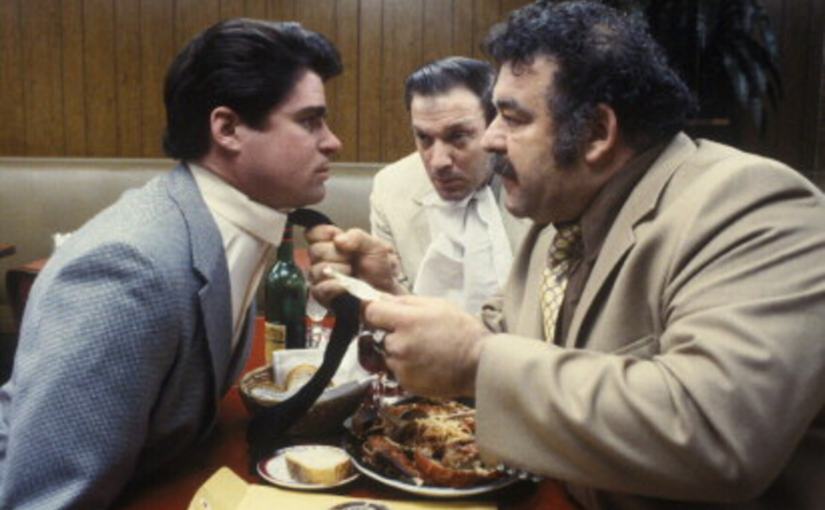
Danny catches cops on the take.  He gets a crooked lawyer on tape.  He’s also taking big risks that amplify his stress.  Lumet showed the increasing agony of a cop against a police department in Serpico with Al Pacino.  I thought the actor was a little overdone in that film.  Here, Treat Williams could not be more authentic, and the transition from cocky detective to paranoid informant, working against his colleagues, comes through much more subtly as the film carries on.  Danny gets caught in a diner sting wearing his wire.  His quick instincts save him, but only after his shirt is torn open showing the wire, and a gun comes out of nowhere.  The sloppy struggle that ensues with a broken glass door and overturned tables loaded with food and dishes is frighteningly realistic.  Lumet shoots the moment with a documentary kind of feel.  Deliberately, there’s no special effect to the camera work here.  It’s all in Williams’ performance and the actors he shares the scene with.

Treat Williams performance is so wired that I am very surprised it did not lead to more recognizable and stand out roles later in his career.  Williams was unknown at the time of this film’s release in 1981, but his lead in this picture is as welcome as Ray Liotta in Goodfellas.

Danny Ciello is a fictional character based on the real-life narcotics detective known as Robert Leuci.  Leuci had a checkered background dating back to when he became an undercover cop informant.  Neither Danny or Robert wears the white hats of pure honor and loyalty.  That is what makes these men so challenging.  Because they are somewhat impure, there is a tipping scale to how they should be regarded. 

A marvelous part occurs in the last act of the film.  Danny’s transgressions as well as what he’s accomplished have all been laid out.  The costs of his partners’ careers have been considered.  The risks and dangers that Danny and his family with two young children have encountered are given their due attention.  Now, as the film is concluding, Lumet along with his co-writer Jay Presson Allen, assemble close to twenty prosecutors and district attorneys in a dark, slightly sunlit office to debate whether Danny Ciello should be charged for violations of perjury.  One prosecutor threatens to resign if Danny is prosecuted.  Another one cannot see how a police officer can be granted pardons for violating the very laws he’s been sworn to uphold. No one is right or wrong in this argument. The collection of actors in this scene is amazing. 

The Oscar nominated script from Lumet and Allen do not provide a straight answer as to whether Danny is a hero or a criminal.  Prince Of The City is never spoon fed to its audience.  Different perspectives and receptions have likely been generated from the picture.  I’d love to hear other people’s viewpoints.

Once again, I commend the running time of Lumet’s film.  Danny Ciello is a complicated man who sacrifices so much that the cost of everything needs to be acknowledged.  The rampant corruption that is uncovered among his colleagues is so extensive that the turnaround response must be depicted.  Some men committed suicide for their crimes.  Some swear they’ll never give themselves up or even Danny.  Danny is expected to do the same in return.  Danny lost friendships and trust over the assignments he accepted. His children and his wife (an excellent Lindsay Crouse) were undeservedly forced to live in fear for their lives, and upend their household, ironically feeling obligated to accommodate those assigned to protect them.  At one time, Danny is relying on men who are heading the investigation, promising to abide by his conditions and guarantee his safety.  Later, these men accept promotions that pull them away to other departments, leaving Danny to deal with people he cannot count on going forward, and who may work against him or refuse to honor original promises.

It’s quite unfair for Danny as he continues to make headway.  An uncaring portrayal by Bob Balaban (really good in everything he does) as a federal prosecutor forces Danny into uncompromising positions where he’s squeezed into offering up everything with little to no options.  Because Danny is no longer the conceited prince that he once considered himself to be, these authorities keep him beholden to his commitments, no matter the cost of his career, his partnerships or how it affects the lifestyle of himself and his family.

Prince Of The City is a very heavy film with much to address.  If this were to be remade, without the guidance of Lumet’s expertise, it could only work as a miniseries.  Though I doubt it would ever compare to Treat Williams’ performance or Sidney Lumet’s specialty in covering the complexities that organically stem from police corruption.  This is a fascinating film that I’m looking forward to watching again.  Because the weight of the material is so thick, I’m certain I’ll discover something new in a repeat viewing.  This is one of Sidney Lumet’s best films.

PRINCE OF THE CITY (1981)

by Miguel E. Rodriguez

DIRECTOR: Sidney Lumet
CAST: Treat Williams, Jerry Orbach, Bob Balaban, Lindsay Crouse
MY RATING: 8/10
ROTTEN TOMATOMETER: 92% Fresh

PLOT: A New York City narcotics detective reluctantly agrees to cooperate with a special commission investigating police corruption, and soon realizes he’s in over his head, and nobody can be trusted.


Sidney Lumet’s Prince of the City is based on a true story, and it never lets you forget it.  In a good way.  The film is defiantly ambiguous when it comes to the main character, Danny Ciello (Treat Williams), who is onscreen in virtually every scene, so we get to see every detail of his epic, tragic fall from a revered cop in the NYPD’s Special Investigations Unit to a glorified stool pigeon for the feds.

…ah, but see what I did there?  Without even realizing it, I’m already sort of siding WITH Ciello, who participated in many, MANY counts of outright theft, evidence tampering, bribery, and so on and so on.  But…in a very Dirty Harry way (but much more realistic), he was helping to cut through the frustrating red tape that would otherwise enable career criminals to get around the system.  But…he had to break the law to do so, and his fellow officers in the SIU were all complicit, some to greater degrees than others.  Their unbreakable code: never rat out your partners.  Ciello has a revealing line at one point: “I sleep with my wife, but I LIVE with my partners.”

This somewhat misguided code of honor is central to Prince of the City.  The film opens as Ciello’s unit makes a lucrative drug bust, confiscates some or most of the cash, and parades the captured criminals into a ramshackle courtroom, whereupon the assorted drug dealers are immediately sent back to Central or South America, bing, bang, boom, no muss, no fuss.  Meanwhile, a special commission, the Chase Commission, has begun questioning officers about police corruption.  Ciello is naturally resistant to cooperating at first, but a feisty conversation between him and his ne’er-do-well brother puts doubts in his mind.  “Look at you in your big house and your two-car garage!  You think I don’t know where this all comes from?  You think I’m stupid, Danny?!”

Ciello’s conscience finally gets a hold of him, and he agrees to cooperate with the commission.  This includes the unbelievably dangerous practice of wearing a wire to meetings between himself and assorted mob-affiliated tipsters.  I’ve seen numerous other films involving wires and mobsters, but Lumet does something different here, and it carries throughout the entire film.  Instead of punching up the suspense with crazy edits or inserts or spooky music, he simply explains the danger and lets the scene play out with as little movement as possible.  In its simplicity, there is as much suspense there as in anything by Hitchcock, accomplished with much less cinematic “pizzazz.”

This simple style pays off in two incredible scenes.  One is where a mobster is dead sure Ciello is wearing a wire and searches him thoroughly…but Ciello’s sixth sense warned him earlier to leave the wire at home.  Another comes when Ciello unthinkingly hands over some evidence to the mobster…wrapped in a post-it that basically says, “From the desk of the State Attorney’s Office.”  Because everything has been presented in such a straightforward style leading up to this moment, this scene has an astonishing effect on the viewer.  There is real danger here, an almost documentary-like feel to it.  The resolution of this scene, including the unexpected appearance of a gun at the worst possible moment, is one of the emotional highlights of this nearly three-hour film.

The casting of Treat Williams in the lead role of this crime epic was also a key to its success.  In the early ‘80s, there were any number of leading men that might have been a much more natural choice for this part: Pacino, De Niro, Hoffman, Beatty, even Travolta.  Putting a relatively unknown, but VERY talented, actor in such a prominent role was a calculated gamble that paid off.  Since he had no major previous roles, Williams was essentially a blank slate.  He hadn’t been typecast as either a villain or a hero yet, so that supports the film’s foundation of maintaining a neutral stance toward the lead character.  The movie isn’t going to come out and tell you if it’s for or against Ciello.  The audience has to make that decision for themselves.

For myself, I would in no way condone his corrupt behavior.  But I admire his decision to at least try to do the right thing.  Despite his adamant stance that he will never, ever turn in his partners, it becomes abundantly clear that the various feds, attorneys general, prosecutors running his case will have no qualms whatsoever about putting him in jail the second he refuses to play ball.  As a result, he winds up being forced to provide crucial evidence that generates indictments for several of his partners.  The aftermath of those indictments varies from partner to partner.  Ciello is being eaten alive by remorse.  He believes he’s doing the right thing, but he can’t stand watching his partners go down one by one.  It’s a fascinating conundrum, manifest at every turn, even in the very last scene of the movie.

In one great scene, a group of prosecutors meet to decide whether to formally indict Ciello and pursue a prison term, even after he has provided them with information that led directly to countless arrests and indictments.  They are divided.  One prosecutor threatens resignation if charges are filed.  But another prosecutor’s argument stuck with me:

“I’ve never known a lawyer to risk his livelihood to expose the crooks in his profession.  And where’s the doctor who ever exposed Medicaid fraud?  Or unnecessary and botched operations?  Or even dope, for that matter?  What doctor ever came in?  Dan Ciello came in, and I don’t care why.  To me, Danny Ciello’s a hero…and we’re trying to decide whether to put him in jail or not.”

For me, that sealed the deal.  The movie is admirably restrained in providing its own standpoint on Ciello, but I would side with those calling him a hero instead of a villain.  I found myself thinking back to Sunday School and the parable of the prodigal son.  After the prodigal forsakes his father and his family, he returns, contrite and humble, begging forgiveness.  The loyal son can’t understand why his father rejoices upon the prodigal’s return, to which the father replies, “We have to celebrate, because your brother was dead and is alive again; he was lost and is found.”

Ciello is that lost soul who desperately wants redemption, no matter how it might hurt himself or his literal partners in crime.  For that, I consider him a hero, not a villain.  Perhaps he’s no longer a prince of the city, but he is at least back on the side of the angels.

Q & A

By Marc S. Sanders

Sidney Lumet is a favorite director of mine.  Maybe it’s because I simply get caught up in good crime dramas and legal thrillers, like Dog Day Afternoon, 12 Angry Men, and The Verdict.  Maybe it’s because I appreciate the genuineness of Lumet’s technique.  The man’s career seems to follow a documentarian theme throughout New York City’s boroughs, politics, courtrooms and especially the various precincts of its police force.  Corruption is the angle that Lumet looks for, and Q & A from 1990 is another such example.

The title refers to the routine transcript that a district attorney will ask a witness following an incident.  So, after the first two minutes of the picture have concluded with New York cop Mike Brennan (Nick Nolte) shooting a Hispanic at point blank range, execution style, outside a seedy nightclub, a fresh-faced D.A. named Al Reilly (Timothy Hutton) is recruited in the middle of the night to collect Mike’s statement on the incident and wrap it up quickly, as his supervisor Kevin Quinn (Patrick O’Neal) strongly urges.

Mike is a celebrated cop with tall tales to share of how he strong arms suspects.  Everyone seems to like his relaxed way of tossing around racist vulgarities in his anecdotes.  No demographic is left out with how he speaks.  In fact, the name calling is shared among the whole precinct in a very casual way.  The two detectives assigned to the shooting that Mike was involved in, Sam “Chappie” Chapman and Luis Valentin (Charles S Dutton, Luis Guzman), seem to take it in stride as well.  They guffaw with the rest of the crowd when Mike describes how he roughs up street hoods who don’t cooperate. 

Al was once a cop as well, and his father before him was a “hero cop” to the boys in blue too.  He’s more than willing to let this incident go the quick routine, but then he soon realizes how corrupt Mike is and how much of a stronghold he has on the precinct and the various walks of life within the city from the Italian mob, to the Hispanic drug runners, to the transvestite hookers and the Jewish lawyers.  They all fall under his thumb.  Nolte’s stature and bombastic voice tell you that Mike carries a large thumb no matter how blatant his crookedness may appear. 

“Chappie” may be regarded by Mike as the “whitest n—er” he knows, but he’d never even think of turning his colleague in.  That’ll be the day he quits.  He proudly announces he’s blue first and black second. Luis, the Hispanic partner regarded as a “n—er with straight hair, is scared to move forward.  He’s got kids.  Kevin Quinn needs this to just move on.  The shooting of a lowlife Hispanic is not worth risking his advancement in politics.  Al is challenged and turns to his Jewish mentor, Lee Richardson (Leo Bloomfield) for guidance, who can help him get this pushed up the ranks and nab Mike for his atrocities, while circumventing the racist and antisemitic nature of Deputy District Attorney Quinn. 

It gets more complicated for Al, as his ex-girlfriend, Nancy (Jenny Lumet, Sidney’s daughter) is now attached to an important witness to the crime.  Bobby Texador (Armand Assante) is a Hispanic drug dealer who can not only pin Mike for the crime but also incriminate others within the system.  He’s just not so willing to sing.  Al is in a difficult quagmire that circles back to pension left for his mother per his father’s prior service.  He’s also wracked with how to handle Nancy.  They broke up simply because his reaction upon learning that her father was a black man did not go so well.  Even Al, born of virtue, is corrupt of prejudice.  Perhaps Lumet’s screenplay suggests the message that intrinsically we are all at least a little too stereotypical or partial for our own good.  It comes with our sensibilities and maybe it’s a mindset we best unlearn.  The most obvious challenge for Al is that he is subjected to intimidation from his boss Quinn, and especially Mike.  You don’t want Nick Nolte in your face.  That’s for sure.

I can’t lie.  Having watched the film for the first time, I was only looking at the plot and story development of Q & A.  I wasn’t seeing the bigoted culture sewn in among the masses.  Afterwards, I watched Siskel & Ebert on You Tube and they focused on the racist themes and casual name calling among the characters.  It never occurred to me while I was in the moment of watching the movie.  I don’t know what that says about me.  Maybe I’ve grown as comfortable with racist name calling as these characters have.  I don’t talk this way.  I may laugh at Cards Against Humanity or Family Guy.  For these cops to talk among themselves, casually using prejudiced connotations for African Americans, Hispanic Americans, Homosexuals, Transvestites, Jews and Italians within the melting pot of New York City with such nonchalance is more telling of Q & A, than the corruption that unfolds over the course of the picture.  Understanding what Siskel and Ebert found within the script granted me much more appreciation for Lumet’s film, because the twists of the plot and the overpopulation of characters was becoming too convoluted for me.

The strengths of the movie come from the cast performances, especially Nolte and Assante.  Nolte has played many roles where he’s the brute.  Here though, he’s downright despicable with his slicked back hair, tall stature, his thick “I’m your buddy” mustache, and his Irish Catholic character background that announces his superiority to all others.  Armand Assante is an unusual kind of drug kingpin.  He plays Bobby Texador with much self-awareness knowing he can be killed not only for what he knows about this particular shooting but other inside information he can share as well.  He’s a guy who will rise above any threat though.  This guy might be a criminal, but he hardly needs an attorney to negotiate on his behalf.

The trio of Nolte, Assante and Hutton works because each of the men are so different from one another.  These guys wouldn’t work well on a baseball team together.  They wouldn’t even socialize at parties.  Lumet writes these characters so far apart from each other, that loyalty can’t exist between any of them.

A lot of the characteristics of the film are consistent with many other achievements within Lumet’s repertoire like Night Falls On Manhattan and Serpico.  Those are better films.  When plot details reveal themselves in Q & A, I found myself rewinding to the beginning of a few scenes to fully comprehend what was just said. After a while, I gave up interest in the twists.

There was a choice of musical style that left me unsure as well.   Ruben Blades conducted the score for the film and a pop/rock song follows the prologue over the opening credits.  It later resurfaces as things are coming to a head near the end of the film.  Especially for the seedy and unglamourous approach that I love in Sidney Lumet’s films, I wasn’t enthusiastic on this style to heighten the dramatic crescendos.   It felt a little too Miami Vice, when I believe Lumet was aiming for his audience to get mad at the corruption that overtakes a system grounded in law and order. 

Q & A is a must see for fans of Sidney Lumet.  I’m glad I finally saw it.  It’s been on my bucket list for quite a while and I could not find it anywhere on any platform or medium.  (At the time of this writing, it’s available for free on Hulu.)  It’s definitely raw in its character creatures of a New York City from the 1990s, and it’s honest how the rite of passage to be a cop is to roll with the punches of racially lampooning your ethnicity.  It’s the only way to survive among the masses.  Fortunately, the cast plows through with that ugly nature to deliver something authentic.  When the film dives into its conspiracies for the sake of the plot, however, it’s a little too muddied for me to appreciate.  Watch the film for the characterizations.  Heck, watch it for the plot developments because if you can make out everything that’s happening and why, I’d love for you to explain it to me.

SERPICO

By Marc S. Sanders

In the 1970’s Al Pacino had a slew of Oscar nominated roles.  One of those revered performances was as Frank Serpico, the righteous cop working with a corrupt New York City police department, in Sidney Lumet’s gritty Serpico.  The wardrobes and appearances of New York and its five boroughs seem unfamiliar nearly 50 years later, but the film can still maintain interest for a viewer because it’s astonishing how valid and true all the facts remain.  Cops were happily taking handouts, while the politicians and commissioners took no issue with looking the other way.  Whether it was disregarding a deli owner’s double-parking offenses for a free sandwich, or skimming some payouts from drug and prostitution rings, Serpico’s morals were always facing an insurmountable conflict.

Lumet’s film starts off with an interesting observation.  Word gets out that Frank has been shot and is being rushed in an ambulance, and one police officer asks the other, if a cop did it (not who did it).  If you never knew anything about this guy’s life or what he experienced, you know in just a small economy of words that Frank Serpico has become everyone’s enemy; not just to the hoods, pimps and drug pushers, but to those who are supposed to be his allies and support.

Long before Al Pacino inherited his gruff smoker’s voice that bellows like an angry lion with too much phlegm, he had the ear piercing outbursts with the same intensity to frighten his co-stars.  His character is seemingly the one true blue cop in the entire squad who doesn’t befriend the local hoods.  Serpico never accepts a bribe or hides a report.  It’s a frustrating ordeal and Pacino goes to the limits with big outbursts while pacing back and forth and showing terrible fear and panic in his eyes.  Lumet’s camera is quick enough to capture every tick that Pacino exudes.  It’s not Al Pacino performing within the frame of the camera.  It’s actually Sidney Lumet’s lens adjusting to how wild Pacino goes physically with his volume and body language.  

Frank Serpico was a lone wolf.  As the story progresses, the other cops find it hard to believe that he will not accept being part of the gang that is on the take. They grow concerned.  Can they trust Frank to keep his mouth shut and let things be?  No, they can’t count on Frank to toss a blind eye.  He is persistent on getting this story out to the proper authorities.  Naturally, it’s hard for these corrupt individuals to share a locker room or ride in the same car with him as a passenger.  Frank’s limit though is that he is reluctant to testify.  Get the investigation going and have the authorities uncover it for themselves, and then do something about it.  That’s all.  If he testifies, then his life is truly in danger as this all becomes official in a court of law.

Serpico is a good film because of Pacino and because of the concept of the story.  It’s more compelling because arguably in the United States’ most well-known city, corruption actually abounds.  Dirty cops in New York City?  Why, that’s unheard of! It was sadly all true and justice was not being executed fairly.  

However, Serpico is not Lumet’s best film, nor Pacino’s.  Often it meanders.  There’s not a lot of action.  There’s quite a number of scenes where Pacino’s screaming paranoia takes over.  It grows tired, honestly.  Moreover, it gets repetitive.  Many of Pacino’s outbursts feel like I just saw a scene like that, five minutes earlier.  

What keeps me going through the film is the fact that one authority after another refuses to take this problem head on.  The captains, the commissioner, the prosecutors and even the mayor of New York City never allow any chance of pursuing the wrongdoing that’s occurring.  After all, if you prosecute everyone involved, who is going to be left and how would that make an elected official look in the eyes of his constituents?

There are subplots focusing on the relationship between Frank and a couple of his girlfriends played by Barbara Eda-Young and Cornelia Sharpe.  I found these connections to exist as additional outlets for Pacino’s outbursts.  I didn’t terribly mind this material.  The acting is fine, but what did I gain from moments?  I read that the actual Frank Serpico had four relationships during his time as a New York City cop.  From a story perspective however, condensed into a film, I didn’t gain any new insight.

Serpico is worth watching.  I just wouldn’t put this on the top of my Lumet or Pacino priorities for must see viewing.  Still, it’s a true story that I’m satisfied was told.  In 1974, Hollywood was taking risks to show the ugly side behind a uniform or face of nobility.  This is where I consider film medium to be a necessary conduit of information and awareness for us.  On that level, Serpico serves as an important treatment.

NIGHT FALLS ON MANHATTAN

By Marc S. Sanders

Sidney Lumet is the director known for shining a light on police corruption. His films were not crime dramas or legal thrillers really. They were an examination in what turns righteous professions within the confines of law and order into something tainted in violations of morality. Night Falls On Manhattan showed what can happen when the politics of New York City could be stained by the policemen who lost their sense of distinguishing right and wrong.

Andy Garcia plays Sean Casey, a newly deputized, very green district attorney and former street cop. His image looks perfect to prosecute a big time drug dealer who wounded his own policeman father, Liam (Ian Holm), and killed two other cops. Richard Dreyfuss does an inspired Alan Dershowitz personality portraying the defense attorney for the dealer, by angling a theory that police corruption is unfairly working against his client. It seems like a very open and shut case for Sean, which occupies the first half of the film.

Afterwards, Sean appears to have a white hot image in the public eye and he is quickly nominated and wins an election as Head District Attorney for the city, following a heart attack from the incumbent and his boss played by Ron Leibman. Conflicts arise though when it is uncovered that perhaps Liam, along with his partner Joey (James Gandolfini), have been taking money under the table as part of a group of dirty cops spread among three precincts.

Sidney Lumet’s films always present topical and complicated real life problems with no expected solutions. These issues of transgressions exceed any kind of quick fixes. He’s shown this time and again with films 12 Angry Men, Serpico, and The Verdict. With his original script here, Lumet gets a little personal. What can you do when a city relies on your image of ethical practice, but your own loving father may be a traitor to the laws he’s vowed to uphold? How can Sean work ethically for his constituents while his father and his longtime partner are possibly betraying sworn policy?

I was always engaged in Night Falls On Manhattan. What is Sean going to do? The dilemma is never patched up with a band aid. It actually feels like it gets worse and worse because it is next to unsolvable. Cops are heroes in this film and a cold blooded killer seems to have been rightfully sentenced? So how can Sean, Liam, Joe and the rest of the cast live with themselves when the end results they wanted all arrive, but came about in all the wrong ways?

This is a terrific assembly of talent. Most especially, credit has to go Ron Liebman as the head DA whose overbearing loud mouth is necessary for the city that never sleeps and the endless amount of police troops and city prosecutors he has to answer for. If New York City had an actual voice that emanates and speaks the endless noise of the Big Apple , it is Ron Liebman. He should have been Oscar nominated. He comes carved out of the concrete of the city landscape.

This is really an unsung picture of Lumet’s that should be seen, much like Find Me Guilty with Vin Diesel. My one issue is the preachy monologue that Sean delivers at the end of the picture. It comes off like a concluding statement and left me with the impression that the conflict of the story painted these characters into an inescapable corner. So, tack on a speech to bring on the credits. The monologue just didn’t work for me though. It didn’t give me that bookended impact I was hoping for.

Other than that, however, Night Falls On Manhattan is another fine piece of filmmaking rooted in a metropolitan setting that becomes a character all its own. Lumet was a genius about acknowledging his settings. This is another perfect example.

THE VERDICT

By Marc S. Sanders

Sidney Lumet is a master filmmaker at shooting predominantly talkie films. In The Verdict by David Mamet, his best special effect is, at least, the just as legendary Paul Newman as washed-up alcoholic attorney Frank Galvin. Lumet opts to shoot Newman for the screen talent he is. Occasionally, his camera points up at Newman, who looks as if he will fall over. Lumet also makes Newman look great as he runs down a hallway, or with a stare of his familiar blue eyes. The chemistry of camera and performance are blended rhythmically.

Alcoholism has been depicted countless times, but Newman’s interpretation ranks at the top of the list. He can’t function without his drink whether it’s gaining a high score on pinball, flirting, reading a brief or even getting a fast protein fix by dropping an egg yolk in a beer. Paul Newman makes you wonder if Frank Galvin is going to pass out or fall asleep even while he’s barely practicing legal brilliance. He toes the line beautifully between coming undone and barely squeaking by. This is one of his best roles ever.

Frank is given a chance to salvage himself as goes up against the Boston Archdiocese and the hospital it owns in a case of medical negligence, who are represented by a conniving antagonist in the form of James Mason with his limitless resources, power, strategies and army of lawyers. If this were a silent film, I’d buy it with Mason twisting a handlebar mustache. He’s absolutely a man you love to hate.

The dialogue crackles against simply the inflection of vocals from Newman, Mason, an unexpected Charlotte Rampling as Galvin’s sudden love interest, a difficult judge played by Milo O’Shea, and Frank’s assistant played Jack Warden. The delivery of lines, the twisty double crosses, and conflicts play to the precision of great Shakespeare. So much so that when on the rare occasion these characters curse or the ominous cue of music steps in, it’s all shocking and applauded.

The settings are great for atmosphere too. Worn in leather chairs, polished cherrywood tables and courtrooms with their squeaky floors. This is a well-worn Massachusetts backdrop of legal reputation and intimidation.

Every member of the filmmaking team from Lumet to the cast, to the composer,Johnny Mandel, and David Mamet’s fantastic script have been thought out and measured to completion.

Some will say this film is dated (rotary phones, ladies’ hairstyles, wardrobe; year of release was 1982). I say its themes are still significant. Power is something that must always be overcome by a weak, flawed protagonist. Whether or not Frank Galvin can do it, matters not. It’s the struggle that’s important to follow in a film like The Verdict.