
3 WOMEN (1977)

by Miguel E. Rodriguez

DIRECTOR: Robert Altman
CAST: Shelley Duvall, Sissy Spacek, Janice Rule
MY RATING: 6/10
ROTTEN TOMATOMETER: 83% Certified Fresh

PLOT: Two roommates/physical therapists, one a vain woman and the other an awkward teenager, share an increasingly bizarre relationship.


Ever see the movie Big?  Tom Hanks, Elizabeth Perkins, Robert Loggia, directed by Penny Marshall?  YOU know.  Well, there’s a scene in Big, AFTER the hero boy has magically changed into Tom Hanks, and he’s now working as a toy-tester at a big toy company.  He’s invited to a focus group to give his feedback on a new toy that transforms from a robot into the Empire State Building.  The other suits are enthusiastic, but Hanks (because he’s a little boy at heart) is confused by it.  He raises his hand and tells the designers: “I don’t get it.”  They try to explain the demographics and the survey results, etc.  He nods, takes it in, and says, “I still don’t get it.”

That was me after watching 3 Women and reading about it a little.  I didn’t get it while I was watching it, and I still don’t get it after I learned more about it.

Robert Altman’s 3 Women is a dreamlike psychodrama that explores concepts of identity, self-discovery, and, I guess, femininity that reminded me, oddly enough, of the Burt Lancaster film The Swimmer (1968), mostly because a lot of it centers around water, but also because of the similar atmosphere created by both films: creepy and reluctant to give up its secrets.  There are numerous shots that are filtered through one of those store-bought wave machines that were so prevalent in the ‘70s and ‘80s, so the shot achieves a surreal effect that’s hard to describe.  It feels like foreshadowing, and in one respect it is, but for the most part it’s just there to either illustrate someone’s mental state or…I’m not sure what else.  I’ve had a day to think about this, and I’m no closer to interpreting exactly what those shots are supposed to mean.

Anyway.  We meet two women, Millie Lammoreaux (an impossibly young Shelley Duvall) and Pinky Rose (an even younger-looking Sissy Spacek).  We’ll get to the third woman later.  They both work at a physical therapy center, assisting elderly patients as they walk through a pool or sit in a hot tub – more water.  Millie is a wannabe sophisticate who is very friendly on the outside, but she doesn’t seem to have any actual friends.  Her co-workers and her neighbors at her hotel do their best to ignore her and her endless patter about articles in McCall’s and what she’s cooking for dinner tonight.  Pinky, whose real name is Mildred, is a young woman whose emotional maturity seems to have peaked around the age of fifteen.  She is immediately awestruck by Millie and contrives to be as close to her as possible at all times.  It’s essentially hero worship, though Millie hasn’t given her anything to really worship aside from being…herself.  They will eventually become roommates.

Millie is fond of yellow; Pinky dresses in, you guessed it, pink.  Millie will talk to just about anyone; Pinky is shy and introverted.  Millie has a large closet full of clothes; Pinky seems to own only one outfit, including underpants.  They are as opposite as it’s possible to be.  These points are drummed home in scene after scene.  The two women frequent a themed saloon called Dodge City, where we will eventually meet the third woman, Willie Hart (Janice Rule).  Willie, who is pregnant, communicates with glares.  She also paints these amazing, disturbing murals featuring what appear to be harpies or something like the mythological Furies.

I could go on with the story, but why bother?  This is not a movie about a story.  This is a movie about conveying a mood.  Altman literally conceived of this movie in a dream, pitched it to 20th Century Fox almost on a whim, and insisted on shooting without a finished script.  The pervasive mood of the film is one of suspense and foreboding.  There are a pair of twins who lurk in the background of scenes of Millie and Pinky at work.  Foreboding.  The musical score is atonal and creepy.  Foreboding.  Pinky starts to read Millie’s diary.  Foreboding.  You may have noticed that the last part Millie’s last name, Lammoreaux, is phonetically similar to Pinky’s last name, Rose.  Foreboding.

So, okay, Altman’s movie is about creating a mood.  To that degree, he succeeded.  It’s nothing if not creepy.  Events occur that were surprising.  Mystery abounds.  But…there came a point about halfway where it all became repetitive to me.  How many scenes of Millie being snubbed socially do we need to get the idea that Millie is not popular?  How many times do we need those shots that are filtered through the wave machine?  How many lingering panning shots do we need of those murals?  I’m just saying.  I got the point after five each.  Call me crazy.

And when we get to the final sequence…man, if I wasn’t confused before, I was completely at sea when the credits rolled.  I’ve seen some open-ended movies before, some I loved (Mulholland Drive, 2001), some not so much (The Lobster, 2015).  When it’s done right, I find it exhilarating to see a film that trusts a viewer’s intelligence so much that it doesn’t spoon-feed you.  But 3 Women gave me an ending that is so open to interpretation that it backfired.  Because it could mean so many different things, it ultimately meant nothing and left me feeling a little cheated.

I get it.  This is not that kind of movie, by Altman’s own admission.  Fair enough.  I give it 6 out of 10 based purely on the craftsmanship and sheer chutzpah of the film, and because the performances by Duvall and Spacek are worth the price of admission.  (And I just wanna say, Duvall may have won Best Actress at Cannes, but my vote would have gone to Spacek, who is utterly convincing as a woman-child in a state of arrested development.)

But I cannot really call this movie “entertaining.”  I don’t mean in the sense that I didn’t laugh or cry or whatever.  I just mean that watching it felt like a homework assignment, not an escape.  I never connected to it emotionally, so I ultimately didn’t care what was happening, or why.  I have enjoyed so many of Altman’s other films, but this one might have just become my least favorite Altman film that I’ve seen, finally replacing [name redacted so I don’t get doxxed].

M*A*S*H

By Marc S. Sanders

Forgive me.  I’m not sure my position on Robert Altman’s film will be fair.  All my life, I think I deliberately eluded seeing the motion picture of M*A*S*H as I have been so accustomed to the classic television show that ran for eleven seasons on CBS.  As I expected the two properties couldn’t be further apart from one another.

Altman’s movie still carries a zippy kind of perspective to the horrors of war.  With their hands and surgical scrubs in the thick of gory, blood red surgery, the characters are so much more apathetic to the turnaround of wounded that arrive at the 4077th American mobile army hospital, located three miles from the explosive front lines of the bloody Korean War.  The well-known characters were first given live action roles here following the published novel by Richard Hooker.  

Most surprising is near the end of the film when two doctors realize they are being sent home. One surgeon who is in the midst of operating on a head injury actually instructs a colleague to take over.  This guy has his hands covered in brains and blood and chooses not to finish saving his patient’s life.  Alan Alda of the television show, as a writer, director or while portraying Hawkeye Pierce, would never respond in such a manner. Yet, this is the approach that Robert Altman chose to follow, having infamously always despised the TV series that eclipsed his film in popularity.

Altman’s movie is a slap in the face to the famed oxymoron called “military intelligence.” In 1970, we say bravo for finally saying something frank and honest while a Vietnam War has carried on far too long for not necessarily any of the right reasons.  It’s not so simple to declare war is hell.  It’s much more complicated and horrifying than that.

The film’s opening bylines are quotes by celebrated military leaders of the time, like MacArthur and Eisenhower.  However, these championed commanders are lampooned as we watch shlubby Hawkeye Pierce (Donald Sutherland) arriving in Korea.  He heads directly towards a General’s jeep and steals it, plain as day.  From there on, M*A*S*H operates like a precursor to Animal House with a series of hijinks and a lack of care for military leadership or the U.S.’s purpose in this conflict.  

About the only time, there is any care or forthright anger from anyone is when the jerky Major Frank Burns (Robert Duvall) chastises an underling.  Trapper (Elliot Gould) and Hawkeye punch his lights out and the schmuck ends up in a straightjacket.  Nonetheless, these guys could care less about criticizing and exposing the truth about the institution they have been drafted to serve.  Their purpose is not to make an ironic statement like a Doonesbury comic strip.  They just punch the commanding officer in the face and drink.  The TV show was at its strongest when it relied on the wit and delivery.  Trapper and Hawkeye never use irony or intelligence to belittle a buffoon.  They punch, or they embarrass an authority who’s taking a shower. Regretfully, it’s the dialogue that’s lacking. Robert Altman encouraged much improv on the set and overlayered conversations within his scenes. He found nothing organized or neat and pretty about war, including daily functioning. Chaos did not only reign on a battlefield.

The pace of M*A*S*H moves episodically, and it is likely what led to the idea of a half hour TV show that dominated the airwaves for the better part of eleven years.  A character called Painless contemplates suicide and so a Last Supper reenactment before he sends himself off is inserted. It’s a funny caption from these halfwits, but a storyline focused on deliberately ending a life does not connect with me in a humorous way here. Burt Reynolds, the dark comedy Heathers, and even more recently Tom Hanks toed the line of humor to be found in death by suicide. I think it worked better in those examples. With the somber, well known theme song of “Suicide Is Painless” that is forever linked with M*A*S*H, I just could not muster the laughs for this bit.

There’s also time to build comedy against another regular army brat like Major “Hot Lips” Houlihan (Sally Kellerman, also the best and most memorable of the cast).  The iterations of shower hijinks has been duplicated so often since the release of this picture. Therefore, this gag is dried up. It does not hold its impact fifty years later after dozens Porky’s movies. As well, there’s golfing off the helicopter pad, heavy drinking and a long, drawn-out final act of an overstayed football competition which leads to one of the first times the F-word was used in a mainstream American film.  

In 1970, Robert Altman delivered a bold, risky and daring film to counteract against a losing Vietnam War and the heroism of John Wayne’s bravado in war pictures.  The chutzpah to lash out against American politics likely felt relatable to many who saw different and more realistic images when they understood their young sons and daughters were not coming home and were thus forever changed.  Richard Hooker’s properties and stories lent an understanding to the animosity of those who forced the war on America’s children and loved ones.  War has never been consistent with the short film propaganda asking you to buy war bonds. M*A*S*H negated the heroism of Hollywood sensationalism found in machine gun fare and overtaking a hill while draped in green fatigues with shiny bronze ammunition hanging off their shoulders. These soldiers of war deserve our country’s utmost respect, but they did so much more than what John Wayne demonstrated. They offered up parts of themselves they would never get back.

M*A*S*H deliberately left out the heroes.  However, seeing the film for the first time, over fifty years later, I wish that at least we could follow the escapades of doctors who also directed a bed side manner to the pawns who were dying while upholding their leaders’ cause.  The doctors of Robert Altman’s interpretation hardly emulate a reason to care. 

The film interpretation of M*A*S*H is outdated of its time of release and the period in which it takes place.  I like to think we live more humanely than not just how our military leaders functioned.  I wished these physicians used their scalpels with a much less obtuse absence of empathy.  Hate the puppet masters, yes. Yet would it kill these guys to still care about the puppets? 

THE LONG GOODBYE (1973)

by Miguel E. Rodriguez

DIRECTOR: Robert Altman
CAST: Elliott Gould, Nina van Pallandt, Sterling Hayden, Henry Gibson
MY RATING: 9/10
ROTTEN TOMATOMETER: 95% Certified Fresh

PLOT: Private eye Philip Marlowe does a favor for a good friend, and as a result he loses his cat, spends three days in jail, and incurs the wrath of a mobster looking for his missing $355,000.


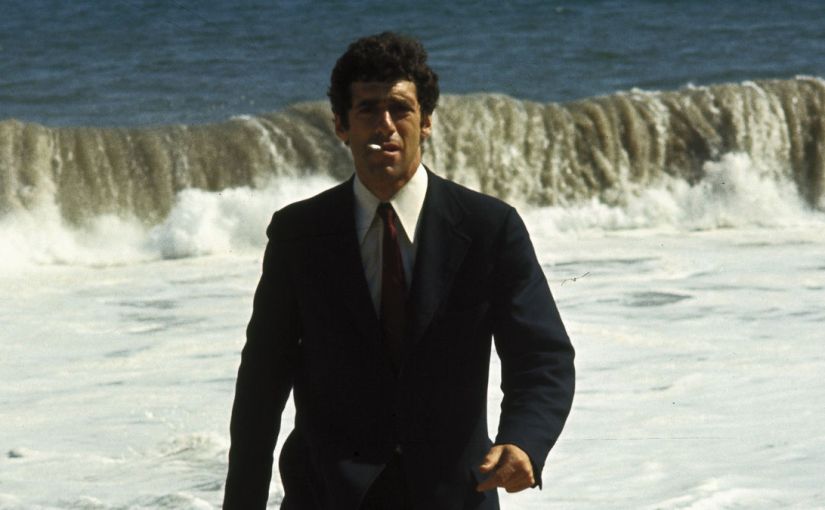
Elliot Gould’s version of Philip Marlowe is a far cry from Humphrey Bogart’s classic interpretation in The Big Sleep [1946], and I’m okay with that.  Who wants to see any actor, no matter how talented, try to follow in Bogey’s footsteps?  Gould resembles no one so much as Walter Matthau as he shambles from one fine mess to another, cracking wise to cops and hoodlums alike, smoking cigarettes like there was no tomorrow, and bemoaning the loss of his cat (played by the original Morris the Cat…no, seriously).

I mention all that because, apparently, there were (and maybe still are) Raymond Chandler fans who were none too pleased with Robert Altman’s film The Long Goodbye when it was released, as Gould did not fit the image they had in their mind of one of fiction’s greatest hard-boiled detectives.  In my opinion, it just doesn’t matter.  Bogey is Bogey and Gould is Gould and, as Marlowe himself repeats throughout the movie, “It’s okay with me.”  Just had to get that out of the way.

The Long Goodbye is one of the finest private eye flicks I’ve ever seen.  With Robert Altman’s trademark style and wit, we first encounter Philip Marlowe as he wakes up in the dead of night to feed his cat.  Much has been made of this opening scene, as the filmmakers apparently intended it to be a metaphor for the Marlowe character being transposed from the ‘50s to the early ‘70s, like a “Rip van Marlowe” suddenly having to deal with a new world after being asleep for 20 years.  I get it, but the movie plays just as well without that kind of metaphysical layering.

Next thing you know, Marlowe’s best bud, Terry Lennox, shows up at his door with bruised knuckles, scratches on his face, and a sudden desire to visit Tijuana, Mexico…indefinitely.  Marlowe does what any friend would do: drives his buddy to Mexico and drops him off at the border.  But when he gets back to his apartment, the cops are already there, interrogate him, and bust him on a phony charge until he tells them where Lennox is.  Three days later, Marlowe is released because Lennox has turned up dead, with a suicide note and a confession to murdering his wife at his bedside.

That’s just the setup.  Next thing you know, he’s hired by a ritzy dame, Eileen Wade (Nina van Pallandt), to find her drunkard husband, famous author Roger Wade (the always dependable Sterling Hayden), who apparently has a nasty habit of taking his drunken frustrations out on Eileen’s face.  That leads to an encounter with a mean little mobster named Marty Augustine (director Mark Rydell) who makes Roger Wade look like Tiny Tim.  HE wants to know where his $355,000 is, that TERRY was supposed to deliver to him in Mexico.  Are these three plot threads connected?  Is the sky blue?

Even if the mystery plot of The Long Goodbye weren’t meticulously plotted and virtually airtight, the movie would still be a pleasure to watch and listen to because, hey, it’s a Robert Altman movie.  I’ve only seen one movie of his that I HAVEN’T liked so far, but I’m reluctant to say what it is for fear I’ll get a deluge of comments about how wrong I am.  Anyway, Altman’s style is in full force in this movie: overlapping dialogue, the occasional cameo (David Carradine as a cellmate, and a certain Austrian bodybuilder as one of the mobster’s muscle men), and characters who never, ever look like they’re acting.

Altman frames his actors and directs them almost as if he’s shooting a documentary, although there are very few (if any?) hand-held shots, so you can tell that there was a method to the…well, not madness, but spontaneity.  Watching them deliver their lines is like watching the scene play out through a keyhole, or like we’re watching them on a hidden camera.  There’s a voyeuristic feel to the whole movie that, while it lacks a certain polish, is nevertheless compelling and absorbing.  I wanted to know what happened next, not because the mystery still hadn’t been solved, but because I simply wanted to see what these characters were going to do or say.  This is a vibe that I don’t even REALLY get, at least not to this degree, in some of Altman’s later films, like The Player [1992] or Short Cuts [1993].  There is something about the synergy between Gould, Altman, and the Marlowe character that struck a chord in me, and I was just happy to be along for the ride.

Naturally, I wouldn’t dream of revealing any of the secrets to the mystery of Terry Lennox and the mobster and the author’s wife.  But I do want to mention one specific scene, between Marty Augustine and his beautiful mistress.  To say that the payoff of this scene was a jolting is a vast understatement.  I can’t even say what other films it reminded me of, but it’s safe to say that it took me completely by surprise.  You’ll know what I mean when you see it.  (And how about that ending!?  Altman had a clause written into his contract specifically stating the ending of the film could NOT be changed by studio interference or whatever…and thank God he did.)

Based on the movie posters for The Long Goodbye, I had always assumed this was Altman’s stab at madcap, screwball comedy.  I could not have been further from the truth.  This is a great film noir, or I guess neo-noir, that does its best (and mostly succeeds) to capture on screen the grittiness and fatalism of only the best dime store detective novels, as well as some of the more highbrow entries in the genre.  Only Altman could have made a movie specifically like this, in this way, and only Gould could have captured that precise mix of “here we go again” and “I’m smarter than you and we both know it”.  I wouldn’t call it a forgotten film, but it’s worth digging up if you’ve never seen it.