THE LITTLE MERMAID (2023)

By Marc S. Sanders

Film remakes can go either way.  It’s even more of a challenge for it to succeed artistically if the original interpretation is such a favorite among the masses.  The 2023 updated version of Disney’s The Little Mermaid directed by Rob Marshall is fair, but it also never overcomes the challenge.

The new film primarily repeats the same story that many are familiar with.  A youthful mermaid girl named Ariel dreams about living among the humans above the surface.  Her father refuses the idea as he finds humans to be vile and dangerous.  Ariel makes a deal to trade in her beautiful voice to Ursula, the sea witch, in exchange for becoming a human.  She is granted three days to fall in love with Prince Eric.  If at the end of the three days she has not kissed the prince with a means of true love, she will turn back into a mermaid and will remain a prisoner of Ursula forever.

To call this new film adaptation of the Hans Christian Anderson fairy tale a live action film is only partially true.  If we are to witness the undersea life of mermaids and talking fish, well then, it’ll have to be animated somewhat, even if it is done digitally.  Therefore, to have the freedom to animate the sequences set to unforgettable numbers like “Part Of Your World” and “Under The Sea,” I wish the filmmakers were paying a little more attention. 

Consider some lyrics to “Under the Sea:”

Down here all the fish is happy…

Up there all the fish ain’t happy

They’re sad, cuz they’re in the bowl

It doesn’t win my attention if Sebastian the singing crab is singing about fish while the heroine of the story, Ariel, is swimming among dolphins who are scientifically regarded as mammals!!!!!!  You can show me any number of different colorfully prancing ocean dwellers, and you show me dolphins?????  In a musical number, the choreography must serve the purpose of the song.  In the original 1989 film, every animated image of any particular song lines up with the lyrics of numbers written by Alan Menken and Howard Ashman.  Regrettably, Rob Marshall seems to have turned the sound off while reinventing this moment. 

Sadly, I didn’t care for the updated composition of “Under The Sea” (an Oscar winning number) or “Part Of Your World.”  Why alter the notes and vocal delivery of some of the most famed pieces in Disney’s musical library?  Steven Spielberg’s update of West Side Story didn’t do that.  Spielberg knows that if ain’t broke, don’t fix it.  These are favorites!!!!  I can’t be the only one who doesn’t like it when the artists change everything about his/her/their greatest hits when I’m at their concerts.  The same accounts here. 

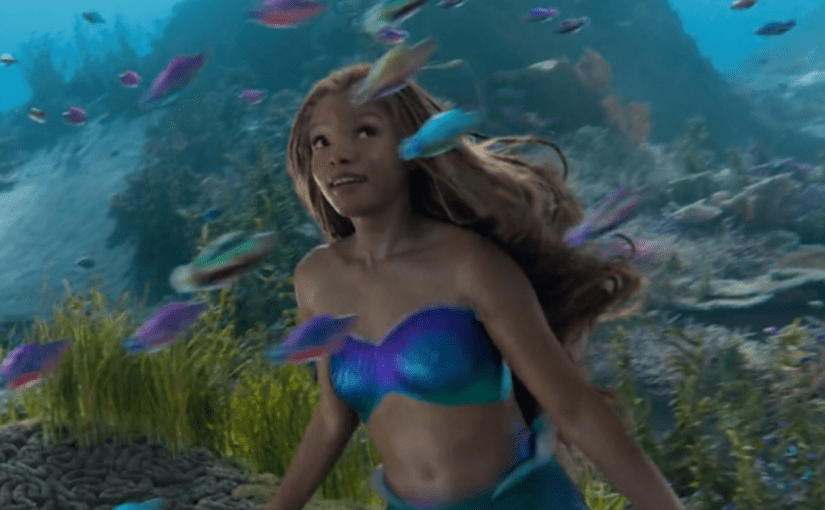
Still, it’s not all bad in this new The Little Mermaid.  Most of the cast is quite good.  Newcomer Halle Bailey (sure to be memorable in the upcoming musical version of The Color Purple) is sensational and she’s wonderful to look at as either the mermaid or the human version lacking a voice.  She has a wonderful singing voice and she’s a terrific actor against a CGI world of complicated water shots and imaginary creatures serving as her companions.  Melissa McCarthy is unrecognizable as Ursula, the sinister squid sea witch.  Her voice has a gruff intimidating edge to it and her torso and head donned in purple texture flow nicely with the CGI tentacles.  Javier Bardem is not doing his best work here because the script doesn’t demand it of him, but he fits in nicely as Triton, king of the undersea and father to Ariel.

Jacob Trembley lends a preteen personality to Flounder whose role is significantly diminished in this update.  That’s a mistake.  Instead, we get more of Scuttle who doesn’t look like a pelican any longer but is a bird who can somehow hold his breath under water for long periods of time to carry on panicked conversations with her pals.  Awkwafina voices Scuttle, and though I heard some laughter from the audience in response to her performance, it just didn’t win me over.  I found this Scuttle to be a nuisance that took me out of the film with each appearance.  The hip hop rap number (written by Lin Manuel Miranda) she performs was a very underwhelming substitute for comedy.  What was sacrificed was the hilariously silly, slapstick number from the original, where the French chef enthusiastically sang “Les Poisson,” as he torments poor Sebastian in a kitchen full of knives, boiling water and searing hot stoves.

Sebastian, the well-known sidekick, is just okay.  Daveed Diggs is a talented vocal performer, but I don’t think the final product served him well.  Often, I looked at this little guy and was not impressed, as remembrances of disappointment came back to me when I saw Jar Jar Binks for the first time.  Just like that Star Wars character, the googly eyes are detached from the head and Sebastian only evokes expression in that one area.  Nothing is done with the tiny mouth or cheekbones or ears.  Not even his claws or tiny legs offer much to do.  This crab lacked life.  As my colleague Miguel simply put it, the crab was not funny.  He just wasn’t funny in the slightest. 

A nice surprise comes from Jonah Hauer-King as the dashing Prince Eric, rescued from a shipwreck by a mysterious woman with a hypnotically, sensuous voice.  Eric’s role is thankfully expanded with the inclusion of his mother the island Queen (Noma Dumezweni).  Grimsby, the Prince’s aid, is also a welcome appearance (Art Malik) with more to do this time around.

I know for sure that I preferred the second half of the film over the first where new surprises are offered.  Rob Marshall’s film switches the influence of the story to a calypso/Caribbean vibe which is different from the slightly implied Greek environment of the 1989 piece.  This change allows a variety of different people of color and cultures to blend nicely together with believability.  After Ariel transforms into a human and Eric guides her across the island for a day of fun and escape, the story and settings come alive in color and calypso harmony.  In this area of the picture, much of the script is concentrated on Eric and his debates with his mother and her disapproval of the undersea colonies.  Confidant conversations also arise between Eric and Grimsby that I liked.  There’s more innocent flirtations between him and Ariel.  Hauer-King has good scenes with all of his co-stars from Halle Bailey to Noma Dumezweni and Art Malik.  The first half of the film is where much of the underwater life takes place, and it only convinced me so far, really taking me out of the film with the reinvention of the movie’s most famous songs.

Ultimately, like the live action interpretations of Aladdin and Beauty And The Beast this new version of The Little Mermaid is not a must watch and as much as I’m impressed with Melissa McCarthy, Halle Bailey and Jonah Hauer-King, I can’t recommend seeing it at $15 a ticket.  Why should you when the easily accessible and wholly original film is available?  This is just an unnecessary venture.

I’ve grown up as a Disney fan, but once again the Mouse House is demonstrating a lack of will to broaden its imagination.  They’d rather run in with another cash grab at the box office by issuing a substandard product repeat. 
CHICAGO

By Marc S. Sanders

When you are a sexy, sultry lady killer, infamy can just about save you from a hanging.  That’s what Rob Marshall’s Oscar winning adaptation of Bob Fosse’s Broadway jazz musical capitalizes on in Chicago. The movie is hot, steamy, dazzling and blazing with magnetic song and dance numbers that are easy to follow while getting your pulse racing.  The design, direction, music, and choreography are magnificent.  The cast is outstanding too.

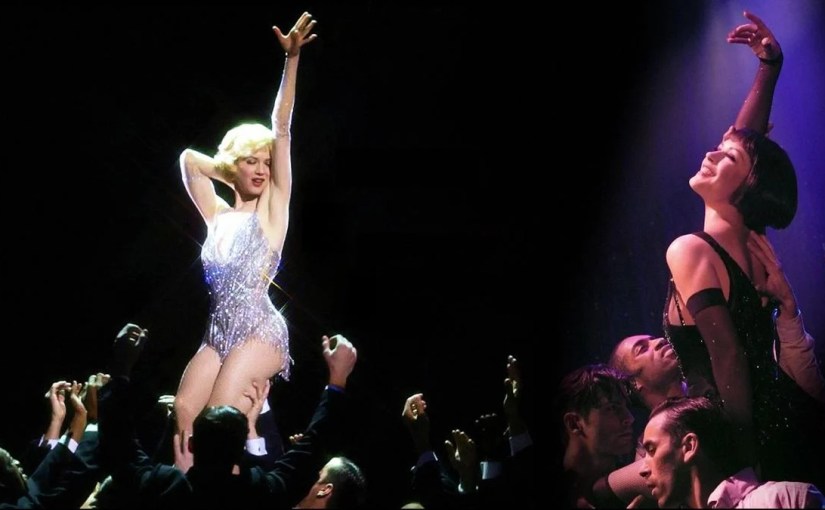
During the glitzy 1920’s in the Windy City, Roxy Hart (Renée Zellweger) is a wanna be night club performer who gets arrested for the murder of her extra marital lover (Dominic West).  She’s thrown in the pokey where the well known warden Matron Mama Morton (Queen Latifah) oversees all of the other murderesses, and often profits off of their sensationalistic crimes.  Roxy’s loser schlub of a husband, Amos (John C Reilly), manages to hire the hottest defense attorney in town, the handsomely slick and underhanded Billy Flynn (Richard Gere), to represent Roxy at trial.  Billy has never lost a case because his specialty is to manufacture drama for his accused clients, generating sympathy in the papers and among the jury.  In the film, there is a scene where Billy is literally pulling the strings on his puppets, particularly a marionette appearance of Roxy on his lap while he does the obvious ventriloquism.  A memorable moment for both Gere and Zellweger.  On the side is Velma Kelly (Catherine Zeta-Jones), a double murderer of her husband and performing partner/sister.  Velma owned the public outcry until Roxy’s name was splashed along the headlines.  Now, the spotlight is quickly moving away from Velma.

Rob Marshall choreographed and directed Chicago.  He demonstrates the fun that can be had with murder.  Call it a new kind of excitement that normally we take jubilant delight with episodes of Murder She Wrote or Agatha Christie tales. 

The theme of this picture is how the story is narrated in a colorful reality.  On a parallel level it is performed on a stage nightclub with a bandleader (Taye Diggs) introducing the players who then breakout into their own testimonial song amid large choruses and dancers to enhance the attraction of headlines and sleazy, operatic narratives.  Christine Baranski is the reporter whose front and center, trying to collect the next big chapter development of whoever leads the hottest storyline at any given moment. 

Marshall will turn a courtroom proceeding led by Billy Flynn into a three-ring circus, while at the same time he’ll cut away to the nightclub.  Billy will be on stage, but he’s now wearing a glittery three-piece suit and doing a ragtime song and dance with a chorus of scantily clad, Burlesque women to apply a little Razzle Dazzle for the judge and jury.  Richard Gere is not who you think of for stage musicals, but he is positively charming.

Queen Latifah has a scene stealing moment to show off her entrance into the picture.  Mama Morton is in a skintight evening dress, complete with a swanky boa while performing When You’re Good To Mama on stage at the nightclub. Frequent cut aways have her dictating her powerhouse tune to the inmates.  John C Reilly performs Mr. Cellophane. He lays out certainty that there’s nothing inauthentic about the pushover loser husband he really is.  Both actors got well deserved Oscar nominations.

Catherine Zeta-Jones and Renée Zellweger are a perfect pair of competitors.  They each have their individual moments and they act with such solid gusto; tough broads not to messed with.  The confidence they exude on screen with character acting, singing, and dancing is second to none.  The script will offer moments when Roxy and Velma think they are high and mighty, and winning the court of public opinion.  Then it will be undone when their hotshot attorney, Billy Flynn, knocks some sarcastic sense into them and a dose of reality sets in.  Roxy isn’t so fond of wearing a conservative black dress with a white collar in court until she sees a fellow cellmate lose her last motion of appeal, and there’s nothing left but to be punished by hanging.  She might be putting on a helluva performance, and signing autographs while souvenir dolls of her likeness are selling on the streets, but none of that ain’t gonna mean a thing if the jury finds her guilty of murder.

Just like I began this article, infamy is the word that kept coming back to me while watching Chicago.  Infamy bears celebrity.  Granted, it’s enhanced for a lively musical motion picture and stage show.  However, there’s a very, sad, and no longer surprising truth to that ideal.  A few years back, I recall news reports about a criminal’s sexy mug shot where he had donned a tattooed tear drop below his eye.  This guy was prime for runway modeling.  However, he was proven to be a violent car thief. He actually got signed by a talent scout following his bail out.  (I think the agent posted the bond.)  Later, he got arrested for some other crime. 

I never saw the reality program Chrisley Knows Best, about a God loving family who proudly live among the finest that money can buy.  Recently, the ultra-vain mother and father were sentenced to over a decade in federal prison for fraud and tax evasion.  Yet, their brand is stronger than ever, as the gossip columns can’t get enough, and their adult daughter’s podcast has millions of listeners.  Word is that a new program is being designed as a follow up to their prison sentences. 

Infamy bears reward.

Chicago pokes fun at the obsessions adhered by the media, the public, the courts and within the penal community.  The well known musical is now decades old, but the topics contained within clearly identify how news is not reported in a simple, objective Walter Cronkite kind of way, anymore.  Everything is heightened.  Everything is dramatized.  It’s not enough that Roxy kills her lover.  That will get her only so much mileage, until the next lady killer comes along (in the form of Lucy Liu, for example).  Roxy must stay relevant.  Announcing she’s pregnant will keep her on the front page (It could help that she faints while doing it). Velma knows all too well that the public favoritism she once had, accompanied with Billy’s sleazy promotion, is even further away. 

Rob Marshall presents a film where any song can be pulled out of context just for its sizzling entertainment.  Try not to forget the Cell Block Tango with solos from Zeta-Jones, as well as her fellow inmate chorus girls, each proudly describing how their guy “Had it coming!!!”.  All That Jazz is arguably one of the best opening numbers to a show, and Catherine Zeta-Jones owns the performance.  Individually, these songs and the performers win my attention in the car or the shower or during a workout.  Assemble them together with the overall storyline, and Chicago becomes a fast paced, kinetic roller coaster that makes you think while you smirk at all the scruples and vices being dismissed. 

The last time I saw Chicago was in theaters in 2002.  I had also seen a stage production of it before then.  I loved it both times.  Rewatching it recently gave me such a jolt of energy.  It is why theatre is a vital source of escapism. Here is an example where you can feel positively entertained while reflecting on a sad truth.  It might be sad, but you’re smiling all the way through while you mouth the brilliant lyrics and tap your feet.

Roxy Hart, Velma Kelly, Billy Flynn and the rest of the cast of characters make Chicago red hot and gleefully sinful.

MARY POPPINS RETURNS

By Marc S. Sanders

PL Travers’ character Mary Poppins is synonymous with the flavor of Disney. You may visit a Disney Theme Park or Cruise Ship or watch a classic film, and you might think to yourself this sidewalk, this room, this cast member’s uniform appears like something out of Mary Poppins. Walt Disney Studios and all its products would be something entirely different without the exactness of the most popular nanny in film. Ironically, until now, since 1964, has there been only one Mary Poppins film…and, well one PL Travers biography.

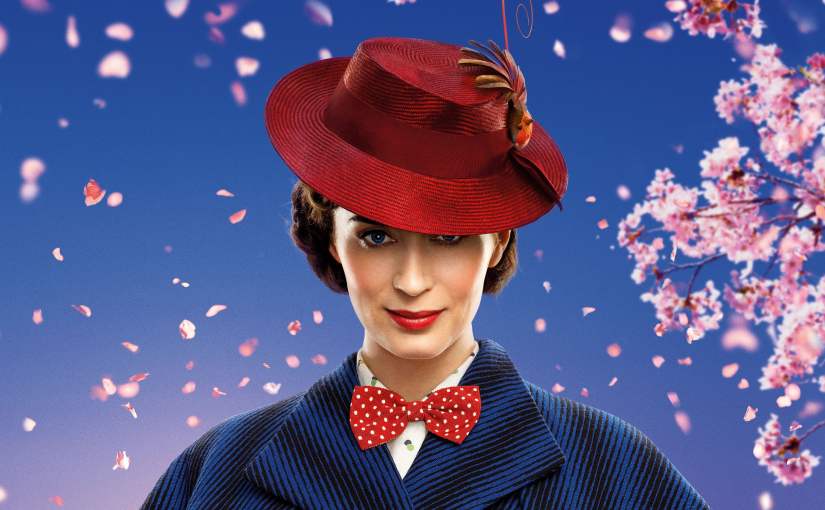
Director Rob Marshall (Oscar winning director of Chicago) has been recruited to bring the magical character back complete with her bottomless bag and her umbrella in Mary Poppins Returns. Perfectly cast is Emily Blunt in the role. Because this new installment that jumps to the next generation of Banks children is not a franchise reinvention, Blunt beautifully carries on the rigid mannerisms and casual magic that Julie Andrews effortlessly brought to the part. Blunt is not mimicking Andrews however. I think she takes the purpose of Mary more seriously actually. Andrews would smile at the fantasy. Blunt responds as if animated dog carriage drivers are seemingly normal. I also detected another dimension of maybe sadness or melancholy from Blunt as she observes the anguish of the children’s father Michael (Ben Whishaw, a great performer) now all grown up and reluctant to accept fantasy as a means to save the Banks’ home from foreclosure. When this Mary Poppins has to depart this family at the end, for a moment, I felt like she didn’t want to, like she needed this family as much as they needed her; not something I got from the first installment. Alas, this is 2018 and people are more attuned to the harshness of the world. Maybe Mary Poppins is as well.

Lin-Manuel Miranda adopts a cockney accent and fills the role of Jack, a street lamp vendor, all too familiar with Mary. What Dick Van Dyke brought to the original, as Bert, the chimney sweep, Jack offers to this film. Miranda is great. The best musical performer of the last five years (Hamilton, In The Heights). He opens the film with the whimsical new song “Under The Lovely London Sky” and Marshall and company make sure the audience catches on quick. It’s not “Chim Chim Cheree” but it’s a fun tune that provides a little mystery to the legendary nanny and the goings on at Cherry Tree Lane. Miranda is the only one I can think of to play this role today. Ten or fifteen years ago, it might have been a younger Hugh Jackman.

Cameo appearances abound from Meryl Streep showing another side of her not seen before as a gypsy like cousin of Mary’s, Angela Lansbury, so fortunate she is still performing, and best of all Dick Van Dyke who can still provide a little tap and two step in his spring.

Amidst an entirely new and well versed soundtrack that feels comfortably familiar, the film includes imaginative scenes like diving into an ocean through the bathtub, spinning into the animated (CLASSIC ANIMATION) world of a priceless porcelain bowl and soaring into the sky with a balloon that is just right for you. These are great scenes because they are so silly but Emily Blunt as Mary encourages you to take all this fantasy seriously. “Everything is possible,” she says. “Even the impossible.”

Walt Disney felt that way too. So without Mickey Mouse or Mary Poppins, there really is no institution called Disney. With these brands however, they are all practically perfect in every way.