HOUSE OF GUCCI (2021)

by Miguel E. Rodriguez

Director: Ridley Scott
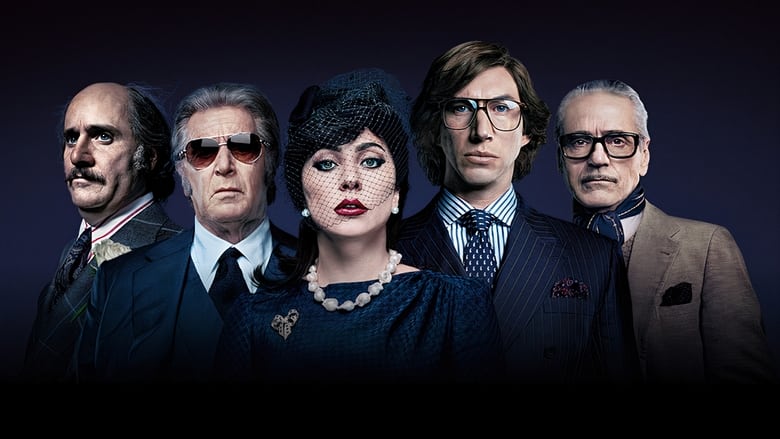
Cast: Lady Gaga, Adam Driver, Jared Leto, Al Pacino, Jeremy Irons, Salma Hayek
My Rating: 5/10
Rotten Tomatometer: 61%

PLOT: An outsider marries into the Gucci family, and her unbridled ambition triggers a downward spiral of betrayal, revenge, and violence.


Watching Ridley Scott’s House of Gucci was a curious experience.  I could see glimmers of a great entertainment through bars of slow pacing, a meandering story, and unanswered questions.  The performances are top-notch, no question, but they are at the service of a movie that doesn’t seem interested in meeting their level of passion.

Inspired by true events, the movie tells the story of Patrizia Reggiani, a young woman from humble beginnings who meets and eventually marries Maurizio (Adam Driver), one of the heirs to the Gucci fashion empire.  Patrizia is played with fury and fire by Lady Gaga, who seems destined for another Oscar nomination.  Her character is portrayed as a latter-day Lady Macbeth, someone who sees through the deceptions of her new husband’s business associates and manipulates people and events for her family’s benefit.  In true tragic form, her ambitions threaten to derail everything she loves.

Adam Driver plays Maurizio as a rather slow fellow who disinherits himself so he can marry Patrizia but finds a way back into the fold via his uncle, Aldo (Al Pacino), who sees Maurizio as a good substitute for his own disappointing son, Paolo.  Paolo is played by Jared Leto, in another of the film’s performances destined for Oscar recognition.  Buried underneath flawless makeup and a skin cap, Leto portrays Paolo as a self-deluded buffoon whose fashion designs aren’t so much daring as unfortunate.  (Apparently, pastels and brown were never meant to mix…who knew?)

I mention the performances because they are the sole highlights of the film.  For two-and-a-half hours, these performances play against a backdrop of one dreary scene after another. Sure, the performances are fun to watch, but at the end of the day, if they don’t have anything interesting to say, it gets a little boring.  We get behind-the-scenes intrigues and betrayals that seem to owe more than a little to earlier crime epics by Scorsese and Coppola, but there was nothing to get really excited about.  Nothing grabbed me.

Ridley Scott’s films are normally way more imaginative than this.  They look better.  The cinematography is usually more inspired.  I’m not talking about his action or sci-fi epics, either.  I mean his small-scale triumphs like Matchstick Men or Thelma & Louise.  What happened here?  Was he not inspired by the story?  There is great material here, more than enough back-stabbing and lying and cheating to go around.  Yet everything is subdued, and plods, and inspires more yawns than anything else.  I didn’t experience any kind of excitement or passion one way or the other for any of the characters, or for the story.  It just didn’t make me care.

By the time House of Gucci is over, we’ve seen betrayals, marital infidelity, divorce, back-stabbing business deals, sex, and murder.  I have a friend who wrote a stage play that has almost all of those things, and it was WAY more entertaining than this film.

PROMETHEUS (2012)

by Miguel E. Rodriguez

Director: Ridley Scott
Cast: Noomi Rapace, Michael Fassbender, Charlize Theron, Idris Elba, Guy Pearce, Logan Marshall-Green
My Rating: 10/10
Rotten Tomatometer: 73%

PLOT: A deep-space research vessel arrives at a distant moon, searching for clues to the origins of mankind.  What they find instead threatens their lives and the lives of everyone back on Earth.


I am at a loss to explain the mediocre Tomatometer score for Prometheus, Ridley Scott’s long-awaited return to the universe he created in Alien [1979].  Intellectually, I can hear the arguments:

  • “Where’s the Xenomorph?”
  • “So did the ‘Engineers’ create humans or what?”
  • “Is that planet at the beginning supposed to be Earth?”
  • “Where’s the Xenomorph?”
  • “Why did that idiot scientist approach the snake-looking creature?”
  • “How is the android able to break almost all of Asimov’s Laws of Robotics?”
  • “What’s with the open-ended ending that provides no resolution?”
  • “WHERE’S THE XENOMORPH???”

I get it.  You hear Ridley Scott is making a prequel to Alien and you build up a lot of expectations, especially after watching some of the sorrier sequels that piled up after Aliens [1986].  When you go into a movie expecting one thing and get another, people get hacked off.  I feel you, bro.

But to those people who dismissed Prometheus because it didn’t deliver what they expected to get, all I can say is: your loss.  Because Prometheus is one of the greatest sci-fi movies of all time, in my humble opinion, and it’s mostly for the very same reasons that people disliked it in the first place.

After a brief prologue set in an unknown time in an unknown place, we jump to the year 2093, when a deep-space research vessel arrives at a far distant moon, searching for clues to the origin of mankind.  Dr. Elizabeth Shaw (Noomi Rapace) says they were led to this specific moon by “Engineers”, humanoid beings who are visible in ancient cave drawings from across the globe.  She believes the Engineers can provide an answer, THE Answer, to Life, the Universe and Everything. (Apologies to Douglas Adams.)

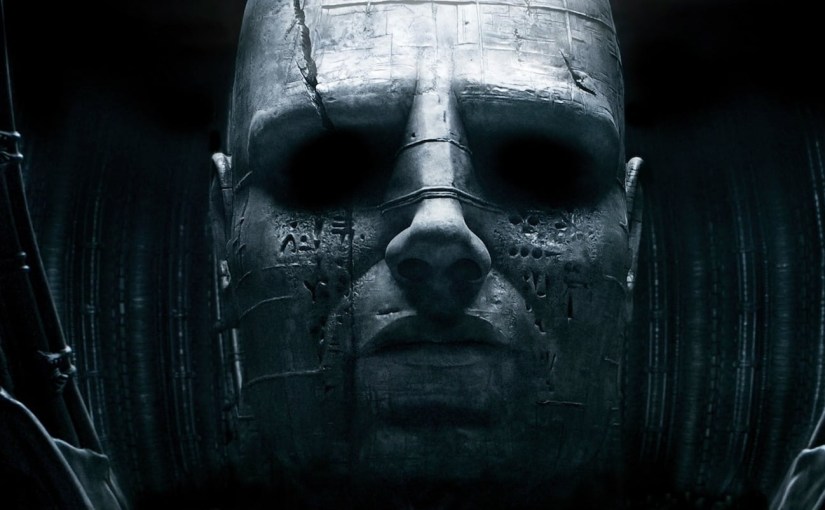
Instead of Engineers, Dr. Shaw and her expedition discover miles of underground caverns and a room full of canisters that turn out to contain a horrifying contagion that attack the body at a cellular and/or genetic level, creating painful mutations that, if they don’t kill the host outright, turns them incredibly violent.  We also get a glimpse of the famous “space jockey”, the fossilized alien creature seated in some kind of contraption inside the spaceship in Alien.  So at LAST we’re in familiar territory.

But still no Xenomorph.

The story progresses, the shipboard android turns out to be less than trustworthy, people die in creative and horrifying ways, an Engineer actually turns up, we get a couple more visually spectacular tie-ins to the first Alien…but by the time we get to the end, what gives?  The movie’s obviously over, but we haven’t gotten any answers to the burning questions: Who are the Engineers?  If that was an Engineer in the prologue, was that supposed to be Earth?  If it WASN’T Earth, why even HAVE that prologue?  And don’t try to tell me that was a Xenomorph at the end…

Well, here’s my two cents.

First, of all, expectations are tricky.  They can color and compromise your entire movie-watching experience.  When I went to see Prometheus, I did have my own set of expectations, but as the movie settled in and it became clear that the movie had other designs, I had to consciously shake myself loose of my expectations and embrace what was being presented to me.

Second of all, the visuals are stunning.  I happened to see this in 3-D, and it’s one of a handful of movies where the technology was used PERFECTLY.  No gimmicky shots of spears or harpoons or whatever being pointed out of the screen.  It was used as it should always be used: as a tool to further immerse you into the world of the film without overloading you or being ridiculously obvious.  The gorgeous landscapes during the prologue and during our heroes’ descent to the surface are awe-inspiring.

And then, the story.  I was completely okay with the open-ended nature of the story, and I’ll tell you why.

There are some films out there that play Prometheus’s game of asking questions and not answering them.  One of the most famous examples is Stanley Kubrick’s adaptation of 2001: A Space Odyssey [1968].  If you’ve never read the book, I defy you to provide a concise explanation of the last thirty minutes of that movie.  But that didn’t bother people, because the goal was to get the viewer to ask questions, to provoke discussions about the movie that would eventually get around to some of the same questions asked in Prometheus: Why are we here?  What is our purpose?

And then there are other films that play that open-ended game and fail.  The one that comes immediately to mind is Darren Aronofsky’s The Fountain [2006].  By the end of that movie, my head was locked in a tilted position like a cocker spaniel hearing a strange noise.  If I had been a cartoon character, the word balloon over my head would have been all question marks.  I once read a full description of what was really going on in that film, but to the degree that I understood it, I simply didn’t care.  If I have to go that much work to “get” a movie, the movie didn’t do its job.

There are those who say that’s what Prometheus did, throwing us in the deep end and making us do some mental heavy lifting with no payoff.  But I disagree.

I think, for me, it has to do with the very nature of the questions Prometheus is asking.  “If we could discover the answers to the riddles of our existence, to what lengths would we go, or should we go, to get those answers?  And do we even want to know the answers?  Are we better off NOT knowing?”  These are questions that, almost by definition, can’t be answered in any satisfying way.  So Prometheus presents a possible answer, but then teases it away so there is still some mystery in the story.  If the characters in Prometheus had discovered some kind of document that laid out the Engineers’ plans in detail, I would have felt cheated.  It would have been woefully anticlimactic.  I liked it better that the biggest questions went unanswered, so I could formulate my OWN theories about the Engineers, their plans, their methods, their history, their future, etcetera.  It’s much more stimulating to let my imagination run riot.

(Granted, some of those questions are answered in Alien: Covenant [2017], but that movie still had the guts to leave some things to the imagination by the end.)

Prometheus couches deep philosophical riddles about our very existence within a crackling good thriller with spectacular visuals from beginning to end.  It stands tall as one of the best prequels ever made…Xenomorph or no Xenomorph.

THELMA & LOUISE

By Marc S. Sanders

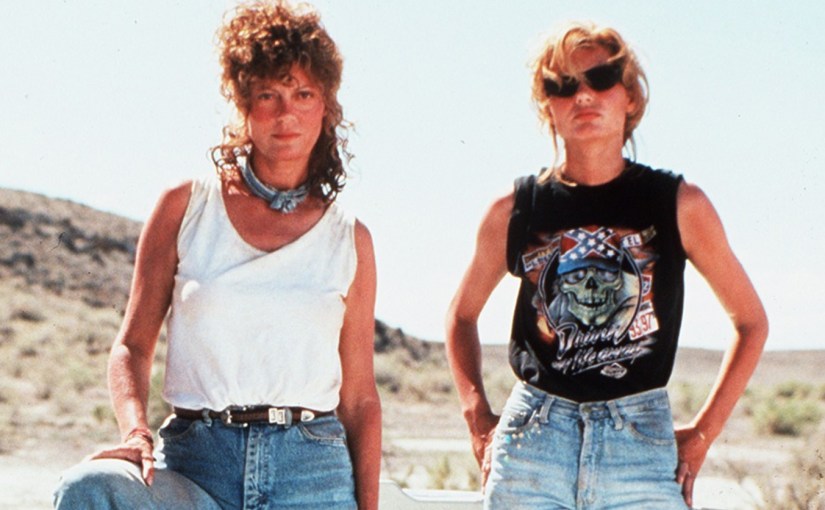
The strength of a good solid picture often depends on a strong cast from the top billing, above the title actors, to the bit supporting players who only have a few minutes of screen time.  Thelma & Louise, directed by Ridley Scott, is that film.  The opening credits of the movie come up in black and white over an out west landscape with an endless dirt road in the center of the screen.  Hans Zimmer’s harmonica and banjo, country sounds build on Scott’s camera work here.  The names of each actor are brought up: Susan Sarandon, Geena Davis, Harvey Keitel, Christopher MacDonald, Michael Madsen, Stephen Tobolowsky, and someone named Brad Pitt. The scene goes to color and then it blacks out and comes up on Louise’s (Sarandon) crowded diner where she waitresses.  Nothing is unfamiliar here.  Yet, it seems a little haunting in a way.  We are about to uncover a history to some common folk who live on the southern bend of America, and we will start in the state of Arkansas.

Louise has made arrangements with her best friend Thelma (Davis) to do a weekend cross country road trip to a cabin in the woods.  This is the southern odd couple.  Louise is always put together, clean and organized.  She’ll check herself in the mirror.  In a crowded ladies room, she’ll check her makeup and tidy her hair while intoxicated patrons are pushing around behind her.  Thelma is scatterbrained.  She’ll bite off a piece of a candy bar, put it back in the freezer and make three more stops back at the freezer for a couple of more bites.  She also will dump a dresser drawer of clothes into a suitcase, taking no time to sort through what she’s packing.

Both women have been treated unfairly by the men in their lives.  Thelma’s husband, Daryl (MacDonald) is a proud white trash carpet sales manager who treats his wife with absolute control, complete disregard and thoughtless disdain.  Louise just can’t even get a hold of her boyfriend Jimmy (Madsen), a musician who can’t commit to anything.  On the first night of their trip, the two ladies hit the road in an iconic 1966 green Ford Thunderbird convertible (one of the greatest, most memorable vehicles in film screen history), they’ll realize there may be worse men than the ones they’ve encountered.  Following an attempted rape, a shooting occurs and the ladies are hitting the road, hoping to make it to Mexico.

Thelma & Louise is at least Ridley Scott’s most sensitive film.  It was not the first or last time he used women as leads in his pictures.  Yet, the film moves symbolically along the stretches of highway and dirt roads as a means to reveal the strength and confidence a woman can have when she escapes the controlling shadow of a man.  At least that’s what I think.  The beginning of Scott’s film, with an Academy Award winning script from Callie Khouri, displays the title characters as weighed down by their past and current lives.  It is only when the two break free (with little options following an unforeseen dilemma) they understand they can be stronger than any man who’s ever dominated them before.  As the road trip moves on, they will encounter more hang ups and they will make mistakes, but by the time the third act comes along Thelma and Louise will sever any restraints that have held them back before.  It is such a gratifying story.

My father encouraged me to go see this movie with him.  It was 1991.  I was graduating high school.  I’d seen trailers for this picture and it was loaded with high energy country music.  I don’t like country music, typically.  In fact, I only can like country music when it is incorporated into a film.  Thelma & Louise is the best example of that feeling.  I hated the title.  Still kind of do.  It doesn’t have the ring of say Starskey & Hutch or Batman & Robin.  However, those are guy pairings.  Thelma & Louise are about two women, and I was never going to forget that.  Once I saw the film, I could not stop thinking about it.  I grew so accustomed to Ridley Scott’s direction and use of cinematography with Adrian Biddle.  The sun on the screen felt hot.  The dirt on the character’s faces and the Thurderbird felt gritty.  The sunburns on Sarandon and Davis felt sore and dry.  The glow of the car’s dashboard light felt bright in my vision. The settings spoke to me.  There’s a great moment where Louise seems to shed her feminine and dainty skin so to speak.  She hands over her jewelry to an old timer sitting on the side of road at an abandoned truck stop.  No words are shared between them.  This guy was born on this spot.  He’s never moved from this spot and Louise will leave her history behind with him.  Later, as the stakes grow, with the FBI and law enforcement closing in on the fugitives, there’s a moment where Thelma tells Louise, that she feels awake; like really awake and alert.  I knew what she was talking about.  I’ve already been on this hike for two hours with these characters, along with the crimes and entanglements they’ve gotten into and the movie has my full attention.  All these years later with repeated viewings, and I still feel that way.  I feel absolutely awake the moment the movie begins.

Khouri supplies her script with a variety of men.  Some are sensitive like the detective played by Keitel who knows that a murder didn’t just happen maliciously.  There’s more to the circumstances at play, and he’s hoping for the best for the ladies.  Some are just procedural like Tobolosky, who doesn’t recognize them as women, only as fugitives. Some are enlightening, yet deceptive like Brad Pitt’s hitch hiking handsome and charming loner that the ladies pick up, and some are simply cruel and vicious, like the rapist or Thelma’s husband, Daryl (MacDonald).  Maybe a trucker along the way is like that as well.  How will Thelma and Louise respond to each of these guys?  As the story contains a gamut of what all these men are, I never regard the picture as a middle finger protest to the male population.  Not at all.  There are men who will give women a chance and will treat them with respect and at least equality, within their surroundings.  Khouri’s script allows time for that.  Sadly though, thirty years later there are still men who will treat women like punching bags with no value and esteem.  It’s wrong.  It’s why the “Me Too” movement had to eventually come into play, long after the release of this picture. 

At the risk of sounding political with potential for debate and preach, watching Thelma & Louise last week, I could not help but think of recent current events that have occurred in mid year 2021.  Bill Cosby was set free from his prison sentence following a technicality that justified his release, but never exonerated him of his crimes of rape.  A former kid actor named Drake Bell was sentenced to three years’ probation for sending sexually explicit materials and texts to an underage girl.  More physical details have been implied on that relationship but Bell was never charged with anything on that topic.  Hence, no jail time.  A Disney channel actor has a warrant out for his arrest following missing a court date with similar charges as Bell.  Following the early rape scene in this film, the attacker is shot and killed in a parking lot.  The ladies consider going to the police and explaining what exactly happened, but they choose to run.  Why?  Because, they know that the police would never believe them.  They were witnessed minutes earlier drinking and partying with this guy in a bar.  Why would anyone believe he would try to rape one of them?  Reader, I know what they mean.  I understand.  Each time I watch the movie, I truly understand.  I know what Thelma and Louise are talking about.  It’s sad.  It’s wrong.  It infuriates me because it’s so unfair.

Callie Khouri and Ridley Scott created an outstanding adventure picture with suspense, and lots of natural humor by means of the outlaw way like Butch Cassidy & The Sundance Kid.  A surprising robbery midway through the picture is hilarious and serves as a legit character change for Thelma.  Davis is great here.  She has scenes of drama and fear throughout the movie, but she also has time for laugh out loud moments.  Alternatively, the Louise character that Sarandon portrays seems to hinge on the dramatic element.  I love a hanging thread that Khouri weaves into the script of an unknown traumatic occurrence that happened in Louise’s past.  I am certain that Sarandon knows what it is even if the audience doesn’t entirely know.  Later in the film, the humor that Louise encounters comes through as Thelma transitions over to a new kind of personality.  These women don’t change individually.  They change together.  It’s a great couple dynamic for sure.

The film is sexy and at times sweet as well.  Yet, it’s also very terrifying, with very real drama.  Thelma & Louise is an important picture to see.  I plan to show it to my teenage daughter when she is a little older.  The rape scene holds me back right now as I find it hard to watch and requires a mature eye.  Nonetheless, I want her to be aware of what is out there.  I want her to know how people, men in particular, respond and treat women.   I want her to be alert and strong when faced with any kind of adversity, deserved or not; justified or not.  I find that some movies offer the best lessons of life about the cruelty and kindness of the world.  Most especially when they are filmed with sensitivity and authenticity, like Schindler’s List or The Shawshank Redemption.  Countless viewings later with thirty years behind it, and I still learn from Thelma & Louise.  It’s another one of my favorite movies.