THE HOT ROCK

By Marc S. Sanders

I’m a sucker for a good caper.  Capers play like strategy games.  An object (Hitchcock called them MacGuffins) needs to be acquired.  It doesn’t matter so much what the object is.  The importance falls within the pursuit. 

William Goldman wrote The Hot Rock, adapted from a novel by Donald E Westlake who penned a series of books focusing on the ex-convict John Dortmunder and his further adventures.  In the film, he’s played by Robert Redford. 

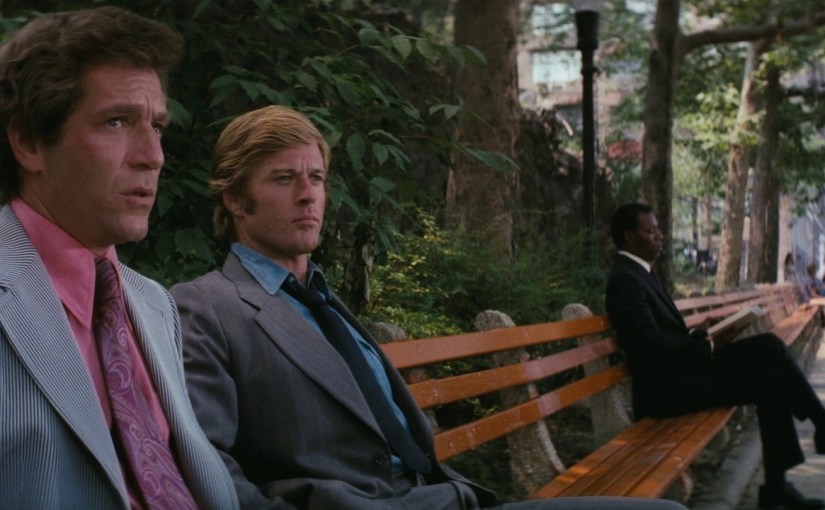
On the day that John is released from a New York state prison he’s picked up by his inept brother-in-law Kelp (George Seagel) who escorts him to Central Park.  Kelp wants John to be the fourth member of a team and steal a priceless diamond.  A man by the name of Dr. Amusa (Moses Gunn) sits about five feet away from them on a park bench.  Amusa breaks it down for the men, but they get interrupted by an elderly woman who sits between them to feed the pigeons.  This is what you can expect from The Hot Rock, a film structured under one pesky inconvenience after another.

This rock is currently on display at the Brooklyn Museum, on loan by an African country who has no business having possession of the valuable.  The stone belongs with Amusa’s country and he’s ready to pay Kelp and his crew $25,000 each to pull of the heist.  He’ll also, reluctantly, front some funding monies ahead of the theft for preparations. 

Like in all of these kinds of movies, John is ready to do one last job.  Then he’s out for good.  However, one last job turns into four last jobs.  Without spoiling too much, the rock gets relocated from one place to another.  So, a late-night heist at the museum turns into a break in a prison, and then it’s somewhere else and somewhere else after that.

As Hitchcock describes, you never care about the MacGuffin.  For movie purposes, you see it on display in its majestic glory, encased in a glass box right in the center of the museum, but so what.  The question is to uncover how the guys are going to get it out of there.  The Hot Rock doesn’t work nice and neatly like Ocean’s 11 or The Score.  In those movies, there are things that don’t go according to plan.  In The Hot Rock, nothing goes the way it should. Honestly though, it should be funnier than it really is. 

I recall there was a movie called Quick Change with Bill Murray doing his best to get out of New York City following a bank robbery.  It was comedic all the way through and maybe that’s because it was Bill Murray of Caddyshack and Ghostbusters fame, not to mention Saturday Night Live.  Robert Redford is the rugged actor of the time in 1972, though.  Not a comic and he plays Dortmunder like a serious kind of thief, even with his famous blond locks and toothy grin.  George Segal along with Ron Leibman and Paul Sand are bumbling chatter mouths, but are they funny?  Segal’s character steals a car to pick up John and we see him trying to figure out how to drive the dang thing, nearly running over Redford.  I never believed he did not know how to not drive the car. 

BY THE WAY: Ever notice in movies that they’ll show someone does not know how to drive a car by having them accidentally turn on the windshield wipers?  That’s all that is done.  That and having the car drive in S shape patterns as if the steering wheel suddenly took on a life of its own.  Then the scene comes to a halt with a startling slam on the brakes.  Never fails.  This happens over and over again in the movies.

Zero Mostel appears as the father/attorney for Paul Sand’s character.  It’s Zero Mostel, but Goldman’s script doesn’t give him much material to play with.  It’s not a silly caper flick because suddenly Zero Mostel of The Producers makes an appearance.  Look at Ocean’s 11, and see what Carl Reiner is doing.  There’s an organic affection for Reiner’s character that Mostel never achieves here. 

Peter Yates directed The Hot Rock a couple of years after the car chase thriller, Bullitt with Steve McQueen.  He impressed audiences with what two cars pursuing one another across the hilly streets of San Francisco could accomplish.  In this film from the early 1970s, Yates attempts to dazzle the audience with a few more speeding car stunts but they just don’t cut the corners.  Everything on screen looks like Yates and his crew are trying too hard.  There’s a helicopter sequence and much time is devoted to seeing how the chopper flies low over the Hudson River and then soars above the Twin Towers, still under construction at the time.  Look everyone!  Ron Leibman is flying a helicopter and Robert Redford and the rest look woozy about it all.  Thing is that James Bond movies were already doing this kind of schtick (with special effects) year after year by this time.  Peter Yates just doesn’t offer up anything that looks like a new sensation.

I’m actually surprised The Hot Rock has not been remade like Ocean’s 11 or The Italian Job.  In this film, the tools and skills are left to the guys and their cons. There’s no computer overrides or laser sensors to assist them.  Today, all of the techno stuff would be there with lots of closeups of fingers tapping away on a keyboard and then data entries appearing on a monitor.  In between, would be the comedy and would you believe of all people, I thought Will Farrell would be the guy to play the straight man and lead the charge.  The comedy of the situations would remain, but the thieves would be nerdy geniuses, each having their unique abilities and quirks. 

The set up is there for a remake.  Who you cast and what is done with it is up to the filmmakers. 

THE FRIENDS OF EDDIE COYLE (1973)

by Miguel E. Rodriguez

DIRECTOR: Peter Yates
CAST: Robert Mitchum, Peter Boyle, Richard Jordan, Steven Keats, Alex Rocco
MY RATING: 9/10
ROTTEN TOMATOMETER: 98% Certified Fresh

PLOT: After his most recent arrest has him looking at a long prison sentence for repeat offenses, an aging Boston gangster must decide whether or not to snitch on his friends to avoid jail time.


When scrolling through movie titles online or on your favorite streaming service, you might be forgiven for thinking that a 1973 movie with a title like The Friends of Eddie Coyle is a dialogue-driven character study by John Sayles or John Schlesinger, about a group of friends gathered at a hunting cottage or a class reunion or something.  Imagine my surprise when I watched it, and it turned out to be a nearly-forgotten gem of early ‘70s crime films.  (I’d call it a neo-noir, but it was released over fifty years ago now, so I’m not sure the term “neo” applies anymore.)  Featuring spare, economical storytelling reminiscent of other crime classics like Rififi [1955] or The Killing [1956], The Friends of Eddie Coyle is indeed a character study, but one that manages to downplay even Robert Mitchum’s heroic persona.

Eddie Coyle is getting old, and he knows it.  He’s currently facing up to 5 years in jail when he goes in front of a judge in a few days, but his old associates still rely on him to obtain “clean” firearms to use in pulling bank robberies.  The first time we see him doing this thankless job, he tells his cocky young supplier a story about why he has extra knuckles on his left hand, a speech that might have been written by a multiverse version of Quentin Tarantino.  (In fact, the bank robberies are accomplished when Eddie’s friends hold the bank manager’s family members hostage, so he’ll open the vault without question, a method paraphrased by “Pumpkin” in the opening scene of Pulp Fiction.)  Mitchum delivers this mini-logue with his trademark brand of world-weariness and menace, leading us to believe at the outset that he’s a man not to be trifled with, when in fact he’s little more than a glorified gofer for his bosses.

The film oozes a 1970’s atmosphere in every frame, but somehow it doesn’t feel all that dated.  There are no long zooms or extended chase sequences.  The most suspenseful scenes are the two bank robberies and one aborted car chase that is over as soon as it starts.  (I actually thought that was pretty clever, subverting our expectations by ending the chase after about fifteen seconds; this method was also put to good use in 2003’s not-as-bad-as-you-think S.W.A.T.)  The dialogue feels more modern, laced with f-words and racial epithets that, again, feel more at home in a Q.T. film than in a Robert Mitchum movie.  For my money, there may be a few movie-watching experiences that can top hearing Robert Mitchum telling someone to go f— himself, but I can’t think of what they are right now.

Director Peter Yates (Bullitt, Breaking Away) never once strains for effect, never showboats.  Like John Huston’s The Asphalt Jungle, it is content to merely set the stage and observe what happens, letting the events and the characters drive the plot instead of contrived action scenes or fancy camera movements.  Instead of becoming bored, I was drawn into Eddie’s dilemma, his conflict between loyalty to his so-called friends and his desire to stay out of prison.  Complicating matters is the fact he has a wife and three school-age kids; they all live in a tiny townhouse where you can touch both walls of the kitchen with your arms outstretched.  This is a wrinkle uncommon in most gangster films, where the heavies lead unattached lives.

When Eddie approaches a federal agent (Richard Jordan) and asks if the New Hampshire judge will look favorably on Eddie’s sentencing if he agrees to squeal on his gunrunner friend, I felt a little sorry for him, and that’s a neat trick.  Because of Mitchum’s presence, you almost automatically want to root for him to do the right thing, but because of the character he’s playing so well, I just got the feeling that things were not going to end well for him, and I was right.  After getting a taste of what Eddie has to offer in terms of high-profile arrests, the federal agent leaves him dangling, telling him the judge will keep him out of jail if he keeps ratting on his buddies.  Poor Eddie is in an impossible situation, and the irony is, when he finally makes his decision, it’s already too late…but I don’t want to spoil anything.  It’s a brilliant catch-22 that left me feeling even sorrier for Eddie than I did before.

The whole movie is like that.  We’re shown right up front that Eddie is a criminal.  But the hands-off filmmaking approach allows the viewer to make up his own mind.  You could, I suppose, watch this movie in one of two mindsets: either you empathize right away with Eddie and his predicament, or you can take him at face value and watch the movie waiting to see if he gets what’s coming to him, both for being a crook AND for squealing on his friends.  Either way, I think the movie’s resolution satisfies both interpretations, which is not an easy task.

If you sit down to watch The Friends of Eddie Coyle, just remember that it’s not The French Connection or Heat or anything splashy or flashy.  It’s a grim, gritty crime drama with a bona fide legend playing a petty thug instead of a crime lord.  Mitchum fits the bill, and the movie fits Mitchum.  The Boston environments – all shot 100% on location – mirror the way Eddie walks and talks: gray, blank, tired.  Beneath that grimy coating, though, is a rather brilliant character study of a man whose life has brought him to a crossroads where he must decide what’s more important to him, his friends or his life.  (His decision kinda surprised me, I’ll be honest.)

BULLITT (1968)

By Marc S. Sanders

The car chase with the movie attached to it is Bullitt from 1968, directed by Peter Yates, featuring Steve McQueen in the title role.  Why do I phrase it that way?  Well, as far as I can tell in the three or four times that I’ve seen the movie, the main attraction is the well-known, and pioneering, car chase at the crux of the film.  Otherwise, the plot is very thin, with characters that have next to no complexity or dimension.

Frank Bullitt has been summoned on a Friday afternoon to the home of a prosecutor/politician named Chalmers (Robert Vaughn).  He’s been requested to guard a key witness over the weekend ahead of giving a deposition on Monday morning that will expose “The Organization.”  Frank lays out the shift schedule with his precinct partners, and soon after the witness is gunned down and sent to the hospital with life threatening injuries.  Now it’s up to Frank to find out how the organization located the witness and who is behind the conspiracy. 

Bullitt moves at a slow pace.  There are some foot chases through the hospital.  Chalmers gives the standard frustration with how the protection assignment has fouled up, and plenty of close ups are given to the marquee actor, McQueen.  For some sex appeal, Jacqueline Bisset appears as Bullitt’s girlfriend offering up a speech that shows resentment for his occupation amid a world of death and violence.  A better monologue of this sort would come later in Michael Mann’s Heat with Diane Vinora expressing her disdain for Al Pacino’s determination as an obsessed detective.

Nevertheless, Bullitt is an important film to watch, if for nothing else then to see what it has inspired since its time.  The legendary car chase between Bullitt’s dark green Ford Mustang and the silent villains’ black Dodge Charger is nearly ten minutes long, and still holds as one of the greatest ever filmed.  The fact that the film takes place in San Francisco only lends to the scene.  The best car chases take place among the sloping streets of San Francisco.  Fortunately, the chase is not accompanied by music, but rather by well timed sound editing of burning rubber and screeching tires, revved up engines, side swipe banging and chassis slams on the hilly pavements. Yates also includes good close ups of McQueen and the villains in the Charger.  They were not always driving the cars.  There were stunt doubles, but I’m not seeing the difference while I’m watching.  I might see the cars pass by the same green VW Beetle three times, but the editing is so perfectly assembled here that it is fair to argue this is one of the greatest scenes in film history. 

In later years, directors would pull moments from Bullitt to use in their own films like the Dirty Harry pictures, The Seven-Ups, and Heat.  One moment during a foot chase in an airport seemingly inspired moments for later films like The Fugitive and Skyfall.  The hero is looking amidst a sea of crowds for the antagonist.  Peter Yates films bystanders in this moment going from one walking face to another.  He cuts back to McQueen moving his eyes from left to right and back again, looking and looking.  The bad guy that Bullitt is trying to find is just an ordinary white guy with brown hair; no discernable features like you might notice in an Alfred Hitchcock movie or a James Bond entry.  So how do you find the guy who just looks like everyone else?

Bullitt sets up a twist or two.  Honestly though, I can’t recall where those moments are resolved.  The witness being protected undoes the chain lock on the door just before he’s gunned down.  Why?  What was the exact purpose to do that?  As well, who exactly gave away the secret location of the witness, and again, why?  These questions weigh on my mind after watching the film.  Bullitt is not a confusing or multi-layered movie.  It’s pretty simple with very minimal dialogue and works like a showpiece for scenes.  So, I have yet to uncover where I got lost or what I missed that could answer those questions.

Best I can say is that if you’re a film buff seeking out where certain standards started, it’s best to watch Bullitt.  After you watch Nicholas Cage supposedly drive a yellow Ferrari through the streets of San Francisco in The Rock, you’ll at least say, “Uh uh.  Bullitt did it better the first time.”

SUSPECT

By Marc S. Sanders

Okay. Fair Warning. I am going to spoil this movie with my review. Why? Well, if you haven’t seen Suspect, directed by Peter Yates, then I’m telling you that you absolutely do not ever need to see Suspect directed by Peter Yates.

What is Suspect worthy of 33 years later? Nothing beyond my personal allowance to spoil the film for you. I know! It goes against my principals as a film critic, but I choose, for YOU, MY READERS, to fall on my sword.

Scripts of any variation whether they be stage plays, television episodes or feature films should always show the unusual. If it’s mundane, it should never be made. You don’t want to watch two hours of someone brushing their teeth. You want to watch epic films like Malcolm X or witness a man that flies in Superman: The Movie or the murderous ways a person will devote his affection for his mother in Psycho. Unusual and special stories make the best stories. Unusual! Not utterly preposterous!

Now, I’m sure in the annals of trial law there had to have been a handful of cases where a defense attorney got involved socially and/or romantically with a member of the jury. Otherwise, we’d never hear of the term “jury tampering.” So, there’s something unusual to sink our teeth into. Preposterous though (AND I WARNED YOU) is that within this very same trial, you know the one where the defense attorney and jury member are getting some from each other on the side, that one, the presiding judge turns out to be the killer. Okay. Now Mr. and Mr. Filmmaker, you’re no longer using your imagination. You’re just throwing spaghetti at the wall, hoping it’ll all stick.

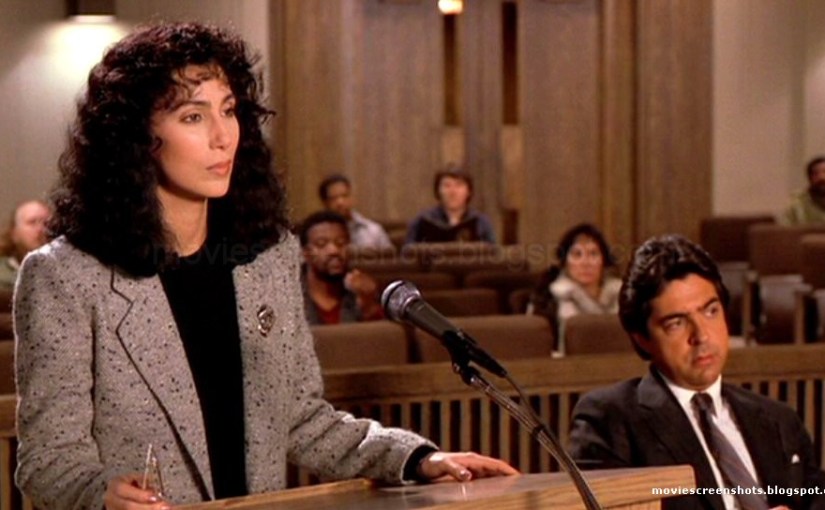
Cher plays a public defense attorney named Kathleen Riley. Dennis Quaid is a handsome DC lobbyist named Eddie Sanger serving on the jury. Liam Neeson is the deaf mute title character who is a vagrant homeless person, and John Mahoney is the presiding judge aka the actual killer revealed at the end. Lawyer and juror meet up outside of court to find clues and eventually make out. The judge is the killer. People please!!!! Washington DC is not this effed up, is it? (Maybe don’t answer that.)

Frankly, Kathleen is not a very good attorney. She’s not aggressive enough with her objections and I don’t think she applies herself well enough to win her case. In fact, without Eddie’s self motivation to dig into the case himself and help her out, then this suspect (Neeson) doesn’t have a chance in hell of being exonerated. The victim, a political staff member, had her throat slashed. Kathleen doesn’t even consider if the killer is right or left handed? Really? Eddie did at least. Still, I’m okay with watching an inept lawyer in a movie. Too often, movies show us lawyers that are too brilliant and quick on their toes. They’re almost too brainy. So, okay yeah, I’ll accept a lawyer whose not the sharpest crayon in the box for a change of pace.

On the other hand, Mahoney, the actual killer, is easy to predict when he voluntarily takes this case and then rules against literally every objection that Kathleen brings up. Every single one! Plus it stands to follow Roger Ebert’s economy of characters. There’s only so many characters in your multiple choice of cast members to consider as the killer. I can’t fathom Quaid, the juror, as the killer, nor Cher the defense attorney. So either Neeson, the suspect on trial, is the killer (not likely because then why have a movie) or it’s the judge. Nah! It couldn’t be the judge. Could it? Hmmmm.

Washington DC makes for a great setting for legal thrillers or courtroom dramas. It’s full of secrets and government and dealings and politics. A million and a half motivations and any one of its residents could find a reason to kill. The script for Suspect, written by Eric Roth, never cares to try that hard though. We are treated to a wasteful side story of Eddie doing some lobbying for milk (I’m sorry. MILK? LIKE DAIRY MILK????) when he’s not in court. He sleeps with a congresswoman to get her vote…and why am I seeing any of this?

There’s no build up in the murder trial either. The few expert witnesses called to the stand are forgettable. Nor do they foreshadow anything. Cher’s character doesn’t seem to work hard enough in questioning a witness. Instead, this dumb lawyer relies on a juror she shouldn’t ever be talking to.

Once again, normally, it’s against my policy to spoil a film. After 40 years, I won’t even spoil The Empire Strikes Back, cuz someone out there still hasn’t seen it. However, this film is ridiculous. This would even be too ridiculous for a Maury Povich episode or a Lifetime TV movie. How absurd must one murder trial be?

Think about it. All in one movie. One murder trial. One case. The defense attorney is involved with a juror AND the judge is the killer????? There are odds….and then there are gazillion to one shots.