WALL STREET

By Marc S. Sanders

Oliver Stone is a very good director at providing the evidence of cynicism within the worlds he films.  JFK covered a clandestine, conspiring environment oozing out of the columns of government.  Platoon not only depicted the horrors of war, but also the cancer that poisons the mentality of soldiers expected to protect one another.  Wall Street explores the temptations to cheat the stock market for grand prizes in wealth.  Gordon Gekko is the 1980s tycoon who never knows the meaning of enough.

The well-dressed yuppie lizard, Gordon Gekko, is memorably played by Michael Douglas in his only Oscar winning role; regarded as one of the most villainous characters of the last fifty years.  It’s not a modest part, and Douglas’ performance is therefore electrifying.  With slicked back hair, the signature crackle of a voice inherited by his father Kirk, and the newest 80s innovation, a brick size cellular phone, the power to earn money and crush corporate enemies is done with ease.  Gekko relies on obtaining inside information (a federal crime) to find the next chest of treasures.  It might be an illegal practice but the best of the best at making mountains of money do it, and if you keep your process on the down low, nobody will catch wind of what you’re up to.  Gordon Gekko is an absolute genius, and he’s awarded a script of fast talking, slick monologues that justify his sins.

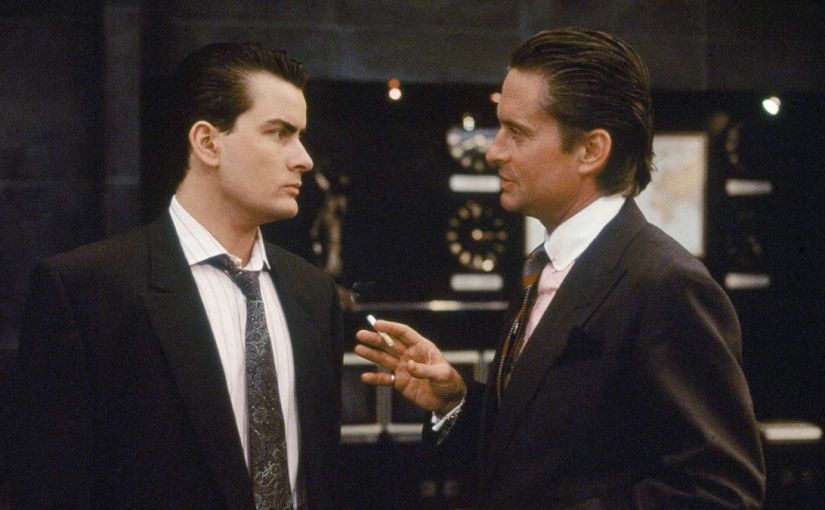
Bud Fox (Charlie Sheen) is the kid on the ground, way below Gordon’s high-rise office, desperately trying to get five minutes with the guy.  A whole day’s wait in the lobby and a birthday gift of Cuban cigars does the trick.  Now the lizard has the fox ensnared in his money-making schemes of deception and pursuits for unlimited greed.

Oliver Stone writes Sheen’s character as virginal when it comes to stock trading.  The kid is dying to get laid with the big boys while getting away from the cold calling hang ups of promising uncertain futures in stocks and bonds.  A subtle and effective angle is to give Bud a mentor.  Hal Holbrook enters the screen from left or right on many occasions to put his hand on Bud’s shoulder and give him his own twist of Confucius philosophy.  Then he exits out of frame towards the opposite direction he enters, leaving Bud to follow the questionable paths that Gordon paves.  Holbrook’s contribution to Wall Street has never been celebrated enough over the years.

Michael Douglas and Charlie Sheen are an outstanding pair of devilish mentorship against innocence lost.  Gekko preaches his passion for wealth on top of more wealth and why nothing should stand in his way, especially the law or the cost of others’ livelihoods.  Bud Fox emulates him as a master of the universe.  Charlie Sheen is great at being the biggest fan in Michael Douglas’ concerts of monologues. Watch how Sheen listens when Douglas has the floor. 

Martin Sheen extends his paternal role to Charlie within Stone’s film.  As Gordon sets designs on taking stock ownership of the small airline company that the father works for, the father/son relationship is tested, and Bud becomes blurred between what is right and wrong.  The Sheens have good debates and heightened dramatic moments.  I wish they were given more to do together though.  Perhaps even showing the wedge of the mother role within this family.

Additionally, Oliver Stone writes dynamics for Bud in a worker relationship with a fellow trader colleague (John C McGinley). There’s a former college pal/now lawyer (James Spader) that Bud tries to squeeze at the behest of Gordon’s demands.  Bud is also covered doing his own tricks of the trade such as dressing as a janitor to dig for what’s forbidden.

Why bring up all of these storylines?  Well, there’s a wealth of great material in Wall Street that’s relevant to the practice of insider trading and corporate overhaul.  Somehow though, Oliver Stone is responsible for writing one of the most unnecessary characters in film history.

Daryl Hannah just had to be cast as the buxom blond love interest for Bud Fox.  She’s never believable as a New York City interior designer and the chemistry between Hannah and Sheen is as thin as water.  Her name is Darien (a 1980s name) and one scene between Michael Douglas and her bustling the streets of Manhattan goes nowhere.  Wall Street is simply not the superb film it could have been because of the amount of time devoted to Daryl Hannah’s character.  Every moment she occupies is cutting room floor material.  When Darien exits the picture she’s never mentioned again.  The history she has with Gordon is never revealed to Bud.  Regrettably, it’s all meaningless.

What’s frustrating with Wall Street is its promise is never fully committed.  The roles awarded to Spader, McGinley, Holbrook and even Saul Rubinek in an early role as Gordon’s nerdy lawyer could have been even more fleshed out in lieu of what is covered with Daryl Hannah’s part.  More moments with Martin and Charlie Sheen would have better served the film.  A competitor tycoon played by Terence Stamp is very interesting and worthy of a larger presence.  Sadly, I imagine a studio producer or even Stone insisted on having a love interest that serves no purpose here except to put a glamorous actress above the title in the credits.  

Nonetheless, Oliver Stone built an authenticity to the hysteria of stock trading and corporate underhandedness.  When he shoots the scenes occupied by Bud and Gordon, he does handheld shaky camera work to emulate that nothing feels sturdy and balanced.  In moments that Bud’s father is at the center, the director shoots with a locked in position, bearing the character’s assured apprehension to trust his son or this prophet of greed.

I especially like the scene where Michael Douglas delivers his famous “Greed…is good!” speech at a shareholders’ annual meeting.  Stone glosses over all the company vice presidents and officers as well as the fat cat suits who carry stakes in the company.  Yet, the filmmaker also takes the time to show that little old lady with the pocketbook who finds her entitled seat to see how the value of her small ownership share is being treated.  Remember, if you own stock like Disney or IBM, you get that invitation in the mail to attend these meetings, and you have just as much a right to attend as all the Gordon Gekkos of the world.

Wall Street serves an important reflection of 1980s capitalism, while taking place in 1985, two years ahead of the infamous market crash of 1987 (the year the film was released).  Guys like Bud Fox had the Charlie Sheen image. Boyish men who got rich quick with little imagination to create and build.  They stood next to tall wealth and learned, but they never gained the knowledge to prepare for quick falls and disheartening sacrifice.  Most importantly, they took their own sense of morale for granted.  These are the best parts of Wall Street.
SCARFACE (1983)

By Marc S. Sanders

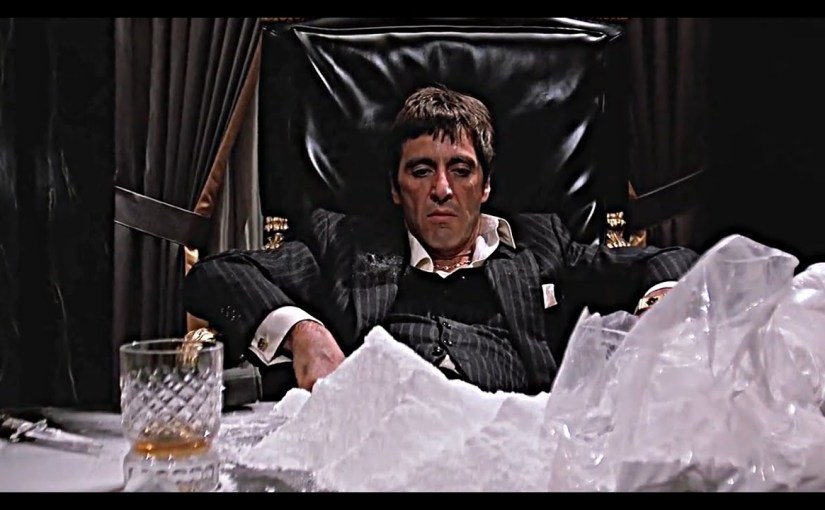
On Thanksgiving Day when we glutton ourselves with an abundance of food, it seemed highly appropriate to watch one of the most self-indulgent pieces ever put on film.  Brian DePalma’s Scarface with a script written by Oliver Stone and featuring Al Pacino.  This is a movie that brags about its boastfulness.  I mean look at everything that is mashed into this thing.  Blood, bullets, lots of cocaine and too much Al Pacino.

Pacino is Cuban refugee Tony Montana.  He is one of a handful of small time criminals who is shipped over to the United States when Castro wanted less people to oversee.  Refugee camps are fenced up under the highways of Southern Florida where no law is enforced among the tented populations.

Soon after Tony arrives he’s hot on the scene of pushing the newest underground product through Miami – cocaine.  With his buddy Manny (Steven Bauer) the two men get in good graces with a well dressed sleaze named Omar (F Murray Abraham), who is second in command to an established drug kingpin named Frank (Robert Loggia).  For Tony and Manny it’ll only be a matter of time before they take over as the numbers one and two bad guys.  That’ll include Tony marrying Frank’s blond trophy girlfriend Elvira (Michelle Pfeiffer in her breakout role) and winning a trusting partnership with a South American drug czar named Alejandro (Paul Shenar).  If you ever expect to get killed, you don’t want to be by the orders of Alejandro.  A helicopter serves much more of a purpose once it takes flight.

Scarface is a step-by-step movie or a climb up a three-hour ladder and then a gradual drop down off a balcony into a bloody fountain below.  There’s no depth and it works like a shopping list that you check off as it moves along. Props and houses and suits and jewelry and cars and cocaine and cash have more significance than what anyone has to say. Other than Tony, none of the people in this film matter. What Tony acquires and what he says about himself is all that is important.

This is a big ass movie with bloody graphics and killings, mountains of drugs and money, a lot of fucks, a gaudy estate home, a way over the top Al Pacino and lots and lots and lots of bullets and guns to go with them.  The film only settles for one chainsaw killing, though.  At the time, I recall that scene was up for big debate on the film’s MPAA rating.  Brian DePalma wanted to up the ante on brutality to grab moviegoers’ attention.  The scene remains quite stomach churning.

DePalma’s best work is at the beginning of the Scarface.  Following the establishing real life footage of the Cuban refugees arriving by boats in search of an American dream, Tony is taken into custody and questioned by a batch of immigration agents.  DePalma only keeps one steady camera focused on a very tan Pacino with a faint signature scar on his left cheek, sitting in the middle of the room and putting on a Cuban accent that only he could uniquely own.  Pacino’s concentration in this moment is admirable as he responds to questions from all different directions.  It’s all done in one take with the director’s camera circling around Pacino.  After this introduction is over, the tone of the movie changes for the next two hours and ten minutes into a gritty interpretation of Lifestyles Of The Rich And Famous.

Oliver Stone’s dialogue with Brian DePalma’s set ups don’t require much of the other actors.  It’s like everything caters to an always inebriated, hyperactive Al Pacino doing his Tony Montana with the gold chains and wide collared shirts over the linen suits.  He’s a motor mouth of endless f-bombs, with a slinky Michelle Pfeiffer in a blond bob-cut, dressed glittery evening gowns, at his side.  She has nothing of significance to say.  This is all you learn about Elvira; what you see of her materialism and all the coke she snorts.  She never smiles or exudes any connection to the Pacino character.  It’s all eye candy.  In fact, there’s never a clear answer of what becomes of this character.  That’s a problem because the movie is so much about Tony Montana, nothing else matters.

Other characters not given enough attention are Tony’s sister Gina (Mary Elizabeth Mastrantonio) and their mother (Miriam Colon).  Momma despises Tony for the criminal thug he is while Gina becomes enamored with the wealth and drug night life.  Unfortunately, Momma only has one meaty scene and Gina’s purpose to the script is to lend reason for another character’s eventual demise.  Both of these actresses are very good with what little they have.  Yet so much is devoted to Tony’s indulgence and the mania that Pacino brings that they are sidelined as well.

Brian DePalma seems to be more proud with how excessive he can make this guy than actually turning him into a guy.  Wait until you see the mansion that Tony gets. His office alone is of black, gaudy exuberance. His master bedroom contains a small swimming pool size tub right in the middle of the carpeted floor.  That setting occupies a fifteen-minute-long scene of Tony in a bubble bath, watching his five TV screens while not talking about anything meaningful except himself as he chastises Manny.  Elvira is only there to uphold her dread for her husband as she snorts coke off of her vanity.  When they both leave, an Oliver Stone monologue ends with a now recognizable sound byte of “Well say ‘allo to da bad guy!” Ah! Big deal! Tony never seemed so bad ass as he does feel obnoxious.

Again, Scarface is about not much else except the conceit of sleazy criminal.

When someone has to die it becomes a long drawn-out process as Tony, aka Pacino, puts on a performance or delivers a sermon.  Tony will meet with kingpins from Columbia along with other South Americans and dirty government officials.  There will be 5-7 guys in the room but for the most part it is only Tony talking.

“Say ‘allo to my little fren!” is one of the most memorable lines to come out of the 1980s decade of excess and it arrives during the ongoing and endless bloody shootout that closes the film.  There’s buckets of blood and truckloads of ammunition fired off.  These machine guns seem designed to kill things twice the size of elephants.  Little Al Pacino, with a ginormous cannon gripped in one hand, gets hit in all places and extremities except the head so that he can keep ranting – I mean this guy never shuts up – and going as he fends off the armies of goons coming at him from all directions.  Truly, it’s laughable and nowhere is it ever absorbing.  It’s like I’m watching someone else play a first-person shooter video game during a sleepover.  My friend is entertained while I’m just watching him be entertained.

Scarface comes to an abrupt halt when the final shootout stops.  There’s no footnote to ponder or real news story to follow up on.  The credits roll and the orchestral strings of the soundtrack cut in. You get the idea that DePalma, Stone, and Pacino became exhausted over this monster of a movie and simply declared “Okay! That’s enough!”

Considering the later insightful pieces that Oliver Stone delivered like Platoon and JFK, I wish he explored more of the politics and Cuban dealings affecting the United States.  As this film arrived in 1983, soon after there would be more of an intellectual standpoint to make us aware of a very real drug epidemic in this country.  It may appear to be sending some kind of message, but Scarface doesn’t challenge the brains that flourished this contraband industry.  Forty five minute episodes of Miami Vice tell more than this three-hour opus.

Plenty of gangster films like Chinatown, The Godfather, and Goodfellas offer up the greed and ego of the criminal mind, but the men of those pictures are never as self-indulgent or off putting as Tony Montana.

Besides, what does it say about a movie called Scarface when no one calls the main guy Scarface, and you hardly ever see the scar graced across his profile?  The real Scarface, Al Capone, would be very disappointed in Al Pacino.

BORN ON THE FOURTH OF JULY (1989)

by Miguel E. Rodriguez

DIRECTOR: Oliver Stone
CAST: Tom Cruise, Kyra Sedgwick, Raymond J. Barry, Jerry Levine, Frank Whaley, Caroline Kava, Willem Dafoe
MY RATING: 7/10
ROTTEN TOMATOMETER: 84% Certified Fresh

PLOT: A biography of Ron Kovic, a fiercely patriotic Marine who fights in Vietnam, is paralyzed in battle, and experiences a dramatic turnaround upon his return home.


I can already tell this is going to be a difficult review to write.

There is nothing overtly wrong with Oliver Stone’s Born on the Fourth of July.  It is expertly directed, and the pacing never flags.  Tom Cruise’s Oscar-nominated performance is deservedly legendary; he leaves nothing in the tank, a fierce rebuttal to critics who thought he was nothing but a pretty face.  But even though there is much to admire, when the closing credits rolled, I felt oddly detached.  The movie kept me at arm’s length from really engaging with the lead character.  Or maybe I kept the movie at arm’s length.

Could it be that I simply don’t care for Vietnam films anymore?  Not likely.  One of my absolute favorite films is Michael Cimino’s masterpiece The Deer Hunter.  In fact, the opening scenes of Born on the Fourth of July are reminiscent of that earlier film in that it takes its time establishing the main character, Ron Kovic, as a young man in the early-to-mid 1960s at the dawn of the Vietnam War.  Born and raised in Massapequa, New York, his strict Catholic upbringing and his devotion to high-school wrestling instill a strong sense of right and wrong in the world.  A point is made about how America had never lost a war up to that time.  Kovic’s wrestling coach exhorts him and his teammates as if he were a Marine drill instructor.  “I want you to kill!  You hear me?! …You got to pay the price for victory, and the price is sacrifice!!”  It’s not very subtle, but Stone is making it clear that, in those days leading up to the Vietnam quagmire, the American credo was, “Winning isn’t everything, it’s the ONLY thing.”

Kovic enlists, sees combat, and during two horrific sequences, he experiences: an unintended massacre of Vietnamese civilians, the accidental shooting of a fellow soldier (with Kovic himself behind the trigger), and a fateful gun battle during which a bullet went through his right shoulder, collapsing a lung and severing his spinal cord, paralyzing him from the waist down.  These scenes are appropriately skittish and terrifying, putting us in Kovic’s boots and making us feel the unimaginable stress of fighting a war where half the time you weren’t sure who or what you were shooting at.  Kovic is shipped stateside…and here, as they say, is where his troubles REALLY began.

If the scenes set at the VA Hospital during Ron Kovic’s convalescence weren’t based on his actual experiences, I would denounce them as sensationalistic and manipulative.  Rats roam free among the beds.  (A nurse provides spectacularly unhelpful advice: “You don’t bother them, they ain’t gonna bother you.”)  Orderlies spend their down time getting high on marijuana or worse.  Unchecked catheters get backed up.  When a vital blood pump malfunctions, a doctor has to go to the basement to “rig up a substitute.”  And through it all, Ron Kovic does everything in his power to prove to the (correctly) pessimistic doctors that he will walk again, even re-injuring himself in the process.

(It’s futile, I know, to critique a film for what it’s not instead of what it is, but I can’t help wondering if I might have developed a more emotional reaction or attachment to the film if the entire film had focused on Kovic’s tenure at the VA hospital…although I will admit that would be a thoroughly depressing film.  Also, it might have developed some unintentional similarities to One Flew Over the Cuckoo’s Nest.  Who knows.)

The rest of the film details Kovic’s return home to his family, his emotional swings between the lowest kind of depression (“Who’s going to love me, Dad?  Who’s ever going to love me?”) and angry shouting matches with his parents and occasional bar fights.  Eventually, Kovic has a revelation: he still loves his country, but he can’t stand the government that sent him and his friends halfway around the world for a cause he no longer understands.  After a short hiatus in Mexico (I won’t get into too many details about that plot point because it’s the one section of the film that borders on boring), he returns home and dedicates his life to speaking up for the men and women who returned from Vietnam to a country that, at worst, hated them, and at best, simply didn’t care about them.

Again, the film is a stirring portrait of a man and a life.  However, as much as I want to, I can’t pin down what it is about the movie that failed to reach me at the kind of emotional level that other biographies have done before.  I just recently watched My Left Foot, with Daniel Day-Lewis’s towering performance at its center.  Another film biography, another main character confined to a wheelchair, a character who comes to terms with himself and how the world responds to him and comes up with a way to respond to the world.  But My Left Foot made my heart soar in a way that Born on the Fourth of July never achieved.  I watched the movie intently, focusing on every plot development and every nuance.  But it just didn’t grab me.  I am at a loss to explain why.

Could it be because of the presence of Tom Cruise in the lead role?  He showed these kinds of acting chops again ten years later in Magnolia, giving another Oscar-nominated performance.  In that movie, he completely disappeared into the role, despite having one of the most recognizable faces on the planet.  Perhaps the younger Tom Cruise (only 27 at the time) emits the kind of wattage that overshadows those around him?  So that you’re aware of the face first and the character second?  Maybe.  So why doesn’t the same thing happen in Magnolia or even The Last Samurai?  Perhaps it took him ten years to find a way to modulate or customize his performance so that, when it counts, the character comes first and the Cruise persona second.

I’m speculating.  The bottom line is, Born on the Fourth of July is a worthy addition to the resumes of both Oliver Stone and Tom Cruise.  It knows the story it wants to tell and resolutely sticks with it the whole way.  There are no sidetracks at any time, not even when he becomes an activist.  The focus is always on Ron Kovic, not the cause.  Stone and his screenwriters trusted that the story of Ron Kovic would draw enough attention to the cause on its own.  That approach would work with just about any other film.  This time, it had the effect of diluting the emotional experience while still holding my attention all the way through.  I would still recommend it to anyone who hasn’t seen it, if for nothing else to see Cruise play a role where he gets to sound notes he rarely got to play in his early career.  Would I watch it again?  Maybe.  I think the story is important enough for me to try to see what I might have missed this time around.

TALK RADIO (1988)

by Miguel E. Rodriguez

DIRECTOR: Oliver Stone
CAST: Eric Bogosian, Ellen Greene, John C. McGinley, Alec Baldwin, Michael Wincott
MY RATING: 8/10
ROTTEN TOMATOMETER: 82% Certified Fresh

PLOT: A rude, contemptuous talk show host becomes overwhelmed by the hatred that surrounds his program just before it goes national.


Oliver Stone’s Talk Radio is entertaining and, at times, mesmerizing without being an altogether enjoyable experience.  I salute the craft of the film and the bravura performance by Eric Bogosian, reprising the role he created on Broadway, but despite my high score, I’m not quite sure to whom I would recommend this film.  I believe it’s an important placeholder in Stone’s filmography, coming as it does after Wall Street and before Born on the Fourth of July.  It shows immense faith in the material and portrays its characters with brutal honesty.  The closest comparison I can make is to the Safdie Brothers film Uncut Gems.  Both films are fraught with tension, featuring unlikable fast-talking main characters who tend to step on or over or around the people closest to them to achieve their goal, or sometimes just to get their own way.  They’re fascinating to watch and listen to, but I would not want to be stuck in an elevator with them.

Talk Radio centers on a Dallas radio shock jock named Barry Champlain.  Bogosian’s look and performance seems so closely modeled on Howard Stern that I’m surprised Stern didn’t sue the filmmakers for not obtaining his permission to do so.  (In fact, the Barry character is modeled after real life talk show host Alan Berg, who was gunned down by an ultra-right-wing group in 1984.)  The whole first “act” of the film takes place in and around the broadcasting booth where Barry holds court, listening to and berating callers from all walks of life on topics ranging from “I Love Lucy” to the war on drugs to Holocaust deniers to one dude who eats dinner with his cat every night.  If nothing else, this sequence boosted my respect for anyone in Barry’s line of work.  To be able to take calls from random folks with random issues, and to somehow spin their questions or problems into a mini-monologue or diatribe that manages to entertain or offend – usually both – the caller or the listening audience – usually both – is a skill I will never possess.  (Bogosian’s voice is tailor-made for the role, a nice sweet-spot baritone that sounds as if he’s been doing radio for years.)

Mixed in with the calls are the ones from clear-cut racists, warning Barry that they know where he lives, that they know “Champlain” is not his real last name, calling him Jew-boy and “f—-t”, sending him packages in the mail and claiming they’re bombs.  One loathsome item is sent to him wrapped in a Nazi flag.  Other callers don’t seem to have any affiliation at all aside from their utter hatred of Barry Champlain.  There’s a scene where Barry has been invited to a public event to introduce someone.  The moment he takes the stage, there are a few cheers that are eventually drowned out by a sea of boos and jeers in concert with a hailstorm of food and garbage thrown by the audience.  Barry has the nerve to look a little shocked.  I remember thinking, “How can you not expect this kind of reception?”

But then I remember thinking, about the audience members this time, “Well, if you hate him so much, why are you listening to his show?”  The movie is making a statement about the bizarre relationship between the general public and entertainment celebrities that they “love to hate.”  It seems to me their lives would be infinitely happier and less angry if they just switched over to NPR or smooth jazz once in a while.  No one forces them, or anyone, to engage with a TV show or movie or radio show or anything else they don’t like.  But with Barry, and presumably many other shock jocks in real life, people seem to need them, to use them as an excuse, I guess, to get riled up, to feel fueled by righteous anger.  The shock jocks are handy targets, especially because the callers can remain anonymous, much like social media.

There is a long rant from Barry himself about this phenomenon late in the film.  There was a plan for his show to go national, but it has been derailed for nebulous reasons, and so a broadcast intended for the entire country is still confined to the Dallas area.  After an ill-advised guest appearance by a stoned idiot (Michael Wincott!) and a couple of calls that go completely off the rails, Barry loses it and tells his listeners:

“You’re happiest when others are in pain.  That’s where I come in, isn’t it?  I’m here to lead you by the hands through the dark forest of your own hatred and anger and humiliation.  I’m providing a public service. … I come in here every night, I tear into you, I abuse you, I insult you, you just keep coming back for more.  What’s wrong with you, why do you keep calling?”

In another movie, that kind of rant might skew towards comedy.  Here, it serves as a painful peek into the psyche of a man who has a job that he’s good at, but there’s a part of him that despises himself for it, and that self-loathing has overflowed the boundaries of his own soul onto and over his listeners.  Even he can’t understand what his audience is thinking. I found myself wondering if any other shock jocks out there might feel this way.  I wonder if this might be one of Howard Stern’s favorite movies, or if it was one of Don Imus’s favorites.  I have never listened to either one of their shows because…well, because that’s my right as a human being.  But I wonder, nevertheless.

As I said before, I admire the craft of the film.  Stone and his collaborators (especially cinematographer Robert Richardson) do a great job with creative camera angles, lighting, and editing for those long stretches of the film where we simply sit and listen to Barry Champlain talking to that endless stream of callers.  Most of those calls end threateningly or are threatening throughout.  This has the effect of creating tension almost out of thin air, a tension that suffuses the entire film.  Are we going to get a maniac who takes Barry hostage on the air?  When Barry unwisely invites a listener to come down to the station and appear on the air, we’re thinking, “You idiot, he’s going to kill you!”  Even if none of that happens, we’re worried about it the entire time.  While this method is an effective use of cinema, as I said before, I cannot honestly say I had a “good time” watching it.  When the ending comes and the final credits roll, I will carefully say that there was a sense of relief, not at how it ended, but just relief that it ended.

Talk Radio is a well-made film featuring a stellar performance from Eric Bogosian.  If you sit down to watch it, I believe you will feel exactly what Oliver Stone meant for you to feel.  Just don’t expect it to tickle.

JFK – DIRECTOR’S CUT

By Marc S. Sanders

Oliver Stone’s JFK is told through perspective, not necessarily history.  It’s not a biography and I do not believe Stone would ever claim it to be so.  It’s a thinking person’s picture that gives viewers entitlement to question what occurred, how it occurred and why it occurred.  It might guide you not to trust what anyone says, sees or hears, but let’s face it.  Probably the day Kennedy was shot, November 22, 1963, could we ever completely trust anyone ever again? 

(Forgive my cynicism.  I must backtrack a little.  I still trust my wife and daughter.)

Oliver Stone works through the eyes of New Orleans Prosecutor Jim Garrison (Kevin Costner, in what may have been his most challenging role to date at the time).  Garrison sees a little too easily that there are circumstances out of place, or maybe too neatly in place to satisfy the ultimate resolution that a known American defector to the Soviet Union, like Lee Harvey Oswald (Gary Oldman), acted alone in the assassination of the President.  Stone wrote the script for JFK with Jim Marrs and used Garrison’s input from his own novel. Nearly every scene builds into another possibility of how that fateful day came to be.  Stone even questions if a famous photo of Oswald on the cover of Life Magazine is real.   Too many cover ups with a building list of body count witnesses and too many coincidences keep Garrison up at night.  So, he assembles a crack team of investigators and fellow attorneys to reopen the case and question the official Earl Warren Commission.

Firstly, JFK is magnificent entertainment with a hair raising and unusual original score from famed film composer John Williams.  His notes on percussion with dings and harpsichord strings cue in at just the right moments when Stone introduces another one of many scenes that point out what seems cagy and suspect. The music of JFK works as a narrator.  This narrative keeps you alert.  Maybe you should look in each corner of the screen at times for some subtle clues.

It was also wise of Stone to go with a well-known cast of actors.  The Oscar winning editing from Joe Hutshing and Pietro Scalia moves at a breakneck pace.  Yet, because I recognize fine performers like Ed Asner, Jack Lemmon, Kevin Bacon, Tommy Lee Jones, Brian Doyle-Murray (Bill’s brother), John Candy and Joe Pesci it is easy to piece together who is playing who and what significance they lend to the many theories Garrison and Stone question next.  

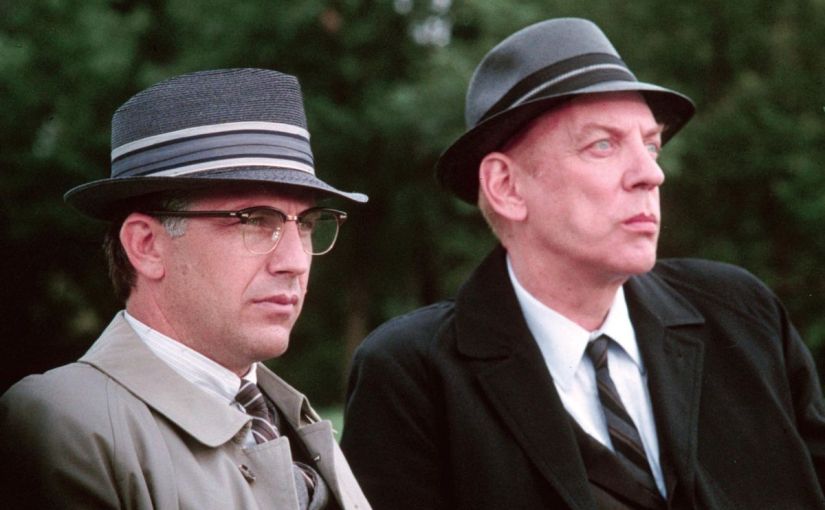
My admiration for the casting continues with the Garrison team that performs with Costner – Michael Rooker, Laurie Metcalf (especially impressive), Wayne Knight, and Jay O. Sanders.  There’s also a clandestine trench coat guy named X portrayed by Donald Sutherland.  Who even knows if this guy ever existed?  He’s more secretive than Deep Throat, but Mr. X has a hell of a lot of information to justify Jim Garrison’s suspicions.  That is an especially marvelous sequence between two men strolling through Washington D.C., eventually concluding a disturbing realization on a park bench.

Sissy Spacek brings out another dimension to the Jim Garrison character.  She’s his wife and the mother of five who suffers the loss of her husband’s attention which is entirely focused on this compounding investigation.  I like Costner’s take on the Garrison character.  Early on he politely asks one of his associates to stop cursing.  He does not like that kind of talk.  Later, it is Garrison who is dropping a number of eff bombs in front of his wife and young children.  This conundrum of a case, a very puzzling detective story, is unraveling the investigator. 

JFK was instrumental for further Congressional consideration following its release.  Files were reopened.  Additional research was executed, and soon many of those secret documents pertaining to the assassination will be revealed in 2029.  Back in 1991, of course that appeared to be a lifetime away.  It’s time we know everything, though.  Arguably, most of who were involved in this incident are dead by now.  Let us know our history.  Still, Garrison was bold enough to point skepticism at not just the adversarial relationship Kennedy may have had with Castro, the Cubans and their Communist allies, but also the people within the CIA and the FBI.  Lyndon Johnson is not even free from scrutiny after he’s sworn in.  Some on Garrison’s team went so far as to factor in culpability from the mafia.  Garrison was not so keen on that theory, actually. 

The construction of Oliver Stone’s film is unparalleled.  I think it’s his best film to date and I can find few others that even compare to how he assembled the picture.  It begins with the voiceover of Martin Sheen laying out many news cycles that were occurring ahead of Kennedy’s murder such as the Bay Of Pigs and the President’s supposed efforts to withdraw from Vietnam.  Sheen’s narrative comes at you very fast with Stone incorporating real life home movies of Kennedy along with his brother Bobby, as well as Castro, and television news footage from Vietnam and anywhere else events were happening.  By the end of the roughly five-minute opening, your head might be spinning. 

Thereafter, though, Stone goes through Garrison’s day on November 22, 1963, watching the outcome following the momentous event and the writer/director works his way into the drama beginning with Asner and Lemmon as two drunk old guys walking through the rain and getting into an argument. 

Three years pass by and so begins Jim Garrison’s motivations to follow multiple trails of breadcrumbs that lead to a lot of different places, all unlike what Earl Warren surmised. 

The scenes work quickly from that point on, and cuts of theoretical reenactments occur.  Who knows if any of these scenes are factual?  Stone and Garrison want you to at least consider their reasonable likelihood.  Moments happen where Joe Pesci and Tommy Lee Jones’ characters appear to be lying about even knowing one another while Stone will depict a sexual role play encounter between them which also includes Kevin Bacon as someone with no more reason to lie. 

Episodes are deeply focused on Lee Harvey Oswald depicted as an infamous and suspected patsy in association with others who may have a reason to want Kennedy dead.  Gary Oldman hides so well in the role.  Oliver Stone even lends focus to how different witnesses describe Oswald.  In some scenes it is Oldman, but then there are other times where a shorter, more overweight man may have been the real Oswald. Later, there’s an Oswald who is taller and more slender. 

A few years ago, I was visiting Dallas, and I was able to spend a some time walking around the crossroads where Kennedy was shot in the convertible while seated next to his wife Jackie.  Watching JFK again lent more clarity to all of the locales such as where Oswald was supposedly shooting from the top floor of the corner book depository.  Kevin Costner and Jay O. Sanders go through the motions of Oswald firing the three shots from his rifle in the short amount of time span.  The script also questions why Kennedy was taken out by Oswald after the turn off the corner of Elm and Houston. There appears to be a better wide-open clear shot long before the turn with the car only going ten miles per hour.  The men question if it was Oswald, then why didn’t he take advantage of the clearer shot.

I know.  I could go on and on.  I have to stop myself.  There’s a ton – A TON – of information in JFK.  It becomes addicting to watch.  You don’t even want to pause the long film for a bathroom break.  I watched the extended Director’s Cut by the way. 

Many common critiques of JFK lean towards how many of these scenes did not even happen.  People are happy to point out there’s no evidence to truly say any of Oliver Stone’s enactments occurred.  I agree, but that’s not the point of this director’s piece.  This is primarily told through the eyes of Jim Garrison.  Kevin Costner is great as the listener, the observer and especially at the conclusion, the describer.  Watch him physically respond to anyone he shares a scene with.  There’s a memorable twitch he offers while at the scene of the assassination that works perfectly with a jarring echo of a gunshot edited into the film.  He’s also great at turning his head down as the thinker while Mr. X lays out an enormous amount of information that comes from several different directions.  Because the film comes from Garrison’s perspective, it does not have to be true.  It only has to be what the investigating prosecutor reasonably believes, and what he absorbs from suspects, witnesses, and his devoted team. 

A final speech of Garrison’s is told at the trial of suspect Clay Bertram, aka Clay Shaw (Tommy Lee Jones), who was the only man tried by Garrison for Kennedy’s murder.  First, it’s important to note that during this fifteen-minute sequence, when Stone cuts back to Garrison in the courtroom, Costner is wearing different suits.  So, while it is assembled as an ongoing rundown, it is not meant to all be in one instance.  Garrison lays claim to an endless amount of possibilities and circumstances that at times have no correlation with each other but could possibly all merge together towards November 22, 1963.  Critics argued this speech of Garrison’s never took place.  That’s correct.  However, this is a movie and for the efficiency of information to come out, a funnel must be opened up to learn what is being pursued and what has been uncovered.  This is the strategy that the script for JFK adopts and it works, leaving you thinking and rightfully doubting what our governing bodies and history books have told us.  Most famous of all of these nonsensical happenings delivered by Garrison is the “Magic Bullet Theory” made extra famous by Jerry Seinfeld with Wayne Knight on the comedian’s sitcom.  It’s silly but it is also a response to the impact that came from JFK.

JFK has a very glossy appearance from the Oscar winning cinematography.  Reflections and natural glares come off of Jim Garrison’s glasses.  The exasperation, along with the shiny persperation of John Candy’s sleazy lawyer character is undeniably noticed as his integrity is being questioned.  Staged reenactments are shown in black and white, clear color or grainy distressed output (such as recreations of the known Zapruder Film).  Nothing is clear about what led to Kennedy’s murder.  So, Oliver Stone’s filmmaking team will ensure that nothing should look consistent.  There are no straight answers; only endless amounts of reasons to ask another question after another.

Oliver Stone does not make JFK as complex as some will have you believe.  It’s quite easy to piece together who represents what in this story.  Many theories are offered at lightning speed, but they hardly ever intersect with each other until a probability is completely laid out on the table and then the film moves on to the next one.

JFK may have a long running time and a large cast with a lot to say and ask, but it’s an exhilarating thrill to behold.  Who knows what is true?  The importance of Oliver Stone’s masterpiece demonstrates that much of what we were told as truth may not consist of the entirety of facts. 

Again, question your governing bodies and ask the hows and whys and whos.  Oliver Stone reminds us that we have that right as the citizens of America. 

What really happened to our President, and who was really responsible?

PLATOON

By Marc S. Sanders

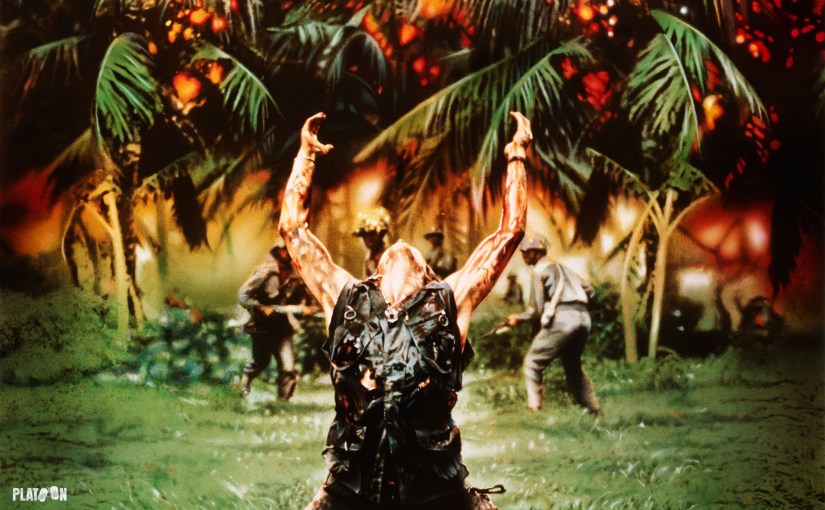
Oliver Stone’s Oscar winning Platoon takes place in the late 1960s, somewhere on the Cambodian border during the Vietnam War.  Many of the chaotic happenings the film presents are based on Stone’s own experiences after he voluntarily enlisted to fight.  However, while there is an unwinnable war occurring for the American troops, there is just as horrifying a battle going on within the ranks of the platoon the film focuses on.

Charlie Sheen echoes a lot of his father’s, Martin Sheen, voiceover narration, and performance in Francis Ford Coppola’s Apocalypse Now.  He portrays Chris Taylor, a college dropout who voluntarily enlisted for a one-year tour of duty to serve.  After only one week within the harsh, humid, and wet jungles, he’s writing his grandmother a letter asking what the hell was he thinking.  Chris is quite virginal to the harshness of war and that won’t work to his advantage when needing mentoring and support from his fellow soldiers.  The newest enlistees are the ones at the front point.  They haven’t devoted enough time to sit in the back and because of their lack of experience with war, they are not as valuable for the ongoing campaign in battle.  Platoon is not the heroics depicted in John Wayne movies.  This was one reason that Oliver Stone wanted to make this picture.  Platoon is a bitter retort to Wayne’s celebrated movie, The Green Berets.

There is an angel and devil flanking Chris in the form of Elias (Willem Dafoe) and Barnes (Tom Berenger).  Berenger is the cruel side of the conflict with his battle-scarred face.  He gives his underlings the impression that because he’s seen so much fighting and endured being shot seven times, that he must be invincible.  Elias is a fighting soldier, but he adheres to the rules of war and when it is time for rest, he joins his fellow troops in a unified vigil of drug-induced relaxation.  Chris warms up to Elias easily despite his initial fears of being a soldier with no experience or knowledge of how to survive, much less fight alongside his fellow men.

What drives the conflict between Barnes and Elias occurs following the first act of the movie.  The infantrymen come upon a Vietnamese village.  Some men, including Chris, get wildly abusive with the unarmed people, burning and pillaging their huts.  Only after Chris gets control of himself does he realize the wrongs he’s capable of by serving in this war.  He prevents a group of men from gang raping a child.  Furthermore, he witnesses Barnes commit the illegal murder of a defenseless village woman, shot at point blank range.  Elias has his bearings though and will file the proper reports when the opportunity permits.  Nothing in Platoon is easy though.  This war rages on and the possibility of an investigation and court martial is held off while the fighting continues. 

An interesting take on Oliver Stone’s direction is that he never really shows any close ups or lends any dialogue to the Viet Cong.  I believe Stone is confident that people know who our battalions were supposed to engage with.  However, as another favorite picture of mine stated (Crimson Tide), the true enemy of war is war itself.  The enemies of Elias, Chris, and Barnes as well as the rest of the platoon permeate within and among themselves and it lends to the chaos of the brutal combat scenes depicted in the film. Stone doesn’t offer much opportunity to see who any of the soldiers are shooting at or who is shooting at them.   There is much screaming and hollering but who are any of the characters shouting at and can they even be heard or understand what is being said amid the gunfire?  Platoon demonstrates that a Vietnam war picture is not one of heroics with grandstanding trumpets and a towering John Wayne who takes a hill.  War is disorganized, messy, and terribly bloody. 

This may be Charlie Sheen’s best film of his career.  As he represents the fictional account of Oliver Stone’s personal experiences, we see the trajectory of his change.  He is supposed to be there for 365 days, and he, along with his buddies, count down to when their tour will be complete.  However, this one short year will be the longest he ever encounters, and it will change him permanently, assuming he survives.  Chris is always tested of his tolerance.  He’s always subject to respond to how Barnes commands or how Elias mentors and leads. 

Oliver Stone is so convincing in his often-documentary approach to Platoon that it is at least understandable to see how the men in this picture behave and carry themselves.  Why do they refer to the Vietnamese as “gooks.”  Why do they bully with intent to commit rape.  Why do they quickly pounce to kill when for even a moment there is no threat.  Moreover, why they are willing to turn on each other.

They were never the decision makers for this conflict.  These soldiers are depleted of sleep and rest.  They are the pawns of a higher power, and they have been left to their own devices in a dense environment infested with bugs, snakes, unbearable humidity, and bodies that infest the waters and land while armed men appear out of nowhere ready to ambush.  Some ensnarements might occur within their own regimen.  None of these men are justified in their actions.  Yet, it is not hard to understand where their motivations stem from.  They are not programmed for heroics.  Keith David portrays a likable soldier who tells Chris that his mission is just to survive until he’s summoned home.  Survive among those you march and sleep with.  Outlast this hellish environment and overcome those that are trying to mow you down in machine gun fire.  Everything else around here is “just gravy.”  When you are an infantryman, you are not making a statement any longer.  You are not fighting for a cause anymore.  You are only trying to stay alive.

Platoon is such a shocking film of unconventional madness and turmoil.  Oliver Stone is relentless in the set ups he stages.  This picture came out in 1986, long before the strategic methods of the modern “shaky camera” approach.  It’s beneficial to watch the film as Stone must be positioning his camera on a track as the platoon hikes through the forest, parallel to his moving lens.  We are walking alongside them.   Early morning overhead shots depict the carnage of battles that occurred in the dark of night. Flares and sparks come from nowhere.  I think you could watch this movie ten times and still not know when to expect gunfire to intersect with the story or when the bombs to go off.  It’s hectic hysteria like I can only imagine these young men experienced before they spilled their blood on the battleground and either died right there or returned home physically and mentally crippled for life.

Platoon is one of the best and most frightening war pictures ever made.