FLASH GORDON (1980)

by Miguel E. Rodriguez

DIRECTOR: Mike Hodges
CAST: Sam J. Jones, Melody Anderson, Max von Sydow, Topol, Timothy Dalton, Brian Blessed
MY RATING: 2/10
ROTTEN TOMATOMETER: 83% Certified Fresh

PLOT: A hotshot quarterback for the New York Jets, an aviophobic travel agent, and a borderline-mad scientist try to save the Earth from the evil cosmic emperor Ming the Merciless.


I could try to intellectualize myself into analytical knots to explain why Flash Gordon is not a good film, but that’s not really in question, even to its fans.  Aficionados readily affirm its badness, its cheesiness, its willingness to go so far over the top it’s on its way up the other side.  That’s WHY they like it.  “I enjoy it for what it is,” a fan told me recently.

Well, after watching it for a third time, mildly against my will, I can easily say that I know and understand what Flash Gordon is, but I still can’t find it in myself to enjoy it the way so many others do.  I remember being amazed by it when I was 10 or 11, but that was a very long time ago, and watching it now gives me no more enjoyment than what I might get from eating a stick of Fruit Stripe® chewing gum.  I get a burst of flavor when I hear the iconic Queen score and/or theme song, but the rest is like chewing on a wad of overdone steak. That this movie came from the same director as the gritty Get Carter (1971) is flabbergasting.

Do I really need to summarize the story?  No.  I’m sure anyone who’s taking the time to read this has already seen the movie, so I’ll just assume we all know how cheesy the plot is.  I was informed by a fellow Cinemaniac that what we see on film is all taken from the first, and only, draft of the screenplay.  Brother, I believe it.

The only thing worse than the so-called dialogue is the quality of the so-called visual effects.  Now, I’m prepared to forgive low-quality VFX from older films when there’s a story I can care about, but when Flash Gordon’s filmmakers ask the audience to suspend their disbelief when a supposedly distant city is being bombarded by what looks like Roman candles, or any number of equally absurd VFX shots…I can’t do it.  I laugh, and not in a “I’m-having-fun” kind of way.

Before you ask, yes, there ARE bad movies that are SO bad that I actually recommend them to people simply BECAUSE of their badness.  Birdemic: Shock and Terror (2010), for example, which features a scene where the heroes are being attacked by a huge number of Windows Clip-Art.  Or the uber-terrible Troll 2 (1990), which gives new meaning to the word I just made up, “corn-ography.”  However, some films either cross an invisible line or fall short of it, I don’t know which, and are so bad that I can’t enjoy or recommend them.  For example, the infamous The Room (2003), which was such an unpleasant viewing experience that I didn’t even enjoy the movie about its making, The Disaster Artist (2017).

That’s where Flash Gordon sits for me.  It’s terribly cheesy and campy, but it’s either not cheesy enough, or it’s TOO cheesy, for me to enjoy myself while watching it.  There may be a cerebral, intellectual way for me to try to parse the reaction I have to it, but if there is, I can’t think of it.

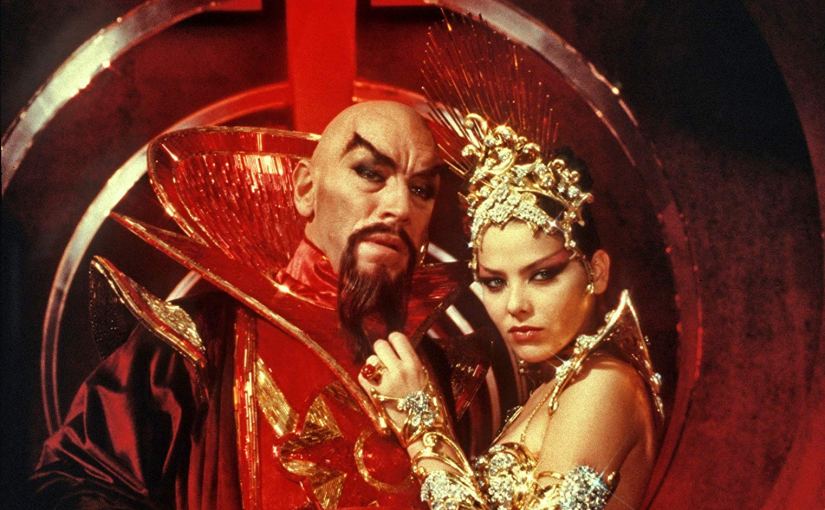
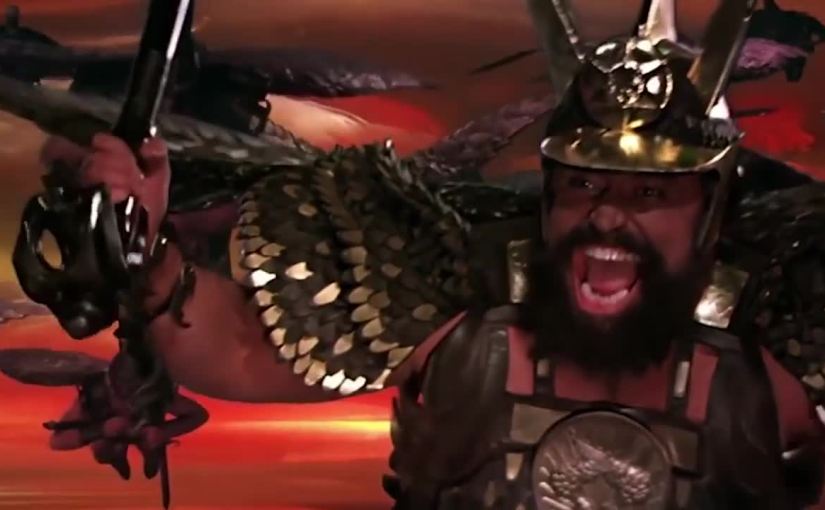
I will say that I thoroughly enjoyed watching one actor out of the entire cast, who seemed to be having way more fun than was needed or expected.  No, not Max von Sydow, whose sneering turn as Ming the Merciless is a master-class in remaining professional in the face of lunacy.  (Timothy Dalton deserves kudos for doing the same as the stoic Prince Barin.)  No, I’m referring to Brian Blessed as Prince Vultan, whose screeching battle cry will forever be stored in my memory banks: “Hawkmen…DIIIIIIIIVE!!!”  Examine his performance next time you watch the movie.  Look at his face, his eyes, the canyon of his mouth when he laughs.  There is a sparkle of delight that, to me, reveals someone who has realized the only way to stop himself from firing his agent is to go completely, full-blown, bull-moose gonzo.  Everyone else is playing it straight, or attempting to.  Brian Blessed is the only one who seems to be having any fun.  What a different movie this might have been if EVERYONE had taken his cue.  Alas.

To the fans of this film, I don’t apologize for my point of view, but I do admit to a tiny, VERY tiny, twinge of regret that I can’t see past its shortcomings enough to enjoy it the way its fan base does.  For me, it’s two hours of tedium enlivened only occasionally by a random chuckle or a smile when Queen’s music makes an appearance.  And by Brian Blessed’s manic smile.  DIIIIIIIIIVE!!!

[editor’s note: this review appears only by special request from the author’s best friend.  You’re welcome, Marc.]
GET CARTER (United Kingdom, 1971)

by Miguel E. Rodriguez

DIRECTOR: Mike Hodges
CAST: Michael Caine, Ian Hendry, Britt Ekland, John Osborne
MY RATING: 8/10
ROTTEN TOMATOMETER: 87% Fresh

PLOT: When his brother dies under mysterious circumstances, London gangster Jack Carter travels to Newcastle to investigate.


While watching 1971’s Get Carter (Caine, not Stallone), I was reminded of so many other later films that I began to wonder what gangster/crime films weren’t influenced by Get Carter.  Throughout the picture, I could see hints and whispers of Bugsy, Beverly Hills Cop, Carlito’s Way, and the John Wick franchise, among others.  I probably missed some.  Maybe I’m wrong.  Maybe those films weren’t paying homage to the best British film ever made (according to a 2004 poll), at least not consciously.  But its DNA is there for anyone who knows where to look.

(To be sure, Get Carter was itself influenced by earlier authors and films.  In very broad strokes, the plot of Get Carter resembles The Big Sleep.  In both films, a hard, cynical man tries to get to the bottom of a mystery that no one else is particularly interested in solving.  They both even involve pornography, though to be sure that was more implied in the older film, while in Get Carter we are left in no doubt.)

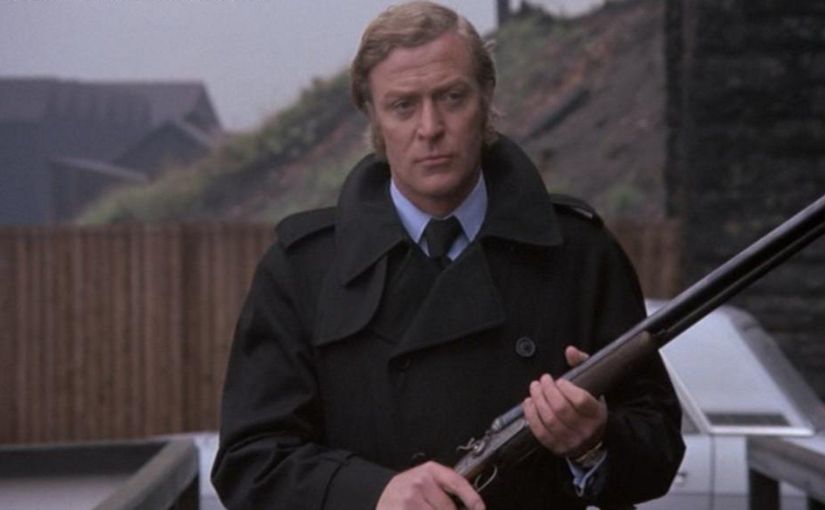
The tone of Get Carter matches its protagonist: cold, flat, uninflected, violent only when it has to be.  Michael Caine’s performance is a masterpiece of understated, simmering viciousness.  He only gets really angry a few times in the film, and he doesn’t smile, not genuinely, until the very end.  I read on IMDb that Caine’s intention was to show a more realistic, less sensational kind of violence than had been seen in earlier gangster films, “never using thirty punches when one would do.”

This is also an echo of a French film, Le samouraï, in which a professional killer shows absolutely no expressions the entire film, even with a gun in his face.  Carter is equally cool under pressure, as in the scene when he is surprised in the act of “lovemaking” (love has nothing to do with it) by two gangsters.  He registers surprise and little else, pulling a double-barreled shotgun from under the bed and, while stark naked, marching his would-be attackers out of the flat at gunpoint.  In a movie with little to no humor, there is a welcome double-take from the nosey next-door neighbor, not to mention the children’s parade taking place down the street.  (In this scene, there is something very Bond-like about Carter, mixing deadly danger with borderline slapstick.)

1971 was not a year for shrinking violets at the movies.  It saw the release of Dirty Harry, A Clockwork Orange, and The French Connection, among others.  Into this mix comes Get Carter with its casual violence and frequent female nudity, profanity, and so on.  Even so, there were a couple of moments that got a little shock out of me.  One was when a car is disposed of while Carter knows what precious cargo is in the trunk, but the bad guys do not.  Watch Carter’s utter impassiveness; he could have raised a warning, but he doesn’t.  There’s cold, and then there’s cold.  Another shocking moment is when Carter absentmindedly turns on a film projector and watches the amateur porn film displayed on the wall.  Watch his face again as he slowly realizes the identity of one of the actresses in this tawdry film.  A tear rolls down his face.  Because of what we already know about Carter, that tear doesn’t just mean he’s grieving.  He’s so boiling mad that I feared for the life of the woman in the next room.  It’s a great moment because of how rarely we see emotion on his face.

Get Carter is classic noir, just in color and with more adult situations.  Carter may not be a cop, but he has a code, nonetheless.  He absolutely will not stop digging until he solves the question of his brother’s death.  He defies his own bosses in London, ignores many warnings, survives several attempts on his life, but he just can’t help himself.  His obsession trumps everything else, just like Bogey in The Big Sleep or William Hurt in Body Heat.  There are hints of tragedy at every turn, but Carter presses on, whatever the cost, even if he thinks he might not like what he finds.  These are the qualities of any great noir hero, and Carter exemplifies them all.

***SPOILER ALERT AHEAD, YOU HAVE BEEN WARNED:***

I feel obligated to mention my reaction, at least briefly, to the film’s ending.  At first, I threw my hands in the air, much as I did at the ending of…well, another very different film from the late ‘60s.  But as I thought back to the events of the film leading to this moment, I had to shrug and say to myself, “Well…it’s not like they didn’t warn him.”  At least it’s motivated by something, and not just random fate.  I can accept it.  It’s not something you would see in a conventional Hollywood film today, that’s for sure.  Look at John Wick.

FLASH GORDON

By Marc S. Sanders

How can anyone not like Mike Hodges’ camp celebration of a savior hero vs a destructive villain?

Flash Gordon was penned by Lorenzo Semple Jr, writer on the 1960s Batman TV show. His first draft is the one and only draft which producer Dino DeLaurentis approved for shooting. A glossy, flashy and fetishistic approach was adopted for the film, and it became timelessly memorable.

What thrills me about the film is its appreciation for the original, pioneering comic strips on which the film is based. Max Von Sydow’s Ming The Merciless is pulled right from the newspapers in his gloss pinks, reds, golds and blacks costume wear. The inflection of his voice is otherworldly from the start (“Klytus, I’m booooored. What do you have for me to play with today?”)

Sam Jones is a level down in the relatable hero of Christopher Reeve, but he’s enjoying every minute of his hero character schtick. He’s perfect for Semple’s playful writing and he looks like a champion.

Timothy Dalton and Brian Blessed are great side characters on opposite ends; one distinguished, the other gluttonous and proud.

The best flavor of the film is its soundtrack. Thank you Queen!!! Their musical touch is an early inspiration to some modern Marvel films like Guardians of the Galaxy, and Thor: Ragnarök, clearly showing direct influence from Flash Gordon. Freddy Mercury, Brian May and company relish in heavy pounding drums and special effect sounding guitars to deliver a cheerleading rock anthem. “Flash…aaaah!!! He’s a miracle!”

Dino DeLaurentis saw opportunity following the success of science fiction with Star Wars. He produced Flash Gordon with his own style, not as a copycat. The film became a fantasy with characters bleeding rainbow colors, pet midgets, cat fighting concubines, great hall football fighting with aluminum watermelons, weird lizard creatures, hawkmen, half egg-shaped planets, and even a thrilling fight to the death on a tilting platform with protruding spikes, the best scene amid all the camp craziness.

It’s all great. Flash Gordon is the savior of the universe. “He’s a miracle!!!!”