
by Miguel E. Rodriguez
DIRECTOR: Louis Malle
CAST: Pierre Blaise, Aurore Clément, Holger Löwenadler
MY RATING: 7/10
ROTTEN TOMATOMETER: 100% Fresh
PLOT: In 1944, an 18-year-old boy from a small French village collaborates with the Gestapo and subsequently falls in love with a Jewish girl.
The effectiveness of Louis Malle’s Lacombe, Lucien may depend partially on how much you know about cinema history after World War II. It’s a historical fact that there were French countrymen who sided with the invading Nazis, going so far as to infiltrate the French Resistance and inform on their neighbors to the Gestapo. When the war ended, that fact was politely and discreetly avoided in war films for decades. No one wanted to spoil the notion that the whole of France united with each other to harass the Nazis at every opportunity, and that the Resistance fighters were unambiguously, morally pure. In France, surviving collaborators went about their business, some more anonymously than others.
In 1974, Lacombe, Lucien became one of the first, if not THE first, French film to not only broach the topic of Nazi collaborators, but also to depict the French Resistance as employing guerilla tactics and carrying out assassinations that were just as morally questionable as any other similar attacks in history. It was a bold move, to be sure. Even when you remove that context from the film, when you watch it as a stand-alone piece of cinema, it is still makes for compelling viewing. However, for my part, the very ending of the movie left me frustrated. While French audiences may have seen it differently in 1974, I saw it almost as if the filmmakers simply ran out of story and used a title card to tie things up in a bow. But the journey to get to those final frames is worthwhile, even though the lead character is one of the most loathsome people I’ve ever seen on film. I would compare him to Amon Goeth from Schindler’s List, not because they are similar characters, but because they elicited the same reaction from me: disgust. (Or maybe they are similar characters…you tell me.)
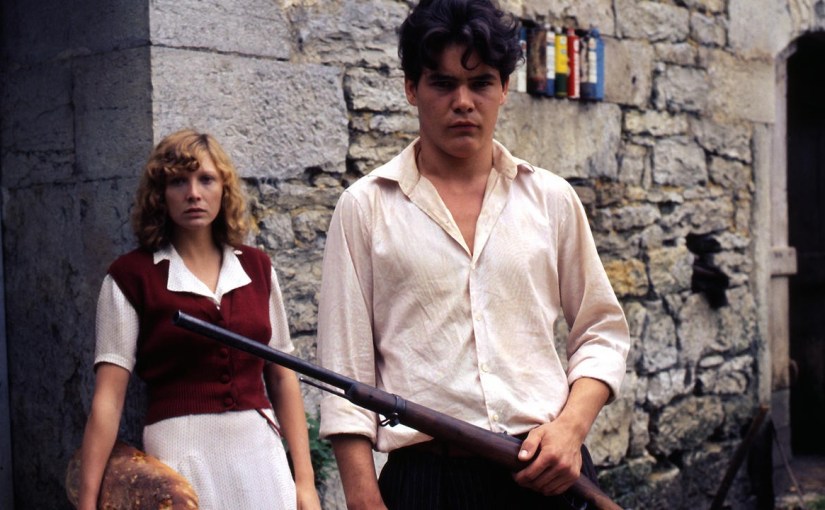
The film opens in 1944, just a few weeks after D-Day, in a small town in southwest France. We first meet young Lucien Lacombe, maybe 17 or 18, mopping a hospital floor, apparently doing a good deed for his community. Through an open window, he spies a small songbird chirping on a tree branch. Lucien makes sure no one is watching, pulls a slingshot from his pocket, takes careful aim, and kills the little bird with one shot. He smirks and goes back to the business of mopping. We will witness many other instances of Lucien killing other animals.
Indeed, many of these scenes are done for real: the actor playing Lucien clearly kills several rabbits with a shotgun, one with a wooden club. In another scene, he catches, decapitates, and calmly starts to pluck a chicken for dinner, all in one unbroken take. Now, this would have been normal behavior for someone living in a farm community in the French countryside, where someone has to prepare tonight’s dinner. The difference is, Lucien seems to enjoy these tasks a little too much. Even worse, though, are the times where he is utterly impassive about it, especially with the one rabbit he catches in the snare. These are hard scenes to watch, but in hindsight, they are vital to unpacking or interpreting Lucien’s actions later in the film.
Through a series of events that reminded me a little bit of Goodfellas (“All my life, I wanted to be a gangster”), Lucien allows himself to be recruited into a cadre of French collaborators whose base of operations is a fancy hotel where their opulent lifestyle is a rebuke to those silly Resistance fighters who must scrape a living from the dirt. He is more than willing to do what it takes to get a taste of the good life. He turns in a schoolteacher who is also a Resistance officer; he makes a show of being contrite about it, but he quickly gets over it.
The rest of the movie shows Lucien puffed up with pride in his new social status, bullying anyone and everyone who dares to talk down to him. There are, to be sure, broader statements being made here about the psyche of anyone who deludes themselves into believing in their inherent superiority over their fellow man just because they’re handed a membership card, regardless of how small-minded or shallow they might be. However, during the movie, I never thought of those broader implications. It’s a testament to how well the movie was directed and acted that I was concerned only with how Lucien behaved and acted, and not with whatever director Malle was trying to say from a metaphorical or allegorical standpoint.
To watch Lucien bully people around was sickening and pathetic. He is introduced to a tailor, Albert Horn, who will make him some new clothes. Lucien’s friend in the Gestapo casually informs him that Albert is a Jew who is only allowed to live in relative peace because of his skills as a tailor, and because he makes regular payoffs to the Gestapo. Albert has a 20-something-year-old daughter, improbably named France, with whom Lucien is almost immediately smitten, despite her ethnicity. He tries to impress France by getting her to the front of a food line, but she demurs. When people in line complain, he smugly explains he’s with the German police and he can do whatever he wants. The idea of that kind of power in the hands of someone as despicable as Lucien made me as angry as I can ever recall being while watching a film.
In the background of Lucien’s plotline is the shadowy Resistance itself. Various members of the French collaborators are being killed here and there, certainly not a bad thing. But the aftermath of their attacks is no less disquieting than anything perpetrated by the pro-Nazi collaborators, especially after a brazen attack on the fancy hotel headquarters, where the bodies of the collaborators are just as dead as the bodies of the Resistance fighters. Perhaps the film is making a point that dead is dead, no matter which side you’re on, so you’d better be sure you’re dead for the right reasons because history will remember you one way or the other.
At the center of all this is Lucien’s face with his cold eyes and virtually expressionless mouth. He doesn’t smile, he smirks. He threatens Albert and France with exposure and arrest if Albert doesn’t allow Lucien to date, then marry, France. For her part, France is wise enough to know when to humor Lucien and when to go along with his behavior, for the good of her father. Lucien, besotted with power, is too clueless to realize how smart she really is.
I have a general guideline that I dislike movies with rotten characters at the center of them. But I must admit that Lacombe, Lucien sucked me into the story and kept me there, despite how much I disliked Lucien himself. I guess I wanted to see how much the filmmakers would allow him to get away with before he was swatted down. Whether he gets swatted down or not is for you to discover, but let it be said that the ending manages to have it both ways, which was challenging for me. I both did and didn’t get the kind of closure I wanted, which explains my somewhat median rating despite how well-made the film is.
It may be that I’m not old enough, or knowledgeable enough, to really appreciate the impact Lacombe, Lucien had on 1974 audiences. I can only report how it made me feel right now. It made me feel anger and indignance towards Lucien throughout the whole movie, even when he makes a crucial decision that seems as if it will redeem his character. I don’t think it does, because the damage he instigated has been done and cannot be undone by a single act of contrition when it’s far too late to make any difference. Perhaps that’s not a very Christian idea, but that’s how the movie made me feel, regardless. Lucien deserves what he gets and more. Does that apply to the real-life French collaborators, many of whom were still alive when this movie was released? It’s not for me to pass judgement on those people. But I can’t deny how the movie itself made me feel towards the people within the world of the film.
 2 UNPAID MOVIE CRITICS!!!!