
THE BAREFOOT CONTESSA (1954)

by Miguel E. Rodriguez

DIRECTOR: Joseph L. Mankiewicz
CAST: Humphrey Bogart, Ava Gardner, Edmond O’Brien, Marius Goring, Rossano Brazzi
MY RATING: 7/10
ROTTEN TOMATOMETER: 100% Fresh

PLOT: The life of a Hollywood star whose candle burned briefly and brightly is told (mostly) by the writer/director who helped discover her.


Towards the beginning of The Barefoot Contessa, I let my expectations get the best of me, as I tend to do.  There were scenes between movie producers and directors and conversations about actors and the movie business and dialogue about bad dialogue at the movies, and I settled myself in for another scorching “behind-the-scenes” movie like Sunset Blvd. or The Bad and the Beautiful.  Heck, it was written and directed by All About Eve’s Joseph L. Mankiewicz, so how could I NOT expect something similar?  But I was wrong.  True, the film takes potshots at the industry, but later on it all feels incidental, a necessary sideshow to lead us to the main attraction.

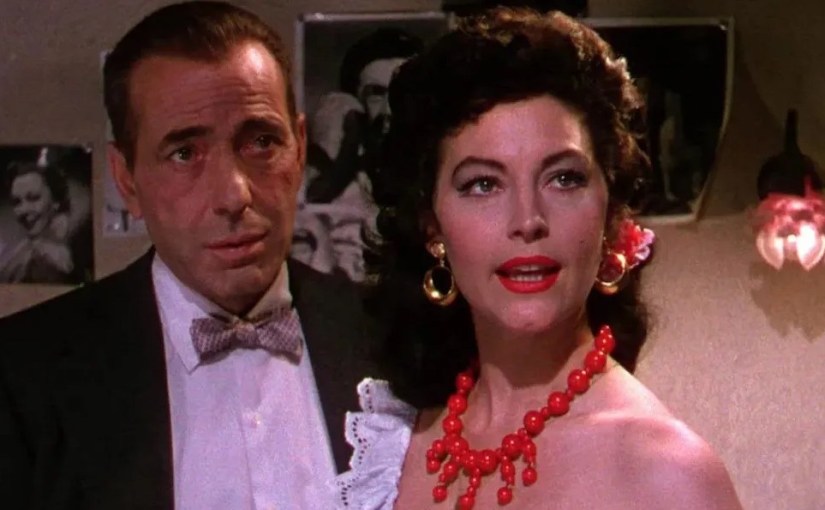
The Barefoot Contessa is a character study about a woman named Maria Vargas (Ava Gardner), who is discovered dancing in a Madrid café by B-movie writer/director Harry Dawes (Humphrey Bogart) and kajillionaire producer Kirk Edwards…whose resemblance to Howard Hughes had to be toned down under threat of legal action from Mr. Hughes himself.  They are scouting for new talent along with Edwards’s gofer, Oscar Muldoon, played by Edward O’Brien, who won an Oscar himself for the role.

Maria is convinced to do a screen test, not by Oscar or Edwards, whose wealth has turned him into a spoiled child, but by the gentle persuasion of Harry Dawes, who quickly sizes Maria up as someone who is not to be bullied or cajoled.  One thing leads to another, and she makes three films in America, all directed by Dawes, and she becomes an enormously popular star, beloved by millions…and three weeks after her fairy-tale wedding to an Italian count, she’s dead.  (That’s not a spoiler; the film opens at her funeral.)

There are so many stories of Hollywood stars who achieve overnight success only to die young for one reason or another.  The Barefoot Contessa tries to get into the mindset of one such actress, but only from the outside, as the public knew her.  Not her friends, because she really only had one: Harry Dawes, the only person who really knew what made her tick, thanks to a heartfelt conversation outside her impoverished Spain apartment.  How much of this conversation reflects what really goes in any actor’s head?  Probably a lot.  She talks about childhood fears, a desire to be loved, her unhappy home life with her parents, insecurities, superstitions (she refuses to wear shoes whenever possible)…there isn’t an actor walking this earth who couldn’t identify with at least two of those issues.

We follow Maria as she moves to Hollywood, changes her last name to D’Amata because it’s more exotic, and becomes a superstar almost against her will.  Ava Gardner plays Maria as someone for whom acting is not a dream job, it’s just a job.  If the by-product is fame and fortune, well, that’s just a lucky break.  Maria is looking for the fairy tale, but it doesn’t involve limos and red carpets, nor does it involve finding a prince who’ll put the slippers back on Cinderella’s feet.

The Barefoot Contessa shifts narrators a couple of times, but it all leads to her fateful meeting with, and eventual wedding to, the dashing Count Vincenzo Torlato-Favrini, an Italian nobleman who “rescues” her from a verbally abusive paramour.  The Count, though, harbors a secret that Dawes, with his “number six sense”, is bothered by, but can’t quite pin down…and since I knew Maria would be dead soon, I thought I knew what that problem was, but boy, was I wrong…

This film may not spark and crackle like All About Eve, but it’s chock full of ideas.  There were times when it felt like it was trying just a little too hard to be a “great” movie, and I know that’s vague, but it’s the best way I can think of to describe it.  I think I need to watch it again, now that I know more or less what’s going to happen, and appreciate what it’s trying to say in the context of stars like Jean Harlow, or Heath Ledger, or Marilyn Monroe, or James Dean.

This movie isn’t so much a “at-what-price-fame” kind of story, though, like Walk the Line or [insert title of musical biopic here].  It’s more like a portrait of someone who beat the system, who was able to reap the benefits of stardom without being consumed by it, much to the consternation of everyone around her.  (But it’s not what killed her; write that up to her desire for the fairy tale.)
ALL ABOUT EVE

By Marc S. Sanders

Today’s actresses can lobby and vie to be Wonder Woman or Black Widow or Jane Bond. Yet, what so many filmmakers and actors fail to recall are the powerhouse performances of yesteryear that didn’t require guns and magic lassos. Movies shouldn’t simply be super heroes and villains in spandex and leather. No movie is a better example of this argument than Joseph L Mankiewicz’ 1950 Best Picture winner All About Eve.

This is also the only film in history to have four actresses nominated for acting awards – Bette Davis, Anne Baxter, Celeste Holm and Thelma Ritter. What an accomplishment!!!

Davis is Broadway legend Margo Channing, a sexy, tough, cigarette smoking broad who grew up and keeps her social life within the limelight. She’s a warrior among the Hollywood and New York elite. When her friend Karen Richards (Holm) welcomes a mousy young girl in a raincoat backstage to meet the famous Miss Channing, it becomes more than just a quick hello. This girl is Eve Harrington who proudly admits to following Margo’s career from San Francisco all the way to Broadway waiting outside the theatre on each performance night for that opportunity to meet the legend in person.

Upon introduction, Eve shares her tragic story of growing up poor and losing her husband in the war. Margo and Karen are taken with Eve, and now the young ingenue has wielded her way into the upper crust life among the pomp and circumstance. Margo’s test of her own celebrity seems to come unexpectedly as it occurs to her and her smarmy personal assistant Birdie (Ritter) that maybe Eve is angling for a way to fill Margo’s big shoes along with her wardrobe and stage costumes.

The elite are intruded upon by this outsider. Karen’s friendship to her playwriting husband Lloyd (Hugh Marlowe) and her friendship to Margo is tested by Eve’s surprising manipulations. As well, Eve is making herself more aware to Margo’s younger lover and stage director Bill (Gary Merrill). Eve also finds ways to build an acting career on the shoulders of these show biz upper class by eventually winning the opportunity to be Margo’s understudy.

The outsider who narrates these developments is the famed theatre critic, Addison DeWitt (a charming and cultured George Sanders who won the Oscar). DeWitt might not get welcomed to every exclusive black tie party in town as he’s “the critic” but that’s fine for it’s how he survives in his career. He’ll recruit a young naive actress like a newcomer played by Marilyn Monroe to maintain a stay within the social circle, and soon he’ll ride along on Eve’s journey for personal gain.

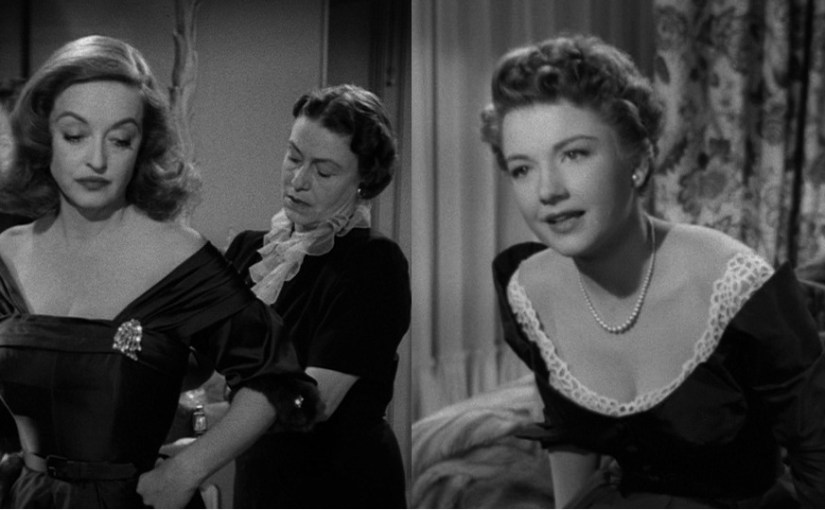
Mankiewicz’ script is brilliantly witty, absolutely biting and sharp. One of the best moments in film belongs to Bette Davis wearing a gorgeous dark evening gown designed by the legendary costumer Edith Head, and used as Margo’s armor ready for social battle. Davis declares “Fasten your seatbelts. It’s going to be a bumpy night.” No line could be so forthright in what to expect of a film like “All About Eve.”

This picture is ranked at the top of many “greatest film” lists. As it should be. This is not a sweeping biographical epic. Rather, it’s a lot of story branches that begin at the introduction of one character and expand in various directions among a handful of others who become disarmed by her ongoing presence. It’s not even that simple as Mankiewicz writes about Eve’s duplicity and how she manages to collide one piece of her destruction with another kind of destruction elsewhere, and the victims are simply blindsided.

Anne Baxter certainly had me fooled as Eve. She’s sweet and innocent on the surface and soon an inner and more evil shell emerges. Bette Davis looks spectacular and delivered one the best female performances of the last hundred years. She can carry herself and keep her guard up and authority in place. There’s a rich and commanding history about Margo that seems easy to believe. She is the queen of Broadway at the film’s beginning. Yet, for a moment her guard is let down and Mankiewicz gives us that window of time for his showcase.

Mankiewicz effectively opens his picture with Eve winning a very exclusive show biz award. She graciously approaches the podium to accept and deliver her speech. However, there are a select handful of individuals who withhold their applause of celebration. Then he flashes back to how we’ve come to this particular moment. It’s a great opening leaving me curious with a bunch of why questions. To watch this sequence the first time leaves you curious. To watch it on a second or third time is to be in on Addison DeWitt’s exclusive story of show biz scheming and diva one-upmanship. I only wonder if Joseph L Mankiewicz was as keen as George Sanders’ character to foresee how much life will come from Eve Harrington’s intrusion upon the lives of Margo & Bill and Karen & Lloyd. Before the age of desperate “if it bleeds, it leads” gossip rags, All About Eve was the real storyteller.