A SERIOUS MAN

By Marc S. Sanders

There’s never anything wrong with questioning the Almighty God.  At least that’s what I believe. 

There’s nothing wrong with being faithful to an Almighty God…if you can find comfort and solace in its doctrine.  At least I think that’s what I believe.

The Coen Brothers released A Serious Man in 2009 to solve a great mystery that frankly we should all know can never be solved.

In 1967, Larry Gopnik (Michael Stuhlbarg) is a Jewish family man living in small town Minnesota.  He never steps out of line with his principles or morals.  He attends synagogue regularly.  He’s simply a good Jew; a good husband, father, brother-in-law.  Again, he’s a good Jew. 

Yet, he is also plagued with suffering through the results of what everyone around him commits as sin or violations.  His brother-in-law Arthur (Richard Kind) has overstayed his welcome in the house and is now under suspicion of committing illegal gambling in various bars.  His daughter is swiping money to get a nose job.  His son is listening to Jefferson Airplane in Hebrew school while getting ready to become a Bar Mitzvah.

Most prominently speaking, his best friend Sy Abelman (Fred Melamed) is gently counseling Larry through an unwelcome crisis at home.  Sy is encouraging Larry to agree to a “Get.”  Sy is ready to begin a relationship with Larry’s bitter wife Judith (Sari Lennick), and as they move towards divorce, Sy will need Larry to obtain a “Get” from the Rabbi. The Coens are admirably nervy in their writing because Sy addresses Larry like a child who he’s trying to get to swallow a bottle of castor oil so that he can finally make after two days of constipation.  That’s truly what it feels like.

I never read the book of Job, but I understand that A Serious Man was metaphorically inspired by its contents.  The question residing in both contexts is simply why must all of these unfortunate circumstances occur in Larry’s life? 

For Larry, it is best to get definitive answers.  After all, Larry is a physics teacher which is built on solid formulaic equations and never compromised because it’s a subject of exact science.  His giant blackboard bears the argument of solid answers from top to bottom with endless scribbles, diagrams and numbers.  It looks like incomprehensible gibberish, but at the end of it all, there’s a definite answer.  The proofs do not lie or compromise.

A South Korean student cannot comprehend that wrong answers on a physics test merit a failing grade.  It’s unfathomable because without passing Larry’s physics course, the student cannot obtain a mathematics scholarship.  Larry knows that is true, because how can you study physics without math? The two subjects hinge upon one another.  Larry sees no other way than to fail the student.  He won’t budge on that.  He sticks to his code of ethics.  He’s right all the way. Still, he’s accused of being prejudiced and then an envelope of bribe money is discovered on his desk.  It won’t sway him, but he can’t return it back to the student, if he can’t find him.  So, here’s another thing to weigh on him.

Larry is a healthy middle-aged father and husband, a devout Jew and somehow he’s the one suffering the most from the misgivings of everyone else.  Poor Larry even has to move with nebbishy Arthur into a local hotel.  Sy assures him it’s a lovely place with a pool (the pool is drained empty by the way).  His chance at tenure is also at risk.  There’s the divorce filing from his wife which causes him to hire an expensive attorney (Adam Arkin).  All this “tsouris!”  It’s too much to carry at once.

Midway through A Serious Man, the Coens opt to have their protagonist visit three Rabbis for the exact answers that will tell of his unfortunate circumstances.  The three visits do not so much lend to the story of Larry’s plight as they prove a point.  As satisfying as it might be for a physics teacher to arrive at the exact answer on the right side of an equal sign, one Rabbinical student (Simon Helberg from The Big Band Theory)- filling in for THE RABBI – will tell you to seek the answers you are looking for in an empty parking lot just outside the window.  ?????????

The second Rabbi played by favorite character actor George Wyner (Hill Street Blues, The Devil’s Advocate, Spaceballs) will tell a tall tale of a dentist and his goyish patient that leaves me wanting to know the end all be all.  What’s concluded may leave you shouting OY VEY!!!!

The third Rabbi is the mysterious Rabbi Marshack (Alan Mendall).  He is the elder, maybe the grand prophet, who is concealed in a private office with his long white beard and black hat, sitting behind his desk at the faaaaaarrrrr end of the room.  Will he finally have the answers to Larry’s questions?

This is reminiscent of that animated commercial that asks how many licks it takes to get to the Tootsie Roll center of a Tootsie Pop.  Did Mr. Owl actually have the answers the little boy was looking for?

A Yiddish told prologue that is seemingly unconnected to Larry’s story opens the film and it tells the story of a dybbuk knocking on a couple’s door in the “mitt en drinen” of winter.  The wife sees the curse of this dybbuk – the soul of a dead man meant to haunt them.  The husband does not.  It’s only after you watch A Serious Man from beginning to end that you’ll likely make the connection of a curse that future generations will never be able to escape now that the dybbuk arrived many years prior. Perhaps that is the answer that no Rabbi could clearly define for Larry.  It’s more apt to be my theory but it’s still not entirely clear.  Then again, perhaps it’s just the tale to resort to when a congregant like Larry Gopnik asks his clergymen why his life is in such turmoil.

I adore this film and it might be on a very personal level that others may not appreciate unless they have had an upbringing like mine.  Practically every single character in A Serious Man, all played by relatively unknown actors, look completely familiar to me. 

From Larry’s obnoxious kids (“I’m studying Torah asshole” with a defined middle finger raised), to his bitter wife that I routinely see a caricature of in Shull. Sy Abelman talks like my father-in-law (a great man, who I love by the way) does at Passover Seders, to his co-workers and even Larry himself.  Wearing nerdy black rimmed glasses, he hunches down to scribble on the blackboard with his fat butt sticking out just like my Hebrew teacher Mr. Katz did in my Yeshiva.  It’s all uncannily familiar and easily recognizable. 

There’s a very striking authenticity to A Serious Man that I’d be remiss in not complimenting.  Many may not see it.  You’d have to a be a northern practicing Jew or at least personally experienced with this secular environment to understand. That being said, seek out this unsung Coen Brothers piece and allow your patience to guide you through its various oddities.  It’s Joel & Ethan Coen.  So, you know it’s going to be odd. I expect that it’ll leave you thinking, though.

These actors that you may recognize, but cannot pinpoint what else you’ve seen them in, were meant for these roles. Only a certain kind of Jewish actor could play these people.

For example, no one else but Fyvush Finkle could play a Dybbuk arriving on a doorstep in the mitt en drinen of snowy winter!
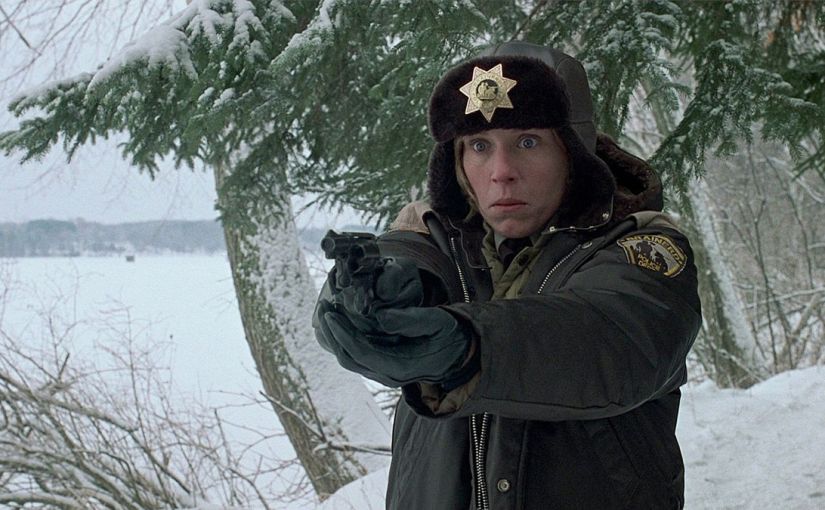

FARGO

By Marc S. Sanders

The seeds of a crime begin in the dead of winter, in a saloon, located in Fargo, North Dakota.  A car salesman requests two thugs kidnap his wife so that they can demand an eighty-thousand-dollar ransom from his wealthy father-in-law.  The salesman will split the monies with the crooks and all will be well.  Hold on there!  It’s not as simple as it looks.

The Coen Brothers (Joel and Ethan) completed some of their most legendary work when they opted to “adapt” a supposedly true story that sheds blood over the snow-covered plains of northern Minnesota when all of the characters involved choose not to cooperate with one another.  The unpredictable is what keeps their film Fargo so engaging.  With each passing scene, you ask yourself “What next????”

Jerry Lundegaard (William H Macy, in my favorite role of many good ones from him) is the salesman who gets in over his head.  This cockamamie scheme of his stems from a need to land a get rich quick investment, but he doesn’t have the money and his father-in-law Wade Gustafson (Harve Presnell) certainly won’t lend it to him.  Steve Buscemi and Peter Stormare are the hired criminals, Carl and Gaere.  As quick as the agreement is made, Jerry wants to call off the arrangement, but things are already set in motion.  The kidnapping occurs, albeit sloppily, and a late-night pullover on a dark, snow covered back road leads to the bloody shootings of three people. 

Marge Gunderson (Frances McDormand, in her first Oscar winning role) is awoken early in the morning.  Her sweet husband makes her a quick breakfast and she’s off in a jiff to inspect the crime scene of the three murders.  She is seven months pregnant, but she’s got a job to do.

Murder, kidnapping, fraud, and embezzlement piece together the Coens’ Oscar winning script.  What makes Fargo special though is how out of frame it all seems among these odd and quirky characters.  The Minnesotan dialects and vernacular (“You betcha!!” “You’re darn tootin’!” “Oh, for Pete’s sake!!!”) from Marge and Jerry do not seem standard in a story like this.  Even their names – Lundegaard and Gunderson – seem totally out of place here.  However, the pregnant, sweet natured police officer should not be underestimated, and the puppet master behind this plot should have known better.  In fact, other than Marge, no one should be doing what they’re doing, and yet that’s exactly what spins everything off the rails.

The Coens humanize the characters of their film.  Marge must stop inspecting the grisly crime scene because her morning sickness is about to overtake her.  “No, I think I’m gonna barf!” It is not the blood or the cold winter that’s holding her back.  Natural pregnancy gets in the way.  When clues lead her to Minneapolis for an overnight stay, she takes advantage of meeting with a high school friend.  Their meet-up has nothing to do with the central plot, but the writers insist on showing Marge during her off hours.  It’s a hilarious scene and Frances McDormand’s timing is naturally comedic with a guy who just has an overenthusiastic way about himself.  Marge is not just a smart cop.  She’s got a life outside of her career as a loving wife, friend and soon to be mother.

As well, Jerry insists to Wade not to contact the police and let him deal directly with the kidnappers when they call.  Wade isn’t just going to sit by for long though.  He got to the top of his powerful pyramid by taking things head on.  Jerry just doesn’t have the instinct to realize this is how the cards will fall.  Wade was not to be involved, under any circumstances.  Yet, that’s exactly what is happening.  This is not good Jerry.

Carl and Gaere (These names!!!!  I’m telling ya.), as crooked hoods, have no honor among themselves.  One might betray the other and that could lead to another gory, very gory, yet inventive moment. 

Other than Marge, either no one is particularly smart in Fargo, or they are just not seeing the possible outcomes all the way through.  Still, even the dumbest of folk can make a turn of events gone awry so fascinating.  When one tiny detail gets out of place, then the players improvise. That only twists several other expectations to go off kilter and the dominoes begin to tumble.  Very quickly, as everything has unraveled, it is any wonder how this all began in the first place. 

Fargo demonstrates that crime is hardly committed with a perfect plan.  Fortunately, the imperfections are at least as entertainingly curious as the perfections found in so many other films.  Oh, you betcha!!!!! 

BLOOD SIMPLE.

By Marc S. Sanders

 “blood simple” is a term coined to describe the addled, fearful mindset people are in after a prolonged immersion in violent situations.

         IMDb – originally located in the book Red Harvest by Dashiell Hammett

The Coen Brothers’ first of several legendary and unique films is a seedy noir thriller called Blood Simple.  Joel Coen is the director.  Ethan Coen is the producer.  They wrote the script together and collected whatever pennies they could find door to door from anyone willing to invest in the picture.  You see how shoestring the budget was for this small film, but that’s exactly why it works so effectively.  The lowlifes of their script are not the sophisticated type like Hannibal Lecter or Harry Lyme.

This is a condensed piece, just over ninety minutes, with four principal players who inadvertently cause themselves to get tangled in a bloody web of gory crime.  The fun part is that none of the four know the whole picture of what’s occurring, or how, or why.  I’m satisfied the audience is in on the whole thing, though.

Without giving too much away, Dan Hedaya is Marty, the owner of a sleazy Texas saloon.  A private investigator provides evidence of Marty’s wife, Abby (Frances McDormand, in her debut performance), having an affair with one of his bartenders, Ray (John Getz).  Marty hires the P.I. to murder the two lovers.

Simple enough, right?  Wrong, because the Coen Brothers wisely have their players color outside the lines and soon there’s blood all over the floor, as well as in the back seat, and maybe something important was mistakenly left at a crime scene.  Perhaps someone who was thought to be dead is not, and maybe what you thought occurred is something else entirely.

Blood Simple. works because it operates beyond convention.  The characters are so unaware of what to do next or what precisely has happened that it introduces one layer of confusion and misunderstanding after another.  This is nowhere near a common episode of Three’s Company.  What’s even more appreciative is that once the end credits roll, those that survive this lurid tale will still never have a complete grasp of what’s happened or when or where the convolutedness began.  It’s satisfying that all of the answers are at my disposal. It gives me a sense of omnipotence.

M Emmet Walsh is the scuzzy private investigator.  You’ve seen this celebrated character actor countless times before.  It is this performance that might be the one where you would no longer recognize him as “What’s that guy from?” because now you’ll never forget his name. He’s a villain who pounces on a genius opportunity, covering all bases, until there’s one minor oversight.  The Coen Brothers inventively have this guy circling the waters of the whole film, and yet only one other character is aware of his existence.  Still, this guy is vital to the assorted conflicts uncovered in this sort of graphic novel pulp fiction.

Blood Simple. sets up scenes  that can be bridged together by what if scenarios. How can two windows mere inches away from each other lend to a painfully agonizing, thrillingly welcome moment of terror and suspense? When this scene arrives, does it make sense for how the characters play it out?  You bet it does.  

The film is strong due to its lack of dialogue too.  We watch what these characters do much more than we listen to anything they have to say.  Important props and locations seem to tell us more than any of the actors, and that’ll allow you to think like the character.  You read their minds rather than feeling a need to have everything explained to you.

Blood Simple. is an inspired nod to some of Hitchcock’s bewildering best like Dial M For Murder and Strangers On A Train.  It succeeds because of the twists it offers as nothing ever goes according to plan.  You’ll watch it once and then you’ll want to see it again to follow the breadcrumbs that trail off the path.

HAIL, CAESAR! (2016)

by Miguel E. Rodriguez

DIRECTORS: Ethan Coen & Joel Coen
CAST: Josh Brolin, George Clooney, Alden Ehrenreich, Ralph Fiennes, Scarlett Johansson, Tilda Swinton, Channing Tatum
MY RATING: 7/10
ROTTEN TOMATOMETER: 86% Certified Fresh

PLOT: A movie studio “fixer” in 1950s Hollywood faces his biggest challenge yet when the star of the studio’s most prestigious film in production is kidnapped by a shadowy organization calling itself, “The Future.”


The word “idiosyncratic” feels like it was invented for the Coen Brothers…or maybe vice versa.  Their 2016 film Hail, Caesar! is yet another case in point.  Packed with the kind of early Hollywood detail we wouldn’t see again until 2022’s Babylon, this film is a love letter to the 1950s studio system that produced such classics as All About Eve, Stalag 17, The Bridge on the River Kwai, and Ben-Hur.  However, the comic story surrounding this love letter is a bit rambling and disjointed.  About halfway through, I found myself wondering if maybe the movie wouldn’t have been better if the filmmakers had just ditched the comedy and made a straight-up drama.  But then we got to the climax, and I realized, no, comedy is better for serving up the kind of silliness we get at the end.  It’s no Raising Arizona, but it’ll serve.

In classic film noir fashion, a narrator (Michael Gambon) informs us that Eddie Mannix (Josh Brolin) is head of production at the fictional Capitol Pictures, which is in the middle of shooting its most ambitious picture ever, an epic Biblical tale called Hail, Caesar!  (Think Ben-Hur with a lower budget and an outright plagiarized screenplay.)  However, their leading man, the improbably handsome and incredibly dumb Baird Whitlock (George Clooney), abruptly goes missing when he is kidnapped by a couple of lurking extras.  Mannix must deal with finding Whitlock while also figuring out what to do about:

  1. DeeAnna Moran’s (Scarlett Johansson) unexpected pregnancy.
  2. Hobie Doyle’s (Alden Ehrenreich) inability to deliver lines without a cowboy accent, which infuriates his director, Laurence Laurentz (Ralph Fiennes).
  3. Two persistent gossip columnists (both played by Tilda Swinton) who are running stories on Whitlock’s disappearance and/or salacious rumors about Whitlock’s past.
  4. A lucrative job offer from Lockheed.
  5. His promise to his wife (Allison Pill in a tiny role) to quit smoking.

Whew!  And I haven’t even mentioned the singer/dancer Burt Gurney (Channing Tatum) or the mysterious group of academics who have apparently kidnapped Whitlock, a group calling itself, “The Future.”  …spooky…

As in many other of the Coen Brothers’ films – not ALL of them, but many of them – the story itself is not really the point.  It just serves as an excuse for Ethan and Joel to present the viewer with scene after scene demonstrating their immense affection for a bygone era of filmmaking.  When Scarlett Johansson’s character, DeeAnna, is introduced, for example, we don’t just get a line or two about what she does (she’s an aquatic star modeled after Esther Williams).  We’re treated to an elaborately choreographed scene with dozens of bathing beauties, ScarJo diving from a great height wearing a mermaid tail, and a mechanical whale complete with a spouting blowhole.

At one point, Mannix visits the chief film editor for the studio, C.C. Calhoun (Frances McDormand), to see how Mr. Laurentz’s film is shaping up.  This scene in particular is lovingly presented, as we get a quick-cut sequence of Calhoun unspooling the film in the dim editing room, re-threading it, punching a button, flipping a switch, click-clack, click-clack, and Mannix watches the opening sequence of “Merrily We Dance” on the tiny Moviola as the projector whirs in the background.  I would bet real money that Martin Scorsese really, REALLY loved this scene.  (Plus there’s a nice little comic button at the end of the scene that is an excellent demonstration of Edna Mode’s immortal dictum in The Incredibles: “No capes!”)

The whole movie is like that.  It’s one of the most nostalgic homages to old Hollywood that I’ve ever seen.  But the movie can’t seem to make up its mind about what it’s about.  George Clooney puts on a clinic of how to play dumb as the clueless Baird Whitlock.  (In fact, this movie serves as the conclusion to the unofficial “Idiots” cycle of films from the Coen Brothers films, which also includes O Brother, Where Art Thou?, Intolerable Cruelty, and Burn After Reading, all of which star Clooney in a lead role…playing an idiot.)  Alden Ehrenreich is pretty convincing as a young star with a pretty boy face and limited acting ability, which I’m sure is far from the truth, but he pulls it off.  His scene where he tries to wrap his Texas accent around the simple line, “Would that it were so simple”, with his director patiently trying to coach him, is hilarious on its own.  But it runs on a little too long, as does the aforementioned scene in the editing room.  The subplot with the gossip columnists feels tacked on, almost as of the Coens were trying to pad the running time.  There’s a magnificently choreographed scene where we watch Channing Tatum’s character do some tap dancing dressed as a sailor for another movie being filmed, but even THAT runs a little too long.

Ultimately, Hail, Caesar! feels more like an intellectual exercise instead of an emotional one.  I hate to keep bringing this movie up by comparison, but Babylon, for example, managed to capture a nostalgia for Old Hollywood AND kept me emotionally involved for its entirety.  There was an energy that kept things moving.  Hail, Caesar! lacks that energy, but I can’t quite bring myself to call it a “bad” movie because I connected with its affection for the monolithic, flawed system that managed to create so many diamonds amid SO many lumps of coal.  (Just like today!)

NO COUNTRY FOR OLD MEN

By Marc S. Sanders

Joel and Ethan Coen have an odd collection of films under their belt. No Country For Old Men, an adaptation of Cormac McCarthy’s novel is no exception. You’re likely to meet the oddest hit man you’ve experienced in a film. (Reader, I’m going under the presumption you’ve never encountered a normal or odd hit man in real life. If you survived long enough to read this passage, you are truly blessed.)

Anton Chigrh follows a discipline that likely no one ever taught him. His code is to continue until he finds what he’s looking for and dispose of any lead in his ongoing quest. His weapon of choice-an air gun hose connected to an oxygen tank. It’s instant in serving its purpose. Its sound is quick and jarring.

Javier Bradem delivers an Oscar winning performance as Chigrh in search of $2 million when Llewelyn Moss (Josh Brolin) takes possession of it after coming upon the sight of a drug deal gone bad.

Tommy Lee Jones is perhaps one of the old men in the title. A Texas sheriff not surprised by the carnage he comes upon, but not of much use either. I think he regrets that he can never do more or better and simply can only surmise what’s already been done. I gathered that especially from a scene depicted in a hotel room during the third act of the film. His approach on the scene and his need to sit down translate that for me. His periodic anecdotes during the course of the film seem to say so as well. This sheriff has likely never rescued anyone from harm despite how intuitive he may be.

The Coen Brothers are never shy with blood. A lot of directors are not, really. Yet with the Coens, it seems the bloodshed is disturbingly honest. The instant splatter and flow following another act by Chigrh couldn’t be more truthful. They tell this tale very well, never concerning themselves with how unsettling they can be. Sun filled deserts are not comfortable. Evenings are sleepless. Blood is dark, thick, sticky, messy.

Moss is a hunter who has no idea what he’s up against. Brolin plays him with quiet reservation. He could not resist the urge to take the bag of money, but he also knows he’ll pay for it as well. When he realizes there’s no way to escape, by even crossing the border, he can only try to kill the devil incarnate. He’s likely aware of how this will all play out though.

Among this trio of fine actors (with Woody Harrelson also briefly in the fold), the film is nevertheless celebrated for Bardem. Whenever the story returns to Chigrh, you sit up in your chair a little more alert. He’s got disturbing dialogue exchanges with those he encounters and Bardem’s method makes you wish you never have to decide your fate with a coin toss.

No Country For Old Men is not an action film. The pace takes its time, invested in three men with respective histories who cannot change what their meant for. No incident will change their lifestyles. They are meant to be an assassin, a washed-up lawman, and a poor country hunter. Until they die, no moment in time will alter their caricatures. That’s what I took from the Coens’ Best Picture winner.

I appreciate its honesty.