
THE CHAMBER

By Marc S. Sanders

Having recently read John Grisham’s fifth novel, The Chamber, I opted to watch the film adaptation directed by James Foley. 

First, allow me to say that Grisham’s novel is primarily stale and boring.  That’s only because his nearly five-hundred-page best seller is occupied with a lot of legal procedurals and tactics necessary to get a convicted, racist murderer off of death row before his scheduled date of execution.  Grisham permits moments where his characters can bond, become forgiven or get even more revolting with each other.  In between though are efforts of appeal after appeal.  It’s likely how it works.  A motion is carried out.  It’s rejected.  On to the next in line.  In fiction though, this is terribly redundant. 

James Foley’s film does not work that way, however.  In fact, it’s a much worse experience.

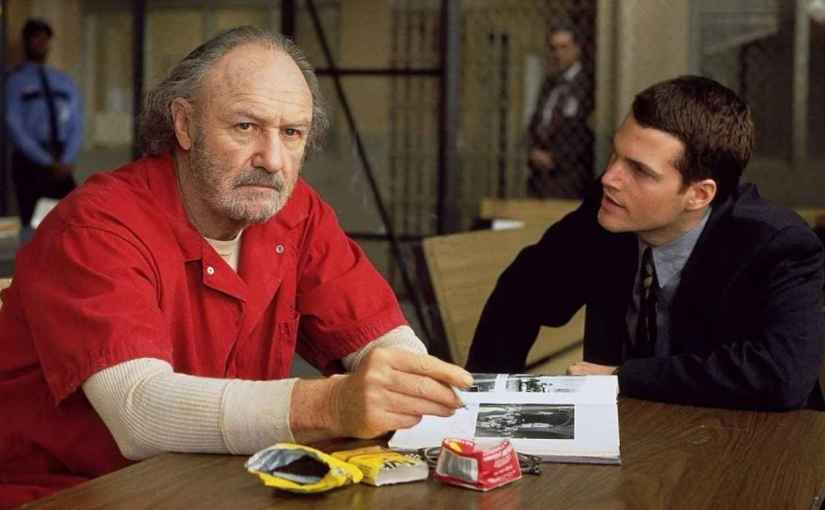
A grey bearded Gene Hackman with oily, stringy hair and tobacco-stained teeth is Sam Cayhall.  He’s a former member of the Ku Klux Klan who is sentenced to the gas chamber for the murder of two young Jewish boys who accompanied their father, a Mississippi civil rights attorney in 1967.  The father lost both legs and years later he took his own life.  Sam is considered solely responsible for bombing the lawyer’s office building. 

Chris O’Donnell plays Adam Hall, a twenty-six-year-old attorney eager to take on Sam’s case and get him off death row.  Sam will finally meet his grandson but he won’t be very welcoming.  Adam is adamantly against capital punishment and he’s repulsed by his grandfather’s past, but that is not enough to send the old man to the chamber.

IMDb trivia documents that screenwriter William Goldman (Butch Cassidy And The Sundance Kid, The Princess Bride) walked away from the film after six drafts.  Another credited screenwriter used a pseudonym to keep his name disassociated with this picture.  John Grisham considers The Chamber the least favorite of his film adaptations thus far.  I can imagine the suffering with trying to assemble something compelling on film.  Frankly, I don’t think it could ever be accomplished.  This stuff is either boring or ugly or both.  Try and project it on a screen and it will not deliver a message like Schindler’s List or Do The Right Thing.

Gene Hackman suffers the most from this film.  His character is clearly there, but the script and directing and even his primary scene partner, Chris O’Donnell, are not up to par.  Hackman puts in the energy with an old man white trash dialect.  He has the expected hateful outbursts of a Klansman.  His appearance is convincing too.  However, nothing he has to say is important.  He’s actually not hateful enough, even if he’s freely uttering the N-word or being derogatory towards the Jewish people who run the legal firm that Adam works for.  As well, the script does not offer empathy for him or enough remorse of his past sins. 

Chris O’Donnell is supposed to be the idealized grandson in the mid-1990s who feels shame for his family’s history of Klan participations and crimes going all the way back to his great, great grandfather.  Hardly any opportunity is offered for the young actor to feel this way.  He barely gets angry or empathetic when he shares scenes with Hackman.  Instead, his moments are wasted with a young staff member of the Governor, played by Lela Rochon. She has too large a role, especially when Gene Hackman could be doing more. The two prattle on about topics that result in no consequence. 

Faye Dunaway plays Hackman’s daughter, now a wife to a Southern aristocratic banker.  She’s a recovering alcoholic, which is assumed to be a residual cost of her father’s misdeeds.  Dunaway, this once great actress, has no connection to either Gene Hackman or Chris O’Donnell.  It’s as if she is not listening or properly responding to either of them when she appears.  Then again, O’Donnell is not lending his best towards Hackman either.  He’s very flat, very plain.  His character from Scent Of A Woman went on to legally represent his racist grandfather.  His Robin, the acrobatic DC superhero, has more personality and drive than this guy.

Thematically, John Grisham builds his thrillers off of what southern American law mandates.  Precedents become obstacles for his protagonists to overcome, or the characters have to learn to embrace what’s at their disposal.  However, it’s tempting to hinge on racial divides to serve as antagonism.  That’s tricky because if you emulate the hate and racism too much, then it looks glamourized. 

James Foley provides many exterior shots of uniformed modern-day Nazis and Klansmen marching outside of Sam’s penitentiary.  Others are there to applaud the death penalty for the old coot.  These are just visuals though.  They say nothing except enhance the image and platforms these sects stand for.  If a film is to bring prejudice to the forefront, then the screenplay or book better have something important to say.  Let’s study the science of hate and where it stems from.  Let’s focus on those who fight against such cruelty.  The Chamber just marches itself towards an inevitable conclusion with nothing gained in the process.

Fortunately, the author’s novel uses its five hundred pages to span the last four weeks before Sam Cayhall is to be executed, and in that time his grandson learns more of what transpired in the convict’s past.  Then the author delves into how Adam grapples with what he learns.  James Foley’s film only flashes back to one very ugly incident.  From there, it’s hardly discussed and it is definitely not focused on enough.  Foley stages the murderous events but his film has nothing to say about any of these things afterwards.  Adam hardly ever gets disgusted or even a little angry.  Sam never regrets or even champions what he’s responsible for.  These are just scenes from a book reenacted for a Hollywood film, and devoid of any emotional weight.  Do something guys!!!!!  Shock me!!!!

I have to credit what Gene Siskel and Roger Ebert observed about the film.  The racist, former Klan member, Sam Cayhall, steps out of his cell and walks down the hallway. A series of hands belonging to African American prisoners shake Sam’s hand through the bars, and they pump their fists in allegiance for their fellow prisoner.  In what world would this happen where the black occupants applaud the cellmate racist buddy?  Forgive the term, but I’d expect they would lynch this guy for what he did before entering this prison.  This kind of staging is an insult to the intelligence of what hate stands for in this country, where it was back in 1996, or nearly thirty years after the movie was released.  Why is The Chamber whitewashing what really happens? 

I was not fond of either the novel (a boring drag of a read) or the film (an insult lacking insight or sensitivity), but at least John Grisham did his homework. Racism is not to be sugar coated for what is genuinely ugly in this world.
GLENGARRY GLEN ROSS

By Marc S. Sanders

The characters in David Mamet’s Glengarry Glen Ross are under terrible pressure.  They are salesmen who are consistently chasing insurmountable sales goals in real estate properties.  One of them has an ill daughter in the hospital.  Another has a temptation to rob his office as a means of earning some fast cash.  Another is in despair of his self-worth.  To be a salesman, of any kind of commodity, is a tough life to lead.  The payoffs can be enormous when a sale is successful.  However, once a transaction is complete, the response is often “what have you done for me lately?”  These guys are never happy.  However, they are also some of the cruelest, most insensitive, and thoughtless people you will ever meet.  They have no other choice but to behave that way.  It’s the nature of the business.

The film adaptation of Mamet’s Pulitzer Prize winning play contains a collection of outstanding actors doing some of their best work.  They embrace the brutal dialogue the screenplay hands over to them with relentless cursing and flaring tempers.  Glengarry Glen Ross has you believe that you run your sales career on your own with little help or encouragement from the people you slave for. 

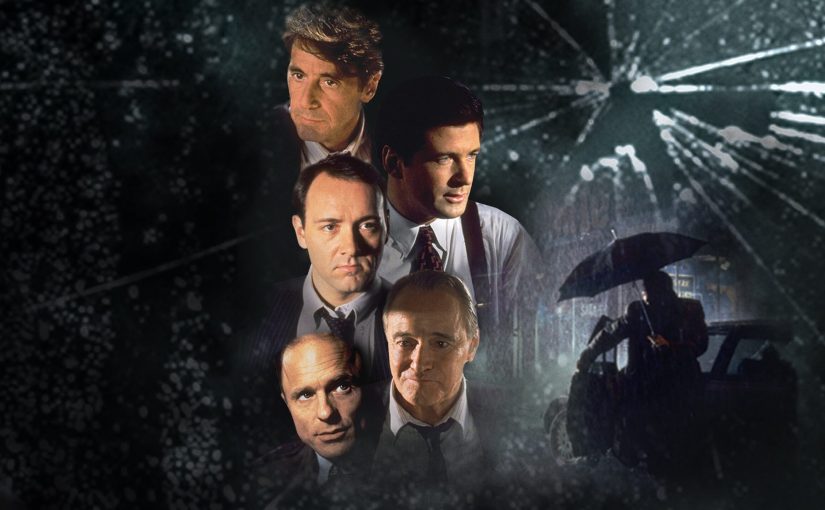
Early in the film, Alec Baldwin, known only as a man named Blake (based on the end credits) visits the office where these salesmen are based out of.  He delivers an unforgiving and harsh reality of what these men must do.  They either get their sales numbers high on the board, where they can win a new Cadillac, or they settle for a set of steak knives for second place.  After that, they are fired.  Regardless of where they currently stand though, they should not even be pouring themselves a cup of coffee.  Coffee is only for closers.  The office manager, known as Williamson (Kevin Spacey), only provides the men with sales leads that have already been exhausted with rejection and hang ups. 

Director James Foley does a wise technique with color.  The first half of the film appears in drabs of greens and greys amid an evening of torrential rain downpour.  Before Blake finishes his threatening presentation, he dangles new leads, the “Glengarry Leads,” in front of the men saying these are not for them, because they are only for closers.  The old leads that Williamson hands out are on green index cards, nothing flashy.  Blake’s leads are bright pink with a gold ribbon tied around them.  Foley makes sure that even a prop tells a story.

The salesman that gets the most attention is perhaps Shelley “The Machine” Levene played by Jack Lemmon.  He’s elderly and past his prime with no numbers currently on the sales board.  Frequently, he is making calls to the hospital for an update on his daughter who is due for surgery, but if he can’t make a payment, then the procedure is likely not to happen.  Lemmon is fascinating in maybe the best performance of his career.  Many of his scenes are toe to toe with Spacey as he shifts from pleading to demanding to disingenuously threatening and ultimately bribing Williamson for the new leads. Levene is so out of touch now that he can’t even sell Williamson on helping him out.  Spacey as Williamson is terrific in his defiance to not lend any sort of aid to Shelley.

David Mamet added additional material to the script, not found in the stage play.  The Blake character is new to the film, for example, and I think it is a better, more fleshed out story because of it.  As well, Foley is able to go outside of the reserved settings of the bar and office, as he follows Levene making a knock-on-the-door sales call in the middle of the rainy night to a family man.  This may be Lemmon’s best scene of the film as he weasels his way into the home to quickly get his raincoat and hat off and get a seat on the sofa as he begins his “once in a lifetime” opportunity that the potential customer may miss out on.  It’s a sales pitch, despite Lemmon’s charm, and the patron can see right through Levene’s performance.  As the door closes on Shelley, you’re terribly sad for his desperation and failure.

On the other end of the spectrum is the current, most successful salesman named Richard Roma.  He’s played by a showy looking Al Pacino who initially doesn’t perform in the broad strokes he’s become recognized for as an actor.  Pacino does a quiet, delicate approach to his character’s sales presentation as he shares a table with a sap (Jonathan Pryce) who is weeping into his liquor glass.  Roma stretches the rainy evening out in the bar with this guy, talking about vague anythings, until he can subtly pounce on him with a brochure that’ll get his signature on a contract. 

Two other salesmen, Moss and Aaronow (Ed Harris, Alan Arkin) vent their frustrations elsewhere in the bar as they eventually segue into an idea of burglarizing the office for those tempting new leads.  However, are they working together as a team on this idea, or is one working something over on the other?  Mamet’s dialogue is chopped up perfectly with utterances and interruptions, that before a character reveals his intentions, you are left flabbergasted.  What is demonstrated here is that a skillful salesman is also an efficacious manipulator.

The second half of the film is set on the following morning where the sunlight has come through.  New revelations following the stormy night from before will present themselves as the men gradually arrive at the office to find it actually has been robbed.  The obvious of circumstances are there.  However, Mamet sets up an ending that’ll leave you breathless.  It did for me the first time I watched the film.  Just when you think you are watching a protagonist throughout the film, something else entirely comes up.

Glengarry Glen Ross has been regarded as a modern-day Death Of A Salesman.  Maybe it is.  I’ve worked in this kind of field before. There were months where I was good at it, and like everyone else, I would brag about my success with recaptured anecdotes and celebratory curse words flying out of my mouth.  There were also months where I would gripe about how uncompromising this life is. When I didn’t want to do sales any longer, I spent twelve years as an assistant to sales representatives.  They are not your friend.  They are only focused on the next contract to be signed and booked before month end, and they will ask anything of you with a seething f-word attached to their request.    Are we so terrible if we can not make an unreachable goal with tools that offer no help and supervisors that lend no encouragement or forgiveness?  To be a salesman means that any of your past accomplishments or education do not define you.  You are only identified as the one who must acquire the next thing, and then the next thing after that.  It will change your attitude about yourself and how you treat others.  It’ll alter your dialogue which is so vitally apparent in Mamet’s story.  It will even influence you to take measures you never thought you’d be capable of.

James Foley enhanced an already electrifying script from David Mamet.  He knew that if he was going to show how hard and challenging it is to be a salesman of boring, uninteresting, and practically intangible parcels of land, then he was going to have to be relentless in the art direction and settings contained in the film.  The first half of the film never, ever lets up with the rain storm going on outside in the city street.  The evening is as black as can be, and yet Williamson casually will ask Levene if he is going out tonight. Who in the dead of night in the rain is going to want to talk to a droning salesman about anything?  Yet, that’s what is expected of this life.  The office setting is unfriendly, decorated with ideals that hang from the walls with phrases like “A man must embrace further than what he can reach.”  Little touches like this only add to the uncaring and selfish nature the men really have for one another. 

Glengarry Glen Ross depicts a hard life for the man in a suit.  You may dress like what is expected of a professional, but you are also always scraping the bottom of another bottom.  The cliché that money can’t buy happiness is personified in a film like this.  You may get to the top and score a nice commission, but it’ll soon be forgotten and nothing you’ve done before will lend to your current state.  Next month, someone else will be standing where you are standing.  Worse, you may never be standing on top again, and then what will you do?

Sadly, I believe that Glengarry Glen Ross reflects what many people experience at least at one point in their lives.  We are all salespeople to a degree whether we are doing a job interview or even trying to impress the parents of someone we are dating.  It doesn’t always work out.  The question is where do any of us go from that point.

AT CLOSE RANGE

By Marc S. Sanders

Sean Penn has been a gifted actor from the very beginning of his career.  Whoever thought the kid who played surfer dude Jeff Spicoli in Fast Times At Ridgemont High would go on to evoke such intensity in future roles afterwards?  Other actors who did that kind of sophomoric material went on to be in Police Academy movies.  Penn would never shake that surfer image, but he would at least equally receive accolades for his dramatic turns. In James Foley’s At Close Range the high stakes drama could not be more apparent. 

Penn portrays Brad Whitefore, Jr. in this film based on a true story taking place in a small, rural Pennsylvania town in 1978.  Brad Jr.  is going nowhere and that’s fine with him.  He’d rather be an intimidating, fearless kid who will defy his step father so he and his brother (Chris Penn, Sean’s real-life sibling) can get drunk and high.  When Brad opts to go live at his father’s, Brad Sr., house, he hopes that he will learn the ropes of becoming a career criminal like his dad.  Brad Sr. (Christopher Walken) specializes in ripping off tractors, farm equipment, cars, wealthy property owners, and safes carrying large amounts of cash.  He happily welcomes his son into his home with his misfit gang and his new young wife.  Dad will also express love to his son by giving him a car and support, while also welcoming in Jr’s new girlfriend Terry (Mary Stuart Masterson). 

There is a code among these criminals however, and it stretches to flesh and blood as well.  No one is to talk about what they do or how they do it.  Shortly after dad allows his son join in on a job, Brad Jr. learns of the consequences if anyone talks about their handiwork, especially if you are seen chatting with local law enforcement.

At Close Range came out in 1986.  Even by then, I don’t think it would be challenging to forecast where the story is heading.  What’s most interesting about the film are the cast performances from Penn, Walken, and Masterson.  James Foley sets up good scenes where loving trust works at one point, but when that is shattered, what is the detritus left over afterwards?  Christopher Walken plays a guy with no limits to upholding his code, and as I reflect on that motivation, I can’t help but think how relevant Madonna’s eerie ballad Live To Tell (from her True Blue album) is so very important to the picture.  The song should have received an Oscar nomination based on its significance alone.  I’ve only now just seen the movie for the first time.  Yet, I’ve been familiar with the song for nearly forty years.  It carries much more meaning now.

James Foley’s film could’ve been better, however.  The first hour is incredibly slow moving and doesn’t seem to offer much direction or exposition for what the film is truly going to be about.  At some points it is a boy meets girl storyline with Penn and Masterson.  They have good scenes together, but were they all necessary?  Couldn’t some of this material ended up on the cutting room floor?  Then in other areas it is a father/son coming of age piece where pals from both of their respective backgrounds get drunk together on any given night.  Brad Sr. is emulated for his leadership, the gun he carries, the money he flashes and the high-end muscle cars he steals, even gifting one to his son.  Brad Jr. is looked upon as the cool rebel (maybe a more aggressive modern James Dean) for not surrendering to intimidation from anybody. 

The movie also ends kind of abruptly.  It’s clearly understood what’s going to come of the father and son’s relationship.  Sean Penn and Christopher Walken stage a nail biting, very intense showdown in the kitchen.  However, what happens to them individually?  The final scene actually ends right in the middle of what could have been some good dramatic work, but it all goes to black.  Had I been in a movie theatre, I might have thought the projector broke down.  Business must have interfered behind the scenes.  A producer must have stepped in and pulled the plug.  It’s the best excuse I can think of, because the end credits intruded way too soon.  If the film was being edited for length, then there was much material to chop out of the first hour.  The filmmakers basically cut off the wrong leg.

At Close Range is not a steady trajectory of a movie.  It moves in too many sideways directions to stay focused on what it wants to be considered.  Is it a more genuine Rebel Without A Cause?  Is it a rural, backwoods interpretation with inspiration from Mean Streets?  Thankfully, what saved me from turning it off or falling asleep are the assembled cast performances.  At the very least, it got me interested to read up on the real story the film is based on.