
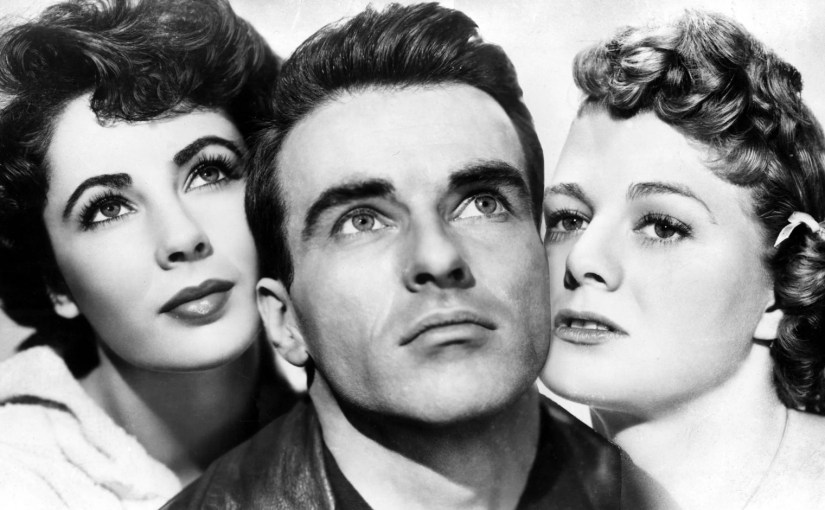
A PLACE IN THE SUN (1951)

by Miguel E. Rodriguez

DIRECTOR: George Stevens
CAST: Montgomery Clift, Elizabeth Taylor, Shelley Winters, Raymond Burr
MY RATING: 9/10
ROTTEN TOMATOMETER: 82% Fresh

PLOT: A struggling young man gets a job working for his rich uncle and ends up falling in love with two women, one rich and one poor.


I first saw A Place in the Sun many moons ago at a friend’s house.  I remember enjoying it but thinking it was too soapy for my taste.  Years went by.  I finally got around to watching Woody Allen’s Match Point and was stunned at how much Allen’s film borrowed from George Stevens’ celebrated melodrama.  Having just re-watched A Place in the Sun, my opinion of it has warmed considerably, without diminishing my admiration for Match Point, which remains one of my favorite films of all time.

A Place in the Sun tells the story of young George Eastman, played by Montgomery Clift at or near the height of his powers.  He’s a bit of a layabout who wrangles a job at his rich uncle’s swimsuit factory.  When George meets his rich relatives, I was reminded of a George Gobel quip: “Did you ever get the feeling that the world was a tuxedo and you were a pair of brown shoes?”  That’s George Eastman to a T, a ne’er-do-well in a sea of the well-to-do.

Against company policy, George falls in love (or at least in lust) with a rather plain girl, Alice, played by Shelley Winters in a de-glamorized role that went completely against type at that point in her career, winning her a Best Actress nomination.  Alice and George flirt and hold hands and occasionally neck (mildly scandalous for a 1951 film), but George can’t help but stare at another girl who pops up occasionally: Angela Vickers.  Angela is played by a ravishing Elizabeth Taylor, who was only 17 at the time of filming and empirically one of the most beautiful women in Hollywood, if not the world.  It’s not too hard to imagine any man, let alone poor George Eastman, falling in love with her instantly.

But George is still connected to Alice, especially because he’s already slept with her.  When George learns Alice is pregnant, he despairs because he had been planning to end things with Alice to pursue Angela.  Alice even visits a doctor who might possibly provide an abortion.  Of course, this being 1951, “abortion” is never mentioned out loud, nor is the word “pregnant.”  But Alice’s visit to the doctor is handled with incredible intelligence and brilliant screenwriting that manages to say everything it needs to say without ever uttering those forbidden words.

The rest of the film examines what George may or may not be willing to do for the sake of his love for Angela, who loves him back, it turns out…but she doesn’t know about Alice.  Since this is based on a then-famous novel called An American Tragedy (by Theodore Dreiser), it may not be too hard to divine what is in store for George before the final credits roll, but getting there is the fun part.  By casting heartthrobs as the hero/anti-hero and the rich girl he loves, the film cleverly gets us to root for them a little bit, even when George is considering murder.

While Elizabeth Taylor dominates every scene she’s in just by standing there, the Academy made sure Shelley Winters was recognized for her incredibly difficult performance as Alice.  There are some movies where, if a character is an emotional yo-yo, it can be frustrating.  With Alice, Winters never crossed a line into unlikability, even when she calls George at a fancy dinner party demanding he marry her tomorrow, “or else.”  It’s clear she has no options left to her if she wants to have any semblance of a life in polite society (by 1950s standards, anyway).  I felt bad for her.  But I also felt bad for George – to a degree – when he demonstrates how sincerely he has fallen head over heels for Angela.  Not just because she’s stunningly beautiful, but also because she really seems to have fallen for him, too.

Lately, my movie-watching itinerary of classic films has involved a fair share of outstanding melodramas (Leave Her to Heaven, 1945; The Heiress, 1949; Dodsworth, 1936).  A Place in the Sun fits right into that mold.  It doesn’t quite achieve the perfection of The Heiress, but it is a fantastic example of its genre, good enough for Woody Allen to “reimagine” its basic story for Match Point, so it’s definitely worth a look if you’re into that kind of thing.
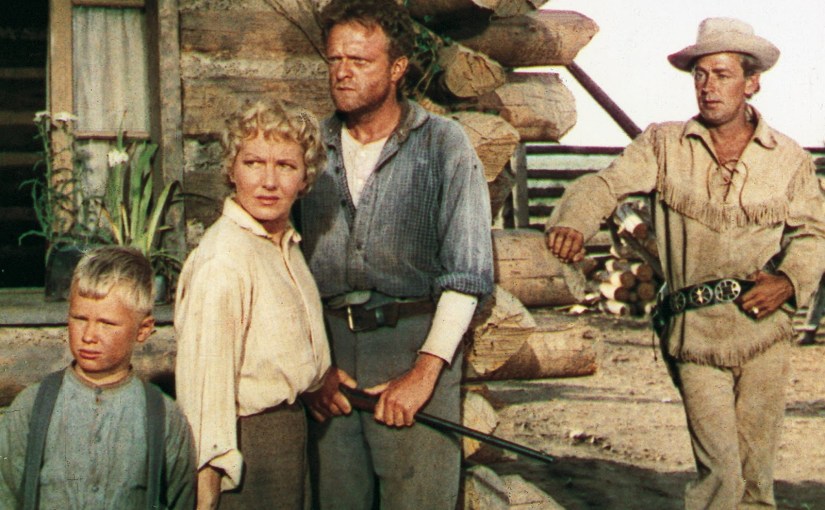
SHANE (1953)

by Miguel E. Rodriguez

DIRECTOR: George Stevens
CAST: Alan Ladd, Jean Arthur, Van Heflin, Brandon De Wilde, Jack Palance
MY RATING: 8/10
ROTTEN TOMATOMETER: 97% Fresh

PLOT: A drifter (who may or may not be a retired gunfighter) comes to the assistance of a homestead family terrorized by a wealthy cattleman and his hired gun.


Shane affords me the opportunity to use a word I never get to use in daily conversation: archetypal.  John Ford’s Stagecoach [1939] may be the granddaddy of the modern Western, but Shane taps into something even more primal.

Alan Ladd as Shane is the archetype of the mysterious stranger riding out of the mountains, either coming to the aid of a community who has lost hope (Pale Rider, 1985) or wreaking havoc as an avenging angel (High Plains Drifter, 1973), and then disappearing into the sunset or riding back into the distant mountains.  This formula was probably already old when Shane was made, and the film does little to dress it up or add any kind of pretentious spin to the story.  But by sticking to the formula and really nailing it home, director George Stevens achieved a weird kind of clarity that elevates Shane into a mythical realm.  If it’s not terribly realistic, well…who wants realism mixed in with their magic?  Not me.

Shane is set in the high plains of Wyoming in 1889.  (I don’t remember the exact year being mentioned in the film – I pulled it off IMDb – but we can tell it’s after the war because a running gag involves a harmonica player who always starts playing a Union song whenever a homesteader called Stonewall, who fought for the South, walks into a meeting.  It’s a mark of faith in the intelligence of the average viewer that the screenplay never comes out and explains that’s what’s happening; we just see it and have to put two and two together.  Nice.)

ANYWAY…it’s 1889, and a land baron named Rufus Ryker is trying to run homesteaders off some land that they rightfully own, but which is preventing Ryker from expanding his cattle ranch.  Among these homesteaders is Joe Starrett (Van Heflin); his wife, Marian (Jean Arthur); and his little boy, Joey (Brandon De Wilde, who earned an Oscar nomination for Best Supporting Actor, but don’t ask my opinion of his performance…just don’t).

One day, true to mythical form, a lone figure rides out of the mountains and up to Starrett’s patch of land.  He is improbably good looking, wears a fringed buckskin jacket, two ivory-handled revolvers, and identifies himself only as Shane.  After earning Starrett’s trust, he agrees to stay on as a hired hand and possibly help with the struggle against Ryker…

…and if you’ve been watching movies as long as I have, you could practically write your own screenplay for the rest of the film, because you’ve seen it before, many times.  The stranger proves his worth, defends his new friends, makes friends with the wife (but not TOO friendly), gets hero-worshipped by the little boy, and eventually runs them cattle barons plumb out of business.  But I’ve never seen it done quite like Shane.

For example, there’s a bar fight that ought to be in the Bar Fight Hall of Fame.  Shane, in what HAS to be a deliberate move to goad the bad guys into action, walks into a saloon filled with Ryker’s men to return a soda-pop bottle for the deposit.  A fight predictably breaks out, first one-on-one, then 1-on-2, then 3, then 4.  (Who does this guy think he is?  John Wick?)  The fight gets to a point when it’s winding down…then it picks right up again.  Then they get Shane on the ropes and start waling on him…until Starrett sees what’s happening, grabs an axe handle, and cracks it over someone’s head.  That may not sound like much in writing, but it’s pretty impressive visually, especially from a 1953 Western that feels at times like a Disney product.

(It almost feels like what Tarantino did with the fight between the Bride and the Crazy 88 in Kill Bill, Vol. 1 (2003).  George Stevens said, “Okay, these people want a bar fight?  I’ll give you a damn bar fight.”)

But while I was watching it, I started to analyze it a little bit.  Bar fights…seen one, seen a thousand.  But Shane felt to me like it was embracing the cliché, making friends with a trope, and in so doing the fight became a myth of a bar fight, a fever dream of itself.  It’s not just a bar fight.  It’s THE bar fight.

A lot of Shane works that way.  Shane isn’t just a mysterious stranger, he’s THE mysterious stranger.  An argument could be made for Eastwood’s “Man with No Name” as the archetype of this character, at least in the Western genre, but it’s clear that Eastwood took a lot of cues from Shane when writing and directing his own films.  I’m not suggesting that Eastwood plagiarized Shane.  I’m suggesting that Eastwood’s creations are infused with Shane’s DNA in all the best ways.  (I wouldn’t presume to speculate how much of Shane is in Sergio Leone’s spaghetti westerns starring Eastwood, though I would say those have more of Kurosawa in them than George Stevens.)

There are just two items that bugged me while watching Shane.  One, the editing was occasionally erratic, using a lot of fades or cuts to virtually empty frames in the middle of the action.  I don’t normally pick that kind of thing apart in a review, but it was glaringly apparent in a lot of places.

Two…the tragic waste of talent by casting Jean Arthur as Mrs. Starrett.  Jean Arthur is the fast-talking, quick-thinking actress who appeared in such classics as Mr. Deeds Goes to Town [1936], Mr. Smith Goes to Washington, and Only Angels Have Wings [both 1939].  She goes (or OUGHT to go) on the list of intelligent female actors like Katharine Hepburn and Rosalind Russell.  By 1953, she was semi-retired and only appeared in Shane as a favor to her friend, director George Stevens.  When I saw her name in the credits, I had visions of her delivering fiery speeches, shaming and out-thinking the menfolk, declaring her admiration for Shane without exactly laying out her TRUE feelings for him, and so on.  Instead, she is reduced to spending the majority of her screen time fretting over her husband’s safety, casting loaded glances at Shane while her husband isn’t around, baking pies, and reading bedtime stories to Joey.  I know I just got done writing about how the movie embraces clichés and becomes mythological, and there’s nothing more clichéd than the “little woman” supporting her husband, etc., but something about her role just rubbed me the wrong way.  After this film, Arthur retired from film completely, and although Shane was a massive popular and critical hit, I can’t help but wish she had been given more to do in her last film.

By the time Shane reaches its famous finale (“Shaaane!  Come baaack!”), justice has been meted out and the little guys have won…all is right with the world.  Echoes of Shane still linger today, because who doesn’t like a good old-fashioned bad-guy beatdown, administered by the archetypal mysterious stranger?  This may not be my favorite Western of all time, but from now on, whenever I do watch my favorite Westerns, I’ll keep an eye out for Shane’s shadow, looming large over all who came after it.