
DIRECTORS: Ellen Hovde, Albert Maysles, David Maysles, Muffie Meyer
MY RATING: 6/10
ROTTEN TOMATOMETER: 94% Fresh
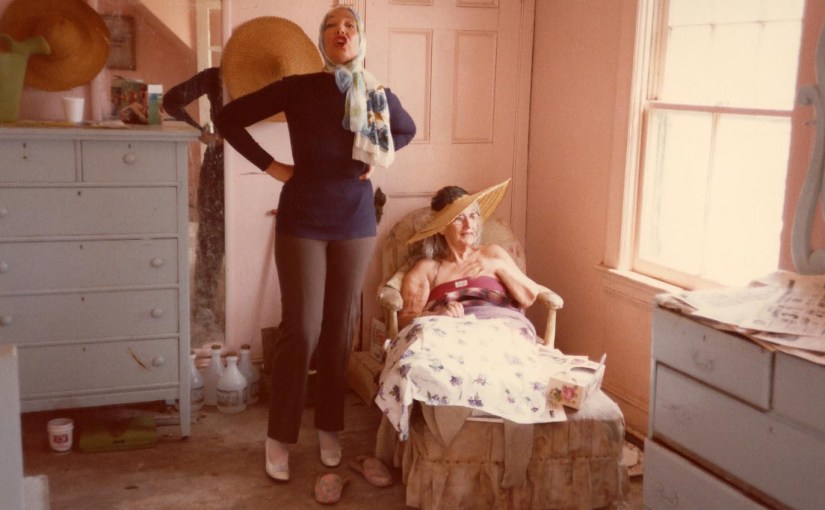
PLOT: The celebrated Maysles brothers spearhead this cult classic documentary about Big and Little Edie Beale, reclusive and eccentric cousins of Jackie Onassis who occupy a crumbling mansion in East Hampton, New York.
I have seen and loved many documentaries in my life, from the sublime (Baraka, 1992) to the absurd (The Aristocrats, 2005), from the terrifying (Gimme Shelter, 1970) to the edifying (Dark Days, 2000). But after watching the cult classic Maysles brothers documentary Grey Gardens, I am sitting in front of my computer terminal and I am at a loss of what to say about it, beyond a summary of its contents.
As the film opens, Big Edie Beale, who celebrates her 79th birthday during the film, and her daughter, Little Edie Beale, 52, reside in a sprawling mansion nicknamed Grey Gardens in a high-end East Hampton neighborhood. Their biggest claim to fame before this film is that they are cousins to Jackie Onassis. To say their house is a mess is an insult to both the words “house” and “mess.” It’s a dump, although we are shown newspaper articles that seem to indicate the house was in even worse condition before the Maysles started filming. The state health department threatened eviction unless the mansion was cleaned up; there’s even a photograph of Jackie O pitching in with the cleanup. Through the course of the film, the Maysles and their film crew will capture what some have described as “an impossibly intimate portrait” of a relationship between two people whose minds have retreated to a point where they scarcely notice their surroundings as they repeatedly hash out old arguments from years past.
Any fan of film has at least heard the name Grey Gardens or the names of the Beales at some point in their life. I’m told it’s featured prominently in at least one episode of the television show Gilmore Girls. The Criterion Blu-ray contains two interviews from noteworthy fashion designers who have both designed clothing lines directly inspired by Little Edie’s clothing in the film. There are even pictures of a European photo shoot that replicates scenes from the movie. This is arguably one of the most famous documentaries of all time.
So, I hit play on my Blu-ray player and started watching. The cameras do indeed capture intimate moments between mother and daughter. Little Edie’s fashion sense involves never being seen without something covering her head, whether it’s a turban, a sweater, or a dishtowel. Big Edie spends – based on what I saw – most of her days in bed, leaving only to take in the sun on her porch or to use the restroom. Sometimes she leaves the bed to eat a meal, but Little Edie usually brings the food to her mother. In one sequence, Big Edie cooks corn on the cob on a hot plate while sitting in bed. She shares her bed with one or more of their many cats, as well as various boxes, books, binders, and photographs. The mattress is dotted with water stains and what appears to be rust.
But wait, there’s more. There is a hole in the top corner of a wall in one of the hallways. This is where a raccoon lives. At one point, Little Edie leads the camera crew to the attic to perform her version of pest “control.” She empties a loaf of Wonder Bread onto the attic floor. Then, as an added treat, she empties an entire box of dry cat food on top of the bread.
Now, why am I mentioning the state of their surroundings instead of recounting the delightful (I guess) eccentricities these two women proclaim at each other night and day? Because I could not take my eyes off the backdrop of the house itself, which is as much a character in the film as the Overlook Hotel is in The Shining. There is a room that Little Edie is in the process of decorating, but it looks as if her design process is stuck at a fourth-grade level. The grounds of the mansion appear to be in utter disarray, overgrown and wild, with unchecked vines and bushes threatening to swallow the house itself. Every corner of Big Edie’s bedroom is laden with stacks of boxes containing old photo albums and vinyl records, many of which feature Big Edie herself. (She was a recording star back in the day, apparently; she doesn’t sound half bad.)
We are treated to many scenes featuring Little Edie talking to us about her past, how her mother curtailed her ambitions to be a model in Europe in order to come back home and take care of her. How her mother sent away one of her suitors because she, Big Edie, didn’t want another cook in her kitchen. We hear from Big Edie talking about how wild Little Edie was, how she was so hard to handle, so she had to treat her sternly. There’s a scene where Little Edie sings and sings, and it’s clear she is not as gifted as her mother was, but do you think that’s going to stop her? No, ma’am, not even when Big Edie begs for a radio so she can listen to something else, ANYTHING else.
I’m watching all of this play out, as the directors capture remarkable footage and whispered conversations. It is undeniably bizarre, yes, and some of it is mildly entertaining. (Little Edie’s dancing scenes are worth the price of admission.) But I could not stop asking myself this question while I was watching: “Why?” Why is this movie necessary for me to watch? What do I gain by becoming a fly on the wall and being privy to conversations between two people who would be better off if they lived in separate houses? In separate states? What am I missing? I would imagine I could find all those answers in various other online reviews or movie blogs, but if those answers didn’t occur to me while watching the film, who should I blame? My own preferences, or the film itself? Yet another answer I don’t have.
I’d like to think my cinematic taste is relatively evolved, although I was a bit of a late bloomer. I didn’t see the gangster masterpiece The Public Enemy (1931) until recently, and I have yet to see more than one film by Abbas Kiarostami. But I love a great documentary, and this has a reputation for being one of the genre’s best. So, why did I not respond to it as enthusiastically as so many other people have? What am I missing? How is this entertaining? This might hit more poignantly with mothers and daughters, but I’m just speculating.
I have no answers. I can only promise that, at some point, I will watch this movie again because I do think it deserves another chance. I don’t know when that will be, but when I do, I’ll try to ignore the house and focus more on the characters. I’ll keep you posted.
 2 UNPAID MOVIE CRITICS!!!!