FIGHT CLUB

By Marc S. Sanders

David Fincher’s Fight Club is a deliberately ugly and dreary film. It has to be to evoke the insomnia its narrator (Edward Norton) suffers from, as well as his lonely depression that offers no answers for his purpose to exist or to be loved by another person.

To alleviate his need for something fulfilling, the narrator resorts to attending support groups for men suffering from illnesses and debilitating diseases like testicular cancer. There he meets a former body builder named Bob (the singer Meat Loaf) who has developed floppy breasts after going through hormone therapy. Bob follows the processes of the self help group and embraces on to Norton’s character as a means of support; stuffing his face into Bob’s breasts. The narrator eventually becomes accustomed to this maternal practice and the ritual of attending these meetings as a regular process. However, he feels he is getting upstaged by Marla (Helena Bonham Carter), a punk looking girl with dark eyeliner and wild jet-black hair.

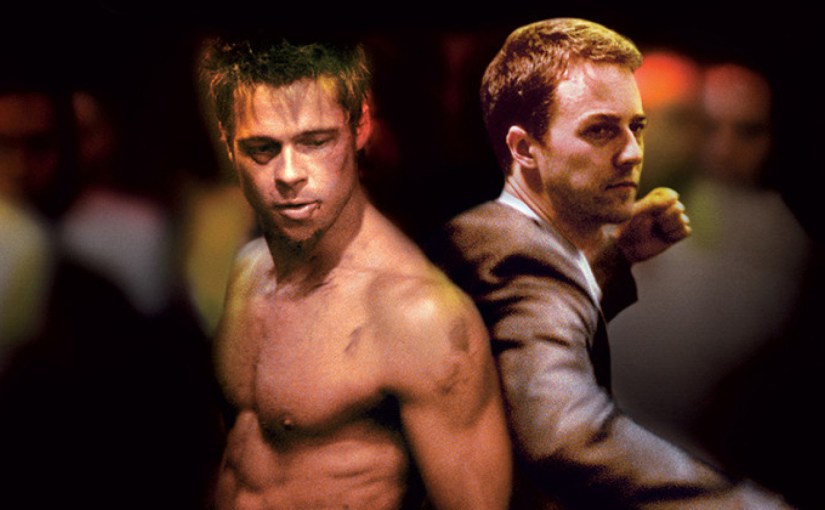
Even though Marla and the narrator negotiate who attends what meetings and on what night, Norton meets another punk like reckless character known as Tyler Durdin (memorably played by Brad Pitt) who manufactures and sells soap but also edits film reels, sneakily inserting penis images into family films. Tyler also works as a waiter at a high-end restaurant where he proudly adds a little of “himself” to all the courses that are served.

The narrator only works at a boring desk job where his boss uses any opportunity to look down upon him and chastise him on his performance or appearance, but never recognizing anything further within his nature. The boss could care less about him. Naturally, the narrator becomes in awe of Tyler’s behavior. Tyler is a rebel and offers much more beyond Bob’s comfort. Tyler serves a purpose for the narrator to pursue.

When Tyler challenges the narrator to hit him as hard as he can it eventually leads to a new kind of gathering for both of them, a support group known as Fight Club. Men from all over soon gather underground to partake of letting out their aggressions with bare knuckle fists and wrestling. Anyone attending gets a therapeutic vibe from bleeding and bruising themselves upon one another. The narrator certainly feels better.

Going a step further leads Tyler and the narrator to fight back against a system of order and capitalism. Their philosophy picks up traction and soon a form of revolution is taking place across the entire country. Somehow, the narrator is taken off guard by this new belief system.

There’s a lot to consider and question in Fight Club, though I’m not sure I care for the film as a whole to debate its message. Sometimes it feels like it’s not moving anywhere. Norton’s character learns things about his own consciousness and need to falsely subject himself as a cancer survivor or as an underground brawler because he has nothing else really going for him. I get that, but why should I care or like it?

Tyler Durdin resides in a broken down house on the other end of the city that is leaking from every pipe and it’s electricity could ignite another fire that maybe this decrepit dwelling survived once before. Tyler is happy with his home and happy to share it with the narrator as well as Marla whom he has endless sex with. Tyler doesn’t want the fancy trappings. It’s revolting to even possess such materialism and suck off the tit of a capitalist regime. With the narrator at his side, he encourages a fight against the power of commercialism and wealth. Find a way to destroy the structures of what the country has built itself into, perhaps.

That’s the message of Fight Club. I just can’t lay claim that I cared for the execution of the revolt. I’m supposed to laugh at Tyler’s antics at times like when he steals the gross liquid fat from liposuction patients to manufacture the soap he sells. Yes, we get a moment where the bags of fat leak and splatter all over the place. It was just never amusing for me. I found no symbolism in this passage. It’s just absolutely disgusting. When Tyler happily pisses in someone’s soup, I don’t think it’s funny either. I don’t like Tyler. I don’t envy him or want to be him. I don’t find anything to cheer for with him. I’ve got more admiration for John Bender in The Breakfast Club than I do for Tyler Durdin. I might respect what he stands for to a degree as we are a culture brainwashed by advertising and commercialism. I just don’t care for the actions taken by this so-called martyr on behalf of the self-described unfortunates like Norton’s narrator.

I also find it ironic and quite hypocritical that Fincher’s film is a call to stand up to materialism and commercialism and yet the cast is headlined by Brad Pitt, arguably one of the biggest box office stars of the last 30 years, complete with his name above the title and his image front and center ahead of Edward Norton’s on the film posters that promote the film. Pitt is also the guy you see first, last and all over the middle of any of the film’s trailers and advertisements.

Now tell me, is that not a contradiction in terms?
GONE GIRL

By Marc S. Sanders

David Fincher is best when he builds tension in dark cinematography. It’s eerie and moody, but it all seems to make appropriate sense.

A skilled director like him proves that even with Lifetime television soap opera material, if delivered with care for detail and with genuine acting he can hold on to the attention of a scrupulous movie going audience. Haunting filmmaking, like Fincher is known for with movies like Seven or Panic Room, can also work in sensational material that at first might draw the attention of lonely housewives pigging out on Rocky Road ice cream while watching hours upon hours of scorned victim gossip material on the WE Channel. Gone Girl adapted from the best-selling novel by Gillian Flynn, who also wrote the screenplay, is a thrilling cinematic piece even if the story’s ending is a little disappointing.

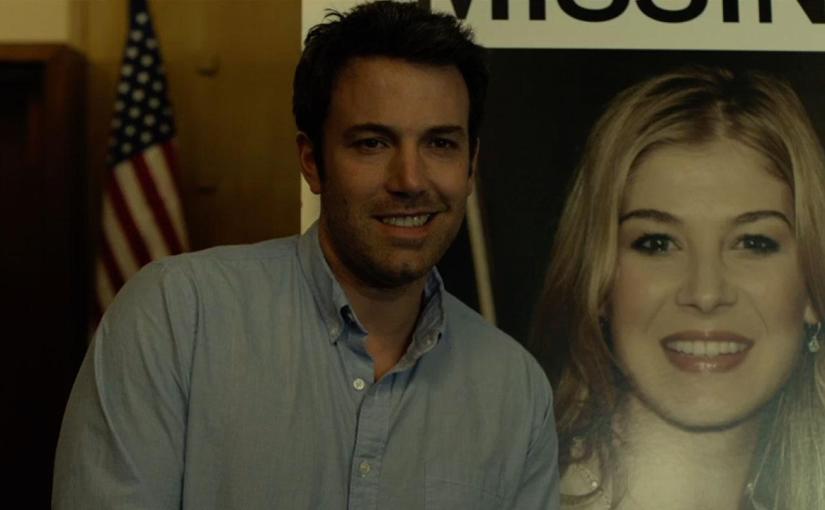
Ben Affleck plays Nick Lowe who discovers a broken glass coffee table in his home and realizes his wife of 5 years is missing. Rosumund Pike is Amy, who seemingly vanished without a trace.

Fincher closely shoots Flynn’s story with developments you might expect or have experienced with various news stories and documented investigations by sensational legal journalists like Nancy Grace. Nick, with Amy’s parents (Lisa Banes, David Clennon), initially form a united front for the press but that falls apart when it’s uncovered that Nick has had an affair. Amy had a close neighbor who expresses tearful concern that cameras latch on to for ratings. The cops (Kim Dickens, Patrick Fugit) grow more and more suspicious of Nick. Nick eventually hires a high-priced lawyer (Tyler Perry). Nick is eventually considered to be an abusive husband as well. It all adds up.

These are the steps you’d expect from a missing persons case. You might also suspect murder, but no one can claim that out loud if there’s no body to be found. So, toe the line carefully detectives, journalists, & gossip mongers!

What is not expected in Gone Girl are the surprises that open up midway through the picture, and the book. Flynn is a really inventive storyteller, and Fincher as director gives ample opportunity to answer for every surprise up the writer’s sleeve. Gone Girl plays with a lot of internal character thought to process its details.

I had read the novel long before the movie was even cast, and I couldn’t put it down. That being said, I was frustrated when the conclusion arrived. I can say the same for the faithful film adaptation. It’s an ending that could happen but, wow, is it a long shot.

Rosamund Pike was Oscar nominated as Amy, the complicated wife in this marriage. She’s good at occupying the complexity of her past shown in flashback. She’s likable in many moments, but then Amy is also a character that we are reluctant to trust based on her relationship to Nick, as well as her own parents.

Affleck remains a good actor with this picture. I think it takes an honest actor, writer and director to accurately show a man who might not be responding to this crisis like a general public expects. I think much of Affleck’s personal issues of infidelity and alcoholism in the public eye lend credence to how genuine he makes Nick out to be. Could this guy be handsome enough to think he could harm or actually murder a woman as beautiful as Amy; the “Amazing Amy” as she’s widely known in her mother’s series of best-selling children’s books? Is Nick that good at hiding his evil side? On the other hand, is Nick simply innocent, despite all the skeletons that are gradually uncovered? That’s a fair question as well.

Again, Gone Girl is superb in its delivery. It’s ending, though, is the setback. At least I felt that way. For every reader, like me who considers it dubious, I’m sure there are readers who applaud the inventiveness of Gillian Flynn’s gripping and modern mystery.

I guess if a good story prompts a group discussion on a Saturday night, then a really good novel or a great movie has achieved its purpose. At the very least, I consider that a great compliment for an outstanding cast, director and writer.

SEVEN

By Marc S. Sanders

There’s an interesting dynamic to David Fincher’s Seven that is not touched upon often enough.  Beyond the clever and grisly murders set to a theme of the Seven Deadly Sins, the two police detective protagonists are carved from completely different molds.  The spine of Fincher’s film, written by Andrew Kevin Walker, focuses on how these men approach the craft of the killer’s accomplishments.  One man wants to cut to the chase, find the criminal and cuff him.  The other wants to study the nature of this mystery man, and only then will it lead to the suspect’s true identity.

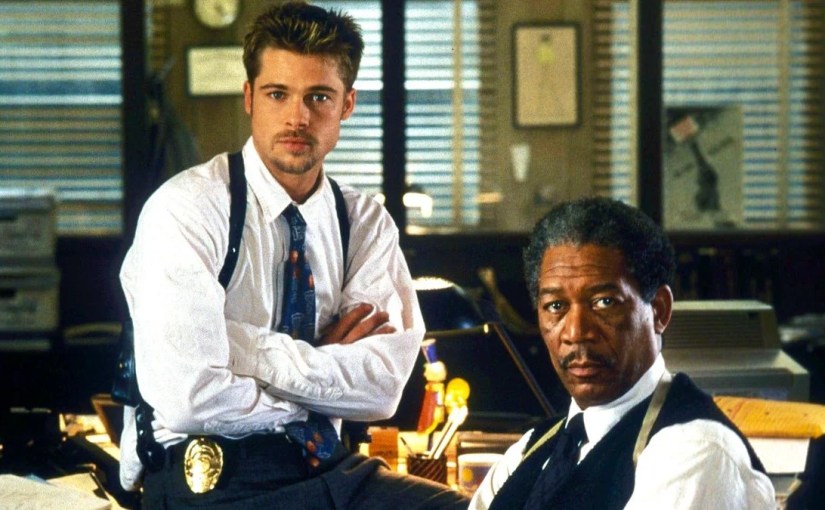
Detective William Somerset (Morgan Freeman) stems from a time gone by for the cinematic detective.  He’s the trench coat wearing investigator who examines and connects dots, never resorting to fists or police intimidation with a gun.  Newly assigned Detective David Mills (Brad Pitt) dons the leather jacket with the cute goatee and boy blond haircut.  He’s more apt to making fun of the sick weirdo they are chasing, hardly lending any valuable insight or observations.  Somerset will approach with respect for the killer and his work.  Mills, with nowhere near the experience of his new partner, will disguise his loss of where to begin with this case by resorting to cheap shots at the killer’s expense, calling him Yoda and surmising this guy must be pleasuring himself in peanut butter, perhaps.

Fincher is widely recognized for the dark photography of his films, like the cherry wood hallways of Harvard in The Social Network or the lurid neighborhoods in movies like Zodiac and Gone Girl.  In Seven, the setting is very much a character in and of itself, but other than the fact that it is a California (thanks to a throw away piece of dialogue) metropolitan area, we never know the name of this city.  It is a dreary, ongoing rain-soaked environment that hinders the police officers and keeps everyone contained in the film, especially David’s wife Tracy (Gwyneth Paltrow), unsettled.  The city has no name or identity.  Therefore, the police officers who occupy it are not the stereotypical cops designed for this place.  One works as a tired, wise and experienced Colombo figure, minus the sarcasm.  The other is an aggressive hot shot who is over trying to prove himself to peers and superiors.  Now he wants to be in charge.  They both follow the footsteps of the mystery together.  Yet, they are reading different roadmaps.

With seven days left before retirement, Somerset meets newly arrived Mills.  They are quickly dispatched to a filthy apartment for an ugly murder scene of an odd nature.  It is a scene labeled as Gluttony by the killer.  Greed follows shortly thereafter, and Somerset knows none of this random.  Whoever has orchestrated these two executions is methodical and resourceful, with a point to prove.  The artistic measure and inspiration are too creative, far from the sloppiness of a standard stabbing or gunshot to the head.  Somerset already knows five more murders will likely turn up and doesn’t want to get involved.  He’s seen enough.  Mills has the cavalier attitude.  Find the freak, and maybe take him out in a blazing shootout.  It’s reckless. 

Could Seven be an answer to how cop movies performed at one time and how they act now?  Seven may be the closest outline of pairing Humphrey Bogart’s Sam Spade with Mel Gibson’s Martin Riggs.  Sure, the murder scenes are hard to look away from, as deliberately repulsive as they are.  Even after multiple views of the film, I still get curious with how the killer planned all of this out to the absolute most minute detail.  However, ninety percent of the dialogue is exchanged only between Freeman and Pitt. Paltrow has a couple of scenes that help paint the sad picture of life in this city, but ultimately the film belongs exclusively to the two cop characters.  Seven has one action scene, but it primarily covers how the two men respond to the nature of what they come upon.  Mills will crack jokes that maybe his college pals would snicker at.  Somerset asks the young man to just be quiet while he explores the scene.  Mills gets grossed out by a bucket of vomit.  Procedurally, Somerset will ask Mills if there was any blood in it.  Mills will resort to Cliff’s Notes on the Seven Deadly Sins.  Somerset will spend his evening in the library, digging through the original source.  Mills will kick down a door without authority.  Somerset will protest against that action without following the standards of procedure.  It’s a dichotomy of impatience versus patience.

The two men actually don’t come to a common platform until the third act of the picture, when the rain has subsided, the sun comes out, and the killer opts to surrender himself.  Still, the mystery of his purpose remains and there’s an unknown element of what to expect next.  So, while the partners may agree that there’s more to come, they still respond to the killer, in person, differently.  Mills can only yell at the deranged suspect and call him names.  Somerset interviews the gruesome and imaginative architect with questions. 

Seven is a sensational crime drama.  It’s eerie, creepy and appreciatively sickening in its crimes.    The outline of some of the killer’s actions might seem conveniently questionable or far-fetched.  Some of the crime scenes were planned over a year’s time. Others were not meant to be revealed until a certain point within these particular seven days.  So, the writing might be a little too overly precise.  However, that should not be dwelled upon.  Rather, one kind of cinematic cop is not the standard in Hollywood films anymore.  Another kind of cop has filled that void in its stead. 

Andrew Kevin Walker’s script follows a very structured outline.  It’s not until the story’s infamous end does the film divert itself, as it is almost unfathomable that it could have actually happened. 

It is fortunate that David Fincher was allowed vast liberties with the production of only his second film, following the abysmal Alien 3 which famously took away any of the personal oversight he depended on as a rookie filmmaker.  With Seven, Walker and Fincher draw out four characters quite well – Somerset, Mills, the city with Tracy as its spokesperson, and the killer’s actions.  Blend these elements together and see if they make for a good product.  Fact is they couldn’t be any more disagreeable, but the chemistry works perfectly. 

Seven is a sensational movie and will likely always remain as one of David Fincher’s best films.

PANIC ROOM

By Marc S. Sanders

There are few films I come across where a phone call to 911 is immediately put on hold. There are few films I come across where the one in danger has an opportunity to speak face to face with a policeman while the burglars factually can not hear, and will still not relay that she, her daughter and her ex-husband are in danger. There are few films. Just a few. David Fincher’s stupid excuse for a cat and mouse thriller known as Panic Room is one of those few films.

I can forgive loopholes on occasion for the sake of maintaining suspense and to simply have a complete movie. I can not forgive it here however. Opportunities open up easily for Jodie Foster and Kristen Stewart to take an upper hand. Equally so, moments open up for the bad guys as well, played ineptly by Forest Whitaker, Dwight Yoakum and Jared Leto. The game of outsmarting you might find depicted in Home Alone is more sensible than David Koepp’s mindless script.

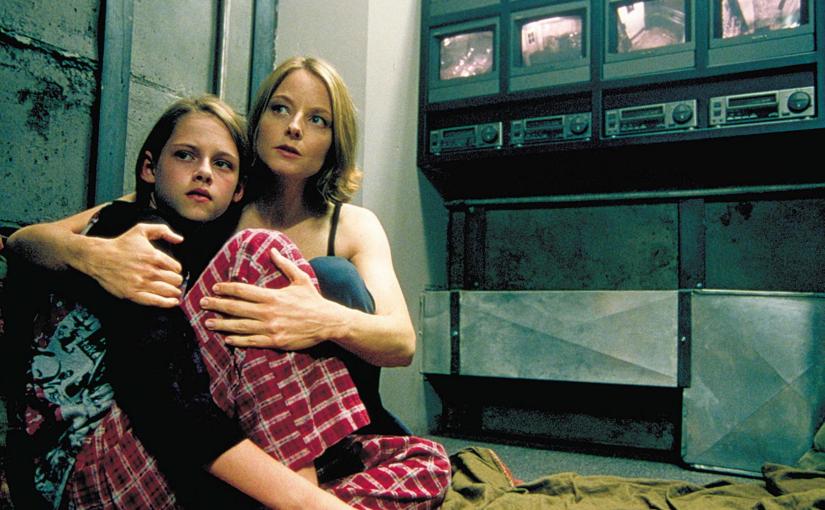
The three bad guys break into a home equipped with a sealed panic room. As they get in, Foster and Stuart make it into the secure area before being taken captive.

Fincher does great camera work within a 3 story New York brownstone. He can capture in a single shot a close up of a breathless Foster in one half of the screen while a menacing figure walks covertly down an adjacent hallway on the other half. The labyrinth of the house looks good in darks and midnight blues. That’s where the attributes of Panic Room stop, however.

Everything else is controlled by manufactured contrivances offered up by Koepp’s script. Security cameras can be smashed while it just so happens that the thieves are not watching the monitors. When the electronic door to the room is opened, no one will hear a thing until a lamp topples over. You don’t even here the buzzing or slam of the steel plated door. You can also sneak around the wooden floors and will not be heard until Koepp’s writing and Fincher’s direction allow it. Otherwise these old floors will creak and echo. I talk often about how the environment in a film is a character in and of itself, like the Overlook Hotel in The Shining. Well if this brownstone is giving a performance in this film, then it dropped a line, came in too early, came in too late and missed a dozen cues during its performance.

Policemen will come to the door and nary insist on coming inside the home, where a dead body lay as well as a wounded hostage and various wreckage is strewn about. Foster knows the bad guys can’t hear a conversation while they are in the panic room, but she will still not share the fact that she’s in peril. Why????

Most infuriating is that 911 will take an emergency call and put her on hold. That’s where I checked out. Nothing else mattered.

Panic Room is beyond intelligence in so many ways.

Oh yeah, also there are no neighbors within an adjacent neighborhood of brownstones that ever hear the commotion at hand.

My colleague Miguel might say, “well then you’d never have a movie.” My reply is Panic Room doesn’t seem like it ever was a movie to begin with.

THE SOCIAL NETWORK

By Marc S. Sanders

Power and knowledge can be a dangerous thing for a kid who is not necessarily as mature as his IQ would suggest. Mark Zuckerberg reinvented the way an entire planet functions from his Harvard dorm room. In the process, he couldn’t have cared less about the antagonism he was generating.

David Fincher’s The Social Network, with a brilliant screenplay by Aaron Sorkin captures kids with too much opportunity to seize, and the hubris they carry when they discover money, jealously, pride, and greed through a winning societal experiment.

The film features one of the best casts ever assembled, at least definitely within the confines of the 21st Century. Andrew Garfield, Justin Timberlake (should’ve been nominated), Armie Hammer (one of the best twin brothers’ portrayals in film), Rooney Mara, Brenda Song, and of course Jesse Eisenberg. Sorkin wrote the dialogue. It’s another thing to deliver it.

These people talk before they think, and it’s likely what caused them the aggravations of their own success and discovery. Watch the first scene between Eisenberg and Mara, as Zuckerberg and his girlfriend, Erica. Zuckerberg is already too smart for his own good. His failure with dating Erica is destined to be his undoing. He’ll never recover from this moment. Never! This is a kid with his hand on the nuclear button and he can’t stop pushing it. The other characters are all the same. Harvard geniuses with so much to gain, but how much will they lose?

Mark Zuckerberg, Cameron & Tyler Winklevoss (the self-absorbed twins of prestige and legacy), and Sean Parker (inventor of Napster) are prophets of a bigger picture. They foresaw the basic human desire for attention. People’s needs to be noticed are the commodities to monetarily profit from. These kids knew that better than anyone else. Ironically, Zuckerberg’s best friend and financial partner, Eduardo Saverin (Andrew Garfield), didn’t know it until he realized he was a large step behind. It cost a lot of money. Ironically, in the process of creating a new means of connecting with friends, it suffered the cost of a friendship, as well.

The Social Network will always be one of my ten favorite films. (Talk about huge Oscar upsets…excuse me The King’s Speech for Best Picture????) I’m always amazed at these kids with power. The knowledge they possess is bigger than anything within the confines of our historical governments, and yet they bicker and steal and betray like toddlers in a sandbox. Switch out “Facebook” for a Nerf football or a Barbie doll, and you can still apply this fast-paced wit of words. Sorkin pounced on that dichotomy. We’ve seen civil lawsuits on film with grand disputes and long speeches in front of arbitrators. We had yet to see college students dominate tables full of lawyers with crackling dialogue exchanged to prove their worth over one another. Amazingly enough, Sorkin used much of the dialogue from recorded transcripts he accessed. These guys actually spoke like this with each other. These technological pioneers gave the planet’s people the attention they wanted. Yet, what ultimately mattered to them was the credit for what they felt entitled to.

I’ll never tire of watching The Social Network, even if listening to Mark Zuckerberg is as exhausting as talking with a stair master.

One of best films ever made.

THE GAME

By Marc S. Sanders

David Fincher is a director always focused on playing tricks with the viewer’s mind. His earliest films from Alien 3 (a poor installment in a celebrated franchise) to Se7en (an unrealistic yet frighteningly suspenseful serial killer story) to his third motion picture The Game, a movie that throws you off from the beginning of each scene to the end of each scene are best examples of this technique. It’s a little jarring, and I’m happy to watch it that way.

This film only works if you mask what’s really happening by showing you what’s fake instead. I know I sound vague but those that have seen The Game would probably agree that is the point. It’s based off a screenplay (by John Brancato & Michael Faris) that strategizes itself like a Dungeon Master setting up a Friday night in the basement with some buddies to play some role playing games with a 20 sided die.

Michael Douglas is really the only guy who could play Nicholas Van Orton, a millionaire with everything but really has nothing; no friends, no spouse (any longer), no one to care about. Beyond his fortune, all he has are a weirdly estranged brother, played by Sean Penn, and his attorney only there to ask Nicky “Should I be worried?” The film takes place during Nick’s 48th birthday. Normally, the song would go “Happy Birthday Nicky.” However, for Douglas’ cold protagonist, the lyrics are “Happy Birthday Mr. Van Orton.” A man with everything, who really has nothing.

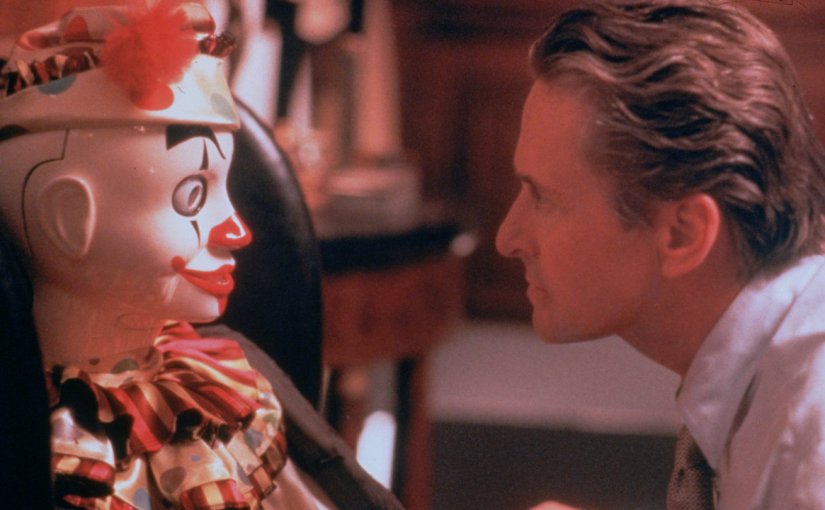
Penn gives him a card with a number to call. This is his birthday present to Nicky. Then the paranoia presents itself little by little; a wooden clown doll, a tv that talks to Nick, a leaky pen, spilled drinks, and soon Nicky’s life is threatened.

Why are these things happening? What’s with the keys? What’s with the waitress who keeps turning up, played by Debra Kara Unger so effectively that she arguably carries the riddles most convincingly? Unger is brilliant at twisting the story over and over. Another great player is well recognized character actor, the late James Rebhorn (also known from Scent of a Woman) who gets the ball rolling and then wraps up the answers later on.

Fincher plays with the mind quietly but never at a slow pace. There’s a consistent tinkling of piano keys that seem to work as puzzle pieces being matched up. It’s much more disturbing to go this route than with grand horns and bass.

When I saw The Game initially in 1997, I started to piece together how to write multi dimensional characters. There’s a past that gnaws at Nick’s psyche sprinkled with glimpses of his father committing suicide. Fincher offers up a background to Nick by means of grainy home movie footage. It all seems quick and taken for granted but it’s necessary to understand Douglas’ cold demeanor and it circles back beautifully towards the film’s unexpected ending. It works so well as a motivator for Nick that I often circle back to its presentation when I write my own scripts.

There’s a great, short scene that sets up the 3rd act. Probably Michael Douglas’ best scene ever in a film, in my opinion. Nick walks into a diner in a dirty suit with scratches on his face. He asks for everyone’s attention and offers up his last $18 to anyone who can offer him a ride. The character is humbled and changed. An arc is completing itself on the other end. It’s a scene that maybe doesn’t belong here until you realize it does. In another director’s hands, a scene like this would be cut or never shot. Fincher took advantage of Douglas’ technique for substituting intimidating power with humble gratitude to simply be able to just ask for a favor. A new character is born in a most efficient 90 seconds of film. It’s a great moment.

See The Game whether you haven’t seen it yet or to watch it again to remind yourself how all the pieces come together.

You might argue that this can’t be realistic but suspend your disbelief because that is what David Fincher always strives for. You’ll be glad you did. Trust me, or maybe…don’t trust anyone?!?!?!?