
by Miguel E. Rodriguez
DIRECTOR: Andrzej Wajda
CAST: Zbigniew Cybulski, Ewa Krzyzewska, Waclaw Zastrzezynski
MY RATING: 7/10
ROTTEN TOMATOMETER: 96% Fresh
PLOT: Against a backdrop of internal political turmoil at the end of World War II, a Polish resistance fighter faces a crisis of conscience when ordered to assassinate a Soviet official.
The Polish film Ashes and Diamonds is reportedly Francis Ford Coppola’s favorite movie, and Martin Scorsese has stated in interviews that he used it as an answer for one of his finals at film school. From a technical standpoint, I can see why. Echoes of this film (and perhaps others from director Andrzej Wajda’s filmography) are overwhelmingly evident in the bodies of work of both directors, from the mobile camera to the shocking moments of violence to the psychological makeup of the characters themselves. As an emotional experience, I confess I didn’t get “worked up” over it, but it was interesting to see where two of the greatest American film directors got a healthy dose of inspiration.
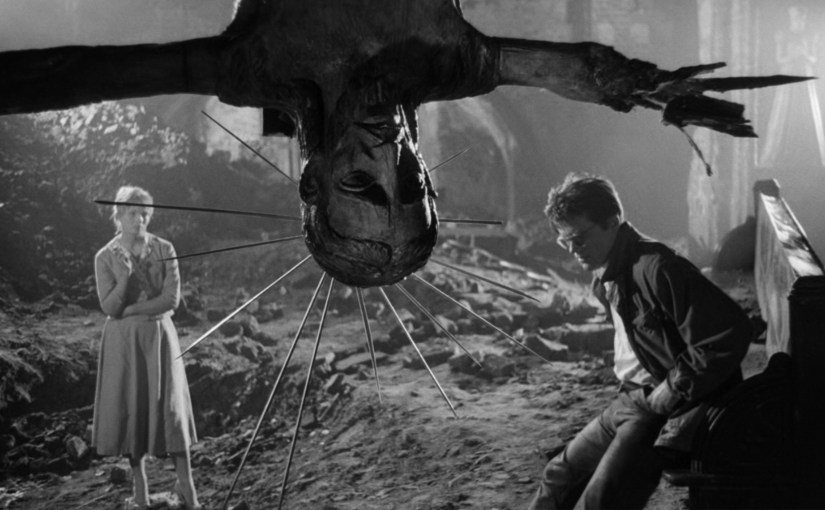
Ashes and Diamonds opens on May 8, 1945, with an idyllic scene outside a country church that quickly degenerates into a brutal double murder. The killers are the calm, detached Andrzej and the flighty, charismatic Maciek, who spends most of the movie behind dark sunglasses. We quickly learn their victims are not who they thought they would be. Instead of killing two Soviet/Communist officials, they have killed two innocent factory workers. War is hell.
Later, through circumstances that feel very Hitchcockian, Andrzej and Maciek hole up in a hotel bar, only to discover that one of their real targets, Szczuka, has booked a room in the very same hotel. Maciek books a room directly below Szczuka’s, and the rest of the film plays out with that element of suspense hanging in the background, leaving us to wonder when and how Maciek will complete his assignment.
Complications arise when Maciek becomes infatuated with the hotel bartender, Krystyna, a blond beauty who rebuffs Maciek’s advances at first. Later, they connect, but she doesn’t want to get involved with someone when it will eventually have to end: “I don’t want bad memories when memories are all I have left.” Maciek falls for her so hard that he starts to doubt his resolve to kill his target. “Will he or won’t he?” becomes the movie’s prime conflict.
Where to begin with the comparisons to Coppola and Scorsese? The most obvious one is the unblinking attitude towards violence. The two killings at the beginning of the film are done with very few cutaways as we see the multiple bullet hits on each victim, with one of them getting hit in the eye and another shot in the back at point blank range with such force his shirt catches fire. (Malfunctioning squib? Possibly, but it’s still effective.) It’s interesting that this movie predates Bonnie and Clyde (1967) by almost a decade, but its depiction of onscreen violence feels very modern, even by today’s standards.
Then you’ve got the moral struggle of the main character, a man of action capable of casual murder who is suddenly given a reason to make something different with his life. This reminded me of Scorsese’s The Departed (2006), with DiCaprio’s character undergoing the same internal conflict. Maciek has multiple opportunities to kill Szczuka throughout the film, but something always pulls him back from the brink. His partner, Andrzej, becomes impatient and reminds him what happens when soldiers let personal feelings interfere with their duties. I had a vivid flashback of Michael Corleone’s credo: “It’s not personal, Sonny. It’s just business.”
(I also felt that the dynamic between Maciek and his more level-headed partner Andrzej were evoked in Scorsese’s Mean Streets [1973], with De Niro’s Johnny Boy and his more level-headed partner Charlie, played by Harvey Keitel.)
But, cinematic comparisons aside, I didn’t find Ashes and Diamonds to be as gripping as other war or crime dramas of that era, such as Elevator to the Gallows, Touch of Evil (both 1958), or Rififi (1955), to name a few. It’s a little weird to me, because all the pieces are there for a first-rate thriller. I’m not asking that every drama pack the exact same kind of emotional gut punch every single time because I know that’s unrealistic. But the fact remains: Ashes and Diamonds, while clearly very influential on future filmmakers, did not get me as involved as I would like to have been. I was never bored, but neither was I over the moon. It was…average. Perhaps one day I’ll watch it again with a fresh eye to maybe see what I missed the first time around.
 2 UNPAID MOVIE CRITICS!!!!