
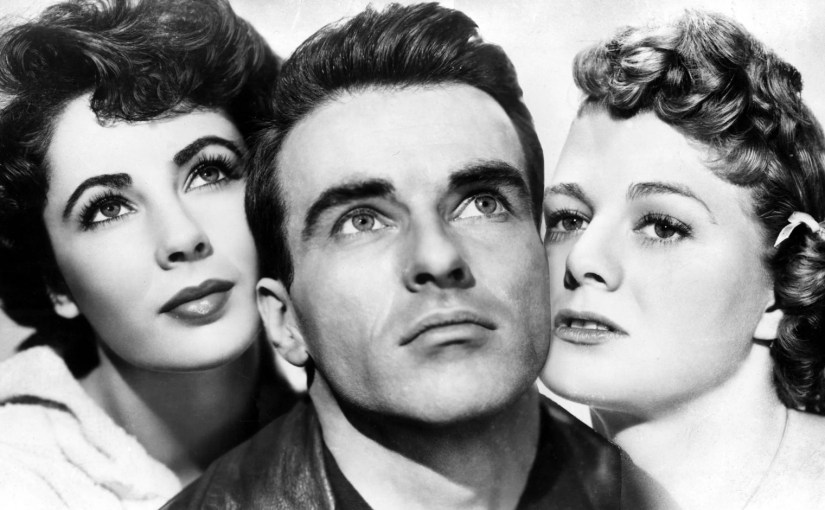
A PLACE IN THE SUN (1951)

by Miguel E. Rodriguez

DIRECTOR: George Stevens
CAST: Montgomery Clift, Elizabeth Taylor, Shelley Winters, Raymond Burr
MY RATING: 9/10
ROTTEN TOMATOMETER: 82% Fresh

PLOT: A struggling young man gets a job working for his rich uncle and ends up falling in love with two women, one rich and one poor.


I first saw A Place in the Sun many moons ago at a friend’s house.  I remember enjoying it but thinking it was too soapy for my taste.  Years went by.  I finally got around to watching Woody Allen’s Match Point and was stunned at how much Allen’s film borrowed from George Stevens’ celebrated melodrama.  Having just re-watched A Place in the Sun, my opinion of it has warmed considerably, without diminishing my admiration for Match Point, which remains one of my favorite films of all time.

A Place in the Sun tells the story of young George Eastman, played by Montgomery Clift at or near the height of his powers.  He’s a bit of a layabout who wrangles a job at his rich uncle’s swimsuit factory.  When George meets his rich relatives, I was reminded of a George Gobel quip: “Did you ever get the feeling that the world was a tuxedo and you were a pair of brown shoes?”  That’s George Eastman to a T, a ne’er-do-well in a sea of the well-to-do.

Against company policy, George falls in love (or at least in lust) with a rather plain girl, Alice, played by Shelley Winters in a de-glamorized role that went completely against type at that point in her career, winning her a Best Actress nomination.  Alice and George flirt and hold hands and occasionally neck (mildly scandalous for a 1951 film), but George can’t help but stare at another girl who pops up occasionally: Angela Vickers.  Angela is played by a ravishing Elizabeth Taylor, who was only 17 at the time of filming and empirically one of the most beautiful women in Hollywood, if not the world.  It’s not too hard to imagine any man, let alone poor George Eastman, falling in love with her instantly.

But George is still connected to Alice, especially because he’s already slept with her.  When George learns Alice is pregnant, he despairs because he had been planning to end things with Alice to pursue Angela.  Alice even visits a doctor who might possibly provide an abortion.  Of course, this being 1951, “abortion” is never mentioned out loud, nor is the word “pregnant.”  But Alice’s visit to the doctor is handled with incredible intelligence and brilliant screenwriting that manages to say everything it needs to say without ever uttering those forbidden words.

The rest of the film examines what George may or may not be willing to do for the sake of his love for Angela, who loves him back, it turns out…but she doesn’t know about Alice.  Since this is based on a then-famous novel called An American Tragedy (by Theodore Dreiser), it may not be too hard to divine what is in store for George before the final credits roll, but getting there is the fun part.  By casting heartthrobs as the hero/anti-hero and the rich girl he loves, the film cleverly gets us to root for them a little bit, even when George is considering murder.

While Elizabeth Taylor dominates every scene she’s in just by standing there, the Academy made sure Shelley Winters was recognized for her incredibly difficult performance as Alice.  There are some movies where, if a character is an emotional yo-yo, it can be frustrating.  With Alice, Winters never crossed a line into unlikability, even when she calls George at a fancy dinner party demanding he marry her tomorrow, “or else.”  It’s clear she has no options left to her if she wants to have any semblance of a life in polite society (by 1950s standards, anyway).  I felt bad for her.  But I also felt bad for George – to a degree – when he demonstrates how sincerely he has fallen head over heels for Angela.  Not just because she’s stunningly beautiful, but also because she really seems to have fallen for him, too.

Lately, my movie-watching itinerary of classic films has involved a fair share of outstanding melodramas (Leave Her to Heaven, 1945; The Heiress, 1949; Dodsworth, 1936).  A Place in the Sun fits right into that mold.  It doesn’t quite achieve the perfection of The Heiress, but it is a fantastic example of its genre, good enough for Woody Allen to “reimagine” its basic story for Match Point, so it’s definitely worth a look if you’re into that kind of thing.
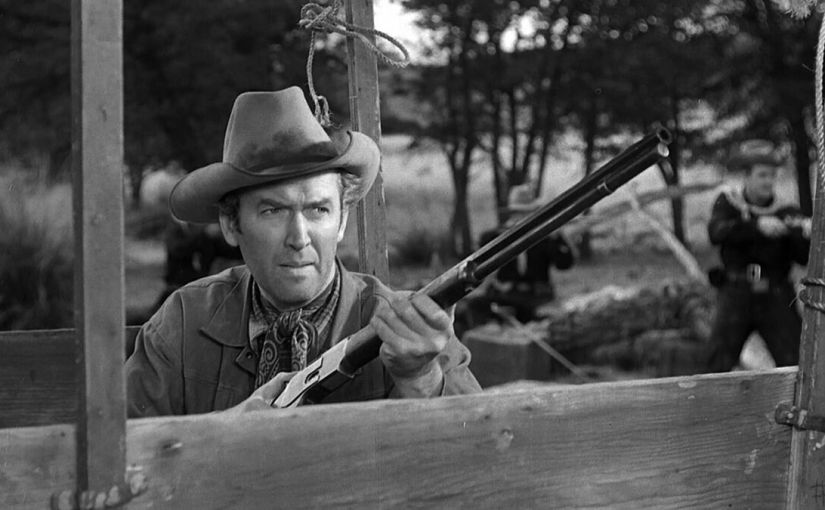
WINCHESTER ‘73 (1950)

by Miguel E. Rodriguez

DIRECTOR: Anthony Mann
CAST: James Stewart, Shelley Winters, Dan Duryea, Stephen McNally, Millard Mitchell, Rock Hudson, Tony Curtis
MY RATING: 9/10
ROTTEN TOMATOMETER: 100% Fresh

PLOT: A cowboy’s obsession with retrieving his stolen rifle leads to a violent odyssey through the American West.


Even without knowing the full history of how the film impacted contemporary audiences, Anthony Mann’s Winchester ’73 still packs a punch.  Using an ingenious story structure, courtesy of a very Western MacGuffin, the film follows the path of a rare, expensive Winchester rifle from hand to hand for ninety taut minutes.  James Stewart is top billed, but he is on screen for less time than you’d think.  That’s actually a good thing in this case, as Mann’s focus is not on star power, but on metaphor and mythology.  (Although Stewart’s star power certainly doesn’t hurt, as he demonstrates in several key moments.)

The movie plops us right into the action with nary a flashback nor an expositional monologue in sight.  The legendary town of Dodge City is holding a shooting contest to celebrate Independence Day, 1876.  Sheriff Wyatt Earp (!) is officiating, and the prize will be a rare model of the Winchester ’73 repeating rifle.  Arriving in town that day is Lin McAdam (Stewart) with his partner, High-Spade Frankie Wilson (Millard Mitchell).

(Around this part of his career, Stewart’s trajectory was on the decline, as he was getting too old to play the aw-shucks-y kind of roles that were his bread and butter in the ‘30s and ‘40s.  Winchester ’73 was an opportunity to showcase his range, and he delivered.  Lin McAdam is not the villain, but neither is he the kind of character Stewart had ever played before.  It’s been written that, when audiences of the day saw Stewart get violent and pin a man to a saloon bar, there were gasps.)

Lin is none too friendly towards another man in town, Dutch Henry Brown (Stephen McNally), who reciprocates in spades.  There is clearly some kind of history, but what that history entails would take too long to explain, so the movie wisely doesn’t try.  They’re enemies, and that’s enough.  Somewhat predictably, they both enter the contest for the prize Winchester, but in the first of many twists, the contest doesn’t play out exactly as you would expect.  Then the rifle is stolen, Dutch and his pals skip town, and Lin and his partner give chase.

From there, the movie gets episodic.  There’s the Indian trader, the Indian himself, Young Bull (Rock Hudson in a fake nose and braids!!!), the obligatory feisty lady, Lola (a luminous young Shelley Winters) and her beau who behaves in a most unmanly manner, a run-in with some cavalrymen (featuring an unknown young actor billed as “Anthony Curtis”), and winding up with a real sleazeball, Waco Johnny Dean (Dan Duryea).  How the rifle makes its way from place to place I will not reveal, but it’s all perfectly feasible.

(I will leave it to wiser minds than I to discuss the racist portrayal of Indigenous Americans, including using Rock Hudson in “red-face” to play a tribal chief.  Yes, it’s shameful and unfortunate, but it happened, and I use the term “Indian” earlier because that’s how they’re referred to in the film, for better or worse.)

If I had to explain what this movie is actually about, beyond its brilliant plotting, I’m not sure I could do it.  I can report that it was engaging and crisp and surprising and almost demands a rewatch after the end credits, but aside from just being a darn good entry in the Western genre, it’s hard for me to pin down its message.  Is it a screed against the violence in the real West?  How some men searched for violence because it was in their nature, or because they felt it was their duty?  I mean…yeah, I guess, but that feels like just scratching the surface.  What were Mann and Stewart trying to say?

Maybe it’s one of those movies where the message depends on the viewer.  If you look at it as an anti-violence film with a bittersweet ending filled with moral ambiguity, it’s there.  If you look at it as just a travelogue or tapestry of the old West, made by a director who loves the genre and an actor sinking his teeth into a great role, that’s there, too.  (Mann and Stewart would go on to make seven more films together, five of them Westerns.)  There’s even melodrama and a hint of romance along the way, but never too much to drown everything else out.  For me, Winchester ‘73 is much harder to unpack than Unforgiven (1992), whose message is crystal clear from beginning to end.  Both movies are equally entertaining, though, don’t misunderstand me.

If any active readers have made it this far, feel free to let me know what the “true meaning” of Winchester ’73 is.  Whether I find out or not will truly not matter, because the movie is still hugely entertaining with or without an explanation.  I might have a tiny bone to pick with the final battle, with its foregone conclusion, but it comes with the territory, so I have to forgive it.  This is a great entry in the genre, featuring a star pushing his boundaries and a director who knew how to harness that energy.

THE DELTA FORCE

By Marc S. Sanders

In the 1980s, a small production company named Cannon Films was started by an Israeli named Menachem Golan.  It churned out at least a dozen Charles Bronsan cheapy crime dramas and gave longevity to his Death Wish series of films.  Cannon also provided another franchise called American Ninja with action star Michael Dudikoff.  Dudikoff, nor any of his films won an Oscar, much less a Golden Globe or even an MTV Movie Award.  The poor guy with twenty bottles of mousse in his hair didn’t even get turned into an action figure. 

While I did see Death Wish 3, ahem…five times in the movie theatres (I mean there’s an outstanding final thirty minutes of a wall to wall shootout action in that film, and it was all a 13 year old boy yearned for at the time), Golan’s best product that I have at least seen to date is The Delta Force, featuring Chuck Norris, Lee Marvin and a host of stars most recently having been featured in every disaster film to crank out of the 1970s; Shelly Winters from The Poseidon Adventure, Robert Vaughn from The Towering Inferno and George Kennedy from every Airport movie under the sun.

Golan directed this film that was inspired by the 1985 hijacking of a TWA flight heading for Athens, Greece and he pretty much directed two different kinds of films in one.  The first hour focuses on the Libyan hijackers, led by an unrecognizable and terrifying Robert Forester, and their hostages.  A plane carrying mostly Americans is taken captive in midair and is diverted to Beirut.  Like the real-life event, a German born American stewardess is forced to select the Jewish passengers (Winters, Lanie Kazan, Joey Bishop and Martin Balsam) and separate them for an unknown fate.  An American Navy serviceman is also brutally tormented and later, an airline pilot (Bo Svenson) is interviewed by the media from the open window of the grounded plane’s cockpit, complete with a gun to his head.  All of this happened during that harrowing event.  Golan does a very good job of capturing these moments with heartbreak, fear and genuine terror.  The Jewish selection process is a scene that I take very personally, and it is not overdramatized as it glaringly hearkens back to the atrocities of the Nazis who sent millions of Jews to certain death, torture and concentration camps.  Remember, this film was released only 40 years after those terrible events.  Golan’s filmmaking makes certain the Holocaust is never forgotten.

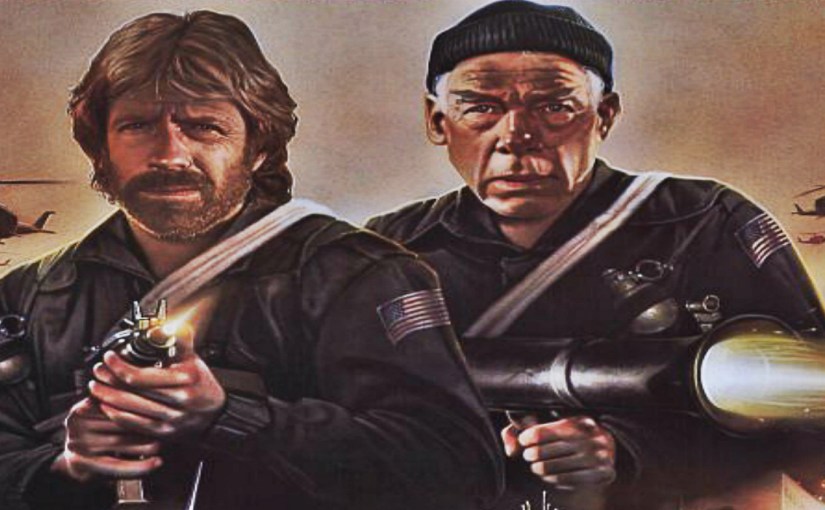
Sprinkled throughout these first hour scenes are bits and pieces of the American strike team known as The Delta Force, led with gruff command by Lee Marvin and silent but deadly Chuck Norris.  These guys gear up, dress in black uniforms, load their aircraft carrier with motorcycles and armed dune buggies, listen to Marvin’s instructions and wait and wait and wait.  There’s something to appreciate in the wait of these skilled snipers and specialists.  Golan doesn’t rush the action.  Material is depicted showing Marvin, Norris and company exploring the options they have for taking out the terrorists and rescuing the hostages.  This is not a typical Rambo movie of destroying the village just to save it.  However, once the action starts, it doesn’t stop and Golan lets Norris do all the things he’s known for while arguably inspiring how POWERFUL Chuck Norris is compared to…well…anything else.  Don’t forget!  Inside Chuck Norris’ chin is ANOTHER FIST!  Also, Superman wears Chuck Norris underoos!  Chuck Norris can unscramble an egg!  Chuck Norris made a snowman out of rain!  It’s hard not to deny these claims when the film boasts a strike team consisting of 20-30 members, but Norris seems to do all the work and heavy lifting. 

It’s hard not to get caught up in The Delta Force.  You wanna see these terrorists get blown up real good.  You also wanna see Chuck Norris ride an agile moped equipped with an endless supply of missiles and ammunition ready to overturn enemy vehicles and bloody up a bad guy until he screams and turns on one foot before dropping dead with his eyes opened.  You also may get a jolt of energy from Alan Silvestri’s rah rah theme music that quickly stays embedded in your subconscious.  I read that his music was used for a time when the Indy 500 would air on TV.  That does not surprise me at all.  Its symphonic themes are as memorable as the Monday Night Football tune.

Unlike, other Norris films this crowd pleaser doesn’t just rely on him and his roundhouse kicks.  There’s a little bit of that schtick for the fans, but I gotta say I was truly touched by the cast as whole.  Lee Marvin (in his final film) echoes George C Scott’s portrayal of Patton.  The collective hostage cast are not overdramatized here.  Golan managed to capture a history to them.  While I thought Shelley Winters was a such joke for fodder in Poseidon, here she is truly sorrowful as she is separated from her husband played by Balsam.  Kazan and Bishop are equally touching.  Reader, this Jewish guy originally from New Jersey, who attended ten years of Yeshiva education, recognizes these folks when they are spirited vacationers early on, and then later tormented prisoners who’ve faced horrors like this before.

I know that Cannon Films also produced another favorite called Runaway Train with an Oscar nominated performance from Jon Voight.  As I write this column, I’ve yet to see that film.  It’s on my radar.  That being said, I have to wonder if Golan and company had stayed on this trajectory of genuine drama like he mustered in portions of The Delta Force, what powerfully impactful films might he also had up his sleeve.  Unfortunately, we were left with too much excess like American Ninja, I’m afraid.

Still, after watching The Delta Force you’ll absolutely believe that Chuck Norris can see things that don’t exist and that he counted to infinity…twice!