SALTBURN (2023)

by Miguel E. Rodriguez

DIRECTOR: Emerald Fennell
CAST: Barry Keoghan, Jacob Elordi, Rosamund Pike, Richard E. Grant
MY RATING: 9/10
ROTTEN TOMATOMETER: 71%

PLOT: A scholarship student at Oxford finds himself drawn into the world of a charming and aristocratic classmate, who invites him to his eccentric family’s sprawling estate for a summer never to be forgotten.


What is Saltburn?

I sit in front of my keyboard and try to figure out a way to write a review of Saltburn that doesn’t spoil its surprises in any way.  I ponder.  I rack my brain.  As of this writing (January 2024), the film has already been released theatrically and in the public eye for almost three weeks.  Any avid filmgoer who hasn’t seen it has heard rumblings about some kind of dark undertones and risqué material in writer-director Emerald Fennell’s follow-up to her astounding debut film Promising Young Woman.  The trailers reveal nothing except a plot that seems almost too similar to another film released over a month ago, The Holdovers.

Having just watched it last night, I can say that Saltburn is a pure thriller, masquerading as a dark comedy about class warfare, heavily influenced by The Talented Mr. Ripley and, say, Howards End, but that’s just plotting.  With this movie, it’s all about style and delivery, both verbally and visually.

First, a plot summary.  Young Oliver Quick (nice Dickensian name), played by Barry Keoghan, is a scholarship freshman at Oxford University in the long-ago year of 2006.  Virtually friendless except for an antisocial math whiz, he notices the strikingly handsome Felix Catton (Jacob Elordi, unknown to me), a very rich…what, junior?  Senior?  Probably a senior.  People of all genders are attracted to him like bees to honey.  Oliver is instantly attracted to him, but that doesn’t stop him from making out with one of Felix’s paramours given the opportunity.  He is nothing if not opportunistic.

After a meet-cute involving a flat bicycle tire, Felix gradually folds Oliver into his flock of hangers-on, much to the dismay of Felix’s cousin, Farleigh (who is brown-skinned…that will be important later), and to Oliver’s math friend, who cryptically tells Oliver, “He’ll get tired of you.”  One thing leads to another, and Felix winds up inviting Oliver to stay at his – there’s no other word for it – palatial manor house, Saltburn.  There, Oliver meets Felix’s aristocratic, idiosyncratic family: Felix’s mother, Elspeth (Rosamund Pike); his father, Sir James (Richard E. Grant); his sister, Venetia (newcomer Alison Oliver); a “friend of the family”, Pamela (Carey Mulligan); and the creepiest butler since that guy in the men’s room with Jack Nicholson in The Shining.

Here at Saltburn, and at Oxford, Fennell proves to be a master at creating a certain kind of mood.  There is an air of…something in the offing.  You know how some animals supposedly know when an earthquake or a tornado is coming?  That’s what the movie feels like during its first half.  I kept expecting a gruesome murder to occur, or for Oliver to discover a literal skeleton in a forgotten closet, or an explosion, I dunno, something.  I don’t know how much of that is due to my expectations after Promising Young Woman and how much to the carefully modulated camerawork and editing, but either way, the mood was there, permeating the screen with a sense of foreboding.

Oliver revels in his proximity to Felix, and I remembered with some chagrin my own formative years as a geeky teenager.  Trust me, I recognize hero worship when I see it.  At Saltburn, they sleep in separate rooms with a common bathroom, but there’s no shower, just an old-fashioned bathtub in the middle of the room.  At one point, Oliver hears…noises…coming from the bathroom and takes a peek inside, where he sees Felix lying back in the filled bathtub and – well, I’m given to understand that in Catholic schools, it was called “interfering with yourself.”

And it’s here I must stop with any kind of summarizing.  It’s here where Saltburn abandons its masquerade as a comedy of manners and becomes something else entirely.  It’s still comic, in my opinion, but it becomes less about manners and more about Machiavelli.  Oliver may present a meek façade, but he reveals the ability to do some very quick thinking indeed, especially in a moonlit scene involving Felix’s sister, Venetia, and during a karaoke party when Farleigh suggests a song for Oliver to sing that hits a little too close to home.

I admired how the movie turned my expectations on their head…twice.  There were a couple of times when, I must admit, my conspiratorial thinking led me to a couple of conclusions that turned out to be right in the end, which is something I don’t really like to do.  I don’t like to be that guy who goes to see The Sixth Sense and thinks, “You know, I don’t see how Bruce Willis could have survived that gunshot…”  I want to revel in the mystery, to live in the moment of the film and let its surprises work organically.  When a movie does its job well, I don’t even have to think about it.

What’s cool about THIS movie is that I managed to pick up on little “clues” about what was happening, or about to happen, but as the movie progressed, other things occurred (especially Felix’s little field trip with Oliver), and I found myself thinking, “Nah, never mind.”  And that is pretty ingenious, I think.  To lead the viewer down the garden path, make a left turn, get back to what looks like the main road so you think you know where it’s headed, then to pull a sudden U-turn into something else entirely?  That’s masterful misdirection.  I dunno, I fell for it hook, line, and sinker.  Call me crazy.

I haven’t even really touched on what will no doubt be the most famous elements of this movie.  That would be the scenes involving the bathtub, the cycle of the moon, a surprise midnight visit, a freshly dug grave, and Oliver’s, er, choreographic inclinations.  With the exception of that last one, which occurs too late to mean anything to the plot except as a wonderful ribbon to tie it up with, these scenes were, yes, shocking, but not in a hostile way.  Or even a Hostel way, if you take my meaning.  They were not intended to disgust or horrify the audience.  Or perhaps they ARE meant to horrify, but not in the kind of way that a serious horror movie disgusts people, like The Thing or Hellraiser.  It’s very tongue-in-cheek.  I’d like to believe there was a certain kind of glee in Emerald Fennell’s face when she watched her actors performing those scenes, knowing the material might completely turn some people off to the film without hesitation.  I found them to be yet another example of misdirection.  The off-putting nature of those scenes sort of lulled me into thinking one thing was happening and that the movie would then follow that thread into a more predictable conclusion.  But it didn’t.

I know, I’m being maddeningly vague.  The movie is new enough that I don’t want to risk spoiling anything.  There are supposedly some moths that, once touched by human hands, can never fly again.  Or is that butterflies?  Either way, I don’t want to deprive this movie of flying high in the eyes of a first-time viewer.  It’s refreshing to see a movie that seems to be following all the mile markers towards one thing, when it was really leading you somewhere else.  Saltburn is a treasure.

FRACTURE

By Marc S. Sanders

When director Gregory Hoblit was shooting this film, did he ever wonder how preposterous this courtroom mystery is?  

This ridiculous effort featuring a tired Anthony Hopkins as a suspect representing himself, and a very green Ryan Gosling as the prosecuting attorney proudly boasts a centerpiece storyline of simply finding a gun used in an attempted murder.  That’s it really.  No nuances.  No subtle riddles.  Just a “what happened to the gun?” plot line.  

It’s any wonder that I had never heard of this movie until I found it on Netflix.

Take my advice.  Find something else on Netflix.

GONE GIRL

By Marc S. Sanders

David Fincher is best when he builds tension in dark cinematography. It’s eerie and moody, but it all seems to make appropriate sense.

A skilled director like him proves that even with Lifetime television soap opera material, if delivered with care for detail and with genuine acting he can hold on to the attention of a scrupulous movie going audience. Haunting filmmaking, like Fincher is known for with movies like Seven or Panic Room, can also work in sensational material that at first might draw the attention of lonely housewives pigging out on Rocky Road ice cream while watching hours upon hours of scorned victim gossip material on the WE Channel. Gone Girl adapted from the best-selling novel by Gillian Flynn, who also wrote the screenplay, is a thrilling cinematic piece even if the story’s ending is a little disappointing.

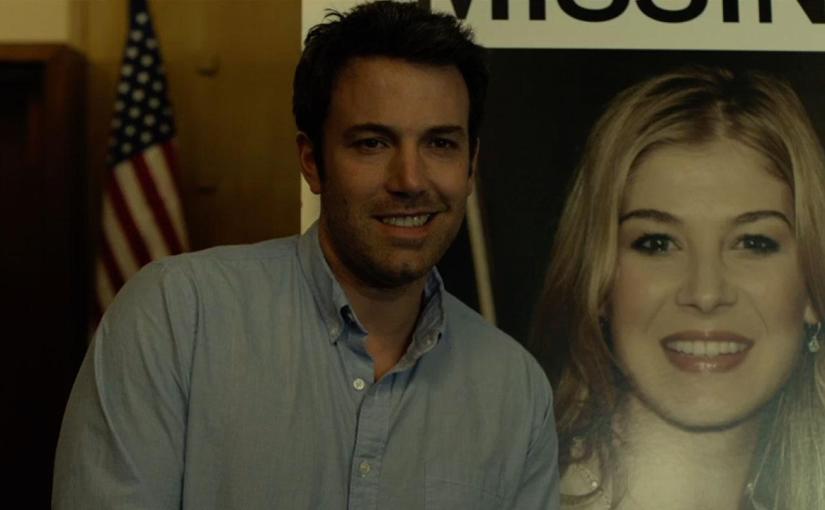
Ben Affleck plays Nick Lowe who discovers a broken glass coffee table in his home and realizes his wife of 5 years is missing. Rosumund Pike is Amy, who seemingly vanished without a trace.

Fincher closely shoots Flynn’s story with developments you might expect or have experienced with various news stories and documented investigations by sensational legal journalists like Nancy Grace. Nick, with Amy’s parents (Lisa Banes, David Clennon), initially form a united front for the press but that falls apart when it’s uncovered that Nick has had an affair. Amy had a close neighbor who expresses tearful concern that cameras latch on to for ratings. The cops (Kim Dickens, Patrick Fugit) grow more and more suspicious of Nick. Nick eventually hires a high-priced lawyer (Tyler Perry). Nick is eventually considered to be an abusive husband as well. It all adds up.

These are the steps you’d expect from a missing persons case. You might also suspect murder, but no one can claim that out loud if there’s no body to be found. So, toe the line carefully detectives, journalists, & gossip mongers!

What is not expected in Gone Girl are the surprises that open up midway through the picture, and the book. Flynn is a really inventive storyteller, and Fincher as director gives ample opportunity to answer for every surprise up the writer’s sleeve. Gone Girl plays with a lot of internal character thought to process its details.

I had read the novel long before the movie was even cast, and I couldn’t put it down. That being said, I was frustrated when the conclusion arrived. I can say the same for the faithful film adaptation. It’s an ending that could happen but, wow, is it a long shot.

Rosamund Pike was Oscar nominated as Amy, the complicated wife in this marriage. She’s good at occupying the complexity of her past shown in flashback. She’s likable in many moments, but then Amy is also a character that we are reluctant to trust based on her relationship to Nick, as well as her own parents.

Affleck remains a good actor with this picture. I think it takes an honest actor, writer and director to accurately show a man who might not be responding to this crisis like a general public expects. I think much of Affleck’s personal issues of infidelity and alcoholism in the public eye lend credence to how genuine he makes Nick out to be. Could this guy be handsome enough to think he could harm or actually murder a woman as beautiful as Amy; the “Amazing Amy” as she’s widely known in her mother’s series of best-selling children’s books? Is Nick that good at hiding his evil side? On the other hand, is Nick simply innocent, despite all the skeletons that are gradually uncovered? That’s a fair question as well.

Again, Gone Girl is superb in its delivery. It’s ending, though, is the setback. At least I felt that way. For every reader, like me who considers it dubious, I’m sure there are readers who applaud the inventiveness of Gillian Flynn’s gripping and modern mystery.

I guess if a good story prompts a group discussion on a Saturday night, then a really good novel or a great movie has achieved its purpose. At the very least, I consider that a great compliment for an outstanding cast, director and writer.

AN EDUCATION (2009, Great Britain)

by Miguel E. Rodriguez

Director: Lone Scherfig
Cast: Peter Sarsgaard, Alfred Molina, Rosamund Pike, Dominic Cooper, Olivia Williams, Emma Thompson, Carey Mulligan
My Rating: 9/10
Rotten Tomatometer: 93% Certified Fresh

PLOT: A coming-of-age story about a teenage girl in 1960s suburban London, and how her life changes with the arrival of a playboy nearly twice her age.


Lone Scherfig’s An Education, written by famed British author/screenwriter Nick Hornby, is yet another example of how my preconceived notions of a film are often very wrong.  Based on the plot description above, I assumed I was in for what I call a “spinach movie”: something that’s good for you, but not a lot of fun to eat.  I thought the film would be dark and deep, delving into unsavory territory involving a predatory older man putting the make on an underage girl.  Lessons would be learned, but it would be an uncomfortable watch.

For about the first half of the film, I felt I was mostly right.  It’s 1962 in England, and Jenny (Carey Mulligan in her first major role) is a sixteen-year-old student who is studying hard to pass her A-levels – I think I got that right – with flying colors, which she hopes will give a favorable impression to the admissions board at Oxford.  Her father (Alfred Molina) supports her plans…or rather, he supports HIS plans for her.  He gives several impassioned speeches about the importance of getting a higher education, making sacrifices, dropping her cello hobby, etcetera, all in the service of getting those Oxford-level grades.

One day, Jenny gets caught in the rain and is rescued by David (Peter Sarsgaard), a charming older man driving an irresistible maroon sportscar.  He isn’t just charming, he’s effortlessly charming, turning the exact right phrases to put Jenny at ease.  The morning after he drives her home, he leaves a bouquet of flowers at her doorstep.  He bumps into her again quite by accident, or “accident”, and asks her on a date for dinner and a concert.  For this, he must convince Jenny’s very suspicious father…which he does with silver-tongued ease.

Jenny is caught up in this whirlwind of attention from a much older man who is clearly well off with sophisticated friends, Danny and Helen (Dominic Cooper and Rosamund Pike).  Jenny’s father, Jack (Alfred Molina), is torn between his protective instincts and the idea that Jenny might have met a man who could make her dreams of Oxford…moot.  Why worry about the expense of university when a rich husband can keep his daughter well cared for?

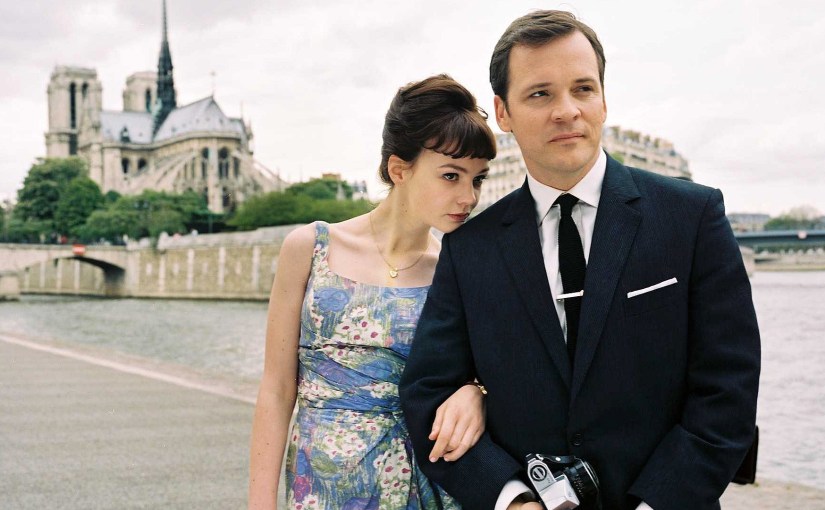
Despite the father’s (and my own) forebodings, Jenny is genuinely enjoying herself.  She loves music, so David takes her to a concert.  She loves art, so David takes her to an art auction.  She loves learning and speaking French, so David takes her to Paris.  His method of getting Jenny’s father to agree to this overnight trip is simultaneously simple and diabolical.  Jenny is having fun for what seems to be the first time in her life.

She’s having so much fun that, for a while, I wasn’t quite sure what the movie was advocating.  Is it supporting this relationship?  She has a very frank conversation with David regarding her wish to remain a virgin until her seventeenth birthday.  David agrees…then, in one of the ballsiest (and creepiest) moves I’ve ever seen from a guy in a movie, he asks her to give him a “peek.”  What is going on?!?  This guy is clearly a cad.  But he’s so nice to her…and she’s having fun…!

Put it this way: I was prepared to throw something at the television by this point.

Around the midway point, though, the movie finally makes its true purpose known.  It’s not about judging Jenny, which is too easy to do, or even judging David, which is ridiculously easy to do.  The film is based on a memoir by a British journalist named Lynn Barber, which made some of the revelations about David’s past and how he makes a living easier to swallow, knowing that it’s based at least partially on fact.  It also made all the “icky” parts in the first half of the film a little more palatable.  When you realize that someone really went through this, it puts everything in a different light.  I had the same epiphany during Schindler’s List; the concept that this all actually happened brought a deeper level to the viewing experience that I hadn’t expected.  (It’s also what made Fargo so much more entertaining than your average crime film, but that’s another story…)

Anyway, this happens and that happens, and before you know it, Jenny has made the kinds of decisions that would make grown men and women tremble with anxiety. The movie’s title takes on a whole new meaning.  It’s not just about Oxford anymore.  It’s about studying at the University of Life, where the only way to know if you passed your test is if you’re still willing to take the next one, and the next, and the next.  Even David learns a thing or two.  Maybe.  It’s a little inconclusive when it comes to that guy.  What a jackass.

So…is it any good?  Yes, it is.  It’s got brilliant performances working from a Nick Hornby script that switches easily among pathos and embarrassment humor (witness the predicament of Jenny’s other suitor at her 17th birthday party) and even a little suspense.  I tend to think of Hornby as Britain’s answer to Cameron Crowe.  Hornby’s books and screenplays walk that same tightrope time after time (About a Boy, High Fidelity, the original Fever Pitch – soccer, not baseball), just like Crowe’s best work (Jerry Maguire, Say Anything, Almost Famous, which I don’t particularly love, but I do acknowledge its craftsmanship).  By the time I got to the end of An Education, the double- or triple-meaning of the title is fully realized.  Everyone has learned something.  Not all of it has been good.  It doesn’t all tickle.  But, except possibly for David, everyone has taken what they’ve learned, good or bad, and put it to good use.  That’s a satisfying ending.

[Side note: after this movie was over, I found myself thinking of Licorice Pizza and its plot regarding an underage boy and an adult woman. I can imagine my friend and partner-in-crime reading my favorable review above and asking me, “If you like this movie, how can you not like Licorice Pizza?” (He really loved Licorice Pizza.) The difference is that, by the time An Education is over, the characters have EVOLVED. Discuss.]

DIE ANOTHER DAY

By Marc S. Sanders

Once the 2nd half of Die Another Day arrived, Pierce Brosnan’s interim as James Bond was all but wrapped up. This was gonna be his last film after this misfire, and the craftspeople at EON Productions knew something had to change.

What happened here? Director Lee Tamahori was on the right path from the get go with some real world parallels and surprising elements for the long lasting franchise. Then, the film goes sci fi gonzo with some kind of robotic armor for the villain, a space satellite that harnesses the power of the sun, a palace literally held together by ice, an invisible car, DNA switcheroos, and James Bond kite surfing to avoid a solar laser beam.

This movie got ridiculous really, really fast.

Early on, 007 covertly surfs his way onto the coast of North Korea to intercept an arms trade in exchange for diamonds. He’s captured and held for the following 14 months. When the British make a trade for Bond with a North Korean prisoner with a bad case of facial diamond acne, Bond is no longer trusted by M (Judi Dench) and he must become resourceful on his own in stopping whoever betrayed him before his capture. He also needs to figure out what a wealthy industrialist named Gustav Graves (Toby Stephens) is conjuring up in Iceland, with a literal ice palace hosted to Bond as well as a slew of investors and dignitaries.

Die Another Day began with a grounded intent. However, the stunts and gadgets that are introduced later in the film fly way off the rails, even for a James Bond film. Bond has always completed his mission by ridiculous measure. However, when your hero and villain are on an out-of-control airplane that is being torn apart by a solar beam from space, ala hammy CGI, well, reader how does 007 even survive that?

Another ridiculous plot element involves DNA transfers. So Gustav Graves, a man who claims he never sleeps, may not be who he claims to be. Graves is the villain here and Stephens plays him like a spoiled brat. I didn’t like him and the best Bond films are primarily weighted by the bad guy. For some reason he has to wear this bionic suit of some kind to control the satellite. A keyboard and mouse weren’t as efficient, I guess. It’s also capable of electrocuting Bond; lots of zig zaggy tesla/lightning bolts surround Bond and so on. You really don’t have to see it to believe it.

The Bond girl is Halle Berry and she’s pretty good as an American agent who goes by the name of Jinx. Yes, there’s time made for the two agents to have some flirtations together, but like Michelle Yeoh before her, Berry gets in on the action.

Man oh man! WOW!!!! Die Another Day started so good and then it fell apart. While I don’t think it is the worst of the series, it borders towards the bottom of the list. It’s a shame really. If only it stayed a little more grounded, maybe it wouldn’t have died on any day.

PRIDE & PREJUDICE (2005)

By Miguel E. Rodriguez

Director: Joe Wright
Cast: Keira Knightley, Matthew Macfadyen, Rosamund Pike, Carey Mulligan, Donald Sutherland
My Rating: 9/10
Rotten Tomatometer: 86% Certified Fresh

PLOT: Jane Austen’s immortal novel receives yet another makeover, with Keira Knightley as the headstrong Elizabeth Bennet, who finds herself reluctantly falling for the brooding, distant Mr. Darcy.


The words “sumptuous” and “painterly” came to mind repeatedly while watching director Joe Wright’s delightful version of Pride & Prejudice.  Much like Kubrick’s Barry Lyndon, the images in Pride & Prejudice appear lifted from paintings of landscapes and portraits you’d find hanging in any given museum.  The details are as stunning as anything you’d find in a Merchant Ivory film.  It’s just gorgeous to look at.

The screenplay clips along at a nice pace, and the English accents are a tad thick at times, so you’ll definitely want to be paying close attention to the dialogue.  While the cinematography is masterful, this is above all a film of words.  It’s not exactly Shakespearean, but there are times when sentence construction coils on itself like a highway cloverleaf.

Other random thoughts:

  • The casting of Keira Knightley is utterly perfect, but Matthew Macfadyen looks JUST a shade too old for her, although it’s entirely possible that was normal for the period.  Who WOULDN’T fall in love with this woman?
  • Carey Mulligan makes her screen debut in this film as one of the Bennet sisters.  Both she and Jena Malone are suitably obnoxious and giggly playing teenage girls, but they do look a little too old for the part.  Just sayin’.
  • Donald Sutherland is magnificent as the patriarch of the Bennet family.  His love for his wife and daughters is supremely evident, as is his frequent exasperation at their nattering and chattering.  His somewhat frazzled wardrobe is the perfect indicator of his inner self.
  • I just have to mention the cinematography again here.  There are one or two long takes (not Goodfellas long, but long nevertheless) that are like a master class in conveying information using minimal dialogue.  It doesn’t hurt that the costuming and production design are flawless.
  • Two words: Judi Dench.  Reportedly, the director convinced her to be in this movie by writing her a letter in which he stated, “I love it when you play a bitch.”  She delivers in spades.
  • In today’s world, I wonder what folks would think of Mr. Darcy’s actions.  He falls for Elizabeth, but she rebuffs him when she believes he ruined her sister’s prospects of marriage.  He then proceeds to assist her family enormously, but behind the scenes, and then tells her, “Surely you must know…it was all for you.”  Today’s PC watchdogs might call that stalking.  Discuss.

As a general rule, I am not a huge fan of Jane Austen adaptations.  It is a measure of the quality of this movie that I felt compelled to make it part of my collection (along with Ang Lee’s Sense & Sensibility and Patricia Rozema’s under-appreciated Mansfield Park).  As period pieces go in general, I would rank it comfortably with Amadeus and Barry Lyndon.  It’s a gem.