
DOCTOR SLEEP

By Marc S. Sanders

I never yearned for a sequel to The Shining.  Yet, color me surprised at how well I took to Mike Flanagan’s adaptation of Stephen King’s return to psychic Danny Torrance and the haunting baggage he carries as a middle-aged adult in Doctor Sleep.  This is a time jump sequel that is nearly forty years in the future.

The film version of this story had a tricky challenge.  King notoriously despised Stanley Kubrick’s horror classic adaptation of The Shining. Several important details were not consistent between his book and the movie.  So, what was Flanagan to do?  Well, he got his blessing from the author to move ahead as a sequel to Kubrick’s interpretation because he also ensured that he would not veer too far away from how the novel was edited.  The director reasoned with King that more people are familiar with Kubrick’s product than what’s in King’s pages. Mike Flanagan found the right balance to please not only Stephen King, but also the respective fans of the novels and Kubrick’s unforgettable film.

Danny is played by Ewan McGregor.  He’s often reflecting on his childhood following his survival from his stay at the haunted Overlook Hotel in the snowy mountains of Colorado, where his delirious and murderous father terrorized him and his mother Wendy with an axe.  Now Danny is making efforts to recover from alcoholism as he takes a job as a hospice orderly in a small New Hampshire town.  It keeps him isolated while the ugly hauntings that he shines on stay contained in his mental lockboxes.  He also uses his gift to allow patients to peacefully carry over to the other side.   Danny becomes known as Doctor Sleep.

Elsewhere in the country there is a traveling cabal of people who devour the energies off of young children with similar shining abilities like Danny.  This small cult is known as The True Knot and their leader is the charming Rosie The Hat (Rebecca Ferguson).  The presence of one very special child is Abra (Kyliegh Curran).  Flanagan gets very creative in showing how Rosie, Abra and Danny locate and communicate with one another from faraway points.  Rosie’s technique is reminiscent of an amusing sequence in The Big Lebowski, though as you might expect the mood is altogether different in Doctor Sleep.  

Doctor Sleep is a longer picture than it needed to be.  The exposition goes on for quite a while where three separate stories are proceeding, and it becomes cumbersome to see how the dots are connected.  Yet, the movie eventually finds its way as things become more simplified.  Flanagan works some action scenes and neat visuals into the picture, but he does not neglect Stephen King’s penchant for nauseating and grotesque horror either.  Normally, I feign at seeing victimized children in deadly peril for the sake of escapist entertainment.  Here, it is repulsive on more than one occasion, but the moments serve the story and enhance the motives of the villains.  

The payoff of the film is the third act where this adaptation relies on much of Kubrick’s treatment of The Shining.  As the book was entirely different with its ending, Flanagan had to take a chance with some creative liberties.  Amazingly, his efforts score very well.  I’m not the biggest fan of Stanley Kubrick’s film (read my review on this site), but I had to cheer as more developments gradually unfolded.  There’s much to explore through the eyes of Ewan McGregor as Danny.

Mike Flanagan’s craftsmanship with a cast of supporting actors, including Henry Thomas (E.T.: The Extra-Terrestrial) assuming Jack Nicholson’s role, are quite uncanny and lend to the argument to not depend on AI or “de-aging” visuals to recapture what once was.  Carl Lumbly effectively takes over for Scatman Caruthers and Alexandra Essoe does a very good pick up from Shelley Duvall’s performance as Wendy – a little flighty, melancholy and zany. The little ticks and inflections in these newly cast actors are mimicked quite well without going over the top.

Set pieces etched into anyone’s subconscious who has seen The Shining are impressively recreated by Flanagan’s team, from stained walls, big curtains and chandeliers to that very familiar orange, brown/black sectional pattern on the carpet of The Overlook.  At one point in film, Danny goes for a job interview and the office he sits in is an exact recreation of when his father Jack met with the managers of the hotel at the beginning of Kubrick’s film.  This kind of attempt at consistency has to be saluted.  It’s really amazing.  Mike Flanagan shows his painstaking efforts at recapturing Kubrick’s designs. I do not look at these efforts by Flanagan as commemorations so much as I see an omnipotence that observes Danny like it did to his father Jack before him. Danny might have survived, but the demons of his past and the sins of his father remain. He can never escape where he came from even if he relocates to New Hampshire, or wherever he goes.

Doctor Sleep offers the disturbing imagery you’d expect from Stephen King.  I’ve never been the author’s biggest fan.  Still, I really appreciate the creativity he lent to his sequel nearly a half century later.  It makes sense to have waited this long for the writer to pick up where he left off with some of his most well-known characters and locations.  

This dark fantasy works for its collection of heroes and their villains.

NOTE: I viewed the Blu Ray Director’s Cut which Miguel informed me is the better way to watch the film. I agree. There are more nods to Stanley Kubrick’s original film, and the outline of the picture performs in chapter sections like you might expect in Stephen King’s novel. Mike Flanagan never lost sight of either storyteller’s accomplishments. Doctor Sleep is an undervalued achievement in film. A very worthy sequel.
MISSION: IMPOSSIBLE FALLOUT

By Marc S. Sanders

Mission: Impossible Fallout is the best of the so far seven films in the series.  It is carried not only by the stunts that Tom Cruise insists on risking his middle-aged self to perform, for the sake of his fans. As well, the film’s casting and the puzzle twisting script from Christopher McQuarrie, writing with inspiration from his famed Oscar winning screenplay for The Usual Suspects is a treat for the eyes and mind.  If this were a novel, I’d quickly be turning each page to see what comes next.  Like McQuarrie’s well-known invention of Keyser Soze, this movie questions Who is John Lark?  Is Ethan Hunt (Cruise) John Lark? 

Hunt chooses to accept the mission of locating this unidentified Lark who is interested in purchasing enough plutonium to wipe one third of the world population, likely in and around Pakistan and China.  However, the CIA doesn’t trust Hunt’s cavalier instincts and insists he partners up with a hulking Henry Cavill playing an agent named Walker.  Benji and Luther (Simon Pegg, Ving Rhames) are back for hacking, field work and some clever mask trickery.  Ilsa Faust (Rebecca Ferguson), the dubious British MI6 agent from the prior film (Rogue Nation) is a welcome surprise and just as perplexing with her actions.  The big bad, Solomon Lane (a snake like Sean Harris), also returns.

Like all the M:I films, Fallout operates with the same kind of formula.  We have to accept the promise that there’s a world ending MacGuffin.  Ethan and the team are assigned to find who has it and who wants to buy it and can use it.  All of this is written outside of the lines of planning out the action scenes these pictures are recognized for.  It’s as if Cruise, with his producer hat on, sketches stunts with skydives, cars, motorcycles, trucks and helicopters and then assigns his writer/director to apply words for the donut filling within the movie.  Mustn’t forget a reason to include a running sequence for Ethan to perform on rooftops.  Fortunately, all of it works best here, more than in any of the other films.

What sells these pictures, and again Fallout is the best example, is the photography and editing applied to these scenes.  Two sequential car/motorcycle chases occur throughout the streets of Paris.  (Look!  I see our honeymoon hotel, The Hotel Regina located across from the Louvre, as Ethan races by in a BMW!!!!!)  A smashing three-person fist fight in an impeccably white men’s room is a brawl for the ages. 

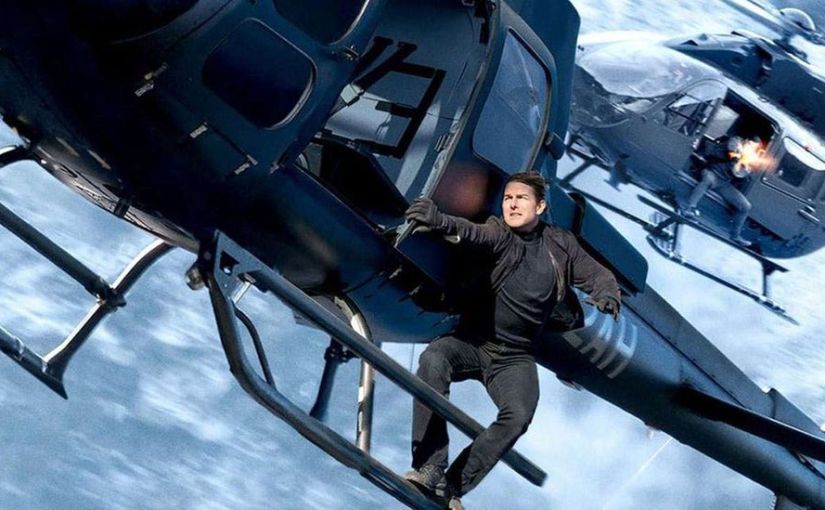
The highlight of this installment is a helicopter chase above and within a mountain valley that first focuses on Tom Cruise himself climbing a rope up, up, up to a chopper and swinging his legs onto the railing to get a foothold.  There’s time dedicated to him falling and inching his way back into the vehicle.  Then it becomes a chopper chase followed by a collision that ends with the remains wedged within a narrow mountain crevice.  What a set piece this is!  Absolutely outstanding camera work.  The wide and close editing, sound and visuals work so perfectly in sync with one another.  I don’t want to watch the making of documentary for this picture.  The trickery of McQuarrie’s camera crew is such a treat.  I’d rather savor the finished product on repeat viewings.

Juxtaposing against this chopper fight are two other scenarios involving Ethan’s teammates.  This is where I’m especially grateful for Christopher McQuarrie’s writing.  Two bombs are rigged in line with each other, and a detonator also must be retrieved by Ethan.  The whole team has to work cohesively, otherwise it is sayonara to much of the Asian continent if both devices explode.  McQuarrie’s “impossible mission” is orchestrated beautifully with suspense cranked way up.  His imagination for adventure allows a magnificently edited third act.  To date, I consider the stakes here to be the highest in the entire series.

The presence of this collection of actors is marvelous with recognition deserving of Henry Cavill donning an untrusting mustache and looking like a brutal, blunt instrument against the superspy Ethan Hunt.  Cavill also plays CIA agent wisely.  He’s got a stoic expression for most of the film but that is because he trusts the audience will assume what a dangerous threat he can be.  Cavill occupies one of the best characters in the seven films.

Mission: Impossible Fallout is truly one of the most thrilling pictures you’ll find.  What’s most important is the action serves the story.  Action just for the sake of action is tiring like in the Fast/Furious films.  There has to be a cost and a tangible feeling to the speed, obstacles and pain that good action scenes serve their characters and the story as a whole.  When Ethan falls from a helicopter or has to jump out a window, I grip both arm rests and let out a collective bellow with the audience.  Films with the grandest of adventure must draw out responses like that.  Otherwise, it’s all just a ho hum journey to the end credits.  Fallout is anything but a stroll.  It’s an absolute balls to the wall, explosive crowd pleaser.

MISSION: IMPOSSIBLE DEAD RECKONING PART 1

By Marc S. Sanders

The object of the Mission: Impossible films is not to wow its audience with thought provoking questions of politics or Cold War intrigue or even daring and uncompromisingly evil villains (apart from Phillip Seymour Hoffman).  The elements of espionage coursing through the TV series are non-existent in the film adaptations.  I’m not watching a film based on a John LeCarre spy novel.  By the time the seventh installment has arrived, titled Dead Reckoning Part 1, the goal of the film series is to sketch out the set ups for one action piece after another.  Only they must be bigger, bolder, and seemingly that much more impossible to overcome for their hero, Tom Cruise (playing a guy named Ethan Hunt).  The action is once again top notch.  The glues that bind these displays of bravado together, you know where the characters have to talk and give us a semblance of a plot, is as nil as the scotch tape that assembles a stretch of film reel into a running time length of nearly two hours and forty-five minutes.

The locales are as grand as any travel getaway. We go through a labyrinthine airport.  A techno night club works as a meeting place for a bunch of characters. There are journeys to the Arabian Desert, Rome, Venice, and a beautiful ride along the famed Orient Express.  Shot on digital, this movie is a gorgeous travelogue.

Let’s get the problems out of the way, though.  The MacGuffin that Ethan Hunt and his trusty pals Benjy and Luther (Simon Pegg, Ving Rhames) have been assigned to recover is two parts of a specially designed key.  One part is supposedly with the disavowed MI6 agent Ilsa Faust (Rebecca Ferguson).  The other half is questionable as to who possesses it, but a thief known only as Grace (Hayley Atwell) may be significant in finding it.  Put the two halves of the key together and it will unlock something that no one seems to know of, or where it is located.  Here’s my first issue.  The audience does know what the key unlocks because it is shown in the first three minutes of the film.  So, while the cast of characters act dumbfounded, we know all along.  So, there goes any curious interest I may have for wanting to follow through with this. 

The other problem is that the same conversation happens over and over and over again.  Lines like (and I’m paraphrasing here, or maybe I’m not) “If this key gets into the wrong hands…” and “Whatever this does unlock, Ethan, could spell the end of the world…” or “It’s important that both halves of the key are not put together…”  or “Whatever this does unlock…”  (See?  Even I just repeated myself in this write up.) Except, we know what it unlocks!!!!!  The same exchange of dialogue occurs over and over.  The redundancy exhausts itself.  It occurs so much in fact that it’s writer/director, Christopher McQuarrie, relied upon the repetitive dialogue to stretch this next M:I chapter into two films instead of one (Part 2 is scheduled to be released in 2024).  I don’t recall the context of any of Ving Rhames’ lines going further than what I have presented here, for example.

The film is also a little too character heavy.  I never understood why two agents (Shea Wigham, Greg Tarzan Davis) are constantly pursuing Ethan.  Just was not clear for me. Heightened suspense?  That’s the best excuse I can think of.  The White Widow from the prior film (Vanessa Kirby) also appears.  Not much purpose to her.  Cary Elwes is the deputy director, there at the beginning and later towards the end, but again I was not entirely certain of his contribution to the story.  Even Ilsa Faust does not seem to have much value, except to work as a step in Ethan’s ongoing trajectory for the key.  I think Rebecca Ferguson had no more than five lines in the whole picture.

Finally, Ethan Hunt seems to be up against an omnipotent enemy, an AI program known as The Entity.  The humans doing the bidding of this phantom program consist of a goatee wearing Esai Morales and his henchwoman, played by Pom Klementieff.  She looks straight out of a James Bond picture and makes for a good car chase through the stone cobbled streets of Rome in a tank like Hummer.  Morales is as boring as most of the other the M:I villains.

What works for the film is what Tom Cruise really wants to impress you with though.  Riding a speeding motorcycle off a mountain and parachuting his way down.  That’s actually a near sixty-year-old Tom Cruise performing that feat.  Very impressive.  The car chase with a handcuffed Cruise and Atwell in a puny yellow Fiat versus an unbeatable Hummer and an army of Italian police vehicles is fun on the level of Roger Moore’s Bond films.  Most impressive for me is the final act where the famed Orient Express train tumbles off a bridge with a gap in the middle, car by car with all the furnishings, piano included, pouring out while Ethan and Grace hold on for dear life. 

It’s the high stakes stunts that work.  Whatever smidge of a story there is fails though.  The script by McQuarrie and Erik Jendresen lacks so much that the cliffhanger the film ends on doesn’t leave me yearning for more because it only hearkens back to the beginning.  The characters catch up to what the audience has known for the last three hours.  So, I’m not losing sleep wondering with what happens next.

Of course, I’ll go see the Part 2 installment.  Tom Cruise won’t let me down in whatever daredevil achievements he’s dreaming of doing next.  However, am I going to these movies to watch Mission: Impossible, or to watch an aggressively updated version of Circus Of The Stars?

MISSION: IMPOSSIBLE ROGUE NATION

By Marc S. Sanders

Mission: Impossible Rogue Nation is as stunt filled as its predecessor. Perhaps even more.  The difference for me though, is that it is better than Ghost Protocol.  The stunts and action are at least equal in both films, but Rogue Nation also plays with its characters while not stopping at certain points to explain what must happen next.  Sure, the movie talks, but it speaks with developments and surprise, rather than starting the story all over again from square one (a shortcoming for me with the prior film).  Much of that is thanks to a new character, a disavowed British Intelligence Agent named Ilsa Faust played with perfect unsurety and mistrust by Rebecca Ferguson.  She’s the actress keeping me interested beyond the magnificent action scenes because I want to uncover what her game really is all about. 

Rogue Nation opens soon after Ghost Protocol ended.  A hearkening back to the original TV series has finally introduced the nefarious and clandestine organization known only as The Syndicate.  No one has been identified as heading this mysterious group.  A face or name has yet to be linked.  None of the major governments, including America, even believe they exist.  Tom Cruise as Super Spy Ethan Hunt is the only one certain that this Syndicate is responsible for a series of terrorists’ attacks and government overthrows occurring throughout the world.  By the way, I always call him Super Spy, because nothing gets past Ethan Hunt.  Not only can he run fast enough to hop onto a cargo plane taking off a runway, but he even has a talent for drawing as well as reading lips in various languages. Amazing!!!!  Incredible!!! Astounding!!!! ETHAN HUNT – SUPER SPY!!!!!

Don’t ask how we get there, but Ethan recruits his trusty pal and computer hacker Benjy (Simon Pegg) to attend an opera in Vienna where the leader of this shadowy Syndicate may be.  Complications and fistfights, along with sniper rifle assassination attempts ensue backstage during a performance, and now Ethan has convinced Benjy that his hunches must be true.  Ilsa is also there, but is she trying to kill Ethan or just fend him off, or is she working alongside of him?  Ferguson plays the role with a perfect poker face, and it helps keep the movie running along while wanting to find out more information.

Every Mission: Impossible film has that one especially heightened action set piece.  This time, Ethan has three minutes of inhaled oxygen while he enters an underwater vault to hack into a “safe deposit box.”  Benjy gleefully sees the simplicity in this.  “Well you can do that!”  As an extra bonus, we are treated to a kinetic motorcycle chase through Morocco.  The sound editing alone with revving engines and cars screeching, machine gun fire, and horns blasting is impressive enough.  Accompany it with well placed camerawork (nothing is blurry or shaky like in many other action films) and you have a set piece that’ll keep you alert.  Who needs dumb Fast/Furious junk when this stuff tops it?  Kudos to writer/director Christopher McQuarrie.

There are some standard motifs to Rogue Nation.  Once again, there’s a government official or two who does not trust Ethan Hunt’s intentions and thus he’s number one on the Most Wanted list.  How many times has this guy saved the world, already?  Give him a break! Also like before, most recently in the last installment, the IMF team has been shut down.  That does nothing for me anymore.  I wouldn’t expect anything less.  No IMF team, but Ethan and Benjy still get a hold of the most inventive gadgets and tricked out cars they can find.  So what’s the big deal if the IMF is on the chopping block?  Still, I like how this picture wraps its storyline up and defeats the villain.  It’s different and a welcome surprise.  Ilsa Faust’s character arc tidies itself up nicely as well.

Amazing stuff happening in this fifth chapter of the film franchise.  As long as Tom Cruise and company get more daring and aggressive with the impossible missions that need to be overcome, the staying power of these films holds.  Mission: Impossible Rogue Nation is a fantastic piece of filmmaking.

DOCTOR SLEEP (2019)

by Miguel E. Rodriguez

Director: Mike Flanagan
Cast: Ewan McGregor, Rebecca Ferguson, Kyliegh Curran
My Rating: 9/10
Rotten Tomatometer: 76% Certified Fresh

PLOT: Nearly forty years after the events of The Shining, an adult Danny Torrance makes contact with someone else who can “shine”, and is soon drawn into a war with a band of people who hunt gifted people like himself.


If you had asked me a year ago to list movies will never get a sequel, Stanley Kubrick’s 1980 adaptation of The Shining would have been near the top of that list.  As adaptations go, it has its share of fans and detractors, but as a stand-alone horror movie, it’s a stone-cold masterpiece that has never been equaled.  When I heard that they were actually making a sequel based on Stephen King’s own sequel to The Shining, I was extremely skeptical.  The last time someone made a follow-up to a Kubrick film was 2010 (1984), and while that film was a decent sci-fi flick, it didn’t come close to the spectacle of Kubrick’s 2001: A Space Odyssey (1968).  So my expectations were, as they say, tempered.

After watching Doctor Sleep earlier tonight, I can say, unequivocally, that while the film is not perfect, I could not have asked for a better sequel to The Shining.  It’s a treasure trove for fans of the original, and also for fans of the extended universe that King has created for his novels, starting with the Dark Tower series forward.  (For those particular fans, you’ll be glad to see a very specific two-digit number making a conspicuous cameo…)

To begin with, the story is classic King.  Danny Torrance has grown into an irresponsible adult with a drinking problem, marking an unfortunate parallel with his father, Jack.  He hits bottom and takes up residence in a sleepy New Jersey town, joins AA, and works as an orderly at a local hospice.  Up to now, he has done everything in his power to keep his “shine” in check, but he finds a pragmatic use for his gift working with terminal patients, with the help of an inscrutable cat who can sniff out which patient is going to die next.

Eventually he comes into contact with a young girl named Abra, who lives in another part of New Jersey, but who can “shine” like he can.  And then there’s this nomadic group of people, calling themselves The True Knot, who are apparently hunting down other people with the “shine” for their own nefarious purposes.

It all wraps and weaves into a thrilling tale that skillfully retains the feel of Kubrick’s film.  Doctor Sleep works on its own merits, but the more you know about The Shining, the more thoroughly you’ll enjoy this new film.  Sharp-eyed cinephiles will be amazed at how many times, and in how many different ways, Kubrick’s style is echoed and referenced in this sequel.  These include liberal use of fade transitions, lots of static shots, Steadicam shots, use of natural lighting, those shots with the axe (!), even the aspect ratio that the film was shot in.  I got a giddy little swoop every time I saw how carefully the director, Mike Flanagan, was working the master’s craft into his film.  It was like watching a very subtle Kubrickian version of Ready Player One.  And it never comes off as plagiarism…it’s definitely homage, not theft.

Another aspect I really enjoyed was how the movie doesn’t rush through anything.  It’s two-and-a-half hours long, longer than average these days, which is yet another echo of The Shining.  When it works, that kind of pacing and running time gives the viewer the luxury of settling into the rhythm of the characters, makes them feel more like real people instead of cardboard cutouts hurrying from one milestone to the next.  For example, there’s a scene where one character performs a kind of astral projection to find someone.  There is a rather long series of shots showing her traveling through space that I can easily imagine would have been truncated in a lesser film.  Doctor Sleep, instead, gives us a good long look at her journey, to really feel the distance involved.  It’s quite a beautiful sequence, in fact.

This was a much better movie than I anticipated, which is good, because I never believed it was necessary.  It’s a relief to see that the continuation of Danny Torrance’s story has been handled in such a respectful manner, both towards the first film nearly 40 years ago and towards the viewers and fans.  It’s not perfect (I could pick nits about one particular aspect of the finale if I wanted to), but it’s a worthy successor to Kubrick’s masterpiece.  This belongs on the list of the best Stephen King adaptations along with It (2017), The Green Mile, and The Shawshank Redemption.

P.S. The blu-ray edition of Doctor Sleep contains a director’s cut that extends the running time by thirty minutes, adds more details about Abra’s powers, among other things, and inserts “chapter breaks” that almost make it feel like a miniseries.