
By Marc S. Sanders
In 2012, Ridley Scott was well established as an elite film director that I’d argue could pick and choose what projects he would want to work on. So, the question is was it worth the opportunity to return to the Alien franchise that had been established back in 1979? Following its just as magnificent sequel, Aliens helmed by James Cameron, none of the other subsequent installments (including the Predator mish mash stuff) lived up to the first two films. Not even close. So, was it worth another go at exploring the world of Alien under Ridley Scott’s leadership? Yes. I believe it was worth every effort exhausted into making the prequel/side story picture known as Prometheus.
The movie begins with an odd prologue where an unusual looking strong man consumes a black liquid while standing at the precipice of a wild waterfall, while an unidentifiable shadow looms above, darkening a blue sky. Shortly after his drink, the man seems to violently implode, and a graphic of his DNA strand explodes apart while what is left of him descends into the bottom of the falls. The natural waters are now contaminated.
Afterwards, in the year 2089, an exploration crew of scientists uncover a hieroglyphic on the wall of a cave in Scotland, and then the film follows Prometheus, a large technologically advanced spaceship (a very cool looking spaceship I might add), on a trajectory into deep space four years later. An elderly man named Weyland (Guy Pearce) is uploaded on a video and describes the mission to the ship’s crew. He explains that he is now dead and that the lead scientists, Shaw and Holloway (Noomi Rapace, Logan Marshall-Green), have discovered a link between what they found in Scotland to similar hieroglyphics uncovered in other parts of Earth. Coordinates lead to this particular planet where Prometheus will make its landing. Their goal is to research what made them–the human race in other words.
Prometheus works like a sci-fi/monster fest of course, like the other Alien films. However, I admire the intelligent questions it asks even if it is all based on fiction. For example, I look at the film as continuously testing whether technology can overcome man, or religion, or even the theory of Darwinism. A significant character in the piece is an android known as David (Michael Fassbender, doing an uncompromisingly sterile performance). As the ship embarks on its four-year journey, with the crew resting in cryo-sleep, David continues to collect data including studying the film Lawrence Of Arabia and looking over visuals of Dr. Shaw’s dreams. Both sources seem to offer a tolerance to live (“The trick…is not minding that it hurts.”) and die. The latter option depicts a pre-adolescent Shaw inquiring of her father about the death of her mother. David is a mechanical creation that never stops pursuing advancement even beyond what the science of humanity allows.
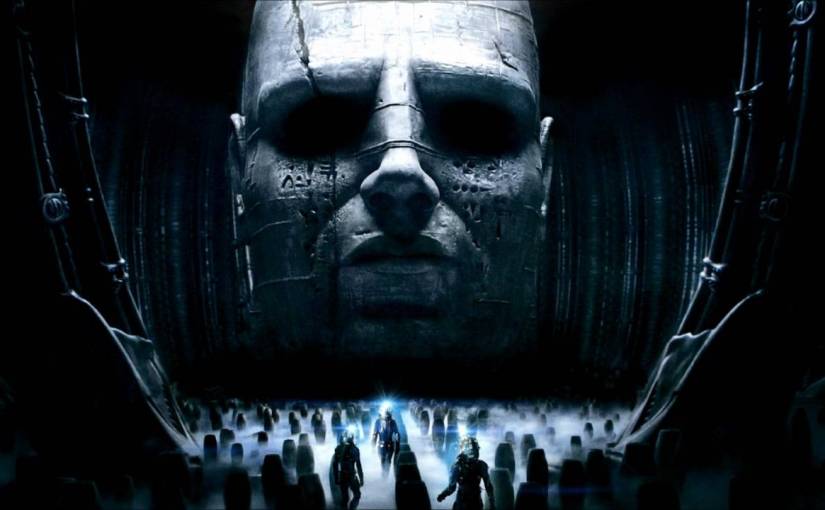
Upon arrival on the mysterious planet, the crew enthusiastically approaches a structure to explore. Finally, they will receive answers to life’s greatest mysteries. It’s not hard to realize that things will not go as planned, however. It’s also not worth detailing everything that happens within the confines of this column. I’ll let you absorb the imaginative visual feast of horrors and effects for yourself. Most interestingly is that Dr. Shaw shares with her lover/scientist partner that the strong men, which they identify as “Engineers,” possess the same DNA as humans. That’s an interesting observation. Is it disappointing though? Should it be grander for this long hike into outer space?
In many films like Prometheus or Alien, not everything cooperates as the characters expect. None of that is surprising but it is welcome for the entertainment of suspense and thrills. However, what I took away from the picture is where technology duals against religion and biology. A pertinent blink and miss moment occurs following a traumatic event for Shaw. David the android removes the cross around her neck. Is there sound reason any longer to believe in God or the biblical teachings she was raised on if Shaw found the origin of herself and fellow humans? Is her faith now a moot point?
On a scientific level, we learn Shaw is incapable of bearing children. Yet, through a set of circumstances David informs her that she is suddenly three months pregnant. The high-tech invention of David may have had a hand in this development by the way, and this is not some normal kind of pregnancy either. Technology lends to a horrifyingly memorable scene where Shaw “delivers” her offspring.
I’m sure we all question our beginnings. Did it begin in six days by God, with Adam and Eve, as initial products? Was there a big bang that just started it all? I’d argue these questions will likely never be answered in our lifetimes. Thus, the debates rage on because we have nothing better to do with our lives. Cynical, right? Well movies like Prometheus try to offer suppositions on possibilities. In fact, there’s one pessimistic crew member on the ship who questions Shaw and Holloway’s goals of undoing a century of Darwinism on some distant planet, billions of miles away from Earth.
As the film reaches its climax, I found it even more interesting that Shaw puts on her cross necklace again, and David asks her if its even necessary at this point.
The visuals of Ridley Scott’s film are impressive, though the planet surface and space travel doesn’t look any more creative than other science fiction films. Frankly, it doesn’t need to reinvent the wheel. The cast is quite diverse in personalities from a space pilot captain portrayed by Idris Elba, to a nothing but business professional played by Charlize Theron. Other cast members are there for the casualty line up.
How Prometheus relates to the universe of Alien is fun, but the film still stands on its own. This movie does not require knowledge of the other films to follow this storyline. Yet, if you’ve seen the other pictures, it is fun to uncover a few wink and nods here and there.
Jon Spaihts and Damon Lindelof (writer of the TV series Lost) deserve more credit for the construction of Prometheus because of the subtle debates ingrained in the monster movie themes of the picture. Would an emergency C-section be considered a natural way of giving birth? Would a belief in an “Engineer” supersede someone’s faith in a higher God-like power? Should technological advancement overcome what’s destined for humanity?
As I close this article, you know what? I’m going to say yes to all those questions. Whatever put people on the planet Earth to live and occupy, granted us the capabilities to find alternatives to biological functionality. Alternatives of religion preach a variety of different content that all humans choose to believe (yes even atheism, because if it’s got a name then it is some form of belief). The science and engineering capability of technology did not arrive and develop without tests and experimentation, and it will forever proceed that way. Dr. Frankenstein toyed with invention that did not go as expected. Ridley Scott’s film suggests that the characters of Prometheus had a similar experience. The point is we never advance unless we try and unless we fail before we hopefully succeed.
 2 UNPAID MOVIE CRITICS!!!!