THE PROFESSIONAL (Léon)

By Marc S. Sanders

The cult following that has come with Luc Besson’s first American made film seems unwarranted to me.  It’s currently listed as number 40 on IMDB’s top 250. I have no idea why. I recognize the artistic style of the picture, but what is here to relish beyond an enlightening introductory performance from would be Oscar winner Natalie Portman?

To watch Besson’s use of the camera makes me feel like a viewer from the director’s native France.  The setting is Little Italy, New York and it has a feel to it like Besson just stepped off the plane and decided to hone his lens on a condensed city section, but lacking an education of its culture or history.  The Professional certainly doesn’t look or feel like Dog Day Afternoon, When Harry Met Sally…, or Die Hard With A Vengeance.  (Perhaps the music from Éric Serra altered my mood.)  I never took issue with this aspect of the movie. It is unfortunate however that Besson’s film comes off too perverse in its storytelling, especially with its character blend.

Portman is Mathilda, a spunky kid who survives the murder of her family when a corrupt, drug dealing DEA agent named Stansfield (a way over the top Gary Oldman) carries out the slaughter after her father fails to pay a debt.  Fortunately, as Mathilda is returning home and coming upon the bloody aftermath, Stansfield and his crony of killers opt not to take her out too as they believe she belongs with the occupant of her neighboring apartment.  Léon lives there and happens to be a skillful hitman and weapons expert who pulls Mathilda inside to safety.  He’s played by Jean Reno.  These killers who massacre by day have no care to eliminate the other tenants living on the same floor, including a little old lady.  Why?  I don’t know.  Maybe they called in sick on the day assassination school covered “Chapter 6: Leave No Witnesses.”

Besson does not apply much brainpower to the script he wrote and directed.  Oldman’s characterization could not be more obvious with how unhinged he behaves.  His department colleagues who take less than a minute and a half to question him don’t even raise an eyebrow.  While the storyline can be dismissed as a pulpy kind of graphic novel come to life, isn’t it lucky that if your family is going to get shot up, you have a professional hitman living right next door? I mean c’mon.  This is only the set-up of the picture, within the first ten minutes, and my suspension of disbelief never arrived.  

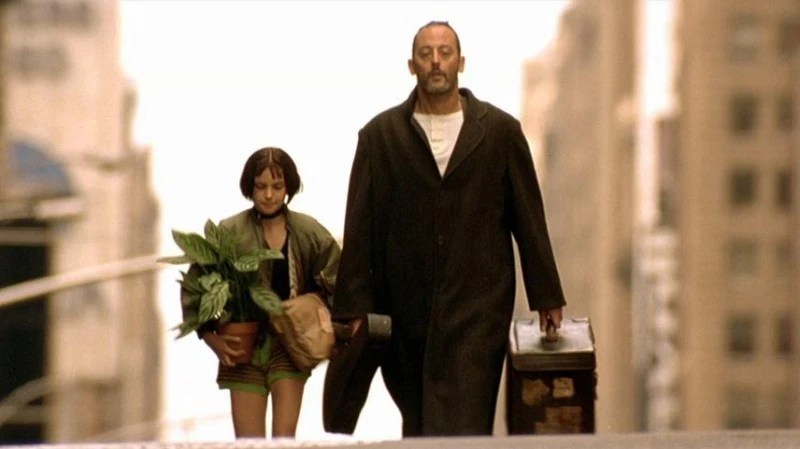
The most egregious lack of consideration falls within the relationship between Reno and Portman’s characters though.  She’s twelve.  He’s in his late thirties or early forties, but his silence implies it is time for assisted living.  When they are not relocating from apartment to apartment, trying to stay out of sight of Oldman’s gang, they are valuing the life of Léon’s beloved plant, drinking milk and demonstrating the fine art of sniper operations.  That’s fine – it’s the stuff of Tarantino fare.  

However, when the pair decide to entertain each other with Portman doing routines of Madonna and Chaplin for play fun, there’s a cringey temperature to the picture.  Besson was seeking out a relationship between a random man and child without any element of sexual proclivities involved and yet, it’s there.  In another writer/director’s hands, there would have been a stronger attempt to develop a paternal relationship between the two characters.  Yet, Natalie Portman doing a childlike song and dance performance of “Like A Virgin,” with Jean Reno’s Léon acting unaware seems artificial and perversely moving in the wrong direction.  When danger crosses their path later and they both say “I love you” to one another, I can’t help but question how this bond might have turned out if they were never forced to separate and save themselves from the bad guys while continuing to live a quiet life with a house plant and gallons of milk.

The final third of The Professional has the inevitable shootout and explosions.  Out of context, it looks good but again this is New York.  So, when Stansfield brings in the firepower of the entire city police to force Léon and Mathilda out of the tenement building, shouldn’t someone be questioning someone?  Anyone? It’s ridiculous.  None of the neighbors run for cover or are given warnings to divert away as a small rocket launcher is propped up for blasting the front door open, along with anyone inside.  

The Professional contains a boring, inappropriate middle section accompanied with a ridiculous opening and ending.  Therefore, I have trouble locating the merits for this piece.  I can recognize the potential of Natalie Portman in her performance.  Yet, if this were the first film I ever saw Gary Oldman in, I might not be so prone to watching anything by this best of the best character actors.  “EVERYONE!!!!” he screams, shouts, screeches, and bellows all at the same time.  Whether you’ve seen the film or not, most cinephiles relish in that sound byte from him on social media. I’d argue it’s in no way a salute to the actor.  Frankly, it’s indicative of the material when a guy as accomplished as Gary Oldman cannot uncover enough of a quirk in a bad guy from a very unimaginative script.  It’s not your fault Gary, so much as it is Mr. Besson’s.

Jean Reno has a cool looking, silent poise to Léon, the professional hitman, but there’s nothing lent to him to work with except a pair of opaque, circular sunglasses, milk, a plant and at least as many guns and ammo as found in The Matrix.  Reno functions on little dialogue and no background save for a few scenes he shares with Danny Aiello as the mob boss who frequently hires him for jobs.  Reno’s scenes with Natalie Portman only demonstrate how inappropriate their connection as actors in a scene are, as well as how their characters are supposed to serve each other. 

The faults of The Professional ultimately lie with its puppet master, Luc Besson.

MAY DECEMBER

By Marc S. Sanders

A blaring piece of pounding piano music from Marcelo Zarvos hearkens awake the silent opening few seconds of Todd Haynes’ May December against that of a caterpillar/butterfly terrarium.  I don’t like the music and I’m immediately reaching for the volume control on my remote.  It’s only as the film progresses, however, that I develop a grateful appreciation for the often-disruptive soundtrack.

Julianne Moore and Charles Melton are Gracie and Joe Yoo, the relationship referenced in the film’s title.  Twenty years prior, Gracie, at age 36 who already had children and a husband of her own, had an affair with Joseph, a 13-year-old seventh grader at the time, in the storage area of a Savannah GA pet shop where they worked together.  Gracie went to prison for the crime of statutory rape and delivered their baby while serving her sentence.  Once her term was finished, the two continued their relationship and got married, bearing a set of twins, a boy and girl.

As the twins are approaching graduation, a television actress named Elizabeth (Natalie Portman) has arrived in town to do observational research and interviews to prepare for her portrayal of Gracie in a made for TV account of what occurred.  On the surface, all seems calm with the past put behind everyone.  Townsfolk will say that Gracie and Joe are so appreciated and loved in the community, and they love each other.  However, the script from Samy Burch will reveal otherwise as Elizabeth develops different kinds of connections with Gracie and Joe, respectively, as well as others she speaks with in town, including Gracie’s attorney, her ex-husband, the pet shop owner, and Gracie’s now adult son from her first marriage.  His name is Georgie (Cory Michael Smith) who was close friends with Joe until the affair was revealed, and now let’s everything hang out avoiding any kind of subtlety.  He’s even candid about what he believes occurred in Gracie’s childhood that could have dictated why she committed her act.

Todd Haynes’ picture is a complete character study of a story that many would regard as sordid or seedy trash material to talk about over dinner with friends.  People like Gracie and Joe may seem real to any of us who live in another part of the country.  We will never have any kind of relationship with them.  They are meant for cover stories in People magazine and The Inquirer.  It’s soap opera junk or trashy romance novels brought to reality.  It’s easy to judge the kind of person Gracie in particular is because what she has done is wrong and disturbing.  All these years later and they are still receiving packages on their doorstep that contain feces.  Gracie committed a terrible crime, but what does an act like this say about someone who would go to that length, so many years later? 

The performances in this film are astounding.  Charles Melton especially.  Samy Burch writes a disturbing and well-drawn character with Joe.  He’s thirty-six years old now, in 2015 when this story takes place, and as his children are graduating and are about to make their home an empty nest, he seems so much more immature than them.  A telling scene occurs when his son takes out a joint and practically instructs Joe on how to use it.  Joe coughs uncontrollably.  He gets ill, and it is his son who is calming him down.  Gracie also appears to treat Joe like the child she bedded all those years ago, instructing him to straighten up the house and put away his butterfly garden, or not to get into bed because he reeks of the BBQ he used earlier in the day.  Joe lives in an adult body, but he skipped his progressive years to go straight into marriage and fatherhood, and therefore he has not had an opportunity to grow up.

Julianne Moore plays delusional all too convincingly.  She might have confessed guilt to her crime.  She served her time, but as her attorney and Georgie will imply, none of that means anything if she still believes she did nothing so terrible.  She’s now married to Joe, who is now well past legal age and has had a twenty-year relationship with him, as well as the children they share.  Gracie happily accepts her new role as a baker in the community.  Yet, it doesn’t even occur to her that some acquaintances merely place orders just to keep her occupied.  Either Gracie chooses to wear blinders or she’s truly unaware of how she’s considered; still remaining a pariah within her social circle.  It’s devastating when someone cancels a cake order, tells her to keep the money that was paid for the work, but is also told that the cake no longer needs to be baked.  Especially now, as her children from her second marriage are leaving the home for college, she is realizing that she has no worth or value to anyone anymore.  No one even wants to sample her cake any longer.  Part of me wants to say it serves her right, but with Julianne Moore’s performance, it’s also terribly heartbreaking.  There are acts we commit in our lives that we will never, ever recover from.

Natalie Portman adds another accomplished performance to an outstanding resume.  Todd Haynes assists with demonstrating how manipulative and subtle Elizabeth, the starlet actress, is supposed to be.  When she first arrives at the couple’s home for a summer barbecue, Haynes captures Elizabeth with no jewelry on and wearing a hat and sunglasses that she never takes off.  Gracie, Joe and the others come to greet her and offer her a hot dog, but Elizabeth doesn’t reveal herself.  She keeps herself hidden.  She’s begun a camouflage as she initiates her observations.  As the story moves on, we get to see how perhaps a Julliard trained method actor prepares.  She begins to apply her makeup just like Gracie would.  Elizabeth dresses like Gracie.  She wears her hair like Gracie.  Elizabeth duplicates Gracie’s hand gestures captured in news articles.  Most significantly, she develops a bond with Joe, just like Gracie did.  A crumpled-up letter from Gracie that Joe has held on to since they began their affair twenty years ago, is reintroduced later in the film that Elizabeth pounces on.  Todd Haynes captures an unbroken take of Portman reciting the letter in a mirror and it’s an eye-opening moment for the character.  Suddenly, I don’t see Elizabeth anymore.  I see Gracie, and Natalie Portman is playing the predatory sex deviant.

By 2015, this story is a been there/done that.  The general public has stopped caring.  Only a few still carry an anger with those packages that are left on the doorstep.  Otherwise, there’s nothing left to share or care about.  Yet, May December does a fine job of showing the residual detritus of what’s come from such an illicit affair.  Gracie’s husband before the affair will say he’s over the betrayal and humiliation, but clearly he’s not.  Gracie now has two families.  The first family from a standard marriage with adult and teen children she greets as if they are neighborhood kids.  She’s on the outside of what she used to have as a mother. Then there is the second family consisting of the college age daughter she delivered while in prison and the twins that came thereafter.  An awkward moment occurs in a restaurant when the two families run into one another.  No one is well recovered from Gracie’s transgressions, even if she served her time.

Reflecting back on the music, I wondered why it made such a presence in this intimate, quiet drama.  It literally pounds at you every time it is reintroduced.  I believe it first serves as an abundance of the cheesy melodrama that naturally spawns from an unwell story like this.  Elizabeth is set to appear in a television movie adaptation of this ripped from the headlines account, much like a Lifetime movie of the week which shamelessly thrives on this kind of gossip trash.  The music seems to tell me to “LOOK AT WHAT SHE DID!!!!!!”  Later though, Marcelo Zarvos’ composition seems to remind me that this is not just “another story” as Elizabeth freely dismisses it when talking to Joe during a personal crisis of insecurity.  Joe immediately snaps back at her that this is not just some story.  “This is (his) life!!!!!” 

Before Todd Haynes’ film begins, terrible acts have occurred.  During the course of the movie, we see that terrible results remain.  The narrative of May December is kept interesting because we don’t learn everything at once.  There is exposition to uncover as soon as the film begins all the way to the very end where Gracie undoes all of Elizabeth’s prep work with a curveball truth.  Then, we witness Elizabeth do one take after another on a soundstage with a pet shop prop snake twisting around her arms as the seduction of a young, teenage boy is reenacted.  I don’t think Elizabeth got a convincing grasp on what makes Gracie and Joe tick, and now she questions what she invested in and what she sacrificed of herself in order to learn about the character she committed to portraying.

It’s disturbing what Gracie did.  Perhaps it’s at least as ominous that it is now being duplicated for the sake of entertainment in front of a worldwide audience.

CLOSER

By Marc S. Sanders

Mike Nichols is a director for those actors who really grind their teeth into the craft of performing with crackling dialogue.  Often, he goes for what makes a person drive awkwardness into a moment.   Equally he focuses on those folk who sustain the discomfort so apparent in a room.  Prime examples are his classic films Who’s Afraid Of Virginia Woolf? and The Graduate.  There’s even some of instances in his slap happy comedy, The Birdcage. Towards the end of his career, Nichols adapted Patrick Marber’s biting play, Closer, into a film.  

Closer carries a four-pronged approach in the shapes of Jude Law, Natalie Portman, Julia Roberts and Clive Owen.  Law plays Dan who catches the eye of Alice (Portman), an alluring stripper who gets hit by a car on the streets of London.  Beginning with playful flirtation in the hospital waiting room, they develop a relationship mostly based on sex for the following year.  Later, Dan gets distracted by a beautiful, much more mature photographer named Anna (Roberts).  She rejects Dan’s horny advances and by some manipulation with online anonymous sex talk, he sways a sex starved doctor named Larry into meeting Anna at an aquarium.  Then, to Dan’s surprise, Anna and Larry get married. There’d be nothing more to discuss if these four lived happily going forward.  What follows, however, is a manipulative chess match of lies and deceit among the four.  

One after the other disarms somebody who they valued and thought they could live with at any given time.  Alice leaves Dan after he reveals an affair with Anna.  Larry has a regretful one-night stand with a woman in New York. Anna doesn’t mind because she’s been having an illicit affair with Dan.  Larry is miserable but begs Alice the stripper to justify his torment, assuming she’s also anguishing over being betrayed by Dan. Not likely the case as she erotically teases him in a private stripping room. This scene with Natalie Portman in control establishes as the best actor in the film.

The four players on the game board all start in their respective corners, only to go around the perimeter or advance diagonally across and pounce on what they don’t have. At any given moment someone is drawing the top card or rolling the dice, and it’ll have a direct effect on one of the other three or all of them at once.

Patrick Marber’s script gets more layered as the partners change hands, but it’s his dialogue that keeps you engaged.  Alice believes “Lying is the most fun a girl can have without taking her clothes off – but it is better if you do.”  An angry Larry confronts Anna by asking about Dan.  “What does it taste like?”  Anna’s reply: “Like you, only sweeter.” Ooooo!!!! Lines like these sting, and I’ve never met someone in real life who can think that quick on their feet with such savviness.

Just as in other scripts like Steel Magnolias and Glengarry Glen Ross, I think the characters in Closer (initially a stage play) speak a little too instinctively.  They’re just so quick with their hurtful insults, comebacks and seething expressions.  Therefore, should I like plays that perform on a higher, smarter plane; plays that work quicker than most minds can register with what to say next?  Well, I appease myself with a constant reminder that a piece like Closer is more performance art than truly authentic. These four characters are so quick with a verbal jab, while engaging in some foolhardy actions that promises to make their circumstance appear worse. How can they be so smart with a comeback while acting so stupid at the same time?

The cast of four are so sharp, alert and precise.  Most of the scenes in Nichols’ film are performed in different combinations of pairs.  Every one of them is expertly rehearsed and Roberts, Law, Owen and Portman are of course the strongest assets in the production.  However, Nichols wisely uses his lens in zoom close ups, practically justifying the quirky title of Patrick Marber’s work.  I never trusted a single character was entirely genuine in Closer.  How should anyone? They’re always stabbing one another in the back. However, when an actor leans in and Nichols meets their expression halfway, I’m being ordered to look that person straight in the eye.  Still, I won’t know what to believe, but that’s the point.  

Dan, Alice, Anna and Larry move the scenes along with question after question because every answer is so dubious.  You’ll likely never get a more skeptical response when a common inquiry such as “Do you love him?” is asked.  It can be frustrating, but thanks to the cat and mouse play of Mike Nichols’ stage direction, on film, I wanted to dig deeper into the bottomless rabbit hole.

You might conclude there is a surprising twist at the end of the film.  I don’t know if it holds much weight to what I learned during the course of the story.  Nevertheless, it reinforces the theme of Closer.  Being bad can be fun, offering an immediate high, and part of being bad is lying and betraying, and maybe the ending reveals who actually won this board game with four players at the table.

Look Closer and tell me what you think.

GARDEN STATE

By Marc S. Sanders

The irony of Zach Braff’s Garden State is that the protagonist he portrays is heavily medicated to subdue any variation of depression or anger induced mood swings.  Yet, it seems like everyone else in the picture should be off the drugs, and those that aren’t taking any, should revert to some appropriate pharmaceuticals.  STAT!

Braff wrote and directed this quirky comedy-drama loosely inspired by his upbringing in northern New Jersey.  He plays Andrew “Large” Largeman.  He’s an actor living in Los Angeles when his father calls him to let him know that his quadriplegic mother has drowned in the bathtub.  Andrew seems like what Cameron from Ferris Bueller’s Day Off might have become a few years after he kicked his dad’s prized Ferrari out the glass garage.  This guy is sullen, sedate and when speaks or responds to a question, you might think he’s catatonic as well.  He’s just so numb from the medicinal products he takes.  They were prescribed by his psychiatrist, who also happens to be his father, Gideon, played with quiet tension by Ian Holm.

At the graveside funeral, Andrew comes upon some childhood friends who never left Jersey behind.  Peter Sarsgaard is Mark who vaguely remembers Andrew and invites him to a party later that night which is likely just like last weekend’s party and the weekend before that.  Mushrooms, weed, coke, alcohol.  It’s all there.

The next day Andrew meets a precocious young lady named Sam (Natalie Portman) who recommends he fend off a humping seeing eye dog by kicking him in the balls.  This unexpected introduction is what will meaningfully break Andrew of his stupor. The bond between Sam and Andrew will carve out the rest of Garden State following a meanderingly weird exposition.  I’m grateful for that because just when you think this film is going nowhere fast, even if it is told at a slow pace, the story absorbs a sweet narrative shared between two very likable characters.

There’s a lot of eccentricities in Zach Braff’s film which he admirably wrote and directed as well.  Living in New Jersey for fourteen years of my childhood, I don’t recall anything within my nearby Jewish suburban neighborhoods being this oddball.  Then again, Braff is maybe a little too ambitious to have one strange character turn up after another.  A woman at the funeral makes him a shirt that matches the wallpaper of the hallway.  A dim-witted cop asks how he did when he procedurally pulls Andrew over.  Another guy shoots flaming arrows into the air in the backyard of his mansion for Sam and Andrew to haphazardly dodge their descent. 

Mark is not only a grave digger in the cemetery, but a robber as well, stealing the jewelry from the remains in the coffins.  Sam lives with her mom and adopted Nigerian brother amid Dobermans and a hamster jungle gym that stretches the entire course of the house and serves as a hazard for one poor rodent after another.  Sam has a well populated little pet cemetery out back.

Amid all these strange visuals and discoveries, there is a background to Andrew’s need to be drugged by his father.  He was the cause of his mother’s disability when he was age nine and pushed her down, causing permanent paralysis. 

There are colorful backgrounds to Andrew and Sam and a curiosity to learn more about them.  Still, the film seems to stretch its running time with too much unusual, oddball material.  I responded to most of it with a smirk or chuckle, but I ask myself why.  Why is so much of this here?  It builds up a setting, perhaps.  I’m just not sure.  There’s an overt weirdness to every single character seen in this film.  Nevertheless, I don’t believe Braff’s intentions were to duplicate a Wes Anderson formula.

Fortunately, Zach Braff offers a wonderful character arc where Andrew becomes more and more awakened as the film moves on, while clinging to Sam’s company and abandoning his father’s prescriptions.  Natalie Portman seems to mature over the course of the picture. Sam’s quirk is that she tells tall tale lies in rapid succession.  That façade nicely breaks down to show the genuine person Sam truly is later.  When her mother boasts a video recording of an ice-skating routine that Sam did while dressed as an alligator, the embarrassment on Natalie Portman’s face is so naturally telling.

Ian Holm should also be recognized as he portrays the opposite of whatever dialogue Braff wrote for the father character.  That’s a great challenge.  A scene in the kitchen has Gideon dressed in a bland, beige sweater and tie and he seems to hide within the pale walls of the room.  There’s no life to the guy.  Nothing stimulating, despite how educated the man may appear.  So, it seems unjustified for Gideon to tell his son later that he wants them to be happy like they used to be.  Braff’s character wisely responds by being unable to recall any time when they were ever happy.  Moments like these are the strength and intelligence immersed in Garden State.  The assortment of side quirks does not have this kind of staying power, though.

I like Garden State but there’s no way I could love it or embrace it.  There’s just too much moroseness within the strange residents amid their sleepy conversations to make me want to stay with any of these characters.  The benefit of watching the film is to see what Zach Braff, Natalie Portman and Ian Holm lend to the picture – three wonderful performances.

THOR: LOVE AND THUNDER

By Marc S. Sanders

Taika Waititi’s Thor: Love And Thunder doesn’t just operate as a standard Marvel Super Hero movie.  I think it encapsulates what moviegoers treasure when watching a film, and that consists of a gamut of emotions with the opportunity to absorb the best in sight and sound.  Even if we are watching a guy fly through the skies with a cape that’ll be marketed into a million toys and t-shirts, sight and sound are nothing without brains behind a script.  It’s fortunate that a director like Waititi always works with that in mind.  Marvel overseer Kevin Feige knows how to recruit talent behind the camera and you just can’t go wrong with the architect of a spoof on the surface, yet an all too horrifyingly real film underneath, like the widely acclaimed Jo Jo Rabbit.

I’ve always laid claim to the fact that movies largely recognized as “tear jerkers” like Steel Magnolias and Terms Of Endearment are actually comedies first, and then dramatic sob stories second.  I’m serious about that observation.  Why?  Because if a film is going to go to great lengths to risk the outcome of one of its main characters, then it must get its audience to embrace and deeply love that person first.  The best avenue to that approach is to outrageously laugh and cheer that character on ahead of what’s to come.  Taika Waititi’s second film to center on the God of Thunder does just that.  The best reward I got from Thor: Love And Thunder is that I laughed quite often (as the trailers imply), but I also teetered on tears as well.  Good fantasy storytelling will incorporate an all too real conflict with its protagonists and then introduce the strange and unusual as an escape.  The best example may be The Wizard Of Oz, and the simple set up of Dorothy and the risk of her perishing with her dog Toto in a threating tornado.  More recently, I also think about Guillermo Del Toro’s Pan’s Labyrinth centering on a young girl in early twentieth century war torn Europe.  Again, Waititi’s coming of age during Nazi occupation opus, Jo Jo Rabbit, follows this formula as well.  Without spoiling too much from Thor’s latest adventure, Waititi presents an all too real and unforgiving circumstance for one of the film’s characters and then segues into his delightfully and never too weird assortment of settings and characters.

It’d be easy to think that by what may be the sixth or seventh time we’ve seen Chris Hemsworth in the garb of this character that anything inventive would have been exhausted by now.  Not so.  A new dimension in storytelling arrives midway through the film that presents a different crisis for the proud God.  Hemsworth really approaches it beautifully.  It was reminiscent of Christopher Reeve in the original Superman, actually.

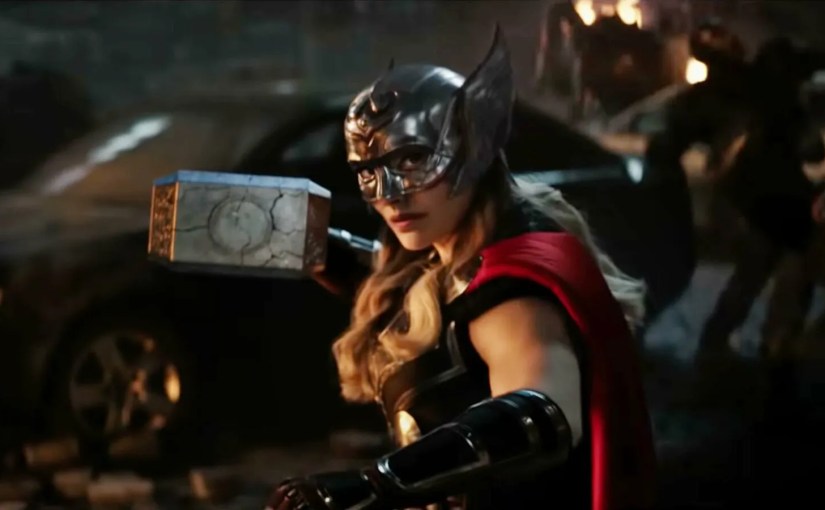
A supporting cast of return players work well together, particularly Natalie Portman, who is given a much more fleshed out and well considered character arc than her two previous Thor films. (Early on, Marvel Studios was notorious for not writing good female characters in any of their pictures.  They were just presented as glamorous damsels in distress. Thankfully, that’s well behind them by now.)  Portman returns as the on again/off again love interest, Dr. Jane Foster, for Thor.  Even better though, Jane actually becomes Thor!!!!! (No spoiler there.  Just look at the trailer or marketing poster.)  There’s great on-screen interaction with Portman and Hemsworth, even when it’s a montage of past dating episodes like in ridiculous Halloween costumes or having a domestic squabble as any typical married couple might have.  Hollywood should reunite these two for a romantic comedy in the vein of Rob Reiner/Nora Ephron material.  Chris Hemsworth is a much better partner than Ashton Kutcher ever was in a past Natalie Portman film.  Put Chris Hemsworth together with Natalie Portman again and they could become as adoring as Tom Hanks and Meg Ryan did.

By the time the fourth movie comes, does it really matter who the villain is played by?  Well, when you are writing a smart script amid ridiculous visuals like Taika Waititi is known for, the answer is yes.  This film surprisingly opens on a downer prologue that necessitates good dramatic acting amid silly CGI and garishly loud costumes.  It’s fortunate that Christian Bale, who regularly performs on a method level comparable to Daniel Day Lewis, was available to portray the scrawny, pale and scarred Gorr The God Butcher.  Bale puts all his talents into what could’ve been a throwaway role like, say a Ghostbusters bad guy.  (Can anyone tell me who actually played Gozar in the 1984 film????)  This is another notch in Bale’s repertoire of outstanding credits that should not be overlooked.  You can sympathize with Gorr, as well as be frightened of him.  There’s much range in this character on the same level as the Thanos villain from earlier Marvel films.

Russell Crowe has a fun appearance as the God known as Zeus.  He looks over the top ridiculous and he works in antics that seem like they came out of episodes of Who’s Line Is It Anyway?  Put it this way, I haven’t forgotten how Crowe walks down a staircase yet.  If Russell Crowe is anything of an educated performance artist, then when he was getting sized up in wardrobe, I’m sure the wheels were turning and he was considering what tics could work for that of a God drowning proudly in his own vanity.

Tessa Thompson and Taika Waititi are thankfully back, respectively as Valkyrie, King of the fishing/tourist destination New Asgard, and the simply innocent rock guy buddy, Korg.  The Guardians Of The Galaxy are here too.  It’s a fun bit of material they have to play with.

In another director/screenwriter’s hands, any Thor film would likely get boring with its standard formal Shakespearean like vocabulary and artificial CGI.  Isn’t that an ongoing problem with CGI anyway?  So often it looks to fake.  Because Taika Waititi opts for bright colors and odd shapes and sizes of setting and background characters, nothing could look artificial, because the fantasy is always acknowledged as over the top by the very characters occupying the space.  A glass castle of pinks and purples that resembles gigantic glass Mary Jane bongs or science lab beakers is accepted in a Thor film, just as much as munchkin size, owl like creatures with small beaks are a terrorizing army in flying jet skis with mounted laser guns.  Mix in a blaring rock soundtrack and Waititi hits the notes where it’s okay to laugh at the silliness of it all. In other moments, he’ll invite his audience back in from recess to take in what’s hard and difficult to live with and endure.  Again, Waititi pleasantly surprised me with the balancing act of outrageous comedy against crushing drama when he made Jo Jo Rabbit.  The blend works so well here in not so typical Marvel fashion.

Thor: Love And Thunder left me thinking that it is the best of the superhero’s four films.  It’s measure of laughs and choked up drama kept engaged and I appreciated the experience.  Remember, I recalled Steel Magnolias and Terms Of Endearment in this write up.  If you don’t take that comparison lightly, then hopefully you’ll have the same experience I did with this installment of the Marvel franchise.

PS: Hats off to the trailers for not incorporating everything the film has to offer.  Within the first fifteen minutes of the movie, I was actually taken aback by an element I never considered or expected.  It only enhanced my perspective of the film.

PSS: Anyone that knows me, knows that I love Guns N Roses.  Consider me a born-again fan.  Particularly Sweet Child O’ Mine will always be one of my most favorite songs.  This film reminded me that it was the first song my daughter heard the day after she was born, when I sang it to her in the hospital room. 

STAR WARS EPISODE III: REVENGE OF THE SITH

By Marc S. Sanders

Star Wars Episode III: Revenge Of The Sith is the best installment in George Lucas’ prequel trilogy of his epic space opera saga. However, that is where the line is drawn.

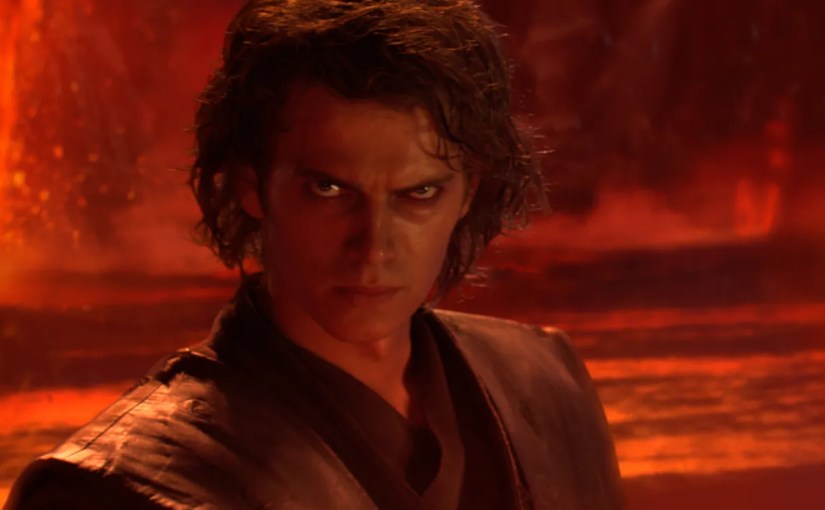
It carries a heightened drama thanks primarily to Ian McDiarmid as the eventual Emperor Palpatine. Shakespeare might have been proud of the character and performer. Much like Alec Guinness received an Oscar nomination for his portrayal of Ben Kenobi, so should McDiarmid have been honored playing an antithetical influence (of Kenobi) on the student and Jedi in Training, Anakin Skywalker (Hayden Christensen in a much more improved performance).

War within the galaxy is rampant and there’s no end in sight. The Jedi Order is overwhelmed. Anakin is used as a pawn to spy on his new mentor Palpatine who in turn insists that the young Jedi occupy a chair in the Jedi Council to spy on them. In addition, it’s hard for Anakin to come to grips with his secret wife Padme (Natalie Portman) dying from childbirth as his nightmares continue to remind him. A deal with the devil himself in Palpatine is offered as an option. Can a manipulation in the Force rescue Padme from death?

There’s a lot of weight on Anakin here. Sith departs from the politics discussed in the prior entries as it focuses primarily on Anakin’s personal struggles. The film really needed to take this direction. After all, it’s time to witness Anakin’s transformation into Darth Vader. Everyone has been dying to see that.

George Lucas’ scene set ups work on occasion. A great performance of dialogue occurs in an alien opera box between Palpatine and Anakin. This is where McDiarmid really comes through. He’s subtle and deliberate in his influence. Fortunately, Christensen just needs to listen mostly.

Later however, a scene works only so much when Samuel L Jackson as Jedi Master Mace Windu duels with Palpatine, having just revealed his secretly evil Sith side. Through all three of these films, Mace Windu has been one of Jackson’s least exciting roles. He’s bland and never doing much. Christensen comes upon this scene and doesn’t give me the genuine anguish I was hoping for. McDiarmid, again, is hitting home runs in surprise and development. This turning point scene is not as strong as it should have been thanks to Lucas’ stilted direction and writing, along with Jackson and Christensen lacking any true depth.

Episode III also has a handful of so what moments that continually frustrate me in this trilogy. We have to watch Yoda and Obi Wan watch a video of what Anakin has done. Why? We’ve seen this already. Bail Organa (Jimmy Smits; I wish he had a larger role) needs to be informed of an upcoming meeting. Honestly, I don’t need an update on a character’s calendar. Just make sure he arrives on time. Moments like these don’t drive towards anything.

Natalie Portman is not served well as a pregnant Padme. Her dialogue is worse than ever, and it hinders her performance. Padme is torn between her affection for Anakin and her passions for democracy. We see next to none of the latter. How does an intelligent woman like Padme suddenly become so unaware? Ironically, opportunity for her political nature was filmed but remains only as deleted DVD features. These scenes would have enhanced the movie as they imply the foreshadowing of the upcoming Rebellion, while a petition attempt is mounted to usurp the Emperor’s administration. Here, Padme is trying to be instrumental in Luke & Leia’s (her own children) future. Really good material here. Nevertheless, George Lucas opted to leave it all on the cutting room floor. Oh well! I’m still holding out hope for a “special edition” cut one day, inclusive of this storyline.

Lucas’ lava planet, Mustafar, is quite grand as the arena for the much-anticipated dual between evil Anakin and noble Obi Wan. Still, again, it could have been better. There’s too much CGI and flashing lightsabers that hide the acting among the swordsmen. Compare this to the duals in Empire and Jedi and you see what I mean.

I know my commentary on the prequels is quite pessimistic, but I do have an (maybe a biased diehard fan) appreciation for the films. The stories work. The execution falls short however in dialogue, performances and visual artificialness.

George Lucas had all the right make up for a trilogy as epic as his original films that began in 1977. Maybe because he didn’t have the monies and technology at that time, his imagination had to work overtime back then. In these later films, however, his hubris got in the way of his craft. So, we have to settle for his next great technological discovery in CGI efficiency. Therefore, we get cartoons with no depth like Jar Jar Binks, General Grievous, and lame, clicking battle droids.

Lucas always defended the position of his writing by insisting these films are aimed for kids. No. I don’t accept that. Star Wars was aimed for kids and the kids that remain in all of us as we continue to grow into adulthood. George Lucas needed to write with that in mind.

STAR WARS EPISODE II: ATTACK OF THE CLONES

By Marc S. Sanders

Star Wars Episode II: Attack Of The Clones is a vast improvement on the prior installment of George Lucas’ prequel trilogy from a galaxy far, far away. Lucas made an attempt to bring his characters out of their shell a little bit. I mean at least they laugh among each another. You need that if you are to believe that Jedi In Training Anakin Skywalker and Padme Amidala (Hayden Christensen and Natalie Portman) are to fall madly in love. So at least have them romp around in a Naboo meadow.

There’s some curious political intrigue in Clones; delving deeper than what Episode I only began to imply. As stilted as some of the dialogue may be, there are ingredients here that allow to me correlate with real life government powers and to date current events. That’s a compliment, but it’s also a shortcoming.

Ian McDiarmid remains the MVP of this trilogy as Chancellor Palpatine, the puppet master with a faux innocent exterior. Anytime he’s on screen you sit up in your chair with a little more focus. He’s brilliant as the manipulator who keeps a short distance on Anakin, the supposed chosen one, while also pushing Padme away from government interference, and yet still managing to prevent the Jedi Order from detecting his true nature. It takes a heck of an actor to pull this off.

At the same time though, the politics take up a large amount of the entire trilogy. While it holds my interest, I still question if this is what a Star Wars film should be comprised of. Where’s the force, and where’s a more defined explanation of what “the chosen one” is to offer, or what the “balance of the force” really means? Some heavy vocabulary in this terminology, maybe, but is there any dimension to any of this? Regrettably, the answer is no.

New characters and planets are introduced. Jango Fett (Temura Morrison), an armored bounty hunter, is the initial antagonist who is part of an assassination attempt on Padme, followed by a revelation that he is the source of a new discovered clone army on a secret water planet known as Kamino. (As a diehard franchise fan, I have a lot of issues with Jango and his pre-teen son Boba, but that is for another discussion.)

Eventually, the antagonism shifts to Christopher Lee as the former Jedi Count Dooku, found to be keeping conference on another secret planet known as Geonosis, where life size dragonflies reside. Lee was legendary by the time this film was released in 2002, but he’s not exactly aggressive enough for me. He was an old man with little convincing agility to be engaged in a lightsaber fight with a very bouncy Master Yoda. In Lord Of The Rings, he commanded from the perch of his tower. Here, Lee is in the mix of the action and he’s a far cry from Ray Park’s appearance as Darth Maul.

Yoda is another issue. Now friends will be quick to remind and tease me over how excited I got when I saw Yoda engage in a climactic lightsaber dual for the first time. My tune has changed though. As The Empire Strikes Back showed way back in 1980, Yoda was convincingly powerful without ever having to prove how powerful he ever was. Here, it comes off gimmicky to me as an excuse to draw a crowd or make a new kind of toy to sell. Just Yoda’s appearance alone should be enough. Now, he’s just like the rest of them. Yoda’s greatest feature was his philosophy, never his combat skills.

I don’t take much issue with the romantic dialogue between Anakin and Padmé. An actor like Leonardo DiCaprio or Billy Zane would sell the “sand monologue” into the stratosphere. Remember, those guys performed James Cameron’s hammy Titanic script. Hayden Christensen could not do that though. His temper, which Anakin is regarded for at this age, is never convincing. It’s terribly overacted. He screeches his dialogue. Darth Vader never had to yell or scream or screech. So why is Anakin? This is also partly Lucas’ fault. Where’s the misuse of the force with Anakin? At one moment, Anakin is upset and throws an object? Why throw an object? Why not “force throw” an object? Anakin demands answers from a captive bounty hunter by screaming at her? Why only scream? Why not “force choke her” or mentally torment her? Don’t you think these ideas, these familiarities we’ve seen with Vader would have held much more dramatic weight and depth?

Lucas stretched himself further than he did on The Phantom Menace. Still, he just didn’t take his second episode far enough. It’s as if he opted not to apply too much effort. There are no twists to Attack Of The Clones. No surprises. We easily have a general idea of where all of this is going long before the opening crawl even begins. So, like its predecessor, Episode II lacks a wow factor that placed the original three films into the greatness they still hold.

There still needed to be more in these films. I’m not gonna even talk about CGI. I’m talking about story, and what makes a saga a Saga. So… WHERE’S THE SAGA?????

STAR WARS EPISODE I: THE PHANTOM MENACE

By Marc S. Sanders

22 years after the first Star Wars film made a ginormous cultural impact on the world, George Lucas finally returned to the franchise to make the first film of a new prequel trilogy with Star Wars Episode I: The Phantom Menace. It was hyped beyond measure, and it sold gazillions in ticket sales but was nevertheless a letdown for diehard fans and pretty much everyone else. I don’t think it’s a terrible movie. I just don’t understand how necessary the film is.

There’s a lot of irrelevant moments here. Early on two Jedi step off a ship, and a droid introduces herself to them and says “this way please,” and the three figures literally walk out of frame. This takes up time that I don’t understand. Why couldn’t the three just end up in the room they were supposed to be in? There are a lot of “so what?” moments in The Phantom Menace, and it all weighs the film down, hindering a story.

Listening to an audio commentary a number of years ago, one of the visual effects makers pats himself on the back of a shot midway through the film that consists primarily of CGI characters and sets. That was when I realized the conception of The Phantom Menace was completed with a short-sighted intent. Sure the scene might have been a technical breakthrough in 1999, but where’s the story? Fact is, there is no story and little regard for the celebrated franchise in Episode I. Lucas and his team were more concerned with shooting new CGI discoveries blended with human interaction. They offered next to no regard for intelligent plot and storytelling. The film suffers because of Lucasfilm’s hubris.

Consider the pod race. There’s a moment where young Anakin’s (Jake Lloyd) racer falls apart at high speed and he’s gotta get it back together. He uses a magnetic tool to get a cable plugged back in. If this child is “the chosen one” and potentially “dangerous,” why not show the child potentially use the force to bring the cable back in place? Why not show moments where unexplainable power emits from Anakin, to what would imply the inevitablity we are aware will eventually happen?

Lucas is also all over the place in his storytelling and characters. From the Shakespearean manipulator, Senator Palpatine, to the immature cartoon like Jar Jar Binks. I think they all serve a purpose to entertain. Yet while adults and die hard fans will relish the return of Ian McDiarmid (a terrific actor) they’ll be bored to death with actor Ahmed Best in the Jar Jar role. This I expect happens in vice versa with 8 year olds seeing their toy figures come to life. There is a silly charm to Jar Jar, but what 8 year old wants to pay attention or even comprehend debates among galactic senators over taxation and trade? It’s as if Bugs Bunny entered the halls of Congress, or Othello walked in on a pie throwing melee among the Three Stooges. At almost every point in The Phantom Menace something doesn’t belong or seems out of place.

The film moves far away from the tradition of the original trilogy. For the first time the human characters are enormously flat. Liam Neeson, Natalie Portman, Ewan McGregor…all flat, all bland. There’s no snarkiness to them. No sarcasm. Before The Phantom Menace when was it ever said that the Jedi order was so formal in their ways? It doesn’t feel very fun to be a Jedi, like it did for Alec Guinness and Mark Hamill before.

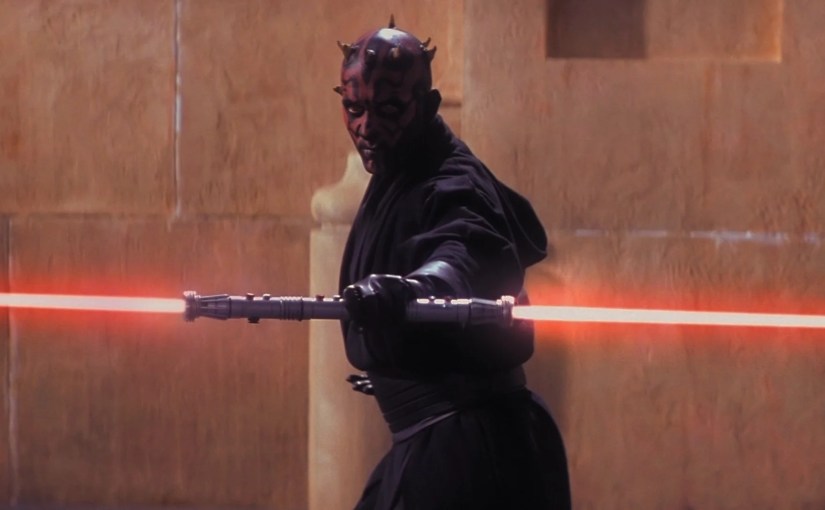
The two redeeming qualities of this film belong to the pod race which is thrillingly edited in sound and visuals. There’s some fun shots of each racer, the pit droids, the crowds in the stands and even Jabba The Hutt. The film really comes alive here much like the memorable cantina scene from the original Star Wars. The other best feature is the villain, the apprentice to the phantom menace, the red and black tattooed Darth Maul played by the agile martial artist Ray Park.

Lucas didn’t use Park enough in the film. With his double bladed lightsaber, the two on one dual Park has with the Jedi characters towards the end is one of the greatest sword fights in film. I would’ve welcomed an additional five minutes of this scene. Shamefully, this would be Ray Park’s only appearance in the film franchise, as well as Darth Maul. This was a great blend of actor and character. Lucas abandoned a good thing too soon.

Yes! I have much to complain about The Phantom Menace. Yet it is not all bad as a whole. I love the political trickery that McDiarmid displays and the senate meeting among the delegates is a nice foreshadowing for what we know will come of it. Visually, it’s a treat as well. (Again, though, what kids are going to be entertained by all of that?) The pod race and lightsaber dueling are masterful as well. There’s some good material here. There just could’ve been a whole lot more….and a whole lot less overall.

THOR: THE DARK WORLD

By Marc S. Sanders

Like Louis Letterier’s The Incredible Hulk, director Alan Taylor’s Thor: The Dark World is a very underrated installment in the Marvel Cinematic Universe. It focuses on a lot of humor with well edited action and moments that allow all the major players to offer up good material.

First Chris Hemsworth as Thor. Yeah, he’s doing the same thing and that’s fine. If it ain’t broke, don’t fix it. Moving on… This is an important chapter in the MCU, as it introduces the second of the legendary Infinity Stones, the red Aether, which consumes Thor’s love interest from Earth, Jane Foster, played by Natalie Portman. Fortunately, it provides better writing for Portman to play with. She really is the MacGuffin of the film, and she works as a story device to explore more of Asgaard, one of the best set pieces in all of the Marvel films. Jane uncovers the mysterious stone, or rather liquid, that has been hidden away for centuries; this is all Lord Of The Rings stuff. Once she finds the stone and is consumed with it, then the film segues into its originality.

Apparently, it’s not good if the Aether is used for destruction while the Nine Realms are in Convergence, which we are told happens every 5,000 years. What is Convergence? Well, that’s where it’s fun to watch Thor: The Dark World. The Nine Realms line up, literally like a rainbow of circles stacking on top of one another. It’s really cool to look at. What’s more fun is how Jane and her crew drop random objects into an open space within a deserted London warehouse and then it disappears, and then drops back down to them from above their heads. Sometimes, they drop something, only the objects don’t return at all. I like all of this stuff, because it’s all visual and ultimately that is what movies are about. Showing us something. Asgaard, The Convergence, Thor’s swing of his hammer, the Aethar, it’s all fun to see. I’ll credit Alan Taylor’s direction for a lot of this. He’s shown great achievements in Game Of Thrones. He carries his visions over to Thor’s universe.

Next is the villain is Malekeith, the head of the Dark Elves, with some really wicked looking makeup, and it only gets more wicked as he progressively gets more powerful. He wants to get the Aether and bring the Nine Realms into Darkness. Christopher Eccleston (best known for G.I. Joe; that should tell you something) takes on this role which is nothing special. I don’t care so much about the villain in this film as I do about the conflict of the story. The conflict is the real treat. Eccleston is nothing special. He’s not bad. He’s not good. He’s just nothing special. Moving on…

Tom Hiddleston is back as the trickster Loki, one of the best written characters in all of the Marvel Cinematic Universe. The script gives him a lot to play with and opportunities to irritate and antagonize Thor who reluctantly recruits his assistance. “Well done. You just decapitated your grandfather.” See the movie (again?) and you’ll love the timing of this line. Hiddleston has fun with the levity of Loki but there is a sad central story to the adopted son of Odin. During his first appearance in the film, following his incision of the New York alien invasion from The Avengers, Loki is arrested in chains to stand before his father, and Hiddleston clicks his heels together at attention, giving a serious grimace before declaring “I really don’t see what all the fuss is about.” Hiddleston continues to work and develop at this favorite character who remains tricky and unpredictable. I love it.

Anthony Hopkins is back as Odin, Thor’s father. Yeah, he’s doing the same thing and that’s fine. Again, if it ain’t broke, don’t fix it. Moving on…

There’s a lot of fantastic sci fi and fantasy sequences to this film and from a CGI perspective, it’s artistically beautiful. It’s just a fun ride of exploration. Thor was never a favorite comic book character of mine growing up. The MCU opened my eyes to something special in his adventures and those that surround him. It’s even great when Thor jumps on the tube to return to a battle in Greenwich Village. I’m expecting some energetic debate on my feelings towards this film. Bring it on and I’ll match you. As Thor might say after his hammer turns a giant rock monster to rubble, “Anyone else?”

Reader, if I can quote this film three times in a review that should tell you how much I love Thor: The Dark World.

HEAT (1995)

By Marc S. Sanders

My all time favorite crime drama, as well another one of my most favorite films, is Michael Mann’s Heat which is widely recognized for the much-anticipated moment where Al Pacino and Robert DeNiro finally share the screen together for the first time. The Godfather Part II never counted as their characters performed in different time periods. Still, Heat has so much more going for it, beyond just its headliners.

Michael Mann wrote the screenplay he directed. It deeply involves both the thief, Neil McCauly (DeNiro), and the homicide detective who pursues him, Vincent Hanna (Pacino), with inspiration from two real life characters. Therefore, this film drives with more authenticity than a standard Lethal Weapon picture. Much more is at stake than a standard kill shot, arrest or the score to take down. The women and children and partners these guys become associated with carry a weight and sense of value. Even the hoods who betray them hold significance. How they matter and are part of the story is just as pertinent.

The story focuses on DeNiro, with Val Kilmer and Tom Sizemore taking down high stakes scores, not petty liquor store hold ups. An early armored truck hold up goes well until a new partner executes the three security guards in broad daylight on the street, at point blank range. Pacino takes the case along with his brilliant squad of detectives that includes great supporting performances from Mykelti Williamson, Ted Levine and Wes Studi. Then it becomes a cat and mouse tale where two equals match one another in wits, skill, and experience. To believe the equal match up though required casting Pacino and DeNiro. The film would not work with any other pair. Through their respective careers, their various performances came off different than one another. Yet, it has been often easy to imagine either one of them playing their classic roles instead. I could envision DeNiro as Michael Corleone or Serpico. I can also envision Pacino as Rupert Pupkin or Travis Bickle. The range of these actors is unlimited.

Diane Venora and Ashley Judd are two actresses not used enough in films. As the wife to Pacino’s round the clock detective, Mann provides time for Venora to show the pain of a woman in love with a man who can hardly ever be home because he’s always on the prowl of DeNiro’s professional thief and his crew. Venora is a likable woman in the role, only the circumstances of her marriage and the difficulties of dealing with a troubled pre teen (a fantastic Natalie Portman who will break your heart with just three scenes) are gradually making her cold. She has a great monologue midway through the film that is terribly dark, as she surmises Pacino’s cunning detective.

Ashley Judd is a different kind of cold as the wife of Val Kilmer’s gambling addicted sharpshooter. She’s a beautiful housewife and mother to a toddler that is trying to maintain a happy home. However, the balance of living with a career criminal is near impossible to maintain.

Michael Mann put so much thought into characters like this. Other directors and writers would keep the story on the streets and in the hideouts and city precincts. Mann goes not just for the low level criminal hoods who provide information in a night club at 2 AM. Mann allows his crime drama to spill over into the home.

He even allows a side story to occur with an ex con (Dennis Haysbert) out on parole trying to get his life back in order. What does this guy with his loving girlfriend have to do with anything else? Eventually, the bridge is connected, and it comes down to an emotional and heartbreaking conclusion.

Heat deliberately takes its time to flesh out a lot of great characters. The large cast are all given moments to stand apart from the rest. It is primarily a quiet, talking picture of careful planning and investigation. However, when the legwork is complete, Mann arrives at two scenes right in the middle of the film. The first is the now famous coffee shop sit down confrontation between Neil and Vincent. Mann did a masterful job of capturing the two actors doing some of their finest work with nothing tangible to aid them; no props or grand music or effects. Just a table in the middle of a crowded coffee shop. The professionals allow their history to show only so much but the cop and thief know this is not going to be easy from here on out. Mann did numerous takes, but with at least two cameras showing at each go round. So, if Pacino is talking, we see DeNiro’s facial reactions and vice versa. Pacino’s take #11 is also DeNiro’s take #11. It is one of the all-time great scenes in film history. Beautifully written. Beautifully constructed. Beautifully performed.

The next centerpiece is the bank robbery that occurs at midday in downtown Los Angeles. Neil and crew are almost scott free when Vincent and squad intercept them in the middle of the street. What sets this massive shootout (based on a real incident) above all others is that I actually get choked up and emotional over the moment. Characters that I have become acquainted with for the last 90 minutes are swept up in huge risks and danger of massive gunfire and ambushes. I even become terrified for the extras that Mann includes in this scene. I’ve watched this scene a hundred times and I can’t help but actually get tearful over it. Mann has the power to make me have an affection for these characters. As well, how will the spouses, who become aware of this matter, be going forward? That accounts for much of the latter half of the film.

Neil holds true to a philosophy he learned while doing time. If you spot the heat around the corner, allow nothing to interfere that you cannot walk away from immediately to avoid getting apprehended. He is put to the test of that motto when he falls in love with an introverted graphic designer played with quiet reserve by Amy Brenneman. This storyline will sum up the ending. Again, Mann shows the characters on the outside of these guys with their guns, working in an underworld environment. How do the risks of these guys play out on others?

Technically, Heat succeeds as well with brilliant blues, blacks and whites in cinematography. Major accolades for Dante Spinotti. Everything from the well-lit coffee shop to Neil’s unfurnished, ocean view apartment and even a blue Camaro that Neil drives away in through an underground tunnel are brilliant. Spinotti paid careful attention to the evolution of the characters. As Neil drives into that tunnel, the car turns white hot. He is on his way to escape with an unsure Brenneman by his side. Often in moments like this, the film tells more than any piece of dialogue could ever sum up.

Heat is a must watch film for genuine portraits of characters few of us will ever cross paths with. We should understand, though, they have more than just a drive to steal or to get an arrest. These guys exist for more than just the score. Few crime dramas ever approach that angle, and that is why Heat is such a special film.