MAXXXINE (2024)

by Miguel E. Rodriguez

DIRECTOR: Ti West
CAST: Mia Goth, Elizabeth Debicki, Michelle Monaghan, Bobby Cannavale, Giancarlo Esposito, Kevin Bacon
MY RATING: 8/10
ROTTEN TOMATOMETER: 72% Certified Fresh

PLOT: In 1985 Hollywood, adult film star and aspiring actress Maxine Minx finally gets her big break. But as a mysterious killer stalks the starlets of Hollywood, a trail of blood threatens to reveal her sinister past.


When I started posting my blissful reviews of X and Pearl [both 2022], I got one response more than any other: “Wait till you get to MaXXXine; it’s the weakest of the trilogy.”  Having just watched it, I would say that calling MaXXXine the weakest film in this trilogy is like calling Return of the Jedi [1983] the weakest film in the original Star Wars trilogy.  You may be technically correct, but it’s still a great ride and a better film than many others in this genre.

Six years after the bloody events of X, we pick up the story of Maxine Minx (Mia Goth) as she auditions for a film role in Los Angeles.  She’s been signed by a devoted but semi-skeevy agent, Teddy (Giancarlo Esposito in a fabulously bad hairpiece), and she has experienced modest success as a porn star.  But she longs to spread her wings in “legitimate” films, because as we all remember, Maxine craves fame more than anything in the world.  As she never tires of repeating: “I will not accept a life I do not deserve.”

Just as things start looking up for Maxine’s career, a package is left on her doorstep…a VHS tape labeled ominously, “For Maxine.”  When she pops it into her VCR, she’s treated to a shot from her filmed but unfinished porn movie from six years ago…evidence which would link her to those horrific murders and endanger her newfound success.  Meanwhile, the infamous real-life serial killer Richard Ramirez, aka “The Night Stalker”, terrorizes Los Angeles at night, not to mention a copycat killer who is branding his victims with pentagrams.  How these murders are linked to Maxine, and when and where John Labat (Kevin Bacon) comes into play, is not for me to divulge.  And one by one, Maxine’s friends and co-workers are turning up dead…

The plot of MaXXXine is nothing new, let’s face it.  What makes it sparkle is the wit and TLC provided by director Ti West and his collaborators.  For anyone who was alive in 1985, this film is like a stroll down memory lane.  I found myself thinking about Quentin Tarantino’s Once Upon a Time…in Hollywood [2019], with its loving recreation of late-1960s Los Angeles and serial-killer-related plotline.  That’s not to say MaXXXine is ripping off Q.T.’s film, not at all.  Both films have an immense affection for their respective timeframes and have gone to great lengths to immerse us in that culture.

Another filmmaker that came to mind during MaXXXine was Jordan Peele, director of his own trio of horror neo-classics: Get Out [2017], Us [2019], and Nope [2022].  Ti West’s films share a lot of characteristics with Peele’s films.  The Maxine trilogy looks like a million bucks on screen, despite what must have been very limited budgets.  The plots and screenplays are airtight with one or two minor exceptions.  (Peele’s plots are more Twilight Zone than reality, so they get a bit of a pass on plausibility.)  And the characters are intelligent, sharply drawn, and rarely fall into cliched behavior.

If MaXXXine is not quite as terrifying as its predecessors, I’m prepared to forgive it.  Whatever it lacks, it makes up for in its besottedness with Hollywood.  There is a scene where one character chases another through a Universal backlot (oddly deserted, but whatever); they run through various movie sets, including the town square featured in Gremlins [1984] and Back to the Future [1985], winding up at – and I almost could not believe this – the Bates Motel and even inside the Bates house behind it.  Only a director/screenwriter deeply in love with the movies, and horror films specifically, would dare to write a scene like that into their script, and I loved it.  (Trivia note: they had to get permission from the Hitchcock estate first…awesome.)

I haven’t even mentioned the movie’s subtext.  The movie Maxine has gotten a part for is being directed by a woman, Elizabeth Bender (the pleasingly towering Elizabeth Debicki), who believes The Puritan II is her chance to prove that her voice is worth listening to in an industry dominated by male voices, especially in 1985.  If the only way to get people to listen is to make a B-list horror movie with A-list concepts/ideas, so be it.  Two of the best horror movies I’ve seen in recent years were directed by women: The Babadook [2014] and Saint Maud [2019].  And yet, out of over 1,850 movies in my personal collection, only 70 were directed by women.  I guess things haven’t changed that much in the movie industry in forty years.  Discuss.

MaXXXine begins with a quote from Bette Davis.  I won’t recite the quote here, but it implies that an actor isn’t a star until they’re considered a monster.  I hope that’s not true.  But for Maxine Minx…if that’s what it takes, well, then…that’s what it takes.
MISSION: IMPOSSIBLE FALLOUT

By Marc S. Sanders

Mission: Impossible Fallout is the best of the so far seven films in the series.  It is carried not only by the stunts that Tom Cruise insists on risking his middle-aged self to perform, for the sake of his fans. As well, the film’s casting and the puzzle twisting script from Christopher McQuarrie, writing with inspiration from his famed Oscar winning screenplay for The Usual Suspects is a treat for the eyes and mind.  If this were a novel, I’d quickly be turning each page to see what comes next.  Like McQuarrie’s well-known invention of Keyser Soze, this movie questions Who is John Lark?  Is Ethan Hunt (Cruise) John Lark? 

Hunt chooses to accept the mission of locating this unidentified Lark who is interested in purchasing enough plutonium to wipe one third of the world population, likely in and around Pakistan and China.  However, the CIA doesn’t trust Hunt’s cavalier instincts and insists he partners up with a hulking Henry Cavill playing an agent named Walker.  Benji and Luther (Simon Pegg, Ving Rhames) are back for hacking, field work and some clever mask trickery.  Ilsa Faust (Rebecca Ferguson), the dubious British MI6 agent from the prior film (Rogue Nation) is a welcome surprise and just as perplexing with her actions.  The big bad, Solomon Lane (a snake like Sean Harris), also returns.

Like all the M:I films, Fallout operates with the same kind of formula.  We have to accept the promise that there’s a world ending MacGuffin.  Ethan and the team are assigned to find who has it and who wants to buy it and can use it.  All of this is written outside of the lines of planning out the action scenes these pictures are recognized for.  It’s as if Cruise, with his producer hat on, sketches stunts with skydives, cars, motorcycles, trucks and helicopters and then assigns his writer/director to apply words for the donut filling within the movie.  Mustn’t forget a reason to include a running sequence for Ethan to perform on rooftops.  Fortunately, all of it works best here, more than in any of the other films.

What sells these pictures, and again Fallout is the best example, is the photography and editing applied to these scenes.  Two sequential car/motorcycle chases occur throughout the streets of Paris.  (Look!  I see our honeymoon hotel, The Hotel Regina located across from the Louvre, as Ethan races by in a BMW!!!!!)  A smashing three-person fist fight in an impeccably white men’s room is a brawl for the ages. 

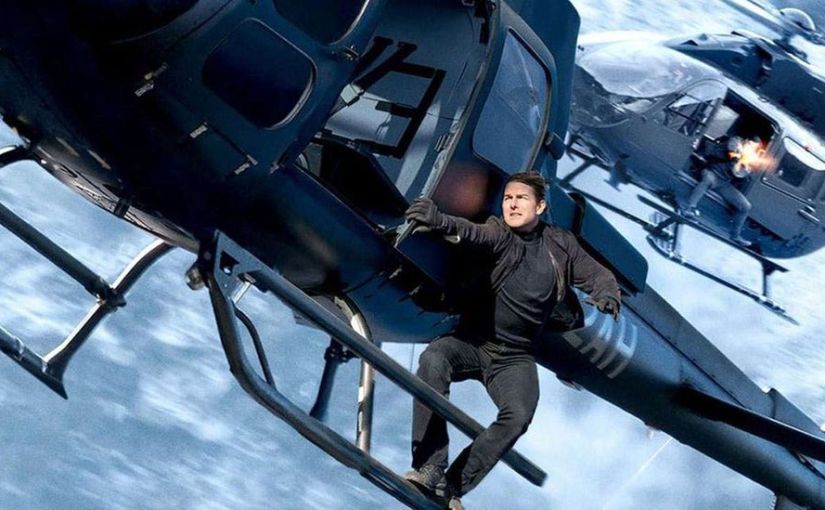
The highlight of this installment is a helicopter chase above and within a mountain valley that first focuses on Tom Cruise himself climbing a rope up, up, up to a chopper and swinging his legs onto the railing to get a foothold.  There’s time dedicated to him falling and inching his way back into the vehicle.  Then it becomes a chopper chase followed by a collision that ends with the remains wedged within a narrow mountain crevice.  What a set piece this is!  Absolutely outstanding camera work.  The wide and close editing, sound and visuals work so perfectly in sync with one another.  I don’t want to watch the making of documentary for this picture.  The trickery of McQuarrie’s camera crew is such a treat.  I’d rather savor the finished product on repeat viewings.

Juxtaposing against this chopper fight are two other scenarios involving Ethan’s teammates.  This is where I’m especially grateful for Christopher McQuarrie’s writing.  Two bombs are rigged in line with each other, and a detonator also must be retrieved by Ethan.  The whole team has to work cohesively, otherwise it is sayonara to much of the Asian continent if both devices explode.  McQuarrie’s “impossible mission” is orchestrated beautifully with suspense cranked way up.  His imagination for adventure allows a magnificently edited third act.  To date, I consider the stakes here to be the highest in the entire series.

The presence of this collection of actors is marvelous with recognition deserving of Henry Cavill donning an untrusting mustache and looking like a brutal, blunt instrument against the superspy Ethan Hunt.  Cavill also plays CIA agent wisely.  He’s got a stoic expression for most of the film but that is because he trusts the audience will assume what a dangerous threat he can be.  Cavill occupies one of the best characters in the seven films.

Mission: Impossible Fallout is truly one of the most thrilling pictures you’ll find.  What’s most important is the action serves the story.  Action just for the sake of action is tiring like in the Fast/Furious films.  There has to be a cost and a tangible feeling to the speed, obstacles and pain that good action scenes serve their characters and the story as a whole.  When Ethan falls from a helicopter or has to jump out a window, I grip both arm rests and let out a collective bellow with the audience.  Films with the grandest of adventure must draw out responses like that.  Otherwise, it’s all just a ho hum journey to the end credits.  Fallout is anything but a stroll.  It’s an absolute balls to the wall, explosive crowd pleaser.

MISSION: IMPOSSIBLE GHOST PROTOCOL

By Marc S. Sanders

When JJ Abrams took the reins of IMF adventures with Mission: Impossible III, he brought his penchant for meet cute romance between Tom Cruise’s super spy and his love interest Michelle Monaghan. It worked well as a new dynamic in the high-octane series. In the follow up film, noted Pixar director Brad Bird takes over with his own touch of tongue in cheek wry humor courtesy of Simon Pegg, as well as a little bit from Cruise and some side characters.

This is a great installment opening with a fun prison break moment accompanied by some Frank Sinatra in the background to earn your appreciative grin. An energetic credit theme sequence featuring Lalo Schifrin’s adventurous theme song follows with a spark on a fuse. I get so wired when I hear the Mission: Impossible Theme.  From there, Bird offers up challenges like putting a spin on the now familiar ID retina scan by any typical spy computer.  There are shootouts, of course. More running – lots of running courtesy of Tom Cruise – a sandstorm, a Kremlin covert operation and a climactic chase for a briefcase within a weird multilevel movable parking garage filled with cars to crash, bash, and drive off high level platforms.

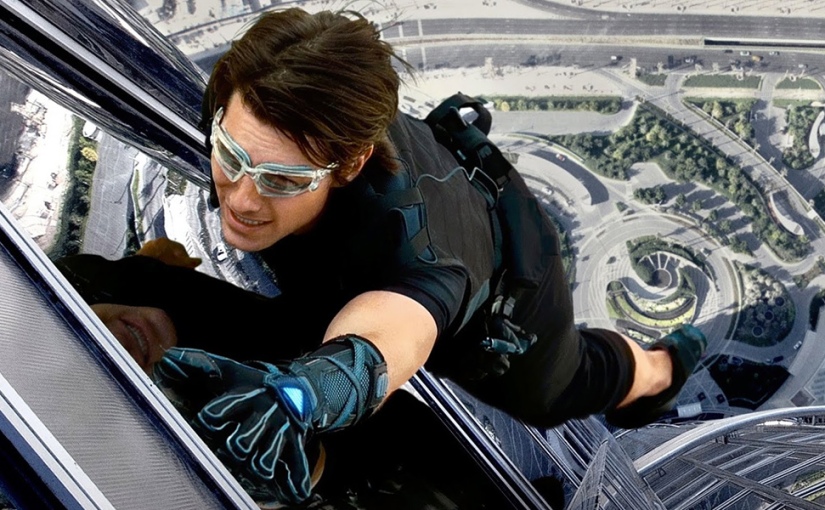
The main centerpiece reaches for the sky however with the world’s tallest (I think) building, the Burj Khalifa in Dubai. I love this scene. Not just because Cruise is doing the stunt of climbing the glass tower himself, but it screams of hilarious moments that belong in Bird’s other great accomplishment, his Incredibles films.  The photography is unbelievable in this sequence even when watching it on a 4K flat screen at home.  This one scene can be taken out of the context of the film and treated like a short story adventure.  The goal that Ethan Hunt is trying to accomplish is to quickly hack into the building computer.  Seems so trivial for the enormous lengths he goes through, but then we wouldn’t get the scene!!!!  So, scale that glass Ethan and let’s see how you get yourself out of this one.  A highlight of not only the film series, but Tom Cruise’s amazing career.

Simon Pegg is hilarious against the reluctance of Cruise’s straight man along with an out of touch Jeremy Renner. There’s a sticky glove that won’t work for Cruise as he scales the outside of the building, but Bird milks the joke while also using Renner, who is of no help but invites nervous glee and desperation.

Especially with Ghost Protocol, the film seems to begin, conclude, and then begin again.  Over and over, the players are explaining what must happen or needs to be done, or what the next step in the mission is.  So, there’s a lot of stops and starts with exposition through the course of the film.  What does it all spell out?  I hardly care.  All I know is the heights of danger are that much bigger, because all IMF agents, including Ethan Hunt and team, are now disavowed following an attack on the Kremlin in Russia. 

I don’t try too hard to piece everything together in the M:I films. Other than Phillip Seymour Hoffman in Abrams’ film, the villains have not been altogether memorable. The breathtaking action is much more fun than the stories. Though this film talks a little too much, something is always happening. This occurs in nearly every installment of the franchise, save for John Woo’s short-changed Mission: Impossible II.

This is a franchise that hasn’t self-destructed.  Cruise and company choose to up the ante with each new installment.  I hope the films continue on that course.

THE BOURNE SUPREMACY, THE BOURNE ULTIMATUM, THE BOURNE LEGACY, JASON BOURNE

By Marc S. Sanders

Sometimes the same old thing is all we want, right?  It’s like comfort food.  That’s what the Jason Bourne films offer.  The first time (The Bourne Identity) it is original.  The second time (The Bourne Supremacy) it is familiar.  The third time (The Bourne Ultimatum) it is what we expect.  When you get to the fourth and fifth time (The Bourne Legacy and Jason Bourne), well then perhaps you’ve overstayed your welcome.

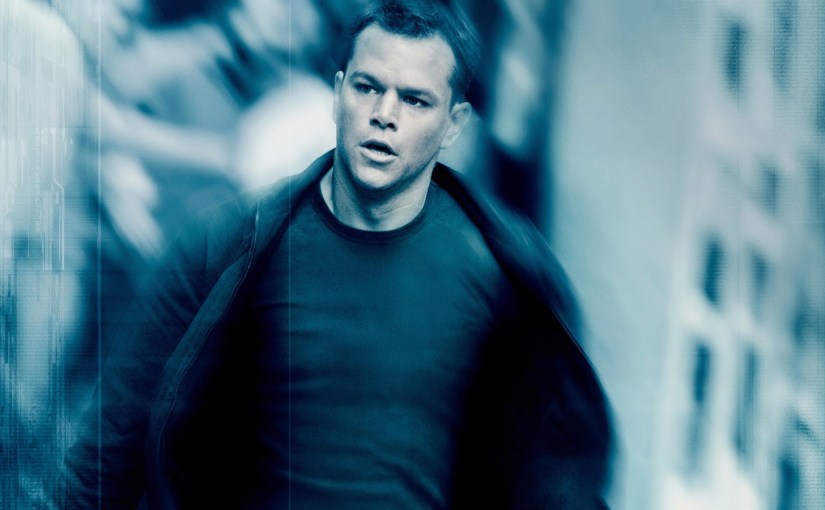
The second and third films in the Matt Damon action series function as one long four-hour film.  They are absolutely gripping in high octane, fast cut editing, pulse pounding music from James Newton Howard, and taut direction from Paul Greengrass.  They work because at least two thirds of the material is shown through the eyes of the former assassin Jason Bourne who is trying to learn of his past and who he worked for and why.  Plus, though he may hide deep undercover on the other side of the world in places like populated India, he only resurfaces when he discovers someone is trying to kill him.

The other third of these two pictures function on the other side of the coin with clandestine departments within the CIA who only consider Bourne being alive as a threat to the integrity of their black operations.  He must be eliminated.  There are great acting scenes with Joan Allen first up against an intimidating Brian Cox, and later she’s going toe to toe with David Strathairn.  If you are not part of the chase for Bourne, then you are engrossed in the cause these three supporting players offer with government politics and debate.  With each passing film, it’s an old, grey haired white gentleman in a suit who is insistent on eliminating Bourne and anyone who he associates with.  This started with Chris Cooper in the first film followed by Brian Cox (my favorite) over to David Strathairn.  The baton is then passed to Albert Finney.  A new film moves over to Edward Norton and then Tommy Lee Jones.  Scott Glenn and Stacy Keach are in the recipe too, but they are not as prominent.  All these guys start to look alike and when you watch the films in succession, one after the other, like I recently did, you start to question when this actor and this actor entered the fold.  Best way to describe it is that it is a ladder climb.  There was one guy in charge, then another above him and so on.

The appreciation for the Bourne series comes mostly from its action and the absolute cleverness of its hero.  Jason Bourne functions with ease about staying one step ahead of those trying to kill him.  They think they have a lead on him, but in reality, he has the lead on them.  Do you know how satisfying it is when he calls these people to talk to them and they play dumb? Jason will simply say “If you were in your office right now, then we would be having this conversation face to face.”  Moments like this are what gets an audience to clap and cheer.  The old white guy has been duped.

The action works because, once again I lay claim to the lack of CGI.  So, the overabundance of car chases seems nerve wracking like they are supposed to.  That door on that car is actually getting bashed in.  That taxi cab is really getting t-boned and turning into a 360 tailspin.  Jason can grab a seatbelt, lie down on his side and when the car careens over the barrier onto the landing fifty below, upside down, I’ll believe he gets out with only just a slight limp and a dribble of blood on his brow.  Only Jason Bourne can drag a wrecked rear bumper on a stolen police car through a busy Times Square and bash an SUV into a concrete barrier.

Fight scenes are not just fight scenes in the Bourne films.  It’s not just fists and punches and karate kicks.  Creatively speaking, the films construct their fight scenes to have the hero arm himself with a ball point pen or a magazine that’s wrapped up ready to wallop an opponent in the nose.  I’ll never forget when my colleague Miguel and I saw Ultimatum in the theatres and witnessed Jason punching a book into the face of a dangerous bad guy.  How many times have you seen a guy get punched in the face?  How many times have a seen a guy punch a book into the face of another guy?  There’s a difference. 

Matt Damon has been quoted as saying he believes the Bourne films carried the least amount of dialogue for him to memorize.  Yeah.  That’s likely true.  These films are visual feasts.  They rely on watching Damon move.  They are paced by how he walks, drives a car or tinkers with props.  Even how he listens and observes move with a kinetic progress. 

The locales are spectacular, spanning the globe from India, to Russia, to London, to Morocco, to the Philippines, and on to New York City and Las Vegas.  Following the first film, Paul Greengrass directed three of the next four.  (Writer Tony Gilroy directed the fourth film, The Bourne Legacy with Jeremy Renner taking the lead while Damon’s character was only talked about.) Each film takes every advantage of the atmosphere, using the overpopulated extras as obstacles and means to hide and weave away from the antogonists while on foot, behind a steering wheel or saddled upon a motorcycle.  Greengrass practically invents the concept of putting the viewer so much within the environment, you can almost smell the diesel or the food trucks within the area.  Zoom in overhead shots offer quick glances of the playground and traffic we are engrossed in.  Approximately twenty-five minutes within the center of The Bourne Ultimatum go by with no dialogue as Jason Bourne pursues a bad guy through a labyrinth of apartment tenements and rooftops, while the bad guy pursues actor Julia Stiles.  Finally, when all three catch up to one another, with a leap through a window, do you let out the deep breath you never realized you were holding on to. 

The first three films in the series (Identity, Supremacy and Ultimatum) work as a tight trilogy.  Each film ends with hanging threads to consider and lend to the next film.  By the time Ultimatum concludes, you feel as if all that needed to be told has been covered.  The next two (Legacy and Jason Bourne) function as cash grabs for the studio.  Legacy is entertaining and it boasts a good cast with Jeremy Renner and Rachel Weisz trying to outrun the government adversaries.  It hinges on operating as parallel material that occurs in the prior Damon installment.  While Jason Bourne is being pursued, this is happening over here.  It’s not unwatchable, but it is also truly unnecessary as it doesn’t advance the universe of the series at all.  A thrilling motorcycle chase closes out the film, but it’s a retread of what we’ve seen before.  It gets old quickly.  The film demonstrates that guys like Jason are trained to become dependent on drug enhancements for their highly trained arts of warfare and instinct.  Renner’s character is just another kind of Jason Bourne.  I was more impressed when I thought Jason was just a highly skilled fast learner to all that he’s capable of.  If you tell me blue and green pills lend to what he’s capable of, well then, he’s not much of a superhero in my eyes anymore.

With the final film, Jason Bourne, Greengrass returned to the director’s chair and Damon agreed to come back (paycheck had to be right, I’m sure), though he was significantly greyer and older than his prior films.  It was a weak return.  Just when we think Bourne has learned everything he needed to know and he could now live comfortably underground as a street brawler for bucks, he is informed that his deceased father knew and did some things for these secret agencies that put Jason on this path of special operations.  It doesn’t hold much weight and the payoff is nothing special.  Another car chase occurs in Vegas that appears nearly shot for shot similar to what we already saw in Damon’s prior installments. 

I wrote in an earlier review of The Bourne Identity, that Matt Damon works so well in the role because he’s such an unexpected surprise.  He’s not the muscle guy like Stallone or Schwarzenegger.  He comes off common.  In the first three films, he’s simply a kid.  When you place him in action or see how he gets the drop on a bad guy who is surveilling him, it is so satisfying.  The Bourne films work best with the locales they choose to shoot from.  Bourne will spy on his pursuers from a rooftop building across the street from where they are.  This is inventive filmmaking not just found in the pages of the script.  Paul Greengrass strategically shoots his players.  Director Doug Liman planted the seeds for this series’ potential (The Bourne Identity), very loosely based on the Robert Ludlum novels with creative adaptations from Tony Gilroy, primarily.   Greengrass enhanced the characters and their motivations by use of scenic locales, skillful shaky cameras to make it look like the audience is running at the same pace of Bourne and his adversaries, and quick cut, real time editing.  He applied this approach to his 9/11 film United 93.  The last two films are good even if they seemingly peter out the series, but overall, the four sequels hold up very well. 

If you’re asking, the best of the series is The Bourne Ultimatum, followed very closely by The Bourne Supremacy.  Either way, no matter which film you’re watching, you’re in for a good time when Jason Bourne shows up on the grid.

MISSION: IMPOSSIBLE III

By Marc S. Sanders

Remember that CW TV show called Felicity?  I’ve never seen an episode, but I remember the advertisements.  Beautiful, former child actor, Keri Russell with the golden, curly locks of love, was on her way to college.  Every commercial had that crisp, home like comfort feel voiceover.  It left me with an impression that this was a corny, yet sweeping exploration of coming of age while at college, and gaining independence.  The show came from JJ Abrams.  Abrams is a good director and writer.  He’s now one of the biggest producers in Hollywood.  Back in the early 2000s however, he wanted to nurture his characters.  Protect them.  Make them feel warm and content.  After Felicity, he went on to develop a spy thriller series called Alias with Jennifer Garner.  She was a college student with a lovable roommate by day and was super spy by night, or whenever the moment called for it.  Abrams went on to blending his coziness with that of stunts and explosions that modernized a series like, say…Mission: Impossible.  Naturally, when Tom Cruise recruited him for the third film of the high-octane franchise, we got the “Felicity Finish” applied.  Ethan Hunt is sweet and kind, and he’s ready for married life.  How precious!

Don’t get me wrong.  Mission: Impossible III is likely what kept the still running blockbuster movie series going.  Following a style over substance lackluster entry before, from action director John Woo, this third entry went in a completely different direction.  Ethan Hunt hugs a soon to be sister-in-law. Ethan Hunt cries.  Ethan Hunt has feelings.  Ethan Hunt has to rescue who he regards as his “kid sister,” Felicity…I mean adorable Keri Russell from being held hostage.  Ethan Hunt belongs on the cover of a Hallmark card with actress Michelle Monaghan.

I imagine JJ Abrams is not fond of the early James Bond movies.  I’d make a case that he watches them and wishes that someone, anyone would just give 007 a warm and sincere hug after he saves the world, and hold him close.  Superspies have emotions too, ya know?

The story of this third M:I chapter focuses on the pursuit of a MacGuffin known as the rabbit’s foot.  A powerful weapons dealer named Owen Davian (a brutally frightening Phillip Seymour Hoffman) is working to get a hold of it.  Following a first act rescue mission that Ethan and his IMF team (Ving Rhames, Maggie Q, Jonathan Rhys Meyers) engage in, the main hero finds reason to capture Davian and intercept the mysterious rabbit’s foot.  Complications get in the way because Ethan has fallen in love with an adorably beautiful doctor named Julia (Monaghan), who is unaware of her fiancé’s exploits.   

The action is superb in Abrams cinematic directorial debut.  Once it gets started after a sweet engagement party scene, it does not let up.  Everything is well edited and choreographed. An essential part of a Mission: Impossible movie.  An unexpected attack on a bridge crossing is spectacular.  The covert tactics are fun to watch as well.  When Ethan and team secretly invade The Vatican, the step-by-step maneuvers are carried out with gleeful ease.

There are twists and double crosses at play as well that you are not even thinking about looking for.  Frankly, they work more effectively here than they did in the original M:I film directed by Brian DePalma.  When the traitor is revealed to deliver a line like “It’s complicated,” it is not unreasonable to gasp.

Hoffman still remains the best of the villains in Cruise’s action franchise.  Maybe that’s by Abrams’ design because this is probably the most personal of all the films to date.  Phillip Seymour Hoffman is the guy who will be apprehended and braced to a railing on an airplane by the IMF team, and yet will still hold the upper hand.  A question like “Do you have a wife or a girlfriend?” has a much more sinister context when uttered by Phillip Seymour Hoffman.

I do recall when I first saw the film that the ending is not original.  It’s an opportunity for Tom Cruise to do another running scene, but it was first used in an episode of Alias where an operative is remotely giving directions to the hero while talking on a cell phone.  Clever the first time.  The second time seeing it, I was just calling it out.  So, Abrams needs to stretch his imagination a little.  No matter.  The pulse of the adventure races at high speed.

Mission: Impossible III might be unabashedly hokey and corny.  Everyone looks like they belong in a JC Penney commercial at Christmas time, or on a CW TV show like Felicity. However, it won’t deny you of what you are looking for which are big stunts in the sky and on the ground, along with the cool gadgets and those signature pull away masks that made the original series so memorable. 

I still realize that by the time film series reached this chapter, the franchise still belonged exclusively to Tom Cruise occupying every frame.  Once again, his team of IMF agents really don’t matter or carry any substance except to wear clothes.  At least this time, Tom Cruise cries over someone else.  So, he’s not as self-involved as the last couple of times, or even the last couple of dozen movies.  That’s a nice change of pace.