
By Marc S. Sanders
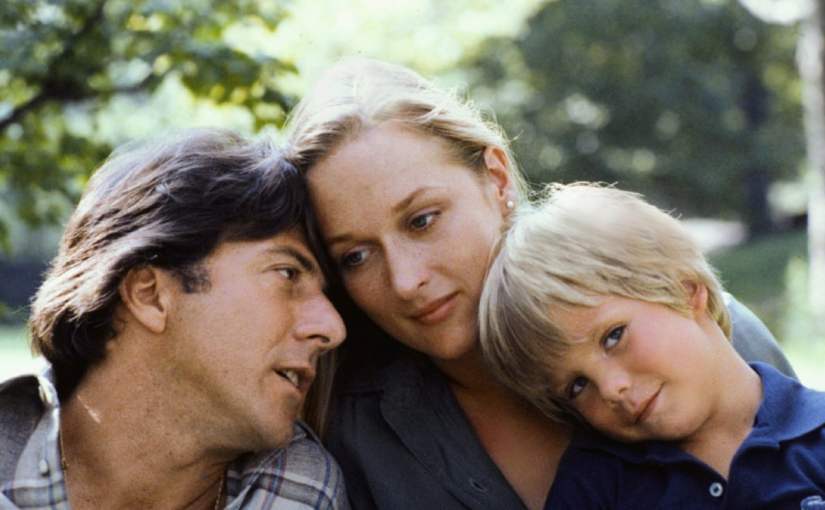
Probably the most personal film for me, the one that I watched for the first time with adult eyes even though I was only age 8 or 9 at the time, was writer/director Robert Benton’s 1979 Best Picture winner Kramer vs Kramer.
Though my parents never divorced, somehow I recognized the character of Ted Kramer, an extremely busy New York City advertising executive who could be having a great day while staying flirtatious but then also having an outburst of frustration when things are not going his way. My father was a busy man and a hard worker. He was a man who was always very proud of his work. He loved his work so much that he wasn’t as present in my life during my adolescent years. My mother on the other hand was my best friend who could make me laugh and demonstrated unconditional and very natural love for me. I learned about humor and love from my mother during those early years. I learned about responsibility from my father and some of his own humor later on. So, as I reflect on this film I imagine what life could have been for me had my mother walked out with no notice, leaving my father to tend to my needs while having to suddenly make sacrifices with his work.
On countless occasions, I’ve written about the importance of a character arc where a protagonist will start out one way and completely change through the middle and end of the film. In Kramer Vs Kramer, the arc is not focused on a character but rather a relationship between father and son. When Billy (Justin Henry in an Oscar nominated performance) at age 6 wakes up to discover mommy is not there, he sees how lost daddy is with waking up and trying to make coffee much less crack an egg properly for french toast. Ted and Billy have been blindsided and without any warning they need to adjust to one another very quickly.
Later, Benton does an insightful tracking shot of their apartment as they wake and we see they’ve grown accustomed to a routine together of getting each other up, setting the table and reading their newspaper and comic books side by side while never uttering a word. Benton realized that the comfort of living with each other does not have to be evoked with dialogue. This routine is offered one last time at the end when an inevitable and unwanted conclusion has befallen Ted and Billy. Again, no dialogue because now as a viewer I’ve become comfortable with this special relationship. Truly, I envisioned my father and I in these three moments.
Meryl Streep is the other Kramer, Joanna. She won the Best Supporting Actress Oscar and its well earned. Benton opens the film on her sad expression in a quiet darkness. When Ted finally comes home with good news from work, Streep is really good at holding her firm stance at leaving the household permanently. It doesn’t matter that Ted has gossip to share of a co-worker’s suicide or that he got a huge promotion. She just up and hurries for the elevator despite Ted’s resistance in allowing her to leave.
Benton follows afterwards with a good long portion of the film to display the struggles that Ted and Billy need to overcome, and in a second act finally has Joanna return stating her desire for Billy to live with her. Ted will not allow that to happen. For a real actor’s showcase, it’s important to watch the scene when they meet for the first time in 18 months. The conversation is cordial and they appear pleased to catch up with one another. Seconds later, the opposite sides on what’s best for themselves, and more importantly Billy, surface and the back and forth is so perfectly timed. Streep and Hoffman have those stutters and talking over one another that seem so natural. The scene ends with a broken glass that was not rehearsed and fortunately Streep’s shocked expression remains before the scene is cut.
Hoffman is extremely good in his role. He runs a gamut of emotions to bring humor, sadness, anger, warmth and love to this part. Another powerful scene is when he desperately must find a new job within three days before Christmas. Benton makes sure that Ted appears completely strong in a disarming situation when he squeezes in a four o’clock Friday afternoon interview during a raucous office Christmas party. I love how Benton focuses a still camera on Ted sitting quietly in a lobby chair amid partiers while waiting to hear if he gets a job offer. This is determination of a very full degree. Nothing will allow Ted to lose his little boy during this custody hearing.
Kramer vs Kramer is a simple and brisk film. It moves with a fast pace, and I believe the reason for that is it takes place in a home with a father, a child and a mother. So, I like to think it was very open to relating to viewers of all ages including my preteen self. There are many different and recognizable facets to Kramer vs Kramer. Billy compares Ted’s rules to what “all the other mothers” do. There’s the school play. Ted running late for work and picking up Billy from a birthday party complete with a goody bag. Of course, there’s also the heightened drama of the courtroom custody hearing. It’s like watching stage work monologues from Streep and Hoffman. It’s brilliant.
I especially took a scene very personally where Billy falls off the monkey bars, and Ted rushing through the streets of New York to get him to the emergency room for stitches. I had a door slammed in my face once that required stitches in my bottom lip. Just like in the film there was blood all over my clothes and there was a terrible fear for this 8-year-old kid who now still feels a bump in that area. Billy’s anguish and Ted’s terrible fear and guilt seem so genuine.
I find it interesting that this film won Best Picture in 1979. A year prior it was The Deer Hunter and Patton was a few years before that. In 1980, Robert Redford’s Ordinary People won the award and in 1983 it was Terms Of Endearment. Hollywood didn’t forget the impacts of hellish war and combat films. However, with the 1980 Reagan years of much decadence and pop culture positivity, a middle-class domestic life was becoming more honest and apparent. These films were not just Father Knows Best. Films like Kramer Vs Kramer were ready to show the hard parts of living a yuppie life. Things seem so normal on the outside when really there’s a struggle to love and live on the inside.
Cinderella like films showed my eight year old eyes that if a prince and princess finally meet and dance together all will be well in the kingdom. However, Kramer Vs Kramer told me that marriage and family life do not equate to happily ever after. Don’t mistake me. I’m not being pessimistic here. What I learned at that young age is that the story really only just begins after the prince and princess fall in love with one another. Thereafter, the conflicts settle in and the happy ending arrives only when the characters adjust to the evolution of their futures together, or if necessary, without one another.


 2 UNPAID MOVIE CRITICS!!!!