
By Marc S. Sanders
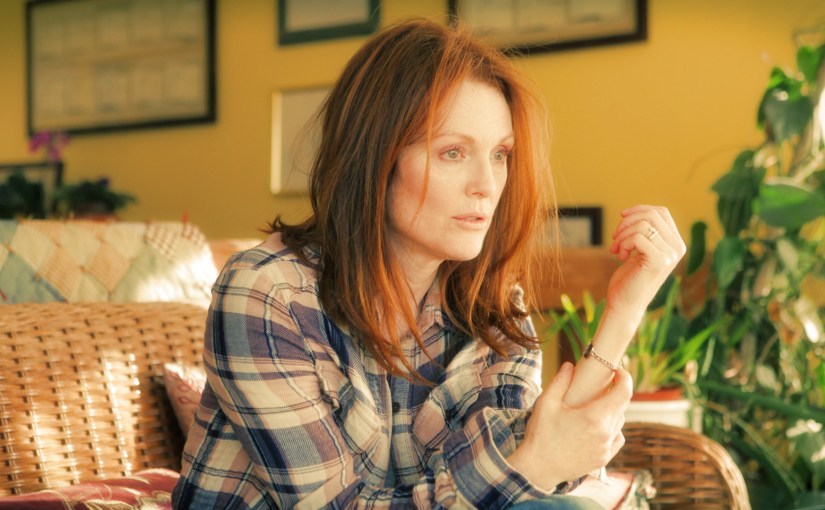
Still Alice is the observation of a woman whose mind gradually deteriorates from the symptoms of early onset Alzheimer’s disease. Julianne Moore won an overdue slew of awards, particularly the Oscar, for the portrayal of the title character. It’s a magnificently sensitive performance that will have you in tears following the first twenty minutes of the film.
Alice Howland is a revered Columbia professor of linguistics. She has three grown children (Kristen Stewart, Kate Bosworth, Hunter Parrish) and John, her loving husband (Alec Baldwin). The sad irony of Still Alice, adapted from Lisa Genova’s novel, is the fact that Alice specializes in teaching word origins and their formations, but she is stricken by the disease that will wipe her memory of the simplest vocabulary. A highlighter becomes a “yellow thing.”
The beginning of the film shows Alice functioning at her highest capacity following her fiftieth birthday. She teaches her classes, does her daily jogs across campus, plays word games on her phone, travels across country delivering seminars and also tries to convince her youngest daughter, Lydia (Stewart) to abandon her dreams of becoming an actor and acquire a college degree. Mixed in, however, are losses of train of thought, forgetting recipes, misplacing basic objects, forgetting appointments and getting lost during her jogs. A quick glance over some visits with a neurologist (Stephen Kunken) set the wheels in motion of what we will witness Alice struggle with over the course of the film. These doctor visits also teach the audience how one is examined for symptoms with simple memory tests and spelling questions.
The film was directed by Richard Glatzer and Wash Westmoreland. After I watched the movie, I learned that Glatzer could not speak while he was directing. Due to his gradual deterioration from ALS, he had to resort to a computer monitor that would express his instructions to the cast and crew. So now I’m that much more impressed. To home in on the sensitivity of Still Alice, it only seems fitting that someone with Glatzer’s condition could co-direct this story.
This is not a glamourous film. Sometimes we may laugh at ourselves because we cannot think of a word or we forget a year or a name or we put our car keys in the refrigerator as soon as we come home and reach for a cold beverage. However, when we see Alice discover that she puts a bottle of liquid soap in the fridge it says so much more. Illnesses like Alzheimer’s and ALS strip people of the basics in living. Having recently witnessed a friend slowly suffer and perish from ALS, I know that one disease brings you to this point with complete mental capacity while the other seems to tease you with how your mind gradually deteriorates. Yet, like Richard Glatzer, my friend Joe did not stop functioning and co-wrote a play with me in his final year of life. He couldn’t speak. He couldn’t walk, but the man could write.
I have to credit the supporting cast behind Moore’s performance. The film begins with the ease of conversations between the family members. Before you know it, the exchange of dialogue shifts and becomes more one sided. Julianne Moore most often shares scenes with Alec Baldwin and Kristen Stewart respectively. She hides so well in her character’s mental incapacity that eventually, it looks like Alice Howland is not even applying the intelligence she’s collected and earned over her lifetime. A scene in a yogurt shop towards the end of the film seems like Baldwin is the only one working. He’s consuming his yogurt and reminding his wife of where she used to work while she sits beside him in an absolute haze of emptiness. He simply says she is the smartest woman he’s ever known and by this point, I know exactly what he is talking about. Moore is so heartbreaking in moments like this that I have to give credit to Alec Baldwin for maintaining his own performance against a scene partner who cannot offer much in return.
Alzheimer’s first affects the victim but also the family. Still Alice allows time to explore the inconvenience of the illness. There is the expected residual squabbling among the siblings. Alice needs to be overlooked more and more as she gets sicker. Who can be with her? John still has to earn a living and has an opportunity for career advancement that he cannot afford to pass up. A relocation is questioned because will it be okay for his wife. Lydia is on the other side of the country trying to build her acting career. Anna (Bosworth) is a pregnant, busy attorney, while Tom (Parrish) is in medical school.
It’s also much more serious when the family learns that the gene Alice possesses has a one hundred percent chance of being passed down to the children. This angle is touched upon for a brief moment, but then is hardly reflected as the film moves along.
Still Alice is a difficult film to stay with because it feels genuine in its account of living with Alzheimer’s. Simple mistakes are just as heartbreaking as the big developments. Leaving a potato in a purse is as hard to watch as seeing a mother speak to her daughter backstage, following a live acting performance. The daughter is now a stranger to the mother.
Yes. At times, the film feels like schmaltz you may find on the Lifetime channel, but then again you are seeing authentic, relatable performances from a cast who make up this family, especially the Oscar winner, Julianne Moore. Alzheimer’s is an unfair and cruel disease that strips away everything a person builds for themselves in a lifetime. Pardon the pun, but Still Alice makes sure you never forget that.



 2 UNPAID MOVIE CRITICS!!!!