
By Marc S. Sanders
The merits of a lot of action/adventure films is predicated on how strong the villain is to the story. Often the hero is the straight character in the heroic garb ready to enter the scene just as the bad guy is on the brink of maniacally destroying the world. In the early 2000s however, the focus diverted to the hero when big franchises opted to reinvent themselves. James Bond’s origin was finally offered up in the best film of the series, Casino Royale. Christopher and Jonathan Nolan served up one of the best cinematic Batman stories on screen. The title said it all.
Batman Begins gets every note right with the all too familiar back story of Bruce Wayne’s drive to become Gotham City’s Dark Knight vigilante. The film has its collection of villains but the center of the picture is always circumventing around Bruce Wayne, perfectly played by Christian Bale, with somber truth hidden by handsome playboy disguise. As a child, he discovers his fear of bats and then attends the theater with his billionaire parents. Upon their exit through a back alley, he witnesses their death and is left to be raised by his trusty butler, Alfred Pennyworth (Michael Caine, my favorite actor in the role to date).
This film achieves my undivided attention because it paints a full canvas of this character before he ever adopts an alter ego in a black costume. We explore how he becomes motivated followed by his intense training in the zenith alps, on the Asian continent. Then we see how he supplies himself with all of the familiar gadgets and costumes when he befriends an ally within his father’s company, Lucius Fox (Morgan Freeman).
Jonathan Nolan’s script diverts away on occasion to embrace the capable villains of this story with the Scarecrow (Cillian Murphy), Rha’s Al Ghul (Ken Watanabe) and mob boss Carmine Falcone (Tom Wilkinson). Bruce’s mentor, Ducard (Liam Neeson), is a big factor in the hero’s development as well. Lastly, there’s Bruce’s childhood friend and legal connection, Assistant D.A. Rachel Dawes (Katie Holmes). Lt. James Gordon is the uncompromised police detective that Bruce singles out to trust within this dense world of corruption.
Just to read this cast list is impressive as they fall beautifully within the matrix of Nolan’s blueprint. Everyone is given enough time to make more than one impression as their storylines twist and alter.
Christopher Nolan’s films are always moving like a smooth ride on a never-ending stretch of road with no traffic in the way. Nothing bears repeating from what was already shown in an earlier scene. There’s something new to learn as the pace continues. Nolan is one of the few filmmakers where you do not mind the time jumps he incorporates into his stories. Bruce will first be seen as a ten-year-old boy, then in his muscular fit thirties in a Chinese prison completely departed from the wealth of Wayne Manor. A step back before that shows him as a Princeton drop out with a mop top haircut. Every different appearance of Bruce is interesting and you become intrigued with how he ends up in one place after another.
Like the first appearance of Daniel Craig in the Bond series, this Batman/Bruce Wayne is repeatedly imperfect. He’s flawed because he still needs to learn and the characters that enter and exit and reenter his life must teach him. Alfred will lecture a short-triggered Bruce when he’s on the cusp of risking the reputation of his father’s legacy. Rachel will slap him when he’s prepared to kill in cold vengeance. Ducard will teach him the ways of physical survival and will test Bruce’s loyalty and the measures of crime with punishment. Even the Scarecrow is smarter than Batman when he springs an unexpected trap.
The ongoing education of Bruce Wayne is the theme of Batman Begins, all the way to the end, when he finally learns to mind his surroundings.
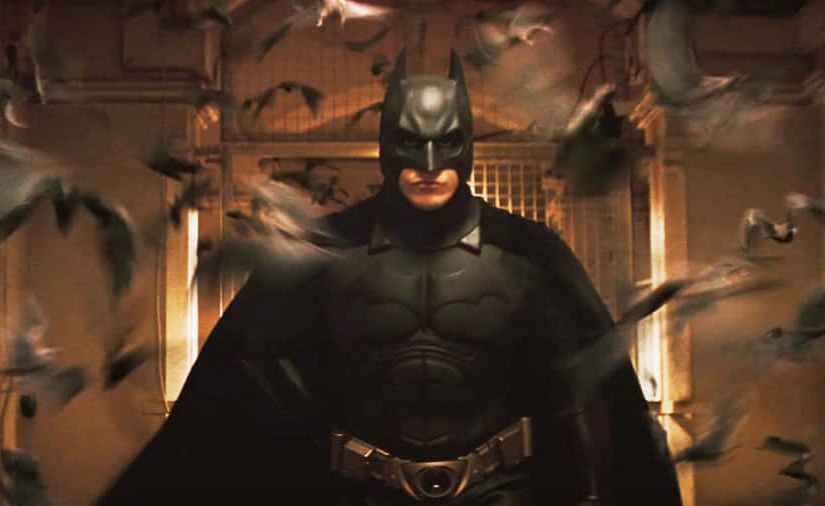
Christopher Nolan made Batman exciting in a new unfamiliar way. The Batmobile is a not a sporty kind of vehicle. It’s a tank called The Tumbler and it bears a thunderous series of sound edits as it barrels through Gotham City. After some slip and falls off rooftops, Batman becomes much more covert than in other interpretations. You don’t have to physically see Batman to observe him operate. If a thug gets swallowed into a void of darkness, you know what has ensnared him. The crusader’s devices which stem from his gold utility belt are demonstrated with explained reason for why he selected them for his fighting advantage. The Nolans proudly recognize the theatricality of this guy.
Cillian Murphy is unforgettable as he lives up to the name of Scarecrow, also known as Dr. Jonathan Crane, a criminal psychologist. His choice to put his victims into a hypnotizing sense of fear lend to the back story of Bruce Wayne’s intent to become a frightening figure himself, where his enemies will recognize his dread. Tom Wilkinson claws his gangster persona straight from a Godfather kind of picture, but he represents an old guard of Gotham City before costumed and makeup identities take over. Gotham will transition from the sharp dressed mobsters over to the crazed clowns yet to come.
Gary Oldman invents another unique personality – a strait-laced city guy who might have come from a 1970s ABC cops and robber show like Dragnet. No two characters of Oldman’s are ever the same. So much so, you almost wish they would all assemble in a movie for the various personalities to interact. Morgan Freeman and Michael Caine are like comfort food who are so subtle and relaxed in front of a camera. Neither one makes big waves with their characters. Jonathan Nolan wrote their respective purposes for this Bruce Wayne and they execute their techniques of less is more beautifully.
Liam Neeson delivers the second-best performance of his career thus far, after Oskar Schindler. He adopts the same kind of method that Freeman and Caine work with, but then he sways from that behavior when Ducard has to surprise Bruce as a means for his pupil’s development. Some of what he does comes from nowhere. Early in the film, his first two scenes could not be more different. Neeson works like an unpredictable entity.
The next film in this trilogy replaced Katie Holmes with Maggie Gyllenhaal. I was disappointed because Holmes was maturing as a very formative actor by this time. She was blessed with a well written character in Rachel Dawes. When I watch the next film, The Dark Knight, I cannot help but wonder how she would have performed the role for a second and much more developed opportunity.
There is not one flaw in Batman Begins. This is the movie that placed Christopher Nolan in the echelon of top blockbuster directors like Spielberg and Hitchcock, along with Lumet and Mann. Hans Zimmer’s soundtrack is thrilling as it speaks for The Dark Knight who is of few words. Zimmer’s scores announce the introduction of Bruce Wayne first, and then later Batman.
Gotham City makes for a sensational character with various rooftops, fire escapes, tunnels, bridges and a gorgeous, elevated train at its center. The entire city breathes steam amid the distressed decay, wet streets and rusted architecture.
Wayne Manor has a ghostly effect as Alfred and Bruce climb the large staircases and floors. Further down under its platforms rests the cave that’ll serve Batman well. The waterfalls and rocky caverns are immense.
Batman Begins is not one of the best films of a genre like any other superhero movie. I refuse to recognize it that way. Instead, I see a character study where a man accepts a responsibility to fix what scarred him at a young age. He wants to right a world that once had promise. I don’t see the costumed protagonist announce himself as a superhero. I don’t see the costume. With the cape and the horns on the head and the car and the tools, I see an image, never a superhero. With Christopher Nolan’s first film in what will become a well-received trilogy, I always see the man underneath the mask.

 2 UNPAID MOVIE CRITICS!!!!