LEAVE THE WORLD BEHIND

By Marc S. Sanders

Anxiety and the unknown are the themes of Sam Esmail’s apocalyptic Leave the World Behind.  Actually, I can’t even be sure it’s apocalyptic or not until the end arrives.  Even then I wasn’t so sure.  

A family (Julia Roberts, Ethan Hawke as the parents, Farrah Mackenzie, Charlie Evans as the kids) make an impromptu getaway from New York City and rent a luxurious upstate air B & B for the next five days.  Upon arrival they are quickly relaxed amid all the amenities and beautiful outdoor pool.  A visit to the beach is refreshing until an oil tanker arrives from the deep ocean waters and drifts upon the shore with no warning.  Strange, but okay.  No need for that to ruin the vacation.

Then other unexpected occurrences happen.  A charming gentleman dressed handsomely in a tuxedo and his formally dressed daughter appear on the doorstep of the home in the middle of the night.  They are played very well by Mahershala Ali and Myha’la.  The man claims that he’s the owner of the house and while attending a concert in the city, they needed to make a quick exit and the best place to hold up was at this house.  Conveniently, he does not have any ID to prove his identity along with no specific personal items in this home he claims to own, not even the title ownership papers.  No photos of family tucked away anywhere.  He does have a key to the liquor cabinet, however.

Quickly, the scene is set where the internet goes down.  Federal blue screen warnings appear on every television channel.  Cell phones don’t work.  Deer, lots and lots of deer, appear in the backyard and then disappear.  Pink flamingos wade in the pool.  Elon Musk’s white Tesla cars have a stand out scene.  Roberts then recalls seeing a grizzled Kevin Bacon collecting an abundance of supplies when she made an earlier shopping trip in the local town.  

The paranoia starts to set in beginning with Julia Roberts’ character Amanda.  Amanda declares early on that she fucking hates people.  Hawke’s husband character, Clay, is not ready to hit any panic button and is happy to accommodate the strangers on the doorstep and just wait for the internet to be restored with a logical explanation.  Ali’s character, known as G.H., lends a welcome smile but it’s clear he’s not sharing all that he’s thinking or maybe what he knows.  

Sam Esmail’s film wants to provide a demonstration of how people respond when they don’t know all that’s going on, particularly when modern technology fails us.  A more relatable inconvenience is suggested as Mackenzie’s character Rose is frustrated that her streaming channel shut down just as she was starting to watch the final episode of the sitcom, Friends.  I felt her anguish immediately as my daughter consumes the trials and tribulations of Ross and Rachel on a repetitive cycle.  Ironically, streaming goes down and now the girl can’t watch Friends.  Netflix is the distributor of this film.  Yet, I think they just gave a ringing endorsement for a dying medium.  If only this girl collected the DVDs.  

My problem with Leave the World Behind is the slow pace of it all.  This is one of those movies where its triumphs hinge upon the final five minutes or so.  Either you applaud what sums up the last two and a half hours you invested, or you roll your eyes at where the picture drops you off with the urge to throw your popcorn at the screen.  

Watching Leave the World Behind brought back experiences of shows like Lost or The Walking Dead.  The set ups are brilliantly intriguing from one development to another.  The follow through on each new happening amounts to nothing or at least not anything where I can suspend my disbelief.  Questions are answered with questions.  It’s like calling an insurance company for information following a car accident.  You just want to slam the phone down.

When Ali’s character chooses to check on a neighbor, he sees a watch embedded in the sand nearby.  He picks it up only to get a fright that makes us jump.  The viewer sees nothing else and we are led to believe that Ali sees nothing else, until Esmail goes to a wide overhead shot showing the massive wreckage of a commercial airplane crash, complete with black smoke and flames and endless amounts of luggage and debris.  It’s hard for me to buy a scene like this.  G.H. doesn’t smell any burning fire nearby?  He doesn’t hear anything? He doesn’t see any other debris left mere inches away from the wristwatch only until Esmail’s direction goes from closeup to wide?  I cannot accept the character’s tunnel vision.  My eyes would go towards the crashed plane before I’d ever discover a wristwatch.  It’s just eerily quiet.  The director’s manipulation is a set up shock for me, the viewer, to grab my attention.  Yet, it backfires because it’s completely implausible.  There are many moments like this in the film.

Other than Marhershala Ali (who I still insist should be considered a viable candidate for the next James Bond or a 007 adversary), the rest of the cast is not dynamic enough.  Julia Roberts is working a little too hard.  Ethan Hawke is not working hard enough.  The dialogue is often boring arriving at no conclusions.  Thankfully, most scenes are enhanced by unusual camera angles from Esmail’s artistic freedoms with his lens.  It’s reminiscent of the deliberately weird structure that Stanley Kubrick often did with The Shining.  Nevertheless, it’s exhausting after a while.

Sam Esmail’s work is no doubt shown through long ponderous imagination.  I certainly felt Julia Roberts’ frustration on display, but still, I got the point.  I see no reason to repeat the same lines at higher volume.  I got the point of a lack of trust between the two parties being brought together.  However, I just got tired of the act.  The racial elephant in the room is even suggested.  Though I wish it wasn’t. People quickly forget that George Romero’s Night Of The Living Dead steered clear of any racial factor, and just look at the legacy of that film from the era of the Civil Rights Movement.

The ending that arrives seems inevitable.  Without revealing anything literal, it is doom and gloom.  However, I might have had more appreciation if suddenly the TV and internet got restored and these odd occurrences all just happened to be one big nothing.  At the very least, then I’d understand that this whole freaking planet would just go nuts without their You Tube, Instagram and Netflix.  

You might have had a conversation at one point in the last decade or so that began as “How did we ever manage to survive before the internet?”  The truth is we did just fine.  The adults in Leave the World Behind never stop to remember that though. 

CLOSER

By Marc S. Sanders

Mike Nichols is a director for those actors who really grind their teeth into the craft of performing with crackling dialogue.  Often, he goes for what makes a person drive awkwardness into a moment.   Equally he focuses on those folk who sustain the discomfort so apparent in a room.  Prime examples are his classic films Who’s Afraid Of Virginia Woolf? and The Graduate.  There’s even some of instances in his slap happy comedy, The Birdcage. Towards the end of his career, Nichols adapted Patrick Marber’s biting play, Closer, into a film.  

Closer carries a four-pronged approach in the shapes of Jude Law, Natalie Portman, Julia Roberts and Clive Owen.  Law plays Dan who catches the eye of Alice (Portman), an alluring stripper who gets hit by a car on the streets of London.  Beginning with playful flirtation in the hospital waiting room, they develop a relationship mostly based on sex for the following year.  Later, Dan gets distracted by a beautiful, much more mature photographer named Anna (Roberts).  She rejects Dan’s horny advances and by some manipulation with online anonymous sex talk, he sways a sex starved doctor named Larry into meeting Anna at an aquarium.  Then, to Dan’s surprise, Anna and Larry get married. There’d be nothing more to discuss if these four lived happily going forward.  What follows, however, is a manipulative chess match of lies and deceit among the four.  

One after the other disarms somebody who they valued and thought they could live with at any given time.  Alice leaves Dan after he reveals an affair with Anna.  Larry has a regretful one-night stand with a woman in New York. Anna doesn’t mind because she’s been having an illicit affair with Dan.  Larry is miserable but begs Alice the stripper to justify his torment, assuming she’s also anguishing over being betrayed by Dan. Not likely the case as she erotically teases him in a private stripping room. This scene with Natalie Portman in control establishes as the best actor in the film.

The four players on the game board all start in their respective corners, only to go around the perimeter or advance diagonally across and pounce on what they don’t have. At any given moment someone is drawing the top card or rolling the dice, and it’ll have a direct effect on one of the other three or all of them at once.

Patrick Marber’s script gets more layered as the partners change hands, but it’s his dialogue that keeps you engaged.  Alice believes “Lying is the most fun a girl can have without taking her clothes off – but it is better if you do.”  An angry Larry confronts Anna by asking about Dan.  “What does it taste like?”  Anna’s reply: “Like you, only sweeter.” Ooooo!!!! Lines like these sting, and I’ve never met someone in real life who can think that quick on their feet with such savviness.

Just as in other scripts like Steel Magnolias and Glengarry Glen Ross, I think the characters in Closer (initially a stage play) speak a little too instinctively.  They’re just so quick with their hurtful insults, comebacks and seething expressions.  Therefore, should I like plays that perform on a higher, smarter plane; plays that work quicker than most minds can register with what to say next?  Well, I appease myself with a constant reminder that a piece like Closer is more performance art than truly authentic. These four characters are so quick with a verbal jab, while engaging in some foolhardy actions that promises to make their circumstance appear worse. How can they be so smart with a comeback while acting so stupid at the same time?

The cast of four are so sharp, alert and precise.  Most of the scenes in Nichols’ film are performed in different combinations of pairs.  Every one of them is expertly rehearsed and Roberts, Law, Owen and Portman are of course the strongest assets in the production.  However, Nichols wisely uses his lens in zoom close ups, practically justifying the quirky title of Patrick Marber’s work.  I never trusted a single character was entirely genuine in Closer.  How should anyone? They’re always stabbing one another in the back. However, when an actor leans in and Nichols meets their expression halfway, I’m being ordered to look that person straight in the eye.  Still, I won’t know what to believe, but that’s the point.  

Dan, Alice, Anna and Larry move the scenes along with question after question because every answer is so dubious.  You’ll likely never get a more skeptical response when a common inquiry such as “Do you love him?” is asked.  It can be frustrating, but thanks to the cat and mouse play of Mike Nichols’ stage direction, on film, I wanted to dig deeper into the bottomless rabbit hole.

You might conclude there is a surprising twist at the end of the film.  I don’t know if it holds much weight to what I learned during the course of the story.  Nevertheless, it reinforces the theme of Closer.  Being bad can be fun, offering an immediate high, and part of being bad is lying and betraying, and maybe the ending reveals who actually won this board game with four players at the table.

Look Closer and tell me what you think.

AUGUST: OSAGE COUNTY

By Marc S. Sanders

Once the dead are buried, the secrets come out.  Some mourn the loss.  Others mourn the reality of what existed.  Tracy Letts’ Pulitzer Prize winning play August: Osage County was adapted into a very well-cast film in 2013.  Letts’ screenplay is just as biting as his original source. Perhaps that is because of the performances of not just Meryl Streep and Julia Roberts, but also the entire collection of actors.

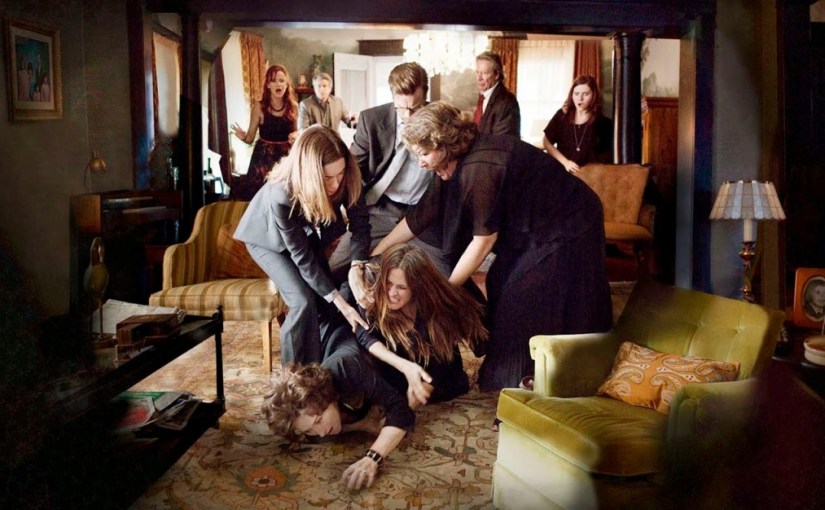
Dysfunctional is not a strong enough word for the Weston family of the sleepy, lifeless area of Osage County, Oklahoma.  The patriarch, Beverly (Sam Shepard) hires Johnna (Misty Upham) a Native American housekeeper/helper, for his pill popping, cigarette smoking wife Violet (Streep) who is also stricken with cancer of the mouth.  Shortly after, Beverly disappears.  The family comes home to the dusty shelves of books and old black and white family photographs and learns that Beverly has committed suicide.  The opportunities flood in for Violet (or Vi) to unleash every ugly, harsh truth that her three daughters Barbara, Ivy and Karen (Roberts, Julianne Nicholson and Juliette Lewis) have encountered along with their partners.  There’s also Vi’s sister Fannie Mae (Margo Martindale), her husband Charlie (Chris Cooper) and their son Little Charlie (Benedict Cumberbatch) to revisit the revelations of the Weston family.  Barbara’s estranged husband Bill (Ewan MacGregor) and her daughter Jean (Abigail Breslin) have their own drama to contend with as well.

It’s best not to spoil too much of what is revealed in the movie directed by John Wells.  The centerpiece of the picture is the afternoon family meal following the funeral service.  This must be one of the most intense and captivating dinner scenes caught on film in recent years.  Wells positions his cameras perfectly, so you know where every family member is seated at the table and the trading of barbs that go back and forth between the different combinations of arguments.  I would say the scene lasts at least twenty minutes and Wells manages to seat the viewer next to or right in front of every person at the table.  At one end of the table is Charlie.  Chris Cooper is a reluctant fill in to the void left by Beverly, the original patriarch.  The instigator is Vi. Meryl Streep is placed at the other head of the table where her drug addled eye contact can be had with anyone seated in her presence.  I’d love to have seen Meryl Streep while shooting this scene because even when the camera is not on her for a close up, I can still see that she is there in the dining room.  I’d argue she never turned off this persona during the making of this film. 

The most agonizing relationship is clearly between Vi and oldest daughter Barbara.  The first pairing on screen for Meryl Streep and Julia Roberts.  Why didn’t it happen sooner?  Moreover, why hasn’t it happened again since this film?  Perhaps because it is rare to find material of this dramatic weight to justify what can come from these two incredible actors.

The dinner scene is left discomforting to say the least, but the timing and delivery of Tracy Letts’ dialogue is functioning with high energy.  At age fourteen, Jean is the youngest member at the table, and she is questioned as to why she doesn’t eat meat.  According to her, you are consuming an “animal’s fear.”  The Westons are only adoring when they are cruel to one another.  One of the rare times that the rest of the family will unite with the antagonizing Vi is when they can mock and chortle at young Jean’s philosophy for “claiming” to be vegan, which is also undone by her parents when they reveal what she eats back home in Colorado. 

A hip middle aged Florida man named Steve (Dermot Mulroney) in a Ferrari has accompanied Karen to Osage.  Karen is the flighty one with her head in the clouds.  Steve has been married three times and takes a liking to teenage Jean’s curiosity to try pot.  Vi expresses disdain for the jerk with another welcome facial expression from Streep, but Tracy Letts does not have his character lash out or protest Karen’s choice to marry the guy.  For Violet Weston, it is better that Karen does marry this letch.  It gives Vi more purpose to criticize and belabor upon one more poor decision made by another daughter.  Violet thrives on bellowing out the shortcomings of her children, her dead poet/author husband, her sister, and anyone else within her presence.  It’s how she lives and overcomes her cancer while an unkempt wig conceals her chemo remaining grey hairs.

On the side, a relationship is brewing between first cousins Little Charlie and Vi’s middle daughter Ivy.  They know it’s wrong, but they can’t help hiding their affections much longer.  Cumberbatch goes against type here as a nervous, insecure young man who has not matured from his boyhood nature.  Julianne Nicholson appears to be the most held together of the three daughters as she has never ventured out of Osage while living with her parents.  She is now ready to give up that lifestyle, and she’s leaving it in Barbara’s lap to figure what’s to come of Vi. 

Barbara is the most unhinged.  She is married to sweet natured but boring Bill and it’s likely that the past demons she clung to from her upbringing left Osage with her when she relocated to Colorado with her husband and daughter.  Bill might be having a tryst with one of his college students but is he the worst one in the marriage?  Barbara Weston might be Julia Roberts’ best role since her early career film introduction in Steel Magnolias and her Oscar winning turn in Erin Brockovich.  In films like these, Julia Roberts doesn’t look like the starlet she once was in the 1990s.  In August: Osage County she has downed her appearance with no makeup, unwashed hair, and wrinkled clothes while carrying an emotionally exhausted physique.  However, she’s perfect to play the eldest daughter who somehow must be the one responsible for picking up the shattered pieces of dishware that hit the floor on numerous occasions and fractured connections left behind in the family dynamic.  This is a commanding performance by Julia Roberts; one that needs to be seen.  Incidentally, she never does clean up the broken plates.  I only assume it would be her who must do so.  However, the quiet Johnna is around somewhere. She will make everything disappear.

Memorably, a physical altercation ends the dinner.  The day passes into the next mid afternoon and more secrets are uncovered.  Some are quite horrifying, considering the circumstances that some members of the family have themselves in.  Just when you think that this script is ending with a debate of which daughter will look after mother now that daddy is gone, there’s more troubling truth to grapple with as well.

August: Osage County is a movie hinged on the acting chops of its cast with a smart, unforgiving script for the damaged characters depicted.  It falls in the same category as David Mamet’s Glengarry Glen Ross or Sam Shepard’s True West.  We may be witnessing the abnormalities and sins of these people, but it would be more unusual had these folks possessed genuine happiness and solid affection for one another.  The quietly muted Native American Johnna enters the household of people who replaced her own people, who occupied this land long before the early generations of Westons ever arrived.  It’s telling that Tracy Letts demonstrates the original occupants still survive in peace while the ones that took over can’t find a way to live happily among themselves.  Watch the film or see the play.  Then come back and tell me if the white folks of the Weston family truly belong in the once occupied Native American Osage County, Oklahoma.

SECRET IN THEIR EYES (2015)

By Marc S. Sanders

So here is a movie I thought I had figured out; the twist, I mean. Yet it’s ending didn’t turn out to be that way at all.

So, what did I get from Secret In Their Eyes? Well, I guess the confidence that I am probably a better writer than the ones who doctored this crap.

This is another mystery thriller, where everybody working in the same law enforcement department must remain divided and have animosity towards each other because if they didn’t have conflict they’d only get along and solve a very basic murder case.

See, it has to be this way.

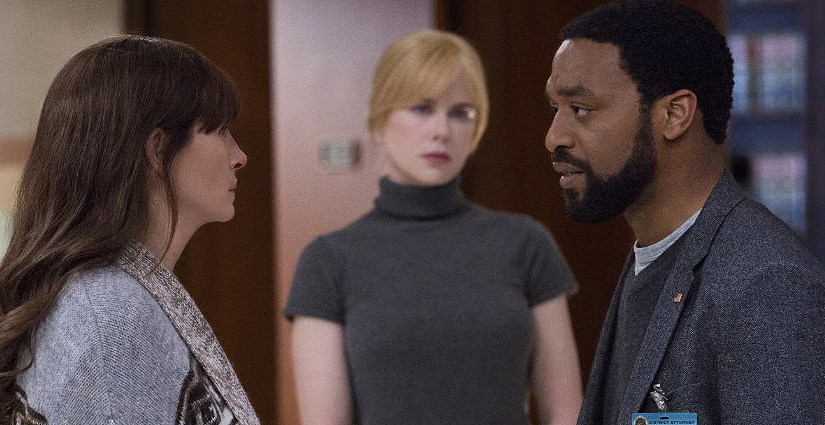
The main character played by Chiwetel Ejiofor must play the obsessive (13 years obsessed!!!) FBI investigator prone to making dumb and impulsive mistakes because if he didn’t there’d be no movie.

Julia Roberts, effectively departing her glamour roles, as the cop/mother of a murdered daughter will only conveniently appear to make things awkward for Ejiofor and DA Nicole Kidman who is unnecessarily, overtly sexy to drive a subplot for more awkwardness. Oh, hi Julia. Didn’t expect you to step on to the elevator. Well, look who showed up at the office just as I get into town; things like that.

Nothing that these characters do seem very wise or necessary but we are supposed to believe these are some of LA’s best legal minds; break in and steal evidence without a warrant, solve a murder by looking at a picture from company picnic, beat a confession out of a suspect, and presume you found the killer again because a guy made parole 13 years later and the ages match up. He might have had a nose job, but that’s gotta be the guy. Ejiofor says it is. So it must be true. Stop arguing with me. Ejiofor says he’s right and you’re wrong. Case closed. Shouldn’t these great legal minds look a little deeper before they make their conclusions? There’s more concrete evidence in a game of Clue than anything I found in Secret In Their Eyes.

I guess now that I’ve watched the film and see that my predicted ending never turned up, maybe I’ll keep it to myself, jot it down on paper and sell my own screenplay. If this crap could attract a Hollywood budget with top talents to fill the roles, how bad could I do?

THE PELICAN BRIEF

By Marc S. Sanders

Tulane Law Student Darby Shaw (Julia Roberts) is unbelievably lucky. She can find herself being pursued by one white guy in a suit after another over the course of a two hour movie and will be fortunate enough to escape every threat by sheer chance. It’s only to her benefit when she is being chased by two assassins in a creepy downtown parking garage that someone left an angry doberman in a car to startle the killers. As well, it’s really a blessing that Darby has caught on that if an engine sputters when turning the ignition it can only mean one thing – car bomb! GET OUT!!!!!

Darby is the main protagonist of The Pelican Brief directed by Alan J Pakula, adapted from John Grisham’s best-selling novel. When the eldest and the youngest Supreme Court justices are murdered, Darby conceives of an outrageous conspiracy stretching all the way to the President and documents the whole rundown in the so-called Pelican Brief. She shares the document with her law professor who shares it with his government friend who shares with the CIA who shares it with…and so on and so on.

Pakula is an under celebrated director when you consider his better thrillers like Presumed Innocent, Klute, and especially All The Presidents Men. Here though, I think he got a little lazy with his screenplay and direction. The Pelican Brief is a little too paint by numbers.

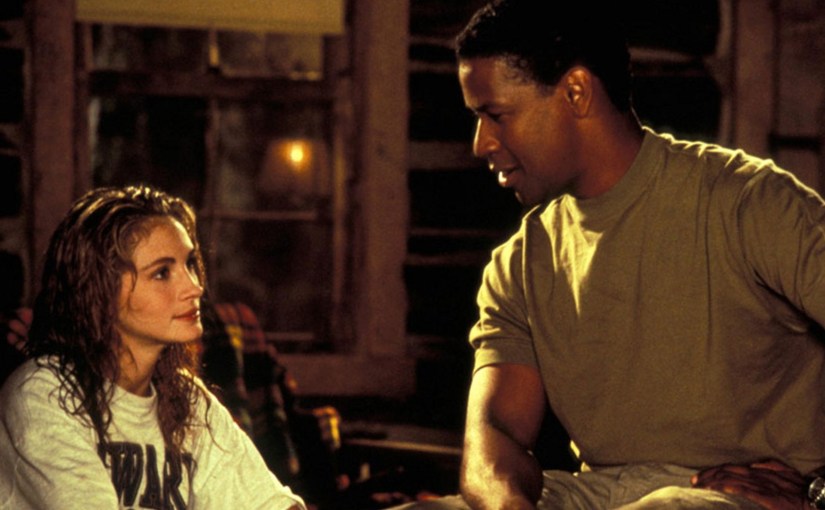
Sure, the film has suspense. I think Grisham’s story has some convincing weight to it where wealth and government won’t stand for the platforms of environmental causes and therefore people have to die. Still, while the meat of that story eventually surfaces, we are left with A LOT of buildup before Darby gets involved. Just a lot of white guys in different office buildings walking down hallways, entering doorways and talking on the phone. Every so often we come across a DC crack reporter, Grey Grantham (Denzel Washington) who gets a phone call from a potential informant. When that guy gets scared and hangs up, thank goodness Darby just happens to call two seconds later regarding the same story. Good on you Grey for being by that telephone.

That’s my problem here. Pakula just works in the lucky conveniences to keep Grey and Darby on the trail. Neither of them ever truly escape a bind on their own. Neither of them ever truly dig the hole any deeper without something COMING UPON THEM to help them along at just the right moment.

We learn a safe deposit box belonging to a dead character exists. Darby just strolls into the bank and posing as the widow, who is not a signer on the box, is just asked for her address and phone number. No proper identification necessary. Why didn’t anyone ever tell me it’s that easy? Folks, hide your valuables because I’m gonna be robbing you blind.

Pakula will even set up a good scenario where Darby thinks she’ll be meeting someone who can help but it’s an assassin ready to kill, only suddenly the assassin is killed while holding Darby’s hand in a crowded courtyard. Wow!!! Lucky again, Darby. I’m still fuzzy on who actually killed the guy. That didn’t concern Pakula though. It’s explained in a quick throwaway line before the credits roll. Pakula only had to get Darby out of danger again. So let’s see he’s got the barking doberman for something else, the engine sputter will be used later on. Hmmmm??? Meh!!! we’ll just have someone randomly kill this guy. Now run, Darby. RUN!!!

Notice I haven’t talked about performances. Well, there’s not much to them. The Pelican Brief boasts an impressive cast of character actors like Sam Shepherd, Anthony Heald, John Lithgow, Stanley Tucci, Robert Culp and John Heard. Yet, these guys, along with Roberts and Washington are flat. Just reciting their lines when the cues call for them. There’s nothing very exciting to any of them really. Very monotone. Roberts is beautiful yet depressing even before she gets caught up in the mystery. Washington, while handsome, does not seem to have the gusto that Pakula’s reporters did when he directed Hoffman & Redford. Grey is too neat, physically fit and tailored for an always on the job, aggressive reporter looking for a scent.

There was a better movie to be made here, thanks to some convincing motivations that were started with Grisham’s novel. Unfortunately, Pakula just didn’t devote enough respect to the original author’s imagination.

NOTTING HILL

By Marc S. Sanders

Notting Hill written by Richard Curtis (Love, Actually) and directed by Roger Michell is a pleasant surprise of a romantic comedy. It’s not a perfect film but it certainly loves every one of its quirky supporting characters, as well as its two straight romantic leads played by Julia Roberts and Hugh Grant.

Grant plays Will Thacker who lives in the Notting Hill district of London where every proprietor is a charming little shop of some form or other; a quaint street where merchants appear on the sidewalks during the weekends selling their art or homemade jams or coffee products. Will owns a travel book shop located across the street from his flat that is whimsically recognized by its big blue front door. His wife left him for another man and now he’s relegated himself to living with a roommate called Spike (character actor Rhys Ifans doing a British equivalent of Cosmo Kramer, Seinfeld’s neighbor).

One day the superstar celebrity Anna Scott (Roberts) simply strolls into Will’s store. They have a quiet moment and he sells her a travel book about Turkey that he didn’t recommend she purchase. Moments later they run into each other down the street when Will spills orange juice all over Anna. From there, a meet cute relationship begins to unfold. It’s not so simple for the pair though as Anna’s enormous celebrity is hard to negotiate; hard for Anna, not hard for Will.

Anna is at ease when she can have a quiet dinner to celebrate Will’s sister’s birthday with his friends or when she can escape her turbulent life of gossip magazines and paparazzi by taking shelter at Will’s flat, even if grungy looking Spike walks in on her taking a bath.

I like Notting Hill. However, the quiet moments shared between Grant and Roberts sometimes carry on too long. Oh my gosh!!!! Will someone say something already????? Hugh Grant has made characters that trip over their words and stumble with what to say into a master craft. Julia Roberts is one actress that a camera loves especially when she’s distressed. A crying moment in any one of her films will milk the scene for every blush, or glassy eye or tear and whisper she can offer. She’s a terrifically skilled actress in almost any film she does. Eventually, we have to move on from all of this though. My patience for some scenes were just running way too long for me at times. Kiss already!!!! Make love already!!!! Scream at each other already!!!!

Fortunately, there’s much escape to be had with the supporting cast, especially Ifans as Spike who is the most absent minded, lovable, dirty underwear wearing and sloppy prig imaginable. Emma Chambers is just as fetching with her scarlet pigtailed haircut as Will’s sister, Honey. Tim McInnery, Gina McKee, James Dreyfus and Hugh Bonneville round out this madcap collection. The birthday dinner party is a great scene for this ensemble as a comedic but relaxed chemistry blends nicely during a competition to see who is suffering the most to earn the last brownie on the dessert plate. The group is unsure how to include a movie star like Anna in their simplicity but Julia Roberts pulls off a trick that even had me fooled. Simply put, for the whole cast, there’s just that much more life and vibrancy when they are all together and it’s not just relegated to only Roberts and Grant in a scene.

Another special moment occurs later when the couple have split up once again. To depict time fleeting by, Roger Michell offers up a transition of Will wearing one outfit but walking through the hustle and bustle of Notting Hill as the weather and seasons seamlessly change all around him from sunlight to rain to snow and spring sunlight again. You even get a glimpse of Honey starting a flirtatious relationship at the beginning of the sequence and by the time it’s over a minute later Honey is breaking up with the guy. It’s a wonderful moment of wordless narration to show Will’s struggle with moving on as time continues to pass by. More importantly, it allows the titled setting to be a character of its own. This is a great example of showing a lovesick character unable to move on while life has no patience to wait for him to catch up.

I like Hugh Grant and Julia Roberts whether it’s in Notting Hill or one of their many other fine movies. I can’t deny the chemistry they have in this film. It works. I only wanted a little more life to the material that was handed to them. Still, Notting Hill is charming and simply a very sweet romantic comedy.