INSIDE MAN

By Marc S. Sanders

The abundance of Spike Lee’s films offer a message as quickly as the film begins.  Then they set out to demonstrate what Lee is talking about in the scripts he writes and/or directs and what is presented on screen for the next two or three hours.  BlacKKKlansman (a favorite of mine) and especially Do The Right Thing are perfect examples.  Lee is direct and hardly ever ambiguous.  Inside Man is an exception.  

This Spike Lee Joint is having a bit of fun with the director’s own take on the staple bank robbery found in so many films.  By the time the film is over, and all the cards are on the table, you realize the audacity of this caper is as unique as Sidney Lumet’s Dog Day Afternoon or Michael Mann’s Heat.  With a screenplay by Russel Gerwitz, Spike Lee is proudly vague until he finally reaches his conclusions during the third act of the piece.  It’s unusual.  It’s out there and it’s a stretch, but the math of the heist seems to add up.  Still, knowing what I know now, I do wish there was a little more focus on some characters that lend to the film’s twist. Then again, maybe that would have implied too much.

Four people wearing sunglasses, caps and painters’ uniforms take a well trafficked New York City bank branch hostage, complete with the entire staff and around thirty customers who are in the lobby.  The ringleader is played by a mostly concealed Clive Owen.  You might not see his face too often in the film, but you’ll be grateful he’s the bad guy in charge.

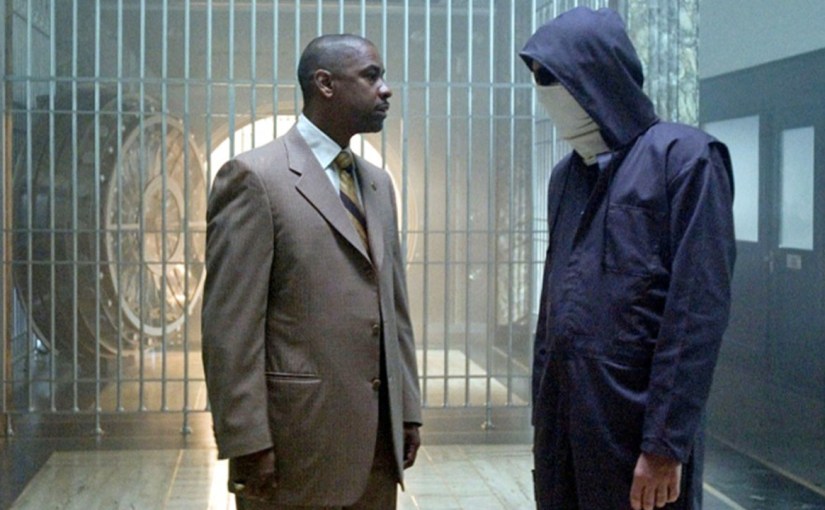
Denzel Washington is Detective Keith Frazier, and with his partner Bill Mitchell (Chewetel Ejiofor), they are on the scene attempting to diffuse the situation. The police captain right next to them is John Darius (Willem Dafoe).  Ejiofor and Dafoe are good as expected, though their roles are routine elements for these kinds of movies.  Washington has the kinetic pace that audiences are familiar with as he tries to outthink the bank robbers.  His character is labeled with a checkered reputation as he’s suspected of stealing drug money.  That element really goes nowhere.

Another party comes into the fold with Jodie Foster as a well-tailored and confident “fixer” hired by the bank’s president (Christopher Plummer).  To get these two actors together in a film along with Washington?  Well, that begs for repeat viewing.  Unfortunately, I didn’t see much point to the Foster character.  Upon hearing the news of the robbery, Plummer’s character clandestinely employs Foster to contain the situation so that a particular item in a safe deposit box remain untouched.  She arrives on the scene, exchanges dialogue with Washington that does not add up to much.  She surveys the hostages being held and then exits the story, until the epilogue.  As welcome as it is to see Jodie Foster, I can’t imagine what was gained from the context of her role, which does nothing to advance the story.

Inside Man always kept me interested and guessing.  The structure of Gerwitz’ script jumps ahead at times to show the detectives interrogating each hostage with suspicion after the incident is over.  So, I always wanted to know how it ever came to that shift in direction.  Plus, what happened to the bank robbers, and what precisely had Christopher Plummer so concerned about one particular branch robbery that he had to reach out for special services from Jodie Foster’s character? 

The answers arrive, and I can swallow the explanations.  Yet, the wrap up actually involves additional characters who hardly say a word or appear on screen earlier in the film.  Because they are briskly glossed over, it did not give me complete satisfaction.  I like the twist a lot.  It just needed a more solid foundation.

Inside Man is of those rare films that Spike Lee is invested simply for the fun.  The quick cuts and bustling New York atmosphere work well.  I love the opening credits to the movie; kind of his own spin on what Lumet did with Dog Day…  Lee has a good villain and appealing heroes. Other than few shortcomings, this is a solid crime drama.  

Often, Spike Lee positions himself on a platform that endorses a cause for the African American populace, or he brings attention to social wrongs in world history.  He is one of the best at what he does with his filmmaking approach.  Ironically, a message and a comeuppance arrive with Inside Man, but for a different demographic.  It might not be as hard hitting or thought provoking as other Spike Lee Joints, but it is appreciated.  

NYAD

By Marc S. Sanders

When some people go through a midlife crisis, they might buy themselves a car, get a new job or opt to not get out of bed for several days.  When Diana Nyad goes through a midlife crisis in her early sixties, she motivates herself to swim 103 miles from Cuba to Florida.  She came up short at age 28, but over thirty years later no one is going to convince her she shouldn’t try again.

Annette Bening portrays the real-life swimmer whose determination will bear the brunt of self-torture to complete arguably the maritime equivalent of climbing Everest.  Jodie Foster is Diana’s best friend and coach, Bonnie Stoll.  As acting partners and the characters they play, the leading ladies make a good pair.  

My first compliment has to go to the makeup department led by Ana María Andrickson.  The actresses received Oscar nominations, but the work done on Bening to play Nyad is astoundingly convincing. Diana makes several attempts to try to complete this challenge that’s never been accomplished before.  With each try, the dried-up complexion, blistering sunburns, chapped lips and bloodied cracks that prominently show on her body are truly painful and awfully uncomfortable to gaze upon.  At times, I was not as focused on the dialogue shared between Foster and Bening as I was on Andrickson’s masterful work.  The makeup alone tells an impactful story. A clear oversight by the Academy.

Annette Bening is particularly good in her role.  At times she’s a terrible annoyance and unlikable.  Yet, a sixty something year old woman who wants to defy all logic and the literal forces of nature will have to be a certain brand of jerk to move forward with her goals. This also comes with the natural degeneration of a body of freckled dry skin, loss of muscle mass and arthritic bones. Bening is far removed from the glamorous roles of an impressively long career past (Bugsy, American Beauty) to get to a persistent, unwavering zenith that the real Diana Nyad had to emote.

Jodie Foster is fine as Nyad’s best friend and former lover now coach.  I’m not sure all the award nominated praise she’s received for this part is merited, but she’s worthy of falling in line with other celebratory coaching mentors like Mickey from the Rocky films and Mr. Miyagi from The Karate Kid.  The film focuses so much on Diana Nyad though that there’s not much depth to Foster’s role.  She does the job, but it did not feel like it demanded much.  Frankly, Viola Davis in Air and Maura Tierny in The Iron Claw left me with more of an impression in an astounding year of great films and performances from 2023.

The unsung cast member who’s getting next to no press recognition is Rhys Ifans as John Bartlett, an oceanographer recruited by Nyad and Stoll to gauge immediate weather patterns and what the currents of the Atlantic are expected to do during the swimmer’s trek.  Ifans is a fantastic supporting character actor who is tasked with finding that suitable small window of time for Diana to start her journey. Within the context of the script, he offers the suspense needed for this sports film.  Can Diana Nyad hold up against the very real and insurmountable warnings that John describes?

Swimming is quite boring to watch.  However, this venture has cause for concerns.  Brutal storms, stinging jellyfish with undetectable approaches, and sharks.  Salt water, weakness and fatigue, the chops of the tide and mental hallucinations are also bears of contention.  A charter boat with Bonnie and John on board with a watchful, supportive crew sail alongside the swimmer, but they can only do so much if she intends to achieve her seemingly impossible goal unassisted.

Elizabeth Chai Vasarhelyi and Jimmy Chin are the directing team for Nyad with a script written by Julia Cox based on Diana Nyad’s novel account.  Most of the film is patterned like many other sports films focusing on an underdog.  I knew nothing about this person or her accomplishments.  Frankly, what I’ve learned is unbelievably impressive beyond what this picture focuses on.  Naturally, you’ll get an idea of how the story is going to conclude.

To enhance the ho hum activity of the swimming scenes, the filmmakers incorporate some of Nyad’s dreamlike delusions to get inside her head.  Falling rainbow stars onto the ocean surface as well as a yellow brick road leading to the Taj Mahal look as fantastical as they should, even if they drift into sidebar distractions.  I appreciated the handful of scenes where Rhys Ifans lays out the desperate concern shared with Jodie Foster about a lack of progress where Diana is wasting strokes against a current as well as his fear of oncoming sharks.  He builds suspense to keep the film focused. It’s pretty cool by the way how the crew responds to the shark issue.  

In addition, as good as Bening and Foster are with enormous careers of outstanding roles, much of their shared dialogue often comes off a little too hokey.  Granted, it’s a standard sports film and it’s more impressive that it’s all true, but Nyad sometimes plays off like a cheesy TV movie lacking that cinematic edge I was looking for.

An unclear element offers glimpses of Diana’s past as a beginner child swimmer who suffered personal trauma. It’s clear what happened to her, but these quick flashbacks are also mixed in with an unclear picture of her parental lineage and other ingredients.  I still don’t know why there were snippets of Diana playing Parcheesi.  Nor do I know who she was playing with to uphold its significance in the final edit of the movie.

Nyad is a biography worth seeing. The endurance the central character sustains to achieve the impossible is tremendously inspiring.  The thought that was running through my mind over the course of the film is that this woman wants to dominate over a powerful Mother Nature.  By the end, you see real life clips of Diana Nyad insisting to audiences that no matter who you are or what age you’re at in life, nothing can defeat what you want to overcome.  As well, whatever you succeed at likely deserves enormous credit for the support team that accompanied you.  Often, I’m a naysayer of Diana’s mantra because I think I’ve chalked up at least five times more failures than successes in my life.  Still, here is the person who eventually proved me wrong.  I should also note that I learn from my failures and remain hopeful that it will lead to success.

I often tell myself never to argue with a woman. Well, at least now I know never to argue with Diana Nyad.  

PANIC ROOM

By Marc S. Sanders

There are few films I come across where a phone call to 911 is immediately put on hold. There are few films I come across where the one in danger has an opportunity to speak face to face with a policeman while the burglars factually can not hear, and will still not relay that she, her daughter and her ex-husband are in danger. There are few films. Just a few. David Fincher’s stupid excuse for a cat and mouse thriller known as Panic Room is one of those few films.

I can forgive loopholes on occasion for the sake of maintaining suspense and to simply have a complete movie. I can not forgive it here however. Opportunities open up easily for Jodie Foster and Kristen Stewart to take an upper hand. Equally so, moments open up for the bad guys as well, played ineptly by Forest Whitaker, Dwight Yoakum and Jared Leto. The game of outsmarting you might find depicted in Home Alone is more sensible than David Koepp’s mindless script.

The three bad guys break into a home equipped with a sealed panic room. As they get in, Foster and Stuart make it into the secure area before being taken captive.

Fincher does great camera work within a 3 story New York brownstone. He can capture in a single shot a close up of a breathless Foster in one half of the screen while a menacing figure walks covertly down an adjacent hallway on the other half. The labyrinth of the house looks good in darks and midnight blues. That’s where the attributes of Panic Room stop, however.

Everything else is controlled by manufactured contrivances offered up by Koepp’s script. Security cameras can be smashed while it just so happens that the thieves are not watching the monitors. When the electronic door to the room is opened, no one will hear a thing until a lamp topples over. You don’t even here the buzzing or slam of the steel plated door. You can also sneak around the wooden floors and will not be heard until Koepp’s writing and Fincher’s direction allow it. Otherwise these old floors will creak and echo. I talk often about how the environment in a film is a character in and of itself, like the Overlook Hotel in The Shining. Well if this brownstone is giving a performance in this film, then it dropped a line, came in too early, came in too late and missed a dozen cues during its performance.

Policemen will come to the door and nary insist on coming inside the home, where a dead body lay as well as a wounded hostage and various wreckage is strewn about. Foster knows the bad guys can’t hear a conversation while they are in the panic room, but she will still not share the fact that she’s in peril. Why????

Most infuriating is that 911 will take an emergency call and put her on hold. That’s where I checked out. Nothing else mattered.

Panic Room is beyond intelligence in so many ways.

Oh yeah, also there are no neighbors within an adjacent neighborhood of brownstones that ever hear the commotion at hand.

My colleague Miguel might say, “well then you’d never have a movie.” My reply is Panic Room doesn’t seem like it ever was a movie to begin with.

THE ACCUSED

By Marc S. Sanders

Jodie Foster won her first of two Best Actress Oscars for playing Sara Tobias, a victim of a barroom gang rape in The Accused, directed by Jonathan Kaplan and written by Tom Toper.

Kelly McGillis portrays prosecutor Katherine Murphy. Murphy initially makes a deal with the three men accused of the rape. An agreement is made for a lighter conviction “reckless endangerment,” rather than “rape,” and a trial is avoided. What happened to Sarah is never put on public record.

Circumstances thereafter motivate Katherine to go another step further and prosecute the men in the bar that encouraged and cheered for the rape to continue. Her own office questions if it will be worth it though and demand she walk away from this seemingly no win scenario.

Kaplan’s film is more or less paint by numbers until it reaches the moment a material witness takes the stand to testify on the exact sequence of events that actually occurred in the back room of a neighborhood bar. Foster is hard to watch at times and that’s the point. There’s nothing glamorous in a film centered on a rape victim, and she puts out all the ugly parts of her character first physically, and then with temper, habitual drinking, and the sense of a poor upbringing. Toper does equip his character with likability though. Sarah tries to get through the tough exterior of Katherine’s no nonsense lawyer ideology with her interests in astrology. Through the film, Katherine shows no interest but we all know that’ll change. Nothing is shocking in the developments of Toper’s story.

What is jaw dropping though is how Kaplan depicts Sarah’s post rape examination. Deep cuts and bruises are shown in various parts of her body. She is propped on stirrups for evidence retention (hair, skin and semen samples for example), even the annoyingly repetitive click and flash of a Polaroid camera are disturbing. You can’t help but be concerned or taken aback.

No. A movie will never measure up to what victims endure following incidents like this. Still, the footage early on in The Accused certainly got me emotional.

The big shock is towards the end when the re-enactment of the rape is presented. Kaplan doesn’t hold back with his crew of extras playing the bar mates. Drinks are abundantly consumed, then a song in the jukebox, some weed, pinball, a wink, then a sexy dance, and suddenly Sarah’s skirt is lifted to reveal her panties and she’s propped on a pinball machine with her arms restrained and her mouth covered by a hand. Then the woo hooing is disturbingly brought on.

Why do I document all of this? I want to show how subtle Kaplan is with the rape scene. Innocent laughs and drunken play can suddenly turn on any one of us, man or woman. A song plays. People are stoned and drunk, and before any of us realize it, there’s a sexually assaulted victim, and a rapist, or three rapists actually. Moreover, there are those who wish for this moment to last and egg it on. For one woman, none of it is fun anymore.

Again, the storyline development of The Accused is nothing we haven’t seen before. It’s step by step, connect the dots within the courtroom and law offices. The crimes (rape for one, cheering & persuading – a crime for another) are terribly shocking though, especially when we see it first-hand.

Every man and woman should watch The Accused. It’s important we remember that we are capable of subjecting ourselves or being subjected.

More so, regardless of our age or experience, we all have something to learn about what a rape victim endures. I imagine this film doesn’t come close, but it’s a solid start.

ALICE DOESN’T LIVE HERE ANYMORE

By Marc S. Sanders

Martin Scorsese was destined to be a great director. No doubt about it. Look at 1974’s Alice Doesn’t Live Here Anymore. Not only does it offer an Oscar winning performance from Ellen Burstyn as Alice, but this early career film contains skilled tracking shots.

Scorsese uses his camera like a musical instrument. He times it to move on a certain cue. Near the end when Alice needs to pick up her 12 year old son Tommy (Alfred Lutter, well played here) from a police station, Scorsese is clearly on foot positioned behind the police counter. When the time is right, he walks it behind the cop and extras in a crescent step by step over to behind Alice. We are in the scene. It didn’t take much imagination, but Scorsese is economical for an engaging payoff. The camera continues to follow a young Jodie Foster as Tommy’s rebellious pal, Audrey and then after she’s quickly escorted out by her mother, it peers into the room where Tommy is waiting. It’s an unbroken steady cam moment that predates his classic tracking shot of the Copacabana in Goodfellas, or the bloody overhead outcome from Taxi Driver.

The story is decent, though nothing big. Alice is forced to flee following one set back after another with the men she encounters in her life. First she’s unexpectedly widowed from her unappreciative and cruel husband, next she encounters a charmingly young Harvey Keitel who sheds his first impression quickly. Then she comes across Kris Kristofferson but is he right for her?

The second half of the film inspired the basis for the classic TV show Alice, featuring Linda Lavin and Vic Tayback who plays Mel the cook in the film as well. Scorsese uses the diner sequences for some good laughs of confusion and slapstick with side characters Flo (scene stealer Diane Ladd) and Vera (Valerie Curtain, another scene stealer).

These are good characters here. You want Burstyn’s Alice to be happy and succeed as a mother to Tommy and become the singer she dreams about. She’s adoring. She tries, and she always works hard. Burstyn has some great moments of various range whether she’s feeling like a pestered mom driving the long highways, having anguish and fear with the men who cross her path, or when she’s singing Gershwin’s “I’ve Got A Crush On You” at the piano of a seedy bar. I loved her in the role.

This is not really a special movie. Yet, it’s an important one in cinematic history. See this film to see the master director when he was merely a pupil, exceeding what was likely minimally ever expected of him to accomplish.

Martin Scorsese is just a great director.

TAXI DRIVER

By Marc S. Sanders

A number of years back I was watching Robert DeNiro interviewed by James Lipton on Inside The Actor’s Studio.  DeNiro recalled considering doing a modern day follow up on one of his most memorable characters, Travis Bickle, with director Martin Scorsese.  Lipton thought it would be a marvelous idea.  So do I.  However, I don’t think it’d be a comfortable film to watch.  Taxi Driver certainly isn’t a comfortable film to watch.  It might seem a little dated now, but its themes of loneliness, isolation, depression and violent obsession remain entirely unsettling.

Travis claims to be an honorably discharged Marine in his mid-20s, when he applies to be a New York City cab driver during the present period of the film, 1976.  He recounts every thought that runs through his head, and when you are alone, behind the wheel of a taxi cab, traveling through the arteries and veins of an ugly, crime ridden, seedy part of town, a lot of ideas run through your sub conscious.  Travis recognizes so much wrong with what he sees through his windshield that he prophesizes one day when a good, solid rain will wash away all of this scum and filth.  Maybe Travis will be the bearer of that inevitable storm.

Travis lives alone in a one room apartment with junk food, an old television set, and his unending thoughts that he writes in his journal.  When he’s motivated, he occupies himself with chin ups and pushups.  He also becomes enamored with perhaps the only pure and innocent occupant of this ugly city-a young, Presidential campaign worker named Becky (Cybil Shepherd).  Travis approaches her innocently enough under the guise of wanting to volunteer for the campaign and invite Becky out on a date.  He’s cordial enough, albeit awkward too.  Yet, he can not understand how twisted it is to escort Becky to a dirty, X rated film.  She’s sickened by the film and Travis is at a loss of what he did wrong.  Travis has become infected by the city he circumvents each day, and he’s blinded of gentlemanly courtesy he could be providing for a woman he’s interested in.

The well-known script for Taxi Driver was written by Paul Schrader.  He quickly conceived its disturbing ideas during an isolation binge he found himself trapped in. Schrader couldn’t make sense of his mindset at times.  One week he was gorging on sleeplessness, junk food, and endless television watching.  The next week, he was motivated to get in shape with exercise and healthy eating.  There was a lack of consistency in his behaviors.  Travis goes through the same experiences, but he also finds motive to respond to the offenses that he sees. 

Scorsese captures scenes of some of the passengers that enter Travis’ cab.  One scene includes the director himself in the back seat as a character obsessing over a woman in an apartment above.  It’s a cameo of an unhinged man that Travis never had any interest in knowing, yet this person insists on sharing his frustrated anguish.  Later, Travis happens upon the Presidential candidate in his back seat.  The candidate seems noble enough inquiring on what issues are most important to Travis as an American citizen.  What I gathered from the scene is that the candidate has his own ways of fighting for a better future dressed in a suit on a campaign trail, while Travis has a more disturbing outlook on what should be done. 

Midway through the film, Travis is purchasing guns from an underground seller and practicing how to quickly unleash his arsenal for when the fight crosses paths with him.  He builds a quick draw sling to hide a gun under a sleeve.  He practices how to whip out the switchblade he keeps strapped to his boot.  One of the most famous scenes in film history occurs when Travis is talking to his mirror image asking repeatedly, “You talkin’ to me?”.  Supposedly, this moment never existed in Schrader’s script, and Scorsese was fortunate to capture DeNiro getting into character.  Whatever the origin of the scene, it sends a chilling summation of where Travis prioritizes his mental focus.  It’s not on love or affection for a fellow human being.  Once he blew it with Becky, other ideas remained with Travis.  Now, he’s solely obsessed with the war that he’ll fight for, all by himself.

Schrader and Scorsese go even a step further with the character as he comes upon a twelve-year-old hooker, named Iris, (Jodie Foster) and her street pimp, named Sport (Harvey Keitel).  He takes Iris for breakfast encouraging her to go home to her family and get away from this life.  Iris cannot see the need for that.  This encounter almost seems to justify Travis’ will for violence.  He now has a cause to rescue this child from the danger she’s immersed in.  I won’t spoil the outcome of this relationship.  Yet, Schrader and Scorsese keep the ending unexpected.  Have we been watching a dangerous villain for the last two hours, or were we watching a hero? Does the bloody and excessive violence that wraps up the picture lean towards heroics or vigilante crime?  These are good questions to ask but they are also consistent with the contradictions of Travis’ mindset.  When all you have to occupy yourself with are the endless, mounting thoughts running through your head, you are doing nothing but debating with your subconscious, and it’s likely you’ll have no other person to assure you that whatever actions and choices you make are the right ones.  One day you wonder if it’s all worth it.  The next day, you feel chosen for a crusade.

So as DeNiro and Scorsese considered a follow up to Travis Bickle in a modern time of the internet, where the world has only gotten smaller and more intimate with itself, I’d be nervous to see what becomes of him.  Travis would likely still be alone, driving his cab twelve hours a day, and listening to the thoughts running through his head.  Only this time, he’d likely be getting responses to journal inputs, that he’d put on blogs and in chat rooms, from unknown keyboard warriors justifying his will for violent cleansings.  Travis would no longer be limited to just his own inner thoughts.  Now, he’d have the influence of others willing to share their own internal ideas of how to clean up the streets.  They might feel helpful and recognize themselves as saviors, but would they be able to decipher what needs saving, what needs improving, and what is the best, healthiest and most ideal way of following through with those missions?  Violence might be their answer. 

You know what.  Perhaps, I’m not being fair.  Maybe I should be more optimistic.  Some of these keyboard warriors who hide behind their computer monitors may attempt to convince Travis that the world is fine as it is and does not need the cleansings that he had always considered.  I don’t know. Sometimes, like Paul Schrader or Travis Bickle, even I go back and forth on what’s right, what’s wrong and what’s the best thing to do.

THE SILENCE OF THE LAMBS

By Marc S. Sanders

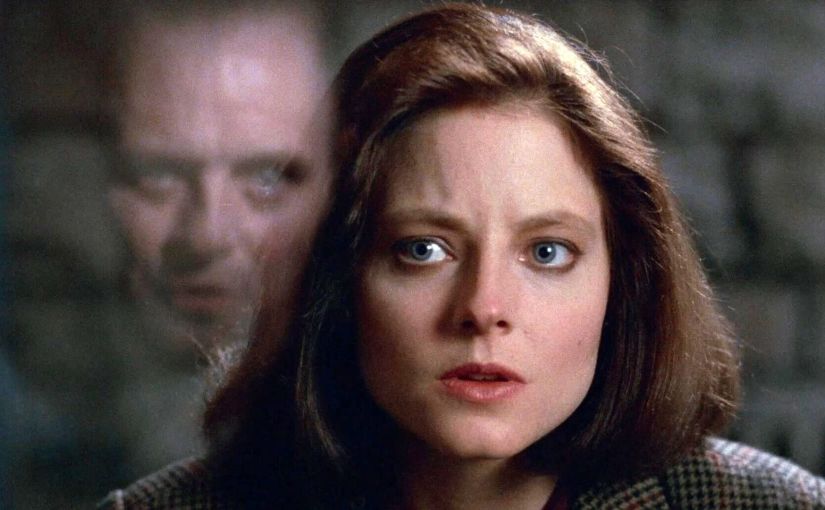
Everyone remembers Anthony Hopkins’ memorable turn as the infamous Dr. Hannibal Lecter in The Silence Of Lambs.  He was “Hannibal The Cannibal;” a renowned and brilliant psychiatrist who was eventually captured for being the one who ate his victims with sophisticated glee.  The real attraction, though, is how director Jonathan Demme delivers the film adaptation of Thomas Harris’ best selling novel through a lens that only finds one strong heroine amid a sea of intimidating men.  The heroine is the intuitive, but petite Clarice Starling.  The men are nearly everyone else cast in the film, and I mean everyone all the way down to the extras; the extras, here, are a perfect example how necessary they are towards any film’s palette.

Ever since the film was released in 1991, the dialogue of Ted Tally’s script is worthy of repeating and mimicking in social circles.  Lecter remains spoofed in nearly every pop culture medium.  Hopkins’ character is unforgettable and he’s been ranked among the greatest film villains of all time with the likes of Darth Vader and Harry Lyme.  It’s a worthy honor.  His timing is subtle and mischievous while he remains silently dangerous.  You can’t take your eyes off the actor and you can’t erase the devilishly fun and evil character from your sub conscious.  Opposite this performance though is Jodie Foster in a top billing role as an FBI trainee named Clarice Starling, assigned to interview and maybe study Lecter as a means to a solid lead in finding a serial killer that has been identified in the media as “Buffalo Bill.”  Bill has been skinning and killing girls with large physicalities, around the east to mid-west portion of the United States.

So, there is a detective story at play here as Hannibal aids Clarice in her search for the killer, but only under his rules.  Demme paints the film with Clarice ably performing her job no matter the towering strength or perverted fantasies found in nearly any man.  An outstanding image early on shows her small frame entering an elevator.  She has been summoned to her supervisor’s office from the outdoor obstacle course.  She is sweaty, and looking tired.  The elevator is full of a dozen men in red uniform polo shirts that hug every muscle; they are strong, fit and healthy.  Clarice stands front and center and she has no reluctance to stand among this exclusive group.  Later in the film, Clarice is invited by her supervisor, Jack Crawford (Scott Glenn in a deservedly dark and quiet performance), to investigate one of Bill’s victims that turned up in the swampy waters of West Virginia.  The coroner’s examination room is filled to the max with sheriffs who believe they serve a purpose to stay there to witness what’s uncovered.  The strength of Clarice is really shown here as she shoos them away.  The men’s facial expressions tell us they don’t care for this request, but Clarice isn’t going to allow them to remain.  Most importantly are her encounters with the head of the Baltimore psychiatric ward that houses Lecter.  He is known as Dr. Chilton played by Anthony Heald.  Chilton – a great character name that clearly colors in the twisted perversion of this guy.  Chilton is happy to boast of his prized attraction, Lecter, as if he’s a rare tiger and he has no reluctance to hit on Clarice when she comes to visit with Lecter.  Always, Clarice will not allow herself to be succumbed, patronized or victimized by any of these towering figures of masculinity in what is unfairly regarded as a man’s world in law enforcement, crime or psychiatry.  Starling easily reminds Chilton that she was a student at the University of West Virginia, not a charm school.  With Tally’s script, Jodie Foster uses these deflective techniques of her character without effort.  Her methods of fencing with these men are a natural ability.  Even when she’s in film transition periods of training at the Academy, Clarice can maintain her stance against a hard-hitting male boxer pounding away at her boxing shield.  She just won’t fall over. As well, she doesn’t wince as the male students give her a glance from behind when she’s jogging on the grounds. 

Demme is an outstanding director who uses these interpretations of this woman to drive his film.  This very same year, 1991, Ridley Scott directed Thelma & Louise.  In that film, the title characters had to realize that they didn’t have to take any shit from a man.  They started out weak, though, and had no choice but to eventually get stronger.  Here, it’s already part of the woman’s instinctive nature. 

Hannibal Lecter is shown to be well versed in the finer things of art, literature, music and, forgive me, cuisine.  At one point, Demme focuses on a picture Lecter has sketched depicting Clarice in an almost angelic nature.  I’ve never forgotten that image.  Nearly all of the settings in The Silence Of The Lambs include stairways that always lead us in the down direction, to an assortment of various hells.  Clarice, the pure angel with nary a fault beyond limited experience as an FBI agent peels the onion away on her quest for a killer by entering into the treacherous depths beneath her; pits of hells.  The opening shot of the film has Clarice pulling herself up with a rope on an obstacle course as if she is ready to enter the heavens, ready to stand above everything, but then she is summoned to Crawford’s office located at the Department of Behavioral Sciences at the FBI.  She has to take an elevator down and then various stairways further down into a labyrinth of claustrophobic offices with no windows, surrounded by cinderblock and populated with men in uncharacteristic suits that don’t appear warm or cuddly.  Crawford may seem like her ally, but really, he’s using her as a sacrificial pawn on a chess board putting her in an arena with psychotically dangerous prisoners, in particular, the worst of them all, Hannibal The Cannibal. 

When Clarice goes to visit Hannibal, she is escorted by Dr. Chilton, who relishes in describing how careful he handles his prized thing, and willingly shows what this monster is truly capable of by providing an unwelcome photograph of how Lecter brutalized a female nurse.  This conversation is played upon a much more frightening descent of unlimited stairways and bars that clang loudly and are painted red and rusted, eventually leading to a stone walled dungeon for these unimaginable beings of death and perversion.  Clarice is left all alone to navigate her way down a long corridor until she reaches Lecter’s cell.

Yet, an even more frightening third descent into hell occurs in the final act as Clarice’s pursuit leads to Buffalo Bill.  Bill’s home is dark, lurid, filthy and maze like; but always seeming to go down further and further into one doorway after another and down one staircase after another, including a deep well where his latest victim is kept.  Like the other descents, Clarice uses her femineity as a tool of strength to survive.  I can claim without any hesitation that Clarice Starling is one of the greatest heroines in the history of film. 

The one man who rattles her, and weakens her, though is Hannibal Lecter.  Watch their tete a tete when they meet for the first time.  Starling demonstrates some overconfidence against Lecter’s seemingly polite demeanor.  With her white trash Virginia dialect, she even gets a little smarmy with the Doctor, but then he disarms her immediately with a comeback that shakes her very core.  Demme’s reliance on close ups for both characters serve this scene and others so well.  Clarice’s encounters with Hannibal are the most important and vital moments in the film because they are the only opportunities for Jonathan Demme and Ted Tally to show the main character’s weakness.  Every hero has to have a weakness if they are to remain compelling.  Clarice is not, in fact, undefeatable. 

The film could have simply worked as a basic detective story.  Put up the clues and the narration of the picture will eventually assemble all together for a resolution where the bad guy is captured.  Yet, Thomas Harris’ character creation uses Hannibal as a defiant obstacle blocking the path for Clarice.  Hannibal lacks much stimulation in a cold, specially designed prison cell.  He’s maybe only honored with impenetrable plexiglass to contain him as opposed to traditional bars.  He needs to be enthralled.  On the surface, Clarice appears as a frail prey that he can take his time munching on.  He’s happy to help Clarice catch Buffalo Bill with the case files she provides, but in exchange he wants to uncover what haunts her psyche.  Such a strong character Clarice is, but she has to be willing to weaken and expose herself to desperately find a dangerous killer.  Can she do it?  She’s never allowed herself to do that before.  And thus, we come to comprehend the obscure title of this film and the book it stems from.  (Anthony Hopkins actually thought it was a children’s fantasy when he was sent the script to read over.)

This write up is not necessarily a review, but a means to honor the careful film and storytelling technique that Jonathan Demme strives for with The Silence Of The Lambs.  You might say, yeah, there’s a lot of walking in this picture, but pay attention to the direction of the walking.  Always going down, somewhat reminiscent as Little Red Riding Hood entering a dark and spooky forest and encountering the biggest and baddest wolf.  Jodie Foster might be in a company of men here, but the film works as a dual of femineity vs masculinity.  It’s strange to believe that Demme actually had Michelle Pfeiffer in mind for the Starling role initially, a more than capable actress, but one who at the time was more glamourous (The Fabulous Baker Boys and The Witches Of Eastwick).  Beyond the silly Disney films, Foster was known for lurid pieces like Taxi Driver and her first Oscar winning role as a rape victim in The Accused.  Clarice Starling is a character beyond a pop culture appearance of the time, and Jodie Foster emanates that portrayal.

The writing of The Silence Of The Lambs is so intelligent.  There’s a witty, yet deliberately poor taste, of sarcasm to Hannibal Lecter as he thrives off his superior intellect over Jack Crawford and the FBI.  It’s only enhanced when he’s dealt a lowly, formally white trash female student to play with.  Ted Tally offers precise timing in the dialogue with Clarice and Hannibal.  Thomas Harris’ drive to further a cameo appearance of Lecter in a prior novel (Red Dragon) with this book is a gift to readers and eventually movie watchers.  The Silence Of The Lambs doesn’t follow formula with a Law & Order technique of ballistics and witness interviews.  It drives into other directions to feed its development. 

Jonathan Demme’s film is pioneering.  I recall seeing it in theatres with other high school friends.  I was not enthused to see it.  The title was too odd.  The picture was primarily a talking piece.  There were gross and unwelcome images within the film.  It’s very ugly at times.  I was frankly accustomed to the likes of Dirty Harry and Lethal Weapon films for my cops pursuing the robbers ideals.  I recall not even liking the film when we left, and I couldn’t comprehend its appeal that followed for the remainder of nearly an entire year, all the way up to when it was awarded the five main categories of Oscar wins (Actress, Actor, Screenplay, Director and Picture).  I definitely wasn’t accustomed to a strong character like Clarice.  Later that year, I saw Thelma & Louise and fell in love with their eventual triumph.  I needed to be spoon-fed their initial weaknesses at first.  Who was this Clarice in this picture, though?  I could not identify her strength that displayed right from the get go.  I wasn’t even 18 years old at the time and now I can say I just wasn’t mature enough for this film back in 1991.  Now, it’s thankfully clearer, though I still appreciate its subtlety so much. Jonathan Demme had such a clear vision of where he was taking this film and because it’s not dated, The Silence Of The Lambs stands as thriller, and an intelligent thought provoking piece that stays with you for a long time after each viewing.

FLIGHTPLAN (2005)

by Miguel E. Rodriguez

Director: Robert Schwentke
Cast: Jodie Foster, Peter Sarsgaard, Sean Bean (who, miraculously, does NOT die in this film)
My Rating: 8/10
Rotten Tomatometer: 37%

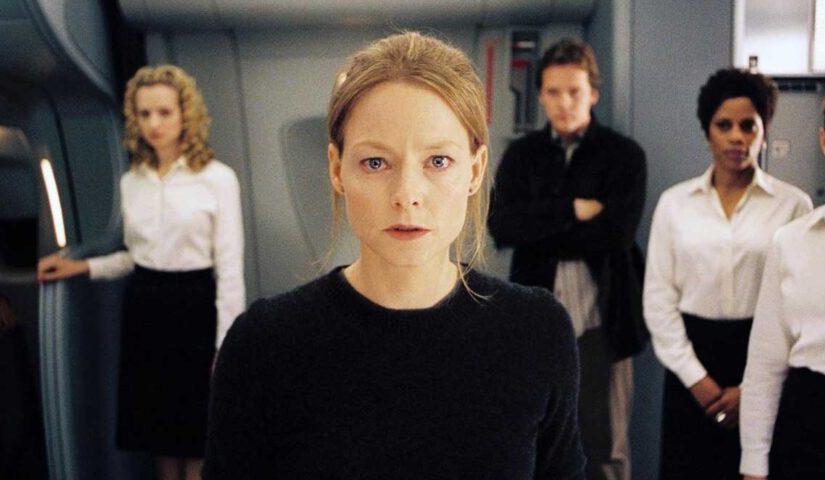
PLOT: A bereaved woman (Foster) and her daughter are flying home from Berlin to America. At 30,000 feet, the child vanishes, and nobody will admit she was ever on the plane.


I get it. Flightplan strains at the leash of credibility. A lot. In order for the plot to work, the audience has to believe that a number of people would have to be involved in a massive conspiracy, a cacophony of coincidences that screams “CONTRIVED” to any sane moviegoer.

But, as ridiculous as it seems, the movie still works incredibly well, even upon repeat viewings. Director Robert Schwentke has not exactly distinguished himself since this film (credits include R.I.P.D., Red, and the last two Divergent movies), but Flightplan displays a surefire command of tone, creating a claustrophobic atmosphere while keeping the camera free to move around the plane along seemingly impossible paths.

This film is a classic example of what Roger Ebert called a “locked room” puzzle. A girl is missing on an airplane – admittedly a very LARGE airplane, but still. There are only so many places she can be. The plane is searched, but she’s nowhere to be found, leaving only two possibilities: she was never there to begin with, or someone’s lying. But who? And why? She thinks she recognizes an Arab passenger on the plane…was he staring in her apartment window the previous night? Is she going crazy, or has there been an actual kidnapping? That’s the central mystery, and it carries the movie for most of its brief running time.

(There’s a neat section where Foster’s character (who, coincidentally, helped design the plane they’re on), monkeys around with the plane’s electronics and gets the oxygen masks to fall, to create a diversion for herself. Tell you what, that would get MY attention.)

The final resolution is…well, let’s say it answers all the questions of what happened without addressing HOW it happened. A lot of folks found that unsatisfactory (thus the 37% on Rotten Tomatoes), but the movie is so well-made and executed that, by the time the credits rolled, I didn’t mind it so much. But, you know…that’s just me.