TEACHERS

By Marc S. Sanders

I grew up watching the television show M*A*S*H with my mother and brother.  Don’t hate me but I have yet to see the Robert Altman film.  Perhaps that is because I was afraid of major disappointment.  The formula for many of the episodes and seasons of the TV show work so well at blending tidbits of comedy within a setting that is nothing else but bloody turmoil.   For those characters to survive required all of them to laugh and lampoon into the face of an uncontrollable situation where their lives could end at any time while they live in misery.

These thoughts came back to me as I watched an unsung and forgotten film from 1984, Teachers directed by Arthur Hiller.  John F Kennedy High School is only going in one direction which is very far south beyond the gates of hell.  A gym teacher is getting students pregnant, a kid shows up at the principal’s office with a stab wound in the arm, and the school psychologist has just lost her marbles because the old fart tenured teacher hogs the ditto copy machine (Remember those?  You could get high off the ink on the paper.).  A mental patient has managed to worm his way into a comfortably welcome substitute teacher position.  The driver’s ed car has been stolen and one student terrorizes another teacher in an assortment of ways beginning with biting and then moving on to theft.

Alex Jurel (Nick Nolte) is the admired social studies teacher who has lost his passion for the profession.  It’s not so much that the student body or the teaching staff is out of control.  The whole administration has taken to a new mentality of profit over proficiency.  The merits that come with an education are all but dismissed.  The assistant principal (Judd Hirsch) used to care as well.  Now, his job is to maintain a façade for the school and churn out one student body after another year after year.  The principal only knows to answer any questions with a genuine “I don’t know.” reply.  Bottom line is no student should ever be flunked from John F Kennedy High School.  If they can read enough, then it’s enough to get the diploma.

A former student of the school is Lisa Hammond (JoBeth Williams), now an attorney and representing a graduated student who is suing the school claiming he is an illiterate who cannot find a job or begin a future due to the negligence of the school. Lisa is a crusader.  She’s not here for the money to be earned from the case.  She’s here to make a change and her lynchpin deposition will come from Alex who will testify about the truth that’s occurring. Hopefully, he will also recruit other teachers in tow to back up the claim.  Naturally, as his former student with the nice ass, Lisa becomes involved with Alex on the side.  Like most movies, this one also does not question the conflict-of-interest circumstance.  We just have to roll with it.

I really take to the dilemma of the school and I understand both sides of the argument.  Now, more than ever, over forty years after the release of this film, I think our educational system is in dire straights with minimal funding, lack of support and respect for a teaching staff, parents who exonerate themselves of being responsible for their children’s lack of progress and behavior, and then of course there is the very real epidemic of school shootings and on campus violence. 

However, school is a necessary element to our society and its where all of us begin.  To uphold a reputation will involve both losses and wins.  Not every student will make it.  Not every student will miss out either.  As Judd Hirsch’s character insists, half of these students will not graduate with a proper education but half of them will.

Okay.  Enough arguing!  How about Arthur Hiller’s movie? Teachers has much to stand on and I wish it had garnered more attention.  It’s undoubtedly worthy of it. 

Like M*A*S*H, there’s organic comedy that comes from the film and a variety of teachers and students appear like they have been cut from familiar cloths.  Most of the comedy works especially well.  I love the ongoing joke of the one teacher who sits at the back reading his paper and dozing off, with the students facing away from him while they complete an assignment during the period.  The punchline to this joke may be predictable, but I’m still allowed to laugh as I watch it play out.  It’s funny. 

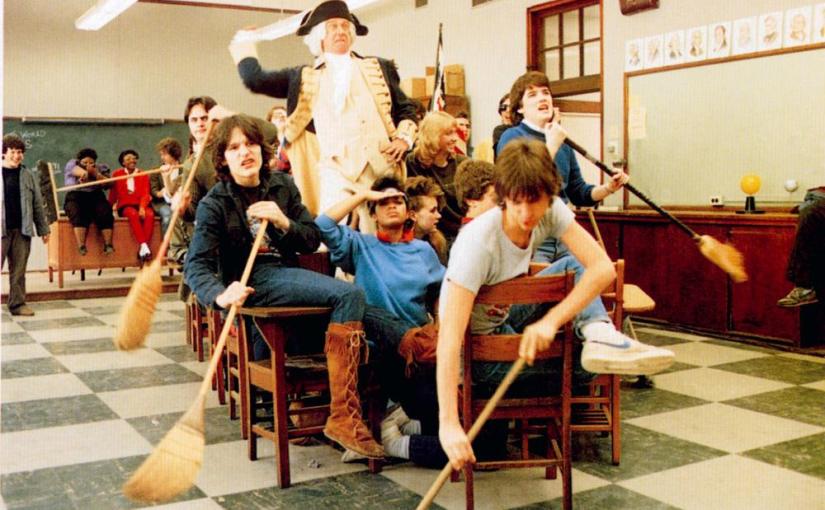
Richard Mulligan (Empty Nest) plays a mental patient that ironically engages his students when he conducts his classes dressed as famous historical figures like Lincoln and Custer.  Watch him reenact George Washington’s crossing of the Delaware with his students “rowing” the boat.  It’s an image I will not forget.  Nor will I forget his final scene in the picture as he encounters Nolte’s character in the hallway.

Where the film falls short is in the one student that is primarily focused on, played by Ralph Macchio, shortly after coming off his first Karate Kid movie.  Just like in The Outsiders, which I recently wrote about, Macchio relies on his dark complexion, stylish black hair, blue jeans and that popped up jacket collar again.  There’s also that strut he always has.  Forgive me for beating up on the kid, but too often I see Macchio donning the same image – that cool kid pose needed for the cover of Teen Beat Magazine.  Nick Nolte shares a lot of scenes with the actor playing the troubled kid with a sixth grade reading level.  However, Nolte is the only one working most of the time.  Another actor in this role would have served better.  It’s a necessary role as it attempts to awaken Nolte’s teacher character to try saving another kid before he gets lost.  Back then, maybe Emilio Estevez or Lou Diamond Phillips would have been more suitable.  Instead, we get Ralph Macchio being Ralph Macchio all over again.

Teachers is a comedy drama that mostly works.  It’s easy to get caught up in the comedy and, sadly, the absurd truth of what goes on in a metropolitan public school system back in the 1980s.  There’s also very dramatic and heavy elements to the film that stay with you.  Before school shootings no longer became shocking (a sad and current truth), Teachers explored the trauma of school bullying and the response the comes with that issue.

Arthur Hiller’s film did not invent the wheel on troubled times within school.  Heck, even The Sweat Hogs from Welcome Back, Kotter were troublemakers too.  Not to mention there are other school dramas to come before, like Blackboard Jungle.  However, Teachers is an very engaging film. I was completely absorbed as soon as the movie began, first in its comedy, and then later in its drama.  A near final scene of the film is eye opening and much like Steel Magnolias will leave you laughing and crying all at the same time.  That happens because you quickly begin to care for most of these characters and the turbulent times they live through as a teacher making next to no money while working under unfair and unreasonable scrutiny.

I think Nick Nolte is delivering one of the best performances of his career.  He has great chemistry with JoBeth Williams, who is good in her role.  The romantic storyline does not go overboard.  It does not get schmaltzy.  It is just enough, and it’s wise to include dialogue where they debate one another from two different sides of a coin.

Teachers also works as a great look back piece.  A lot of well-known, eventual recognizable actors round out this cast including Morgan Freeman, Crispin Glover, Laura Dern, Allen Garfield, and Lee Grant. Anytime Nolte is on screen, he only enhances the scenes he shares one on one respectively with most of these actors.  The moments between him and Macchio only work because of Nick Nolte.  Call Nolte the Alan Alda/Hawkeye Pierce of this picture. 

Teachers might look tame by the turmoil we see today in schools across the country but none of what is seen is untrue or exaggerated either.  Well, maybe except for the mental patient who arguably turns out to be the most engaging and influential instructor of them all.  That’s funny stuff, but you gotta be a little bit crazy to become a teacher nowadays.
POLTERGEIST (1982)

By Marc S. Sanders

The original Poltergeist holds together based only upon its visual imagination.  The characters?  Well, they’re pretty thin to me. 

The Freeling family are JoBeth Williams and Craig T Nelson as mom and dad, with a teen daughter (Dominique Dunne), a preteen son (Oliver Robins) and an angelic five-year-old girl named Carol Anne (Heather O’Rourke) who speaks to the “tv people” through the white noise channel in the middle of the night.  Following odd occurrences that include unexplainable trickery from the kitchen chairs, a monstrous oak tree comes alive during a violent thunderstorm ready to consume the boy, while little Carol Anne is abducted by her closet into another realm that “exists” somewhere within the suburban house.

Mom and dad recruit help from ghost whisperers to uncover the mysteries that reside in the home and hope to rescue Carol Anne.  Beatrice Straight is the leading scientist of this team.  She introduces dialogue that says their home might be not be so much haunted as it is consumed by a “poltergeist.”  That little nugget to ponder stops there though, and is never explored further.   Who cares, actually?  Poltergeist!  Haunting!  Tomato! TomAto!  The piano is still moving by itself, and the toys are still floating around the children’s room.  Since the unexplainable can never be explained, a psychic is brought in, perfectly played by Zelda Rubinstein as a withered old lady with a kinship for the supernatural.  She knows how mom and dad should direct Carol Anne back to their dimension, and has a pretty good idea how they need to enter the other realm and physically rescue her.

Watching Tobe Hooper’s classic haunted house film from 1982 (rumored to primarily be directed by producer/writer Steven Spielberg), almost feels like I’m touring a warehouse of monster creations at a movie studio with all the lights turned on.  Most of the inventions offer little depth or curiosity.  I could care less about any of the characters like the parents and three kids that make up the Freeling family, or the squat psychic who enters the second half of the picture.  Beatrice Straight is an interesting actress with a humorous shiver and terrified whisper.  She leads two ghost hunter assistants who lack the speak to talk with researched authority.  I run down this list though, and all I get from the movie is an arts and crafts display of the dazzling and grotesque creations spawned from the imaginations of Industrial Light and Magic.  The artistry is to be admired.  Yet, I question if anything I saw ever served a story. 

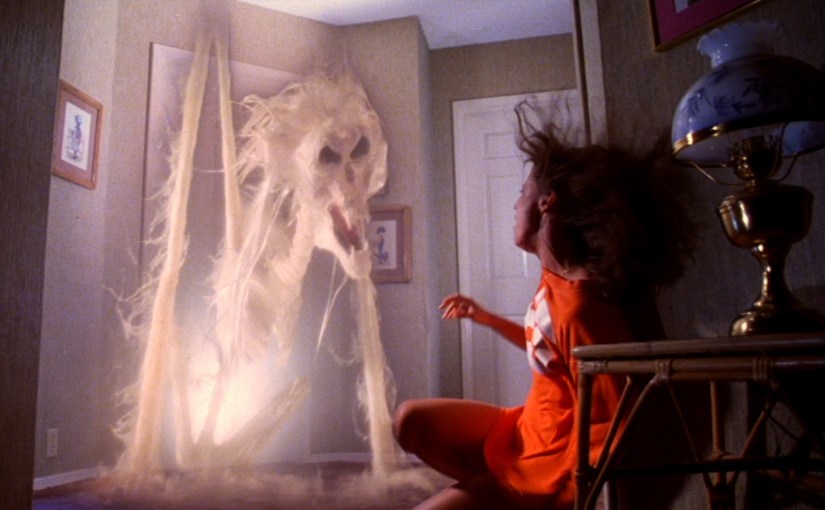
I don’t watch Poltergeist as often as others I know, simply to avoid experiencing the terrorizing clown puppet that dons a wicked tooth like expression and strangles the young boy.  Still very effective.  Coffins burst from the muddy swimming pool to pour out skeletons upon a screaming JoBeth Williams.  A ghostly white phantom guards the door to the children’s room and the closet entrance becomes a gaping, hellish monster mouth ready to swallow what it inhales.  Raw meat crawls across the kitchen counter.  A chicken leg turns into maggots and let’s not forget about the guy who hallucinates in front of mirror while pealing the skin off his face.  These are just lists!  Lists of scary things to do.   

Poltergeist is a simplistic fun house of haunts.  Nothing further.  I appreciate that only to a degree, however.  I wanted more.  An explanation is given for these occurrences in a tiny exchange of dialogue during the terrifying climax.  Beyond that, there is nothing I can say about these characters or what they stand for.  The kids toss cereal at each other at the breakfast table, and the parents smoke pot in bed, but there’s really no affection, or conversely, animosity shared among the family members.

If I were to compare Poltergeist to other fright fests like Hitchcock’s The Birds or even the original Predator or Alien, I would undoubtedly say those are superior films because beyond the monsters that terrorize the characters there’s also room for mistrust and paranoia among the players.  There’s time to devote towards care that those characters may have for one another.  A suburban mom is seemingly expected to want to be reunited with her little girl.  That’s a give in.  It’s standard.  Completely apparent in every way.  Couldn’t some competition from mom and dad come into play though?  Some blame pointing tossed about for example?

I guess I get a little bored with Poltergeist because it doesn’t stop to acknowledge the value of its cast of characters.  There are only a few moments of suspense that come upon me like when I’m trying to figure out where the scary clown puppet went off to.  Another terrifying moment is watching JoBeth Williams hustle as fast as she can to her children’s room while the hallway seems to stretch the bedroom door further and further away from her.  These are all things to look at though.  These are not moments that I connect with emotionally.

Some close friends of mine absolutely love this movie.  They can’t get enough of it.  They recite the lines.  They get caught up in the supposed “Poltergeist Curse.”  They watch all of the making of documentaries and return to the film for the nostalgia.  For me though, I never felt an intimacy with the mystery, or the family being victimized.  On that level, it’s almost on the same plane as a disposable Jason or Freddy movie.  I’d like to shed at least one tear before that teen gets their head chopped off, or the screaming kid gets eaten by the tree trunk.

KRAMER VS KRAMER

By Marc S. Sanders

Probably the most personal film for me, the one that I watched for the first time with adult eyes even though I was only age 8 or 9 at the time, was writer/director Robert Benton’s 1979 Best Picture winner Kramer vs Kramer.

Though my parents never divorced, somehow I recognized the character of Ted Kramer, an extremely busy New York City advertising executive who could be having a great day while staying flirtatious but then also having an outburst of frustration when things are not going his way. My father was a busy man and a hard worker. He was a man who was always very proud of his work. He loved his work so much that he wasn’t as present in my life during my adolescent years. My mother on the other hand was my best friend who could make me laugh and demonstrated unconditional and very natural love for me. I learned about humor and love from my mother during those early years. I learned about responsibility from my father and some of his own humor later on. So, as I reflect on this film I imagine what life could have been for me had my mother walked out with no notice, leaving my father to tend to my needs while having to suddenly make sacrifices with his work.

On countless occasions, I’ve written about the importance of a character arc where a protagonist will start out one way and completely change through the middle and end of the film. In Kramer Vs Kramer, the arc is not focused on a character but rather a relationship between father and son. When Billy (Justin Henry in an Oscar nominated performance) at age 6 wakes up to discover mommy is not there, he sees how lost daddy is with waking up and trying to make coffee much less crack an egg properly for french toast. Ted and Billy have been blindsided and without any warning they need to adjust to one another very quickly.

Later, Benton does an insightful tracking shot of their apartment as they wake and we see they’ve grown accustomed to a routine together of getting each other up, setting the table and reading their newspaper and comic books side by side while never uttering a word. Benton realized that the comfort of living with each other does not have to be evoked with dialogue. This routine is offered one last time at the end when an inevitable and unwanted conclusion has befallen Ted and Billy. Again, no dialogue because now as a viewer I’ve become comfortable with this special relationship. Truly, I envisioned my father and I in these three moments.

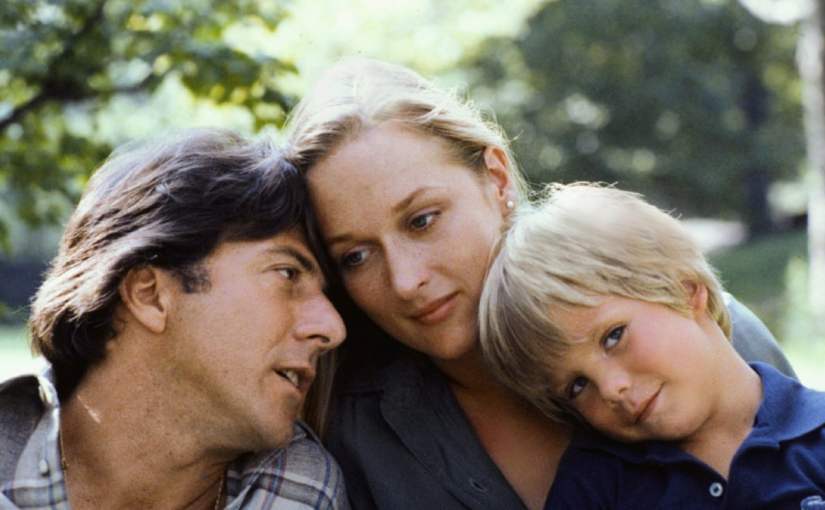
Meryl Streep is the other Kramer, Joanna. She won the Best Supporting Actress Oscar and its well earned. Benton opens the film on her sad expression in a quiet darkness. When Ted finally comes home with good news from work, Streep is really good at holding her firm stance at leaving the household permanently. It doesn’t matter that Ted has gossip to share of a co-worker’s suicide or that he got a huge promotion. She just up and hurries for the elevator despite Ted’s resistance in allowing her to leave.

Benton follows afterwards with a good long portion of the film to display the struggles that Ted and Billy need to overcome, and in a second act finally has Joanna return stating her desire for Billy to live with her. Ted will not allow that to happen. For a real actor’s showcase, it’s important to watch the scene when they meet for the first time in 18 months. The conversation is cordial and they appear pleased to catch up with one another. Seconds later, the opposite sides on what’s best for themselves, and more importantly Billy, surface and the back and forth is so perfectly timed. Streep and Hoffman have those stutters and talking over one another that seem so natural. The scene ends with a broken glass that was not rehearsed and fortunately Streep’s shocked expression remains before the scene is cut.

Hoffman is extremely good in his role. He runs a gamut of emotions to bring humor, sadness, anger, warmth and love to this part. Another powerful scene is when he desperately must find a new job within three days before Christmas. Benton makes sure that Ted appears completely strong in a disarming situation when he squeezes in a four o’clock Friday afternoon interview during a raucous office Christmas party. I love how Benton focuses a still camera on Ted sitting quietly in a lobby chair amid partiers while waiting to hear if he gets a job offer. This is determination of a very full degree. Nothing will allow Ted to lose his little boy during this custody hearing.

Kramer vs Kramer is a simple and brisk film. It moves with a fast pace, and I believe the reason for that is it takes place in a home with a father, a child and a mother. So, I like to think it was very open to relating to viewers of all ages including my preteen self. There are many different and recognizable facets to Kramer vs Kramer. Billy compares Ted’s rules to what “all the other mothers” do. There’s the school play. Ted running late for work and picking up Billy from a birthday party complete with a goody bag. Of course, there’s also the heightened drama of the courtroom custody hearing. It’s like watching stage work monologues from Streep and Hoffman. It’s brilliant.

I especially took a scene very personally where Billy falls off the monkey bars, and Ted rushing through the streets of New York to get him to the emergency room for stitches. I had a door slammed in my face once that required stitches in my bottom lip. Just like in the film there was blood all over my clothes and there was a terrible fear for this 8-year-old kid who now still feels a bump in that area. Billy’s anguish and Ted’s terrible fear and guilt seem so genuine.

I find it interesting that this film won Best Picture in 1979. A year prior it was The Deer Hunter and Patton was a few years before that. In 1980, Robert Redford’s Ordinary People won the award and in 1983 it was Terms Of Endearment. Hollywood didn’t forget the impacts of hellish war and combat films. However, with the 1980 Reagan years of much decadence and pop culture positivity, a middle-class domestic life was becoming more honest and apparent. These films were not just Father Knows Best. Films like Kramer Vs Kramer were ready to show the hard parts of living a yuppie life. Things seem so normal on the outside when really there’s a struggle to love and live on the inside.

Cinderella like films showed my eight year old eyes that if a prince and princess finally meet and dance together all will be well in the kingdom. However, Kramer Vs Kramer told me that marriage and family life do not equate to happily ever after. Don’t mistake me. I’m not being pessimistic here. What I learned at that young age is that the story really only just begins after the prince and princess fall in love with one another. Thereafter, the conflicts settle in and the happy ending arrives only when the characters adjust to the evolution of their futures together, or if necessary, without one another.