
By Marc S. Sanders
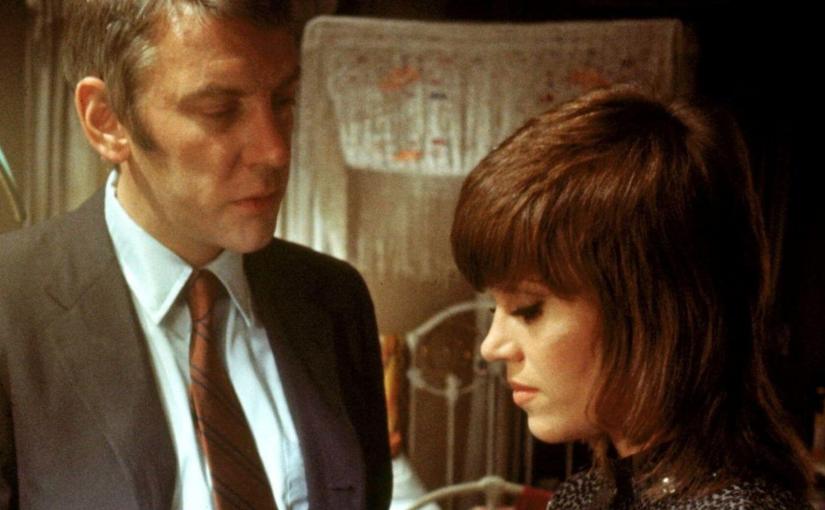
Perhaps Klute, directed by Alan J Pakula, was one of the earliest erotic thrillers to hit the cinema. In 1971, with Jane Fonda portraying a call girl who briefly goes topless on screen, the daringness of the picture likely garnered a lot of attention. I bet it was perceived as controversial and elevated the common murder mystery to a grittier more forthright and sleazier height. Even John Klute, the investigator, played by Donald Sutherland, did not possess the theatrical disposition of a Sam Spade like Bogart or even a Jake Gittes that was just a few years away. The case at hand in Klute felt real and disturbing. The actions of the characters were unmentionable and unfathomable.
A highly respected married man named Tom Grunerman turns up missing. The most unusual clue into his disappearance are letters found in his desk that were written to a New York City prostitute named Bree Daniels (Jane Fonda). According to his wife and the CEO of his company, the letters seem out of character for a man like Tom. Six months go by and there is still no sign of the man. So, John Klute voluntarily goes to New York to investigate for himself while becoming acquainted with Bree.
Bree is a very high-priced call girl who estimates she does between five hundred and six hundred calls each year. She’s trying her best to step away from this lifestyle and work as a professional actress and model. Yet, to uphold her means of living and to make up for the various rejects at auditions, she can’t help but return to what she’s best at. Occasional visits to a therapist help her justify why she maintains this seedy occupation. Various recordings of Bree’s observations and conversations with her Johns are about her regard for the profession. She claims that she is capable of catering to any particular vice a man might have. Most impressive is that she does not get turned on by the trysts she shares with these men. She also does not cast much judgment on whatever niche her various clients are into. She’s positively cold to the demands of her job. Tom does not sound familiar to her, but he might have been the guy who beat her up a year earlier.
I like the slow burn wait of this story. A picture like Sea Of Love with Al Pacino works this way. That’s a better movie though.
Donald Sutherland has significantly less dialogue than Jane Fonda. He’s got a disturbing expression with large eyes and closed lips, not to mention a tall stature, that allows him to seem alert as an observer and a listener, particularly to Fonda’s character who is protective of herself even if she has much to say. So, while the two get to know one another with Bree offering some possible leads for Klute to follow, there is an eerie and deliberately meandering pace to the story. I knew I had to keep up my patience with Klute because an unexpected payoff would eventually arrive.
What bothered me though is that the twist of the mystery is revealed midway through the movie. You brought me my steak before I had time to finish my salad. Now, for the rest of the story I’m smarter than the characters and I’m only watching everything unfold. That left me feeling unchallenged through the whole second half of the film. Klute became boring and less inviting.
In 1971, this was a bold kind of picture though, not a common 1990’s erotic thriller like Basic Instinct or Color of Night. It was seedy, unheard of and therefore fascinating. At the time, the intrigue for a picture like this must have been off the charts. Pakula even shows off how novel a tiny tape recorder was in 1971. Imagine what this recorder is capable of!
Had Klute been released today, I’m certain many would take issue with its final edit of story development. I would also argue that a young Jane Fonda would never be accepted in a role like this. Frankly, twelve years after this film, Jamie Lee Curtis was more convincing to me as a call girl in Trading Places. Fonda’s inflection and voice of maturity just did not work for me in this role. I did not find her alluring in the part, and I think she was too organized and educated to be Bree the call girl. I was surprised to read afterwards that Jane Fonda won the Oscar for Best Actress for this film because I considered her miscast. Fonda’s voice always sounded overly patronizing to me. I read later that the actress’s moments with the therapist were primarily improvised by Fonda, shot after the bulk of the picture was completed. Pakula honored her wish to shoot the therapist scenes later because Fonda wanted to have more of a grasp on this call girl character. The therapist scenes definitely look unpolished, particularly for the woman portraying Bree’s counselor. I could detect the improv going on before I knew that it was so. I was watching Jane Fonda, the actress, making a case for the research she collected to prepare for this role. I wasn’t convinced Jane Fonda was playing the role, though.
The film provides moments where Bree is catering to a couple of clients. Pakula is honest with his staging. One client breathes heavily with nervousness about the trouble he’s about to indulge in and then there is the awkward business agreement between Bree and the man followed by the necessary construction of turning the hotel sofa into a bed. It’s weird and unromantic. All this business interrupting this guy’s ultimate fantasy. Very good direction by Alan J Pakula.
Another client hires Bree to pose like a woman from a pre-World War I era where she simply narrates a scenic moment from his past. He does not touch her. He does not undress. This old man from the city’s fabric district simply takes it all in, allowing Bree to do the heavy lifting while he remains stoic in his chair surrounded by the darkness provided by famed cinematographer Gordon Willis (The Godfather). Still, Fonda seems out of place in these episodes. Even her fear of a possible killer on her trail left me unsatisfied. This woman always looks like she has it altogether. She arrives on John Klute’s doorstep in the middle of the night because she’s apparently haunted by what he’s pursuing and also, she’s getting prank calls at odd hours. Nevertheless, I’m still not convinced that Jane Fonda as Bree the call girl is truly shaken by any of this. Jane Fonda is just too put together and hardly evokes any convincing weakness.
It is ironic the film is named after Sutherland’s character, Klute. The story begins with his perspective. I liked his detective. Almost like the guy could’ve branched off into other stories, like Sherlock Holmes or Sam Spade or Mike Hammer. The fact that the picture is called Klute leaves me wondering if a series of mysteries would have been paved for this character. To my knowledge, I do not believe that ever came to be. I’m sorry the trajectory of the movie veers off into Fonda’s character primarily when she enters the story. Little is revealed about John Klute. I only know his experience as a detective is limited, and he’s actually never visited New York City before. Some interesting challenges for this guy, but none of this hardly becomes obstacles or factors for the rest of the film. Much is learned about Bree Daniels, but hardly anything is absorbed about the title character, John Klute.
Klute starts off with a lot of promise. I was excited to tag along with a new kind of brooding investigator who is impervious to influence and looks like he could not get easily overwhelmed. The mystery to uncover why a man went missing but not murdered is very intriguing. My curiosity was there from the start. Unfortunately, my interest dwindled as the picture carried on. Jane Fonda talks a lot with not much to say and when the real culprit is unmasked at the midway point, my attention span is no longer demanded by the film.
Klute was likely a risky, pioneering kind of picture at the time of its release. A sexy thriller. Nowadays, it’s like any Saturday night midnight kill thrill of the week where the tempos are foreseen several minutes before they come to life. Klute just loses its lust–ahem–sorry luster.
 2 UNPAID MOVIE CRITICS!!!!