
IPHIGENIA (Greece, 1977)

by Miguel E. Rodriguez

DIRECTOR: Michael Cacoyannis
CAST: Irene Papas, Kostas Kozakos, Tatiana Papamoschou
MY RATING: 9/10
ROTTEN TOMATOMETER: [Not scored]

PLOT: In ancient Greece, King Agamemnon, in order to appease the gods, is told he must sacrifice his favorite daughter, Iphigenia, before his troops can march to war.


To my mental library of favorite closing shots in cinema, I must now add the final image of the engrossing Greek film Iphigenia.  I won’t spoil it, but the hatred in the eyes, the set expression of the face, spell out exactly what will follow in the years to come without saying a word.  It’s cinematic, yes, but it’s also theatrical, expressing oceans of passion (good or bad) with a stare instead of a monologue.

Director Michael Cacoyannis’ filmed adaptation of an ancient Greek tragedy by Euripides (Iphigenia in Aulis) does not immediately seem like the kind of film I would cotton to.  I’ve never read any of the ancient Greek plays, nor have I ever read the Iliad or the Odyssey, though I am familiar with their plots…barely.  This is not the kind of literature I have traditionally sought out, and I am content in my decisions.  But a weird thing happened while watching Iphigenia.  After a somewhat rocky start, I became enthralled with the language these characters were using.  I don’t mean the Greek language itself, but the subtitles used in the English translation.  I cannot say with any certainty how closely the subtitles mirror what is actually being said, but if they’re even just fairly accurate, then I now understand, at least to a small degree, why these plays have endured for millennia.

The story itself is one that has undergone countless interpretations and revisions over the course of history.  King Agamemnon (Kostas Kozakos) and his vast army are ready to set sail for war against the kingdom of Troy, but their ships are stranded by a lack of wind.  The seer Calchas informs Agamemnon that the winds will not blow until he sacrifices his eldest and favorite daughter, Iphigenia, to the goddess Artemis, who is withholding the winds because his men have offended her by killing a sacred deer.  (And now I know where the title of The Killing of a Sacred Deer [2017] comes from…knowledge really IS power!)

Agamemnon agonizes over this decision, but his hand is forced by the eagerness of his troops to sack Troy; he’s afraid they’ll mutiny if he doesn’t go through with the sacrifice.  He invents a pending marriage of Iphigenia to the great warrior Achilles to get Iphigenia to the encampment, but Clytemnestra (Irene Papas), her mother and Agamemnon’s queen, tags along unexpectedly.  The rest of the movie churns with gloriously over-the-top melodrama, as Clytemnestra rages at Agamemnon, Iphigenia pleads for her life, and Achilles swears to defend Iphigenia at all costs.  Agamemnon also argues with his brother, Menelaus, in a terrific scene during which they both change each other’s minds just a little too late.  In the meantime, the winds never blow, the Greek troops grow restless, and the seer waits a little too eagerly for the chance to carry out the impending sacrifice.

It was during Agamemnon’s argument with Menelaus that I really started to perk up.  This is not an easy scene to write or act out.  Even with English subtitles, the sentence construction and syntax were occasionally overworked.  I remember thinking at one point, “Huh…this is almost Shakespearean.”  Except these scenes were written roughly two thousand years before Shakespeare was born.  When that concept smacked me in the face, I started paying attention a little more to the style and the passion of the words.  And I can’t explain it, but everything acquired a new dimension.  It started to feel more like a play than a film.  It became – at the risk of sounding a tad abstract – poetic.

That feeling permeated everything after that scene.  Throwaway scenes felt more immediate, and really important scenes felt monumental.  Sure, there is some overacting, particularly from the actor playing Achilles, but really, it’s called for in this scenario.  When Clytemnestra promises her husband that, if he goes through with the sacrifice, she will accept his will but hate him for the rest of her life…I really felt it.  And it’s not just the language, but the zealotry of the acting on display, especially from Irene Papas, who must have salivated at the chance to play this fiery woman, a proto-feminist who accepts her duty as a queen but never lets the king forget who truly rules the roost.

And then there’s Iphigenia herself, played by a waifish, almost elvish actress I’d never heard of before seeing this movie, Tatiana Papamoschou.  In her first scenes, she’s almost too innocent to be taken seriously.  It’s only when Iphigenia learns of her father’s plans to murder her for the sake of war that Papamoschou’s acting style allows her to really embody the character, and she delivers a speech late in the film that is, for lack of a better word, biblical.  She accepts her fate and shames the men around her with the same surgical precision that can be found in the Gospels when Jesus accepts His own fate while dismantling the Pharisees with His words.  There are monumental themes at play behind the scenes, and “normal” dialogue just would not feel adequate.

And then there’s that final shot.  I did a tiny bit of research on the original play, and when you learn what historically happened to the main characters after the play’s events, that last look carries even more weight, foretelling decades of death and tragedy without saying a word.  That a foreign film of a 2,200-year-old play was able to affect me this greatly was very pleasantly surprising to me.  I doubt any newer version with today’s technology or modernized dialogue would affect me the same way.  Iphigenia was a very pleasant, surprisingly effective discovery.
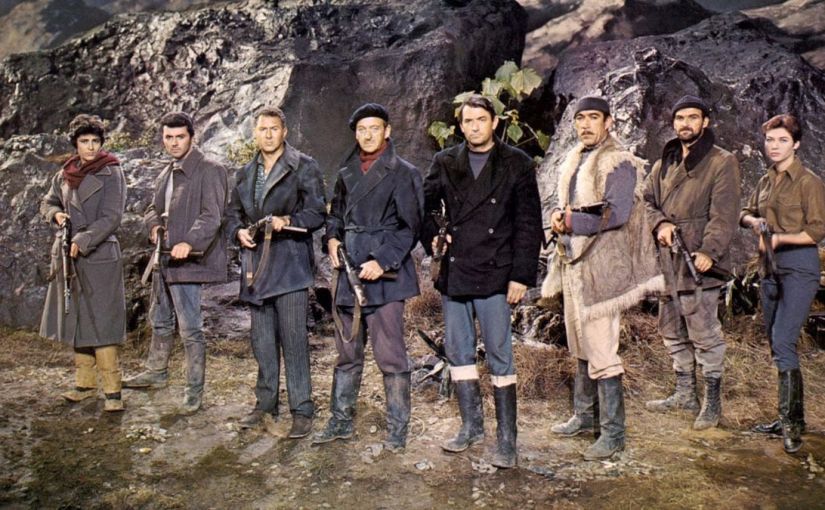
THE GUNS OF NAVARONE (United Kingdom, 1961)

by Miguel E. Rodriguez

DIRECTOR: J. Lee Thompson
CAST: Gregory Peck, David Niven, Anthony Quinn, Anthony Quayle, Irene Papas, Richard Harris
MY RATING: 8/10
ROTTEN TOMATOMETER: 92% Fresh

PLOT: A team of Allied saboteurs is assigned an impossible mission: infiltrate an impregnable Nazi-held Greek island and destroy two enormous long-range field guns preventing the rescue of 2,000 trapped British soldiers.


The Guns of Navarone is a “message” picture cleverly disguised as a World War II action-adventure/thriller.  No surprise there since the screenwriter was Carl Foreman, who also co-wrote 1957’s The Bridge on the River Kwai, another stirring wartime adventure with a strong anti-war message buried inside.  I found it interesting that, in the multiple behind-the-scenes documentaries on the Blu-ray, not one of them mentioned the one movie which I feel most resembles The Guns of Navarone: 1967’s The Dirty Dozen.  In both films, teams of men mount insurmountable odds to accomplish an insanely difficult mission, incurring casualties while ultimately succeeding.  In both films, there is a buried, or not-so-buried, subtext about the futility of the mission and/or war in general, while still gluing audiences to their seats.  However, given the timeframe of the release of The Guns of Navarone in the early 1960s, I find it to be the more surprising of the two, despite the foregone conclusion of the movie.

The movie’s narrated prologue tells us everything we need to know.  (Forget for a moment that there is not, and never was, a Greek island called Navarone.)  In 1943, two thousand British soldiers marooned on the island of Kheros must be evacuated before Germany convinces Turkey to join the Axis.  But the only sea lane to Kheros is defended by two massive German guns built into the sheer cliffs of the island of Navarone.  The guns must be knocked out of commission by a team of Allied saboteurs before any rescue attempts can be made.  This team will be led by Captain Mallory (Gregory Peck), Corporal Miller (David Niven), Colonel Stavros (Anthony Quinn), and Major Franklin (Anthony Quayle).  Along with the rest of the team, they must sneak on to Navarone, scale a steep cliff at night, and sneak across the island to the guns, hooking up with Greek resistance fighters along the way.  These details are laid out with admirable brevity, during which we are given just enough information about each of the three primary characters to understand their actions once the mission is underway.

The Guns of Navarone may be constructed almost entirely out of war movie cliches regarding desperate men behind enemy lines on a secret mission, staying undercover, close calls, and unexpected setbacks.  However, I enjoyed how much Navarone sort of “leans into” the material.  It’s almost as if the filmmakers said, “Okay, so this is a cliché, right?  We might as well embrace it and do it up right.”  For example, we find out that one of the squad commanders has a nickname: “Lucky.”  In the history of movies, any character in a war picture named “Lucky” has been anything but.  You know this, I know this.  Even so, as events transpired, I found myself thinking less and less about the most cliched material and just admiring how it was executed.  It’s a tribute to the director, J. Lee Thompson, that he found a way to present everything in such an uncomplicated fashion that its very directness pushes aside our suspension of disbelief.

That’s not to say there aren’t a couple of surprises.  Capt. Mallory devises an ingenious method of dealing with a man so injured he may have to be left behind.  A clandestine trip to a local doctor turns into something quite different, offering Anthony Quinn the opportunity to perform some amazing off-the-cuff histrionics that would make Nicolas Cage envious.  The Greek resistance fighters turn out to be two women who offer much more to the story than mere eye candy or comforting shoulders.  (One of them, played by the great Irene Papas, may even be the strongest member of the squad…discuss.)  David Niven’s character, Corporal Miller, is given two remarkable speeches that would have stopped a lesser film in its tracks, considering their anti-war and possibly even anarchic sentiments, including this exchange:

Mallory: And if Turkey comes into the war on the wrong side?
Miller: So what!  Let the whole bloody world come in and blow itself to pieces.  That’s what it deserves.
Mallory: And what about the 2,000 men on Kheros!
Miller: I don’t know the men on Kheros, but I do know the men on Navarone!

Was that kind of dialogue or sentiment even possible in a war movie made in the ‘50s?  (Aside from The Bridge on the River Kwai, of course.)  A war movie made in 1961, just fifteen years after The Greatest Generation rallied to defeat the worst dictator in history, and one of the main characters seems to be advocating desertion in order to survive the night?  Wow.

In my eagerness to describe how, I guess, subversive The Guns of Navarone is, I have yet to mention the action.  It’s top-notch.  Find it in your heart to forget how some of the effects are clearly matte paintings and models and miniatures and remember that this was top-of-the-line production values in 1961.  In fact, Navarone won the Oscar for Best Visual Effects that year.  There’s an impressive shipwreck sequence, attacks from dive-bombing airplanes, massive formations of tanks and troops (provided by the Greek monarchy), and the titular guns themselves, full-size props that dwarfed the actors and belched real fire when activated.  No expense was spared to provide audiences with true spectacle.

Is The Guns of Navarone perfect?  I mean, I personally could have done without the sequence where one of the soldiers sings along at a local wedding.  The story itself is ageless, but the film doesn’t quite feel timeless, despite its anachronistic tendency towards liberalism in the middle of a war zone.  There are one or two story decisions that I found questionable.  (One character’s death looked as if he was basically committing suicide, and I found no reason for it story-wise.)  But there’s no denying it’s a thumping good yarn.  And come on, who doesn’t enjoy watching Gregory Peck and Anthony Quinn tear up the screen for two-and-a-half hours?