
A WOMAN UNDER THE INFLUENCE (1973)

by Miguel E. Rodriguez

DIRECTOR: John Cassavetes
CAST: Peter Falk, Gena Rowlands, Fred Draper, Matthew Laborteaux (for all you Little House fans out there)
MY RATING: 9/10
ROTTEN TOMATOMETER: 89% Fresh

PLOT: Domestic turmoil gets a whole new definition in director John Cassavetes’ landmark portrait of a family in psychological free-fall.


I am a newcomer to the films of John Cassavetes.  The only one of his films I’d seen prior to A Woman Under the Influence is Love Streams (1984), a character study of a woman, played by Gena Rowlands, whose determination to only be herself puts her in conflict with the people and expectations around her.  As a director, Cassavetes seemed only to be interested in putting real people on the screen.  I don’t mean that other great films don’t do that kind of thing, but few directors have made films with scenes so genuine that I had to fight the urge to cough and look away because I felt like I was intruding on a private conversation.

A Woman Under the Influence is about a woman, Mabel Longhetti, a mother of three, who is similar to the woman in Love Streams in that she is constantly waging a battle between how she wants to behave and what is expected of her.  The difference this time is that Mabel is clearly suffering from…well, I’m not going to embarrass myself by putting a name to it because I’m not a psychiatrist.  She seems to be overly anxious all the time.  ALL.  THE.  TIME.  Her husband, Nick (Peter Falk), appears to be sympathetic with her anxiety, almost to a fault sometimes, but he tends to explode at her when she tries to be the life of the party.

How has this relationship lasted through three children?  Nick promises Mabel a romantic night at home, but is unexpectedly called away when a city water line bursts.  (He works in construction.)  She assures him everything’s fine on the phone…and promptly walks out of the house, goes to the nearest bar, and picks up a random dude and brings him home to spend the night.  But hey, Nick’s no angel, either.  After a long shift at work, he impulsively invites his entire crew of roughneck buddies to his modest home for a spaghetti dinner…cooked by Mabel, of course.  Mabel anxiously tries to “act normal” by being friendly and chummy with Nick’s co-workers, but she overdoes it, and Nick blows up at her.

Later, there is a remarkable scene where Nick brings a doctor to the house to see if he can talk Mabel down from one of her episodes.  Gena Rowlands adds these brilliant physical tics and peculiarities to Mabel that, in someone else’s hands, would be showboating, but with Rowlands, they come off as so real that it felt like I was watching a documentary.  I read on IMDb that Cassavetes did very little rehearsing, if any at all, so a lot of what we see in this scene and elsewhere was improvised on the spot.  It’s one of the best performances I’ve ever seen.  Had it not been for One Flew Over the Cuckoo’s Nest (1975), Rowlands would have walked away with the Oscar.

A Woman Under the Influence was one of the first movies to really make waves as a truly independent production, predating the modern indie movement by some fifteen years or so.  Is it a movie I enjoyed watching?  Yes, but not in the same way that I enjoy watching The Goonies or Avatar.  This was like watching There Will Be Blood or Sophie’s Choice.  It’s an amazing example of acting as a craft, as an art form.  Not a single scene felt scripted or contrived.  I never knew Peter Falk had this kind of range as an actor.  I’d heard that Gena Rowland’s performance was the stuff of legend, and now I understand the hype.  If I have to be honest, I didn’t care for the very end of the film, a scene that seems to indicate that nothing will keep Mabel and Nick apart, even though they are not good for each other, in my opinion, especially considering what happens in the scene immediately preceding it.

This is a shorter review than I might normally write, but words are failing me with this one.  I’ll start describing one scene, then another, then another, and soon I’ve just recapped the entire film, which I don’t want to do.  This movie is searing, uncompromising, authentic.  To do it justice, I’d have to go away for a month or two and write an old-fashioned research paper (remember those?) complete with outlines, bullet points, and a bibliography.  Whatever you may have heard about Gena Rowland’s performance is 100% true, and then some.  In an earlier review of Peter Hall’s The Homecoming (also 1973), I mentioned that I did not have a lot of space in my head for blistering dramas about dysfunctional families, but I’m glad I made room for A Woman Under the Influence.  It’s a master-class of direction and performance.
ANOTHER WOMAN (1988)

by Miguel E. Rodriguez

DIRECTOR: Woody Allen
CAST: Gena Rowlands, Mia Farrow, Ian Holm, Blythe Danner, Betty Buckley, Martha Plimpton, John Houseman, Sandy Dennis, Philip Bosco
MY RATING: 8/10
ROTTEN TOMATOMETER: 59%

PLOT: Facing a mid-life crisis, a woman becomes drawn to the plight of a pregnant woman seeking psychiatric help from the shrink next door.


Woody Allen’s Another Woman is the first movie I can remember that compelled me to do a little background research before writing about it.  It is moody, somber, theatrical, and by far the least funny of Allen’s films that I’ve seen (and I’ve seen Blue Jasmine).  It falls in that part of his career when he was delving into more dramatic fare; September had been released the year before, and Crimes and Misdemeanors would come a year later.  There is none of the charm and lightness of his earlier comedies, which may account for why I’ve never seen it mentioned alongside his other films whenever his filmography is discussed.  And yet, I was curiously drawn into this story to such a degree that when two revelations arrive almost on top of each other, I gasped.

Another Woman tells a brief chapter in the life of Marion (Gena Rowlands), a middle-aged woman married to Ken (Ian Holm).  Marion is Ken’s second wife; she was literally the “other woman” that caused Ken to divorce his first wife, Kathy, played by Betty Buckley in a single devastating scene that vividly showcases the guilt that Marion and Ken have both learned to live with in different ways: Ken gently accepts Kathy’s “condemnation”, while Marion buries the guilt deep.

Marion is a professor of philosophy at a local university.  To work quietly on a new book, she rents a small one-bedroom flat nearby and uses it as her office.  However, through a trick of acoustics, she realizes she can hear voices coming from the flat next door through an air vent on the floor.  It’s a psychiatrist’s office, and she is suddenly privy to intensely personal conversations with his patients.  (I was reminded for a minute of Rear Window.)  One such patient is Mia Farrow, playing a character whose name I won’t reveal because it’s barely mentioned in the film for a reason.  She is pregnant, and during her sessions, she reveals doubts about her identity and/or purpose in life.

For Marion, who has always been sure about everything and everyone in her life, Farrow’s confession strikes a nerve, and the rest of the film consists of Marion’s struggle to reconcile her perception of herself and her well-constructed life with how everyone else truly sees her.  Throughout the movie, people are telling her how wrong she is about her relationships with her divorced brother, with an old friend, with her own husband, with her best friend, even with the Mia Farrow character.  Has she been deceiving herself her entire life?

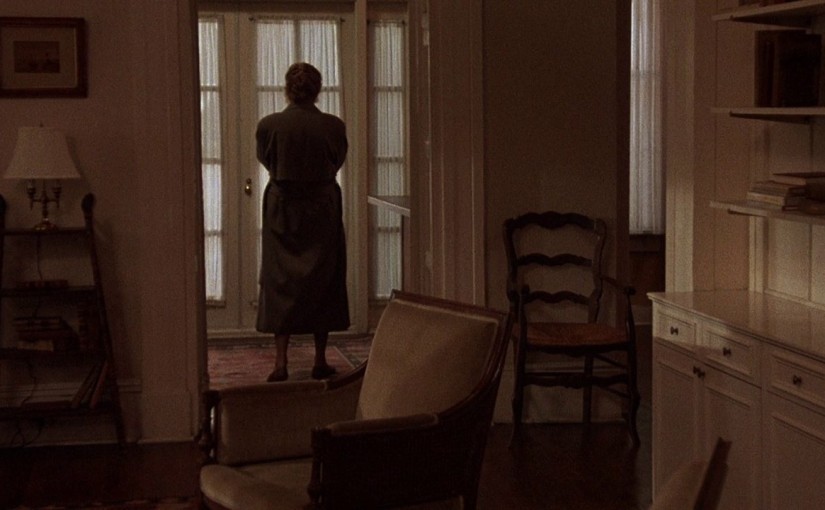
Okay, so this subject matter isn’t exactly a barnburner.  But consider how the movie looks and moves, and the performances from Gena Rowlands and her supporting cast (it’s Rowlands’s movie to win or lose).  Look at the warm, yet subdued lighting schemes, shot by Ingmar Bergman’s favorite cinematographer, Sven Nykvist.  (Allen is a huge Bergman fan – indeed, this film is actually a loose reinterpretation of Bergman’s film Wild Strawberries [1957].) Interiors look, not sad, exactly, but…lived in.  Bright sunlight is only ever seen from inside through a window.  Exteriors look as if Allen specifically waited for overcast days to shoot.  Everything matches Marion’s internal gloom as she re-examines her life.

At the center of the film is a dream sequence that feels more like a foreign film than anything I’ve ever seen from an American film.  Marion dreams she is in an old stage theater, where figures from her circle of family and friends are rehearsing a play based on moments in her life.  Is this self-indulgence from Allen?  Maybe.  The dialogue in this sequence is so formal and, I guess, elliptical at times that it almost feels as if it were something translated into English from another language.  Vincent Canby of The New York Times called this out, saying, “The rounded sentences sound as if they’d been written in a French influenced by Flaubert, then translated into English by a lesser student of Constance Garnett.”  I’ll probably understand this criticism more when I learn who Constance Garnett is, but I get his point.  However, while it was noticeable, I did not find it distracting.  I thought it was a fair interpretation of how our dreams rarely follow strict logic.  Marion’s dream is structured, but the content is skewed.  I was fascinated by it.

Do I think this is a movie you need to see?  Who can say.  I’m glad I saw it, at least.  It shows a side of Allen’s directorial psyche I had never seen before, even though I had read about it from many other sources.  And it inspired me to do a little introspection of my own, which is something, I guess.  The movie’s final scene includes a beautifully loaded question: “…I wondered if a memory is something you have or something you’ve lost.”  Marion has been asking herself this question the whole movie without realizing it.  I wonder if my answer would be the same as hers.  Or yours.