DOWN BY LAW (1986)

by Miguel E. Rodriguez

DIRECTOR: Jim Jarmusch
CAST: Tom Waits, John Lurie, Roberto Benigni, Nicoletta Braschi, Ellen Barkin
MY RATING: 8/10
ROTTEN TOMATOMETER: 88% Fresh

PLOT: A disc jockey, a pimp, and an Italian tourist escape from jail in New Orleans.


The bare-bones plot description above sounds to me like a challenge from some bizarre reality show for screenwriters.  “Here’s your plot, aaaaand GO!”  The opening sequences of Jim Jarmusch’s Down by Law look and feel like an ambitious student film, down to its use of music and the black-and-white cinematography and the artsy montage of Bourbon Street and Orleans Parish, where the film takes place.  Having never seen a Jarmusch film before, as I watched these scenes, I was prepared to sit through a dense character study in which nothing much happens but a lot of talking is involved.  In a weird way, I found myself thinking of Clerks, but I despaired that Down by Law would come anywhere near Smith’s film in terms of getting me engaged in the story.

And then…a funny thing happened…

The film introduces us to two characters.  The first one we meet in great detail is Zack (Tom Waits), a gravelly-voiced former deejay living in near squalor with his girlfriend, Laurette, played by Ellen Barkin on the cusp of major stardom.  Their one scene together reveals the strategy for the rest of the film.  As I suspected, not much happens aside from a lot of talking or, in the case of this first scene, a lot of yelling, but there is a vibe or a sensation or something to the dialogue and the crisp black-and-white images that made their scene more immediate.  I am at a loss to explain exactly what it was.  I got the sense that I wasn’t watching two actors playing a scene.  I felt as if I was looking through a crack in the back wall at two real people having a real conversation.

The next character we meet, Jack (John Lurie), is not as savory as Zack.  Jack is a pimp whom we get to know during a conversation with one of his girls, Bobbie (Billie Neal).  Jack is a small-timer who dreams of hitting it big, but we know, as Bobbie does, that Jack’s big talk will never amount to much.  Jack walks and talks like he’s the man, addressing other hookers and pimps by name, and maybe he even sounds a little dangerous.  But his eagerness to expand his operation leads to some questionable decision-making that lands him in jail, to the great surprise of no one.

I just have to mention again the peculiar power of the direction and the dialogue.  The characters sometimes tend to ramble, but there’s never a second that feels superfluous.  There’s a scene where Zack, the deejay, is approached by an old acquaintance who offers him $1,000 just to drive a car from point A to point B.  The little verbal ballet between the two men, performed in mostly one shot as I recall, could have gone wrong any number of ways, as Zack demurs and his friend persists and round and round they go.  Perhaps because the dialogue is a little circular, it feels more natural than the kind of “punchy” dialogue you might get in a film noir.  The style, the camera placement, the acting, everything just sort of comes together and turns potentially boring dialogue into small windows into Zack’s psyche, and everyone else’s, for that matter.  (I think my online colleague, Marc, would enjoy this film very much, because it uses everyday language to illuminate precisely observed and defined characters.)

Zack winds up sharing Jack’s cell in jail for reasons I won’t get into.  It’s here that the story takes a unique turn.  I’ve read Down by Law described elsewhere as dreamlike or even like a fairy tale.  If so, Roberto Benigni is a benign Rumpelstiltskin.  Benigni plays Roberto (of course), an Italian tourist who has landed in jail for…well, let’s just say his offense is a little more severe than what Zack and Jack are in for, which is funny because Roberto speaks mostly broken English and walks and talks like an Italian Charlie Chaplin.  He doesn’t look like he would hurt a fly, much less commit the crime he supposedly committed.

Benigni’s presence in the film brings a lightness to the movie’s center section as the three men stew in their jail cell for weeks and months.  Zack and Jack are world-weary, anxious to tough out their time with minimal connection to each other, much less to Roberto, who is about as different from Zack and Jack as it’s possible to be without being an actual Muppet.  Is there some kind of deeper commentary being made here about how important it is to just connect with each other to make our lives easier to cope with?  How we would all be better off if we were more like Roberto, who delights in the phrase, “I scream, you scream, we all scream for ICE cream” so much that he almost starts a prison riot with it?  I don’t know.  Maybe.  I just know I felt a warm little glow watching Benigni’s performance, and how well he contrasted with Zack and Jack.

Eventually, the three men escape from prison; Jarmusch makes a bold move by never revealing exactly how they escape, because the how isn’t as important as the fact that they escape, period.  Here is where the movie really evokes fairy tales as the three men trudge through the Louisiana swamps, slowly starving, wary of alligators, working together but getting on each other’s nerves.  Even Roberto’s bubbly personality takes a brief hiatus when his comrades appear to desert him…twice.

I would rather not synopsize the plot any further.  The movie isn’t concerned with a Hollywood-style plot as it is with showing the interplay of these three very specific characters under extraordinary circumstances.  When it’s done as well as this, it’s a pleasure to experience a film that seems completely free from cliches and predictability.  As I said, I’ve never seen a Jarmusch film, but even without knowing much about his filmography, I’m glad I started with this one.  When the closing credits rolled, it strangely didn’t feel like the movie was over.  Instead, it felt as if everything I just saw was the prologue for the rest of their lives.  I envisioned a future where each character is sitting in a bar or on a park bench and spinning a yarn to whomever will listen.  “Hey, I ever tell you about the time I escaped from a New Orleans prison with two other guys?”  Maybe that’s not quite realistic, but when you’re dealing with a seriocomic neo-noir fairy tale, anything’s possible.

[Note: there is a late sequence featuring an Italian actress named Nicoletta Braschi.  Roberto falls in love with her, and she with him, and says they will spend the rest of their lives together.  In real life, Braschi and Benigni were married five years after the film was released, and they are still married today.  Fairy tale, indeed…]

SEA OF LOVE

By Marc S. Sanders

Al Pacino is a twenty-year veteran New York City cop, working out of Manhattan, on the trail of a serial killer in Sea Of Love.  The profession is nothing new to Pacino’s repertoire of roles, but the portrayal is unique thanks to a smart and suspenseful script from Richard Price and intense directing from Harold Becker.

The killer leaves a calling card.  A 45 LP record of Phil Phillips ’50s classic crooner, “Sea Of Love,” spinning on the turntable.  The victims are naked men lying face down in bed with a bullet to the head.  Turns out that a cop from another precinct played by John Goodman has uncovered a similar crime scene in Queens.  So, the two team up.  They believe the murderer is a woman.

All the victims have posted a Lonely-Hearts Club blurb in a magazine. The invitation for a date stands out because the text rhymes.  The detectives decide to post their own ad in the same kind of format, meet the women who respond and hope to nab the killer.  It gets complicated when Pacino encounters a breathtaking and sultry woman played by Ellen Barkin. 

Pacino’s cop is a smart guy.  He’s got instincts.  Yet, perhaps due to his constant drinking, insomnia, and the bitterness he carries now that his partner (Richard Jenkins) has hooked up with his ex-wife, he’s also quite vulnerable.

The mystery is strong, and the tension builds as Sea Of Love moves on.  Barkin has Pacino and the audience convinced that she’s the prime suspect.  Still, he lets his defenses down because he’s easily getting seduced by her advances.

Whether you’re watching Al Pacino share scenes with John Goodman or Ellen Barkin, the execution is fantastic.  Great performances from the three.  Pacino and Goodman have a natural exchange with one another. Often humorous, but the guys always talk like cops.  When Pacino admits to tossing away a fingerprinted glass from Barkin, Goodman suggests lifting the prints from something- ahem – more personal of his.  A cute wink and nod exchange.

More important to the film is the erotic chemistry between Barkin and Pacino.  Harold Becker uses a late-night supermarket visit in the vegetable aisle to evoke the risky and irresistible nature the two characters develop for one another.  Other scenes build well on the relationship between these two lonely strangers who’ve only recently met. 

Moments of isolation and drunken stupors also work towards fleshing out Pacino’s burned out cop.  He’s got a schleppy posture to him and an exhausted expression with his sullen eyes and shaggy black hair.  At the same time, his character’s twenty years of experience seem to uphold his alertness.  This cop knows he’s letting his guard down. Without any dialogue, you see the internal struggle Pacino has with what should be done against what he is deliberately neglecting.

This film was Ellen Barkin’s breakthrough role.  She received rave reviews as someone who takes care to uphold a New York City trendy appearance by day as a shoe salesperson in contrast to a woman looking for some carefree lust in the evening.  For Pacino, Sea Of Love reinvigorated a career slump following a series of poorly reviewed films.  Together, they make for a sexy yet untrusting pair.

Circumventing this relationship is the mystery.  Is Barkin the culprit? She seems to have a dark way about her that may not surprise you.  Price, Barkin and Becker designed the character quite well for her to at least have the potential to be a killer of men.  Is she setting Pacino up to be the next victim?

New York City from the late 1980s looks great, even though interiors were shot in Toronto.  Trevor Jones offers a nail-biting soundtrack to keep the suspense heightened at just the right beats of the picture with Becker’s camera pointing down dark hallways or when new clues are discovered.

I’ve seen Sea Of Love a few times and even with knowing the surprise ending, the film still holds up thanks to the performances from its three stars, along with its taut editing, well-paced writing, and smart direction. 

This is a good erotic murder mystery.

TENDER MERCIES (1983)

by Miguel E. Rodriguez

DIRECTOR: Bruce Beresford
CAST: Robert Duvall, Tess Harper, Betty Buckley, Wilford Brimley, Ellen Barkin
MY RATING: 8/10
ROTTEN TOMATOMETER: 84% Fresh
Everyone’s a Critic Category: “A Movie that Won the Oscar for Best Original Screenplay”

PLOT: A broken-down, middle-aged country singer gets a new wife, reaches out to his long-lost daughter, and tries to put his troubled life back together.


Tender Mercies does not feel like a movie that was released the same year as WarGames, Octopussy, and Return of the Jedi.  It has more in common with the spare, character-driven films of the early ‘70s like Five Easy Pieces [1970] and The Last Picture Show [1971].  It’s a movie where not much seems to happen, at least on the surface.  Underneath the barren landscapes and big skies, however, great truths about life and acceptance are on display.

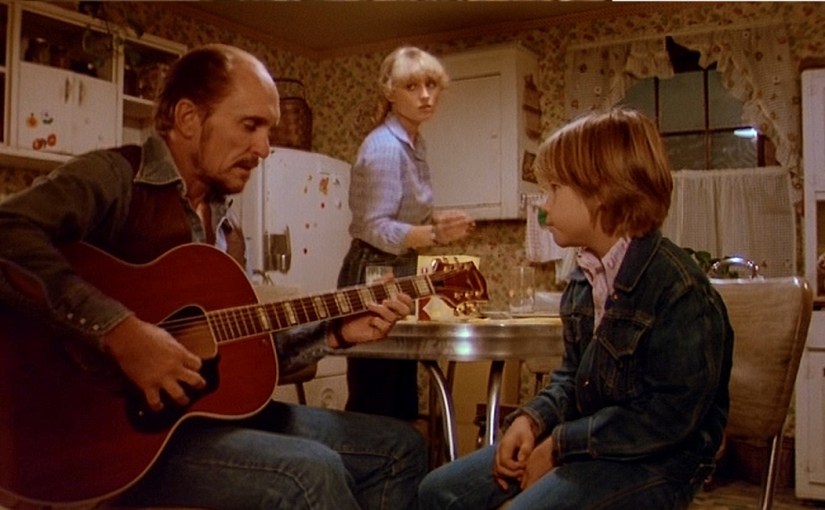
Anchored by an Oscar-winning performance from Robert Duvall, Tender Mercies tells the story of Mac Sledge (Duvall), whom we see at the opening of the film collapsing in a drunken stupor on the losing end of a fight in a rinky-dink roadside motel in rural Texas.  The next morning, broke and abashed, he makes an arrangement with the widowed motel owner, Rosa Lee (Harper): he’ll do odd jobs at the motel for room, board, and $2 an hour.  Rosa Lee’s son 10-year-old son, Sonny, watches this situation unfold impassively and asks Mac some very direct questions: “Did you used to have money?”  “How’d you lose it?”  “You think my dad would’ve liked you?”

The filmmakers (directed by Bruce Beresford, Oscar-winning screenplay by Horton Foote, who also wrote the screenplay for To Kill a Mockingbird [1962]) make some interesting choices for everything that follows.  There is a gentle scene between Mac and Rosa Lee where he shyly asks her, “You ever think about gettin’ married again?”  She says she has.  “Would you ever think about marryin’ me?”  She says she will think about it.  And in the very next scene, it’s made clear that time has passed, they got married, and have been married for several months.  In another film, that kind of “condensed storytelling” would go into the negative column in my book, but not here.  Instead, it feels…right.  We don’t need to show any further details of their courtship, their wedding, Sonny’s feelings about it one way or the other, etcetera.  Those extra scenes would have delayed the narrative structure, showing us things we don’t need to see, but which we can easily deduce.

There’s another scene (I’ll try to tread lightly here) where Mac gives a heartfelt, but still masterfully underplayed, speech to Rosa Lee about how he was in a bad drunk driving wreck years before, and how God saw fit to bring her into his life, but to do so meant her husband had to die, and so on.  “See, I don’t trust happiness.  I never did, I never will.”

When he finished, and Rosa Lee stood there taking it in, in my head, I imagined her replying with something like, “Well, Mac, you don’t have to trust happiness, you just have to trust me”, or “yourself”, or some similarly corny platitude.  Instead, in what must have been superhuman restraint on the part of the screenwriter, Rosa Lee simply stands there, processes what she just heard…and walks offscreen, leaving Mac alone with his thoughts.

That was a big moment for me.  It seemed to me to be a gesture from the filmmakers that this is not a movie about processed dialogue and ancient story arcs and the kind of emotional beats you might expect from a film.  Instead, it felt like I was looking at real people, reacting realistically to real dialogue.  Rosa Lee could have drawn the scene out, but instead she seems to realize there is nothing she can say that will make things better for Mac.  She loves him, but she knows this is something he’ll need to work out for himself, and no amount of sermonizing will help him towards that goal.  It’s a small moment, and it doesn’t occur until late in the film, but it’s this moment that convinced me Tender Mercies had a lot to say in between the pauses and transitional shots of country roads and straight horizons.

There is a lot more to the story, but the film presents very little of it with the kind of forward momentum we’ve come to expect as moviegoers.  Instead, we are treated to new developments almost as if we are intruding on these people and their lives.  Even in a scene at a crowded Opry house where we see Mac’s previous wife, Dixie (Betty Buckley!), belting some good old-fashioned, Parton-esque country tunes, the shot choices and editing still feel almost like we’re voyeurs as we watch Mac listening to one of Dixie’s ballads, then leaving, not quite in disgust, but clearly uncomfortable.  It’s in the aftermath of this concert we get the first solid information on his estranged daughter (Barkin), who would be about 18 years old by now.  Dixie screams at Mac, “She doesn’t remember you!  All she remembers is a mean drunk!”  This scene was so well-realized that I started having flashbacks to some of the fights my own parents got into before their divorce.

I don’t mean to suggest the movie does not have an arc.  It absolutely does.  But Tender Mercies does such a good job of “burying the lead” that I didn’t fully get what the movie wanted to say until the very last scenes featuring two characters tossing a football back and forth.  Mac’s life seems to be back on track.  His music career seems about to be resurrected.  Mac might still have trust issues when it comes to happiness.  Perhaps all we can do is appreciate the small moments of happiness we have while we can.  If sadness or tragedy comes, let it come.  It will hurt for a time, but it will also make those small moments all the more precious.

If that sounds clichéd, well, maybe it is.  Tender Mercies does a much better job of delivering that message than I could ever do, proving once again: a movie is not about what it’s about, it’s HOW it’s about it.


QUESTION FROM EVERYONE’S A CRITIC

Unless you read the script, you can only judge a screenplay by the movie. Based on the movie, do you feel this script deserved the award for Best Screenplay? Explain.
Great question!  For the record, the other nominees that year were the screenplays for The Big Chill, Fanny and Alexander, Silkwood, and WarGames (that last one kinda surprised me).  I am a little surprised Tender Mercies edged out The Big Chill, a movie with far more prominence than this little Texas character study from an Australian director, but I would say Tender Mercies certainly deserved the award based on the movie by itself.  Much like Lost in Translation [2003], the screenplay relies more on silences and context to deliver its message rather than on showy dialogue or melodramatic plot developments (to be fair, there is one sort-of melodramatic plot twist in Tender Mercies, but it’s handled so well it doesn’t play that way).  Sure, Tarantino and Sorkin might deliver high-quality screenplays that are flashier and certainly wordier, but to craft such a high-quality film in such a minimalist style is admirable and deserves recognition.