
SOMETHING WICKED THIS WAY COMES (1983)

by Miguel E. Rodriguez

DIRECTOR: Jack Clayton
CAST: Jason Robards, Jonathan Pryce, Vidal Peterson, Shawn Carson, Royal Dano, Diane Ladd, Pam Grier(!)
MY RATING: 5/10
ROTTEN TOMATOMETER: 62%

PLOT: In a small American town, a diabolical circus and its demonic proprietor grant wishes to the townsfolk…for a price.


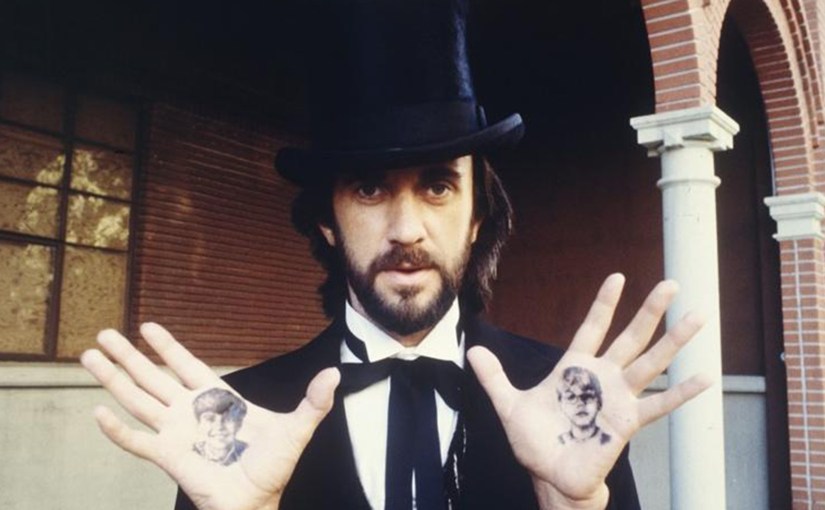
Something Wicked This Way Comes answers the question: What would the Disney version of Needful Things (1993) look like?  Instead of the Devil opening a curio shop in the middle of town, we get a malevolent carnival impresario, Mr. Dark, and his devilish carnival that promises delights beyond your wildest dreams.  But beware, for the price of having your wish granted comes straight out of The Twilight Zone.

And no wonder, the screenplay was written by Ray Bradbury, based on his novel.  Too bad the movie fell victim to studio interference, resulting in jarring tonal shifts, some awkward edits, and two re-shot scenes where the two child stars are clearly a year older and a year taller than they appear elsewhere in the film.

The movie starts out as feel-good Americana, right out of Normal Rockwell: a small midwestern town in what looks like the late 19-teens or early ‘20s, complete with a town square, a general store with the obligatory cigar-store Indian out front, and a friendly bartender with one arm and one leg.  We are introduced to Will and Jim, our two child protagonists, and Will’s father, Charles (Jason Robards), who looked to old to have an 11-year-old son in 1968, let alone 1983, but whatever.

So, there’s that part of the movie, where it looks like it’s going to be a gentle fantasy like Field of Dreams (1989) or something, with the background score to match…but then really weird things start happening.  A local eccentric vanishes after seeing a ghostly woman inside a funeral parlor.  Mister Dark’s Pandemonium Carnival opens just outside of town.  We watch as the local miser takes a ride on the Ferris Wheel with a beautiful woman…but she’s the only one who gets off the ride at the end.  The disabled bartender sees a marvelous reflection in the House of Mirrors and walks in…but never comes out.  Our two heroes, Will and Jim, witness something incredible when they peek under the big top at a broken-down carousel that only runs in reverse…

And so on.  I’ve seen umpteen versions of this story, and so have you.  It can be done well, but it takes a singular vision.  Watching this movie felt like someone spliced two films together and hoped no one would notice.  First of all, who in their right minds casts Pam Grier as a non-speaking character called The Dust Witch?  Granted, she’s a looker, but you don’t cast Pam Grier in a movie just because she’s beautiful.  You gotta give her something to do besides seduce men and stare menacingly, which, granted, she does better than most, but what a waste!  I wanted to hear her vow to bring the powers of darkness down upon your village in a fiery rage, or something, I dunno, anything.

But that’s a side point compared to the horrors awaiting our heroes.  In a scene right out of your nightmares, our two heroes are faced with an army of tarantulas in their bedrooms in the middle of the night.  So many tarantulas, in fact, that in one horrifying moment, you can see the bedsheets moving from the sheer numbers of arachnids under the covers.  (This was one of those re-shot scenes where the kids are a year older.)  Much later in the film, Mr. Dark grips someone’s hand so hard that we see the victim’s hand literally splitting open – in a VERY brief shot, mind you, but there is no question of what has happened, as the victim wears a bandage on that hand for the rest of the movie.

What is this horrific material doing in a Disney movie, for crying out loud?  Something Wicked This Way Comes arrived during a transitional period for Disney, when they were testing the waters with more adult-themed fare – The Watcher in the Woods had been released a few years earlier, and Touchstone Pictures was on the brink of breaking out with Splash (1984).  But when it came to this weird hybrid family/horror movie, they got a little gun shy.

According to the invaluable IMDb, after a poorly-received test screening, Disney execs delayed the film’s release for a year so the film could be re-edited, an opening narration could be added, additional scenes could be shot and old ones replaced, and an entirely new score could be composed by maestro James Horner.  In their attempts to make the movie more family-friendly, they were the embodiment of the axiom “too many cooks in the kitchen.”  On an early laserdisc commentary, Ray Bradbury stated that much of his original intention for the film was destroyed as a result of these after-market edits.

There is a really, REALLY good movie trapped inside the existing version of Something Wicked This Way Comes.  Watch the movie, and you can see that really good version peeking through here and there (it feels like there was a LOT more that could’ve been done with Jonathan Pryce’s rendition of Mr. Dark).  As it is now, the movie is little more than an object lesson on why so many directors dream of getting “final cut” in their contract…so something like THIS doesn’t happen.
CHINATOWN

By Marc S. Sanders

Forget it Jake!  

Roman Polanski turned Robert Towne’s page turning script into a noir mystery for the ages.  Practically every scene in Chinatown turns whatever you learned before off its axle.  The mystery of what Jake Gittes, a private dick played so well by Jack Nicholson, is attempting to uncover seems to repeatedly take the guy back to square one.  

Towne’s Oscar winning original screenplay, one of the best ever written, begins with simplicity in motion.  A Mrs. Mulwray insists on hiring Mr. Gittes to find out if her husband is having an affair.  The husband is in charge of the water supply within the surrounding areas of Los Angeles.  Despite Jake’s encouragement for her not to go down this path and recuse herself of heartache, he accepts the case charging his regular fee plus a bonus should he turn up anything that points to something illicit.

Just before meeting with the wife in despair, Jake wrapped up a case, handing over photographs of a wife to her bruiser husband (Burt Young).  The poor guy understands that his spouse was messing around.  None of it is shocking to Jake.  He’s seen the same results many times before and he’ll likely come upon the same situation with Mr. Mulwray.  However, as he follows her husband, it does not seem to be just an affair that is transpiring.  Jake finds himself driving out to a dried-up reservoir and then he’s adjacent to a drainpipe by the ocean shore.  The more he sniffs out, the more likely his nose is going to pay for what he gets closer to.

It’s hard to write about Chinatown as I reflect on the film for a review.  There’s just so much to spoil, even beyond what is now considered to be one of the all time great twists in film history.  I would dare not give anything away.  Some of the luckiest people today are those that have never seen the picture.  To watch Chinatown with a blank slate.  If that’s you…Wow!!! You are blessed of the experience that awaits you.

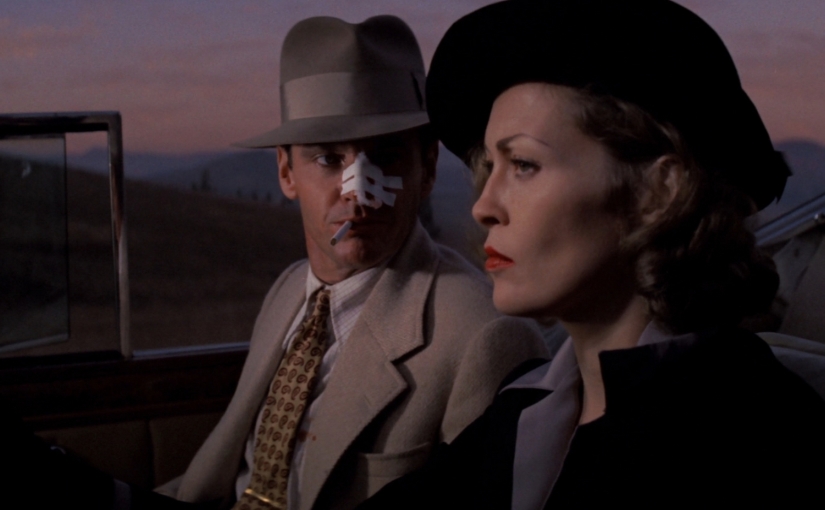
The cast is a bevy of recognizable faces; character actors who went on to popular television shows and movies (Higgins from Magnum P.I. and Miss Collins from What’s Happening!!!).  Faye Dunaway though is maybe the most unforgettable.  Jake is smart enough not to trust the famed actress’ character (I don’t even want to share the name of who she portrays).  Long before Sharon Stone hammed it up with a less creative eye rolling commando cross legged sitting, Faye Dunaway was best at being sexy, alluring and especially enigmatic.  With her Hollywood glamor appearance in costume wear from Anthea Sylvester, she has that classic noir dame appearance with a smooth inflection in her voice.  Word is that Polanski wanted Dunaway to reflect his own mother’s appearance.

Then there is the celebrated filmmaker John Huston representing old money, a lot of it, in a rare acting appearance.  He plays Noah Cross, a great name to be associated with water.  His gravelly voice and hulking mass lend to what he’s earned demonstrating his power over a commodity resource that everyone cannot live without.  Per Jake Gittes’ experience, he knows it’s best to seek out a motive long before he can uncover a crime.  Gittes’ perusal of some photographs on an office wall will allow him the gumption to go up against a titan like Cross. 

It’s a welcome setting to see late 1930’s L.A.  There is a drought going on and coincidentally Jake is perhaps tailing the guy responsible, but only because of a likely affair.  Still, when his pursuit takes him to the most unexpected places, something more sinister may be happening.  When someone turns up dead by drowning, Chinatown becomes more deliciously complex. Why would Dunaway’s character pay Jake, and later why would Noah Cross double the fee to hire the detective, as well? Jake’s clients may be playing against one another, but he’s the one being tossed in several different directions.

There has to be over a dozen twists in Chinatown.  Thankfully, none of them are contrived or thought up out of the blue.  New depths await further down the rabbit hole.  

I love how Jake Gittes functions.  He might be accused of being sleazy in his profession, but he drives a nice Pontiac classic convertible and dons a stylish wardrobe to go with his fedora hats, designer sunglasses and sterling silver cigarette case.  He’s also quite sharp.  He’s got methods to easily prove how long someone has been at a certain locale and how to follow another car at night.  All of it makes perfect sense.  

Jack Nicholson is great in his role. He does not go all looney like in other pictures, but he’s quiet with his tone, reserved of any kind of shock to the discoveries he finds.  Yet, this particular case might challenge the detective’s sense of acuity into another realm.

Polanski, Towne and Nicholson also thought it best to apply a crudeness to Gittes.  He’ll happily tell an off color joke to his colleagues.  When Dunaway, sneaks up behind him, Gittes is not quick to apologize.  Instead, he gives an annoying scowl for her being there when a prim, genteel woman has no business listening in.  When he gets a phone call, he’ll tell his partners in the room to “shut the fuck up.”  Sam Spade never talked like this.  

The production value is great.  Nothing in or on top of a desk, for example, looks out of place.  From the cars to the interior furnishings of the homes and offices, it’s a Technicolor transport back in time with the dialogue uttered like characters of the ‘70s and ‘80s might deliver.  Humphrey Bogart could never occupy the role of Jake Gittes.

I recently watched The Offer on Paramount Plus which explores how The Godfather made it to the big screen.  Chinatown was next on the horizon, but executives were left confused by a boring middle section about – excuse me, water???? Plus, there was an unsavory plot twist that is hard to even fathom.  The script’s first draft doesn’t even have a scene set in Chinatown.  So what’s with the title? Casting was also unsatisfying.  Now producer Robert Evans wanted you to see more and identify with the chutzpah of the ultra-powerful and wealthy, because only the super-rich are the ones who can get away with murder.

Despite the movie’s welcome yet perplexing surpises, it’s all incredibly satisfying.  Who is doing what to whom, and why?  The best mysteries are the ones that make perfect sense yet can’t be figured out until someone finally starts telling the protagonist the whole shocking truth.  In Jake’s line of work, nothing is shocking. However, the greater the secret, the bigger the liability for everyone involved. 

I’m sorry reader.  I know I’m being vague but therein lies the delight in watching Chinatown.  As you watch, you may throw your hands in the air.  Now what?  You’ll find yourself in disbelief and that would be the best compliment you can give to Roman Polanski, Robert Evans and Robert Towne.

Chinatown is the best example of a film noir pot boiling thriller.  It’s the reason movies continue to thrive; to witness a scene chewing villain, pine after a beautiful, lustrous woman who is not telling us everything, and follow a gumshoe detective who thinks he knows everything but actually could never fully comprehend anything until he makes it all the way back to Chinatown.

ALICE DOESN’T LIVE HERE ANYMORE

By Marc S. Sanders

Martin Scorsese was destined to be a great director. No doubt about it. Look at 1974’s Alice Doesn’t Live Here Anymore. Not only does it offer an Oscar winning performance from Ellen Burstyn as Alice, but this early career film contains skilled tracking shots.

Scorsese uses his camera like a musical instrument. He times it to move on a certain cue. Near the end when Alice needs to pick up her 12 year old son Tommy (Alfred Lutter, well played here) from a police station, Scorsese is clearly on foot positioned behind the police counter. When the time is right, he walks it behind the cop and extras in a crescent step by step over to behind Alice. We are in the scene. It didn’t take much imagination, but Scorsese is economical for an engaging payoff. The camera continues to follow a young Jodie Foster as Tommy’s rebellious pal, Audrey and then after she’s quickly escorted out by her mother, it peers into the room where Tommy is waiting. It’s an unbroken steady cam moment that predates his classic tracking shot of the Copacabana in Goodfellas, or the bloody overhead outcome from Taxi Driver.

The story is decent, though nothing big. Alice is forced to flee following one set back after another with the men she encounters in her life. First she’s unexpectedly widowed from her unappreciative and cruel husband, next she encounters a charmingly young Harvey Keitel who sheds his first impression quickly. Then she comes across Kris Kristofferson but is he right for her?

The second half of the film inspired the basis for the classic TV show Alice, featuring Linda Lavin and Vic Tayback who plays Mel the cook in the film as well. Scorsese uses the diner sequences for some good laughs of confusion and slapstick with side characters Flo (scene stealer Diane Ladd) and Vera (Valerie Curtain, another scene stealer).

These are good characters here. You want Burstyn’s Alice to be happy and succeed as a mother to Tommy and become the singer she dreams about. She’s adoring. She tries, and she always works hard. Burstyn has some great moments of various range whether she’s feeling like a pestered mom driving the long highways, having anguish and fear with the men who cross her path, or when she’s singing Gershwin’s “I’ve Got A Crush On You” at the piano of a seedy bar. I loved her in the role.

This is not really a special movie. Yet, it’s an important one in cinematic history. See this film to see the master director when he was merely a pupil, exceeding what was likely minimally ever expected of him to accomplish.

Martin Scorsese is just a great director.