WALL STREET

By Marc S. Sanders

Oliver Stone is a very good director at providing the evidence of cynicism within the worlds he films.  JFK covered a clandestine, conspiring environment oozing out of the columns of government.  Platoon not only depicted the horrors of war, but also the cancer that poisons the mentality of soldiers expected to protect one another.  Wall Street explores the temptations to cheat the stock market for grand prizes in wealth.  Gordon Gekko is the 1980s tycoon who never knows the meaning of enough.

The well-dressed yuppie lizard, Gordon Gekko, is memorably played by Michael Douglas in his only Oscar winning role; regarded as one of the most villainous characters of the last fifty years.  It’s not a modest part, and Douglas’ performance is therefore electrifying.  With slicked back hair, the signature crackle of a voice inherited by his father Kirk, and the newest 80s innovation, a brick size cellular phone, the power to earn money and crush corporate enemies is done with ease.  Gekko relies on obtaining inside information (a federal crime) to find the next chest of treasures.  It might be an illegal practice but the best of the best at making mountains of money do it, and if you keep your process on the down low, nobody will catch wind of what you’re up to.  Gordon Gekko is an absolute genius, and he’s awarded a script of fast talking, slick monologues that justify his sins.

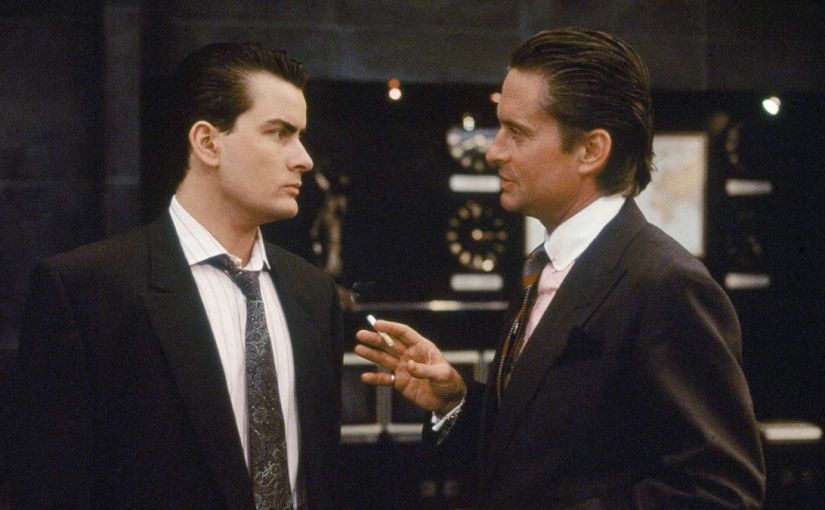
Bud Fox (Charlie Sheen) is the kid on the ground, way below Gordon’s high-rise office, desperately trying to get five minutes with the guy.  A whole day’s wait in the lobby and a birthday gift of Cuban cigars does the trick.  Now the lizard has the fox ensnared in his money-making schemes of deception and pursuits for unlimited greed.

Oliver Stone writes Sheen’s character as virginal when it comes to stock trading.  The kid is dying to get laid with the big boys while getting away from the cold calling hang ups of promising uncertain futures in stocks and bonds.  A subtle and effective angle is to give Bud a mentor.  Hal Holbrook enters the screen from left or right on many occasions to put his hand on Bud’s shoulder and give him his own twist of Confucius philosophy.  Then he exits out of frame towards the opposite direction he enters, leaving Bud to follow the questionable paths that Gordon paves.  Holbrook’s contribution to Wall Street has never been celebrated enough over the years.

Michael Douglas and Charlie Sheen are an outstanding pair of devilish mentorship against innocence lost.  Gekko preaches his passion for wealth on top of more wealth and why nothing should stand in his way, especially the law or the cost of others’ livelihoods.  Bud Fox emulates him as a master of the universe.  Charlie Sheen is great at being the biggest fan in Michael Douglas’ concerts of monologues. Watch how Sheen listens when Douglas has the floor. 

Martin Sheen extends his paternal role to Charlie within Stone’s film.  As Gordon sets designs on taking stock ownership of the small airline company that the father works for, the father/son relationship is tested, and Bud becomes blurred between what is right and wrong.  The Sheens have good debates and heightened dramatic moments.  I wish they were given more to do together though.  Perhaps even showing the wedge of the mother role within this family.

Additionally, Oliver Stone writes dynamics for Bud in a worker relationship with a fellow trader colleague (John C McGinley). There’s a former college pal/now lawyer (James Spader) that Bud tries to squeeze at the behest of Gordon’s demands.  Bud is also covered doing his own tricks of the trade such as dressing as a janitor to dig for what’s forbidden.

Why bring up all of these storylines?  Well, there’s a wealth of great material in Wall Street that’s relevant to the practice of insider trading and corporate overhaul.  Somehow though, Oliver Stone is responsible for writing one of the most unnecessary characters in film history.

Daryl Hannah just had to be cast as the buxom blond love interest for Bud Fox.  She’s never believable as a New York City interior designer and the chemistry between Hannah and Sheen is as thin as water.  Her name is Darien (a 1980s name) and one scene between Michael Douglas and her bustling the streets of Manhattan goes nowhere.  Wall Street is simply not the superb film it could have been because of the amount of time devoted to Daryl Hannah’s character.  Every moment she occupies is cutting room floor material.  When Darien exits the picture she’s never mentioned again.  The history she has with Gordon is never revealed to Bud.  Regrettably, it’s all meaningless.

What’s frustrating with Wall Street is its promise is never fully committed.  The roles awarded to Spader, McGinley, Holbrook and even Saul Rubinek in an early role as Gordon’s nerdy lawyer could have been even more fleshed out in lieu of what is covered with Daryl Hannah’s part.  More moments with Martin and Charlie Sheen would have better served the film.  A competitor tycoon played by Terence Stamp is very interesting and worthy of a larger presence.  Sadly, I imagine a studio producer or even Stone insisted on having a love interest that serves no purpose here except to put a glamorous actress above the title in the credits.  

Nonetheless, Oliver Stone built an authenticity to the hysteria of stock trading and corporate underhandedness.  When he shoots the scenes occupied by Bud and Gordon, he does handheld shaky camera work to emulate that nothing feels sturdy and balanced.  In moments that Bud’s father is at the center, the director shoots with a locked in position, bearing the character’s assured apprehension to trust his son or this prophet of greed.

I especially like the scene where Michael Douglas delivers his famous “Greed…is good!” speech at a shareholders’ annual meeting.  Stone glosses over all the company vice presidents and officers as well as the fat cat suits who carry stakes in the company.  Yet, the filmmaker also takes the time to show that little old lady with the pocketbook who finds her entitled seat to see how the value of her small ownership share is being treated.  Remember, if you own stock like Disney or IBM, you get that invitation in the mail to attend these meetings, and you have just as much a right to attend as all the Gordon Gekkos of the world.

Wall Street serves an important reflection of 1980s capitalism, while taking place in 1985, two years ahead of the infamous market crash of 1987 (the year the film was released).  Guys like Bud Fox had the Charlie Sheen image. Boyish men who got rich quick with little imagination to create and build.  They stood next to tall wealth and learned, but they never gained the knowledge to prepare for quick falls and disheartening sacrifice.  Most importantly, they took their own sense of morale for granted.  These are the best parts of Wall Street.

LEGAL EAGLES

By Marc S. Sanders

In Legal Eagles, Robert Redford plays a promising district attorney named Tom Logan, who becomes ensnared by Debra Winger, playing a private defense lawyer named Laura Kelly.  Laura is representing Chelsea Deardon (Daryl Hannah), a mysterious, but alluring twenty-something accused of stealing a priceless piece of art.  Murder eventually comes into play.  Romance does as well.  Unfortunately, none of it works in what should have been a charming comedy from director Ivan Reitman (Ghostbusters, Stripes, Meatballs).  The casting is solid.  The script is not.

When this film was released in 1986, Robert Redford looked like the best option for the standard romantic comedy, to lead the fraternity of male actors eventually to come by way of Billy Crystal and Tom Hanks.  Debra Winger was well known with a collection of Oscar nominations for more serious subject matter.  However, she has always possessed that smart yuppie look; aggressive, professional, and ready for love.  Redford and Winger make a perfect pair.  The flirtations between the actors’ characters in Legal Eagles work quite successfully.  The regret is that a flat, boring mystery for them to tackle is always getting in the way. 

During Chelsea’s eighth birthday she is presented with a painting by her renowned artist father at a lavish party.  Later that night, a fire ravishes through their apartment.  Her father perishes in the flames and the painting along with other priceless pieces of art were thought to go up in flames.  Jump eighteen years to present day 1986, and Chelsea insists to both Laura and Tom that some of those paintings, including her father’s gift to her were stolen before the fire occurred.  Suspects are interviewed.  Danger gets in the way and so on.

The problem with this initial set up is that this conundrum is pretty stale.  It doesn’t offer enough to keep me interested.  What do I care about a stolen painting?  Moreover, I could care less about the fate of Daryl Hannah’s character.  She’s designed to be the standard Olan Mills Photography glamour model of the 1980s, and she is most certainly beautiful, but she is written with as much dimension of what a thumb tack does when you push it into a wall.  She just sticks there. 

There are some usual suspects for the lawyers to pursue like Terence Stamp, an interesting character actor by reputation.  Regrettably, his art dealer portrayal is not written with much logic.  The two lawyers follow him to a warehouse and find themselves in danger when Stamp traps them inside with a ticking time bomb that will not only kill them but destroy his immense collection of assets and records.  Why go through all this trouble?  You’ve got some of the most valuable, sought after pieces of art tucked away in here. 

Brian Dennehy is a cop who welcomes himself into the story and the “intuitive lawyers” happily accept his trust when he offers his file on the fire investigation from eighteen years prior.  He just turns up at random, odd moments.  Do Tom and Laura even think to wonder why this guy is so interested in assisting them all of the sudden?

What really sends Legal Eagles off the rails though is a step away from the narrative so that Robert Redford and Daryl Hannah can be caught in bed together.  This serves no purpose.  It’s a scene that screams of a producer demanding this happen to sell movie tickets and it betrays the intelligence any of us would expect of a sharp-witted New York City District Attorney.  Even more absurd is when Redford and Hannah are awakened the next morning, she is arrested for murder.  So the lawyer sleeps with the client, but no concern regarding ethics is ever questioned.  As well, Winger’s character just delivers an eyeroll response to Redford’s error in judgment, but the two continue to work in flirtatious harmony.  That doesn’t offer much respect for the aptitude of Winger’s character.  She should be repulsed by this transgression.

Legal Eagles contains more charming and mature humor than Ivan Reitman was recognized for by this point in his career.  It’s a yuppie ‘80s film.  I only wished for a more insightful pursuit and storyline for Redford and Winger to be focused on while they fall for one another amid the scenic backdrop of a bustling New York City. 

Daryl Hannah looks like she’s in another movie altogether.  Yes, she sleeps with Redford’s character, but I don’t think Hannah has more than five lines of dialogue exchanged with either Winger or Redford.  She’s expendable here.  You practically forget that she’s the accused client the lawyers are working to exonerate.

The value of the missing painting is hardly stressed upon.  The motive for murder really isn’t either.  There are not one or two fires in the film, but rather THREE!!!! Did the craft of invention just stop after page one of the screenplay? 

From a marketing standpoint, based on casting alone, this film had such potential.  The movie features some of the best working talent going for it.  Sadly, it gave all the players nothing to do, and what little was done lacked any kind of foresight or wit.

On the subject of Legal Eagles, my motion stands.  This movie is inadmissible in court!

BLADE RUNNER

By Marc S. Sanders

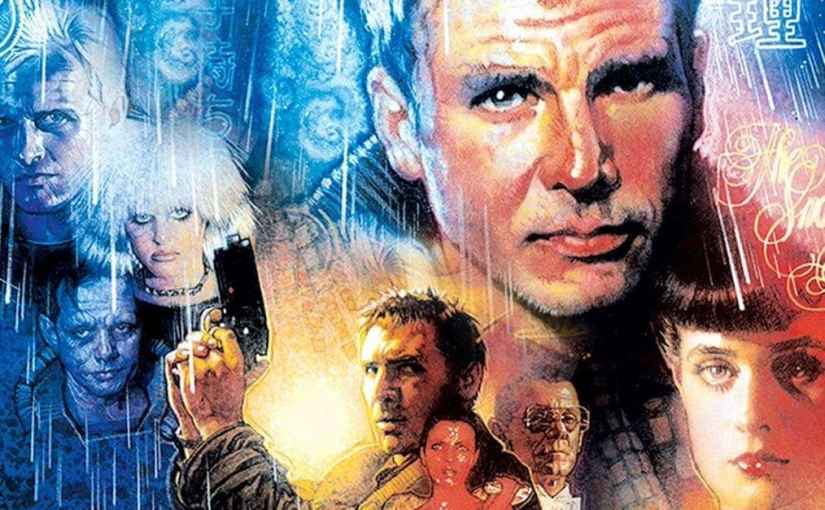
Ridley Scott’s Blade Runner is a technical and special effects masterpiece…however thin-very thin-its story may be. 

When the film was originally released in 1982, its period setting of November 2019 seemed unimaginable.  So, it was easy to accept that the dystopian future first conceived by author Phillip K. Dick (in his book Do Androids Dream Of Electric Sheep?) could actually happen.  With the Vietnam War behind us, and shopping malls becoming the happening place to be in our Members Only jackets and Jordache jeans with Swatch watches, the 1980s seemed like eternal bliss.  Middle class America felt prosperous and free and comfortable with a President on his way to eight years in office.  Bright pastel and neon colors took over.  A hopeless, dreary future was all but fantasy.  Therefore, just like Star Wars, a gritty, urban Los Angeles seemed like another possibility where science fiction had become as trendy as super hero movies are today.  It was cold and rainy and dirty, but we wanted to see that because that was nowhere near what we were living in, much less envisioning. 

Ridley Scott achieved greatness with visuals never thought possible.  George Lucas might have introduced moviegoers to desert and swamp planets and industrialist Death Stars, but Scott delivered an Earth where Coca-Cola, Pan Am, Atari and Cuisinart still existed amid a dark, rainy Chinatown section of Los Angeles with glowing umbrella handles, flying police cars and cabs, hovering electronic billboards, and exhaust flames that spewed out of the rooftops of cylindrical skyscrapers.  Ridley Scott might have supervised this palette of futuristic film-noir, but the real heroes of Blade Runner belong to its Oscar nominees Lawrence G. Paull, David L. Snyder, and Linda DeScenna for set decoration, as well as Douglas Trumbull (already a legend for 2001: A Space Odyssey), Richard Yuricich and David Dryer for visual effects.  All these years later, there’s much to explore within the appearance of Blade Runner, but the storyline still remains shallower than a puddle of water.

I’ve watched Blade Runner a number of times because fellow peers and colleagues carry such admiration for the film.  I cannot deny the first third of the film holds your attention as you acclimate yourself to this enveloping world.  Once your accustomed however, the story is what has to carry you through to the end, and the journey is as slow moving as a rickshaw on one wheel.  Harrison Ford is Rick Deckard, a blade runner and the best one there is.  Upon learning of an escape of four Replicants from an off-world slave site, Deckard is tasked with coming out of retirement to hunt down these Replicants and “retire” them.  Retire is the polite word for kill, exterminate, slaughter or execute.

A replicant is an android that looks completely human, bleeds like a human and talks like a human.  It’s near impossible to tell the difference on sight between a human and a replicant. As well, replicants are manufactured with four-year life spans and are not permitted on Earth.  They are intended for the sole purpose of slavery towards their human creators.  Yet, what makes them so exemplary or offensive?  What trait do they carry that threatens their human counterparts?  Racism often occurs because of fear derived from skin color or appearance.  Antisemitism will have you believe that Jews have horns growing out of their heads under their yarmulkas.  What is so terribly misconstrued or offensive or threatening about Replicants?  The film never makes clear, and that’s frustrating.  What makes a villain a villain?

M Emmet Walsh comes on early enough to tell us through dialogue that he needs the best of the blade runners back and that’s Deckard.  When I’m to understand that I’m watching the absolute best of something, whether it be a cop, lawyer, baker, student, doctor, painter or blade runner, I want to see what exactly makes them the best.  In Top Gun, I saw the aerial maneuvers that potentially justified why Maverick could be the best of the best fighter pilots.  The problem with Blade Runner and the script, written by Hampton Fancher and David Webb Peoples, is that I never see in its two-hour time span when or how Rick Deckard is such an exceptional blade runner.  How is a blade runner different from an ordinary cop or a simple person with a large gun?  No matter which of the various cuts of the film I’m watching, with or without Harrison Ford’s voiceover narration, I fail to see any outstanding fighting skills or clear thought-provoking intuition.  This guy is neither as good as Dirty Harry or Sherlock Holmes or even James Bond.  He’s not even as personable as Sam Spade, the original noir detective.  Rick Deckard just looks like Harrison Ford with a very large hand gun.  Furthermore, where does the term “Blade Runner” derive from?  Is it just there because it sounds cool?  The moniker wasn’t even created by Philip K. Dick.

The film’s eventual sequel, Blade Runner 2049, is a far superior film.  It’s longer, but it’s much more fleshed out in tone and character and understanding of its setting.  The original film stands on the heels of its cult like legendary status.  Some of the best filmmakers today cite Blade Runner as an influence in how they construct their own movies.  I buy that.  The assembly of whatever cut I’m watching is evident of how mind blowing its appearance is.  You can see some of the blue print visuals that carried over in to Christopher Nolan and Denis Villeneuve’s pictures. But I’m past all that.  Now I need to appreciate what it’s all there for, and who is playing in its yard. 

I cannot simply rely on IMDb trivia and endless social media sites that speculate on whether Deckard is a replicant himself, or why he dreams of a unicorn and why Ridley Scott opted not to include said dream in the original cut.  I cannot just tickle my curiosity with the picture’s eerie foreshadowing of the various product placements that suffered real life eventual downfalls after its release.  Beyond the visuals, what am I watching Blade Runner for?  This is not just a riddle in the Sunday paper.

The film boasts an eclectic cast that work well together.  I just wish they were provided with something much more insightful with background and personal experience.  Rutger Hauer became a familiar name following the release of this picture.  When he’s finally given the opportunity within the second hour of the film to come off as hideous and terrifying and strange, it’s worth looking at.  His famous “tears in the rain” closing dialogue is beautifully poetic, as it was personally written by him.  It’s as ambiguous as the film.  Yet, Shakespeare can be vague too.  I might not understand what anyone is talking about, but the performance can keep my attention.  Regrettably, he does not do much else in the film beyond his closing fight scene with Ford.  Ridley Scott insisted on casting Sean Young as Rachel, as her appearance was reminiscent of Vivian Leigh.  She’s intentionally mysterious as a likely replicant and/or niece of the wealthy creator of the replicants, Dr. Tyrell.  It works, but again, if the viewer is going to be questioned on the mystery of this major character early on, then why doesn’t the film follow further into that enigma?  You don’t have to say for sure, but at least give me evidence to argue one way or the other.  The same goes for the speculation on Deckard.  Had it not been for outside references, I’d never question who or what Deckard really is.  Daryl Hannah, Brion James and Joanna Cassidy round out the rest of the cast/replicants within the film.  Edward James Olmos is here too with a curious and odd habit of making origami.  They all have their unique way or look about them.  In science fiction, every character should stand apart.  Yet, again, it’s all about appearance.  What is the motivation here?  What is the motivation to live on earth or off earth?  What is the motivation to kill a human?  What is the motivation to kill a replicant?

I’ve beaten my head enough over this film.  Blade Runner has always been frustrating to me.  Maybe I’m not being fair to myself, as I try to find something else or some underlying layer each time I watch it.  Why do people love this movie so much?  Why does it consistently appear on “greatest of all time” tabulations?  Ultimately, I’ve come to the conclusion that I’m just pounding sand, or maybe as Rutger Hauer’s Roy Batty suggests, I’m impossibly looking for tears in rain.

KILL BILL VOL. 1

By Marc S. Sanders

Kill Bill Vol. 1 is Quentin Tarantino’s love letter to the best in Kung Fu films. A cinematic celebration for the eyes amid swords, blood and feminine gusto.

I consider Tarantino a writer of two dimensional characters; people with roll off the tongue names like Elle Driver and the only depth he awards them is to provide a code name like a breed of a deadly snake (Black Mamba, Cottonmouth). Multi dimensional characters are an absolute must for me most of the time. The only time I forgive its absence is when I watch Han Solo, Indiana Jones (circa the original Raiders…) and anything introduced by way of QT. Why? Because with these examples it is the situation and depiction of action that offers more than what you see. A ball and chain with a saw blade is wielded by Gogo, the catholic school girl assassin, and we don’t care so much if it hits its target. Rather we care about its traveling trajectory. The ball will zing through the air, sever a wooden table into splinters and zing back to hit its target in the back of the head. QT can thank his loyal editor, the dearly departed Sally Menke for achievements like this.

None of this is serious. It’s a step-by-step storyline of vengeance by Uma Thurman as The Bride, who is vows payback on Bill and his underlings for having the nerve to crash her wedding, leaving her for dead.

Getting from place to place is the glorious fun of the picture, thanks to a rocking soundtrack and actors (Thurman, a stellar Lucy Liu and a brash Vivica A Fox) ready to recite heightened, forthright dialogue that a 10 year old might give to his favorite action figures. “The baseball diamond where I coach little league and we have ourselves a knife fight.” Only assassins from Quentin Tarantino’s glossary talk like this.

Action scenes are not only gorgeously crafted with knife choreography and plenty of martial arts, but there’s almost a slapstick element to it all, along with a comic book feel. Tarantino is a well-known Three Stooges fan and beyond being an admirer of cinematic heroes. The Bride doesn’t just spill the blood of her opponents (The Crazy 88), she severs limbs and heads, so arteries spray never-ending geysers of blood. By the time the showdown of 1 vs 88 is over, the blood is in such excess, it appears as if the most extreme of pie fights has occurred among the mess. If Wile E Coyote took it up a few notches against the Road Runner, it might border what’s presented in this film. This is Quentin Tarantino with free reign and an unlimited budget providing what Kung Fu cinema fondly remembered from the offerings of legends like Sonny Chiba (who appears as a sword maker here) and Bruce Lee.

Kill Bill Vol. 1 is a glory to behold. It’s a variety of clear cinematography through different lenses Black & white, red with siren sounds, quiet dual set ups in glowing blue, and the purity of Lucy Liu’s code in a snowy white setting. Following a prenote of “Our Feature Presentation” the picture is bright in color and crisp in sound. Cereal is spilled all over a kitchen floor following a knife fight, and you just adore the crunch beneath The Bride’s feet as she walks out.

Overhead crane shots give an outline of a locale’s interior. Scorsese did this for terrifying effect at the end of Taxi Driver. Tarantino uses it as a means for the viewer to be let in on everything The Bride considers or looks for. The 4th film from Quentin Tarantino is so well constructed and so well-orchestrated. You see something new with each repeat viewing.

KILL BILL VOL. 2

By Marc S. Sanders

Kill Bill Vol. 2 offers an entirely different narrative than Volume 1, and that is why Quentin Tarantino is an electrifying storyteller. No two moments seem similar, even if the elements of the scenes (or chapters) seem the same with samurai swords, quick close ups, snap of the finger changes in cinematography and gonzo music cues.

I do prefer Volume 1 over 2 simply because it is a leaner film. This installment has just a little too much fat layered in, such as a storyline focusing on Michael Madsen’s “Budd” character. Not sure it was necessary for a scene where he is getting docked work hours from his boss because he was late. Not sure I needed a scene close to the third act where The Bride meets up with a South American contact before going to meet Bill. The dialogue in a few scenes like these offers nothing and didn’t even bring me the typical smirk I naturally get from QT’s films. They seemed more catered for bathroom breaks during the run of the movie.

Still, there’s a lot of glee and atmosphere in this picture, from a rehearsal wedding in gorgeous black and white with a nice Samuel L Jackson appearance to an enclosed, flashlight lit interior of a buried coffin. Best of all is the centerpiece of the film, The Cruel Tutelage Of Pai Mei (the best scene of both volumes and the salute that sends Tarantino’s love letter for Kung Fu cinema home). I love the Kung Fu Master Pai Mei, easily one of Tarantino’s best characters in all of his films combined. Tarantino works in the extreme close ups that Japanese filmmakers might have used for EXTREME DRAMATIC effect. Everything about Pai Mei is graciously recognizable and hearken back to these movies I’d catch while flipping channels on Saturday afternoon. Frankly, I never stuck with those flicks until the end, but for the fleeting seconds I watched, I got a white robed Kung Fu master Pai Mei to now fully appreciate in Kill Bill Vol. 2.

The Bride could arguably be Uma Thurman’s best role of her career. She’s a great carrier of the Tarantino heroine. The fighting skills she offers and what are deceptively edited in (thanks to Sally Menke) look so natural with her at the lead. You can’t take your eyes off of her, and you love to look at her.

David Carradine is another attraction. It’s rumored that Warren Beatty was up for the role of the sadistic, yet charming, Bill. No way could I see that working out. Carradine was the star of the series Kung Fu. How do you go with anyone else but David Carradine???? Carradine has a gorgeous, gravely stiletto voice that sounds awesome in stereo; deep and guttural. His facial features lend to a history of a villainous, but wise leader.

SPOILER ALERT: I’d be remiss if I didn’t mention QT’s smart imagination for disarming Daryl Hannah’s one eyed deadly assassin, Elle Driver. Find me another movie where an enemy is left in a trailer located in the desert with her remaining eye ripped out while a deadly black mamba snake slithers somewhere nearby. Tarantino closes this storyline by leaving her screaming alone with no eyes…in a desert…WITH A DEADLY BLACK MAMBA SNAKE. Does the audience need to see her die? Definitely not. Use your imagination of this being worse than stranded, and worse than dead. Pardon me but that’s fucking brilliant!

Again, QT’s characters are two dimensional. The Bride and Bill might have a little history behind them but that’s about it. It’s okay though, because this is pulp fiction (pun intended) that comes alive on the screen. No writer/director has ever elevated this kind of material so well.