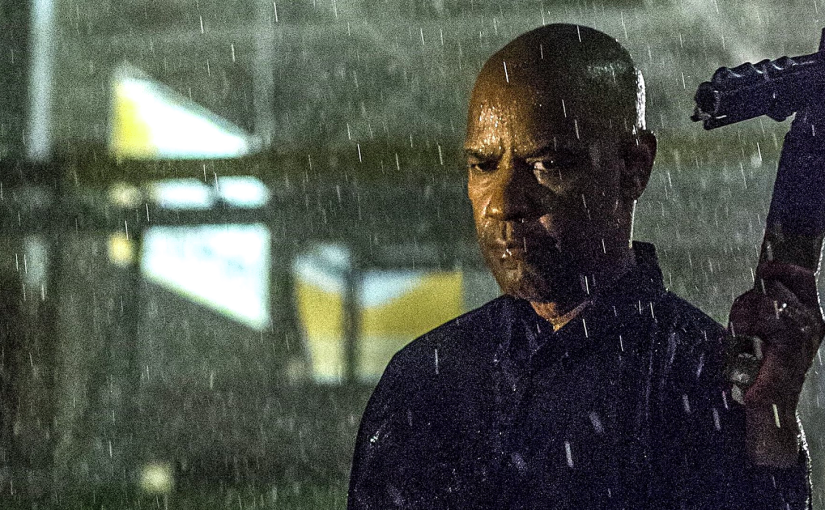
THE EQUALIZER

By Marc S. Sanders

I guess Liam Neeson and Gerard Butler were unavailable when Antoine Fuqua and Denzel Washington collaborated to make the first installment of The Equalizer trilogy, based on the CBS television series that starred Edward Woodward.  This film is nothing special with a nothing special kind of script, a nothing special hero and a nothing special collection of Russian Mafia villains.  The kills are nothing special either.  The action is nothing special.  The explosions are nothing special, even when they are started by a trip wired microwave.

Robert McCall (Washington) lives a quiet life by himself, while working at a jumbo home improvement store (think Home Depot or Lowes – big places for lots of not so special action to take place at the conclusion of a not so special movie).  Turns out McCall, who also lives with OCD, is a retired special ops commando.  Robert uses his down time to read one of a hundred books that should be read before you die, while sitting quietly in a coffee shop each night.  He also volunteers his assistance with getting people to improve their lives.  A plump co-worker named Ralphie (the go to name for fat guys) played by Johnny Skortis is on Robert’s strict diet regimen to lose enough weight so that he can be promoted to the store’s security guard position.  Skortis occupies the best and most interesting character in The Equalizer.  During the final action sequence, it’s what Ralphie does that earned my one cheer during the course of the picture.

Robert also becomes acquainted with a young lady named Teri (Chloë Grace Moretz) who has aspirations of becoming a singer but is weighed down by her call girl commitments to members of the Russian mob.  When Robert sees that Teri has been beaten and is in serious trouble, he doesn’t wait to be asked for help.  He just does what is necessary to even the score.

That about does it for The Equalizer

No.  Seriously.  That’s all there is to it.  And so I’m very disappointed. 

First, Denzel Washington does not even look like he’s trying.  His demeanor to this character is no different than what he did in the lousy Man On Fire, directed by Tony Scott.  The script to this film is not challenging in the slightest.  Like Man On Fire, The Equalizer is simply a series of scenes where Robert torments his villains.  David Harbor is a corrupt Boston cop who gets trapped in his own car, while Robert runs a garden hose from the exhaust pipe to the inside with the engine running.  Where is the entertainment in this?  Washington sits in a chair while he mechanically opens and closes the car window and Harbor gasps for breath.  McCall is inventive with his methods but it does not lend to any story progression or character depth.  I guess Robert McCall is an artiste – one who specializes in torment, torture and death.

The climactic showdown, within the store, is a great set up for some tête-à-tête methodology to happen, but all of it is executed with little interest.  Here’s where I asked myself a question.  McCall nabs a guy in a makeshift kind of bear trap down aisle 10 (I guess).  The thug gets his neck caught in a barb wire noose and up he goes to the second level of pallet platforms for McCall to stare the guy down while the blood squirts out from his throat.  There’s four or five heavily armed other guys roaming the store, but McCall can take a break to stare this guy down for his last breaths.  If this trap works so well with this one guy, then why not set up six or seven more of these MacGyver contraptions and let each machine gun toting baddie go through the same routine?  I know.  I know.  Miguel would respond, “because then there would be no movie!”  Yet, what does that say about The Equalizer that my mind drifts to this idea?

Later in the sequence, McCall easily walks up to another thug from behind and delivers a power drill to the back of his head.  Then he puts the drill back on the shelf.  Again, if this worked so efficiently and covertly, why not just do it again? And what is so exciting about a power drill anyway if Jason Vorhees isn’t using it?

A nail gun is used a few minutes later and Fuqua opts to just have Washington shoot one nail after another into his opponent.  Bang – Nail – Cock! Bang – Nail – Cock!  There’s no pun or one liner.  There’s just a bad guy who falls to one knee, then an arm goes down.  The machine gun lets off a few rounds and drops to the floor. There goes the other knee and then he’s dead.  Washington just observes the guy die while the sprinkler system drenches him stylistically in slow motion. 

I look at The Equalizer and I think back to the ‘80s actioners from Schwarzenegger, Van Damme, Stallone (some of them), Jackie Chan and even Seagal.  The Rock had fun with a few of these action pieces too.  Go check out The Rundown.  There was a pizzaz to the hero’s methodologies back then.  It wasn’t just a brutal killing and bloodletting.  A one liner accompanied the kills.  It made you cheer and applaud.  Those pictures worked like symphonies of dialogue and ultra cool action that John Wayne never accomplished.  Robert McCall is boring.  Just boring.  An absolute bore.

The villain of this effortless piece is also boring.  Marton Csokas did not advance his career with the lack of anything beyond his Russian dialect and three-piece suits used in this picture. 

Antoine Fuqua has yet to wow me.  Though I know he’s an accomplished director, Training Day always feels like it comes up short with the three or four times I’ve watched it looking for its merits. The critically poor procedural of The Equalizer only lessens his promise for growth and potential.

Denzel Washington has resorted to uninspired characters a few times now. He still earns accolades with pictures like the recent The Tragedy Of Macbeth (a Best Actor nomination) and on stage (I was in the third-row orchestra when I saw him do a forty five minute monologue in The Iceman Cometh on Broadway.  Amazing!).  Still, he just recently completed the third installment of the Equalizer series. Ugh!  Why?  Why Denzel?  Why are you trying to be another past his prime, tired Liam Neeson in these cheapo action pictures?

What I wouldn’t give for another Crimson Tide kind of thriller.

NIMONA (2023)

by Miguel E. Rodriguez

DIRECTORS: Nick Bruno, Troy Quane
CAST: Chloë Grace Moretz, Riz Ahmed, Eugene Lee Yang, Frances Conroy
MY RATING: 9/10
ROTTEN TOMATOMETER: 94% Certified Fresh

PLOT: Framed for a crime he didn’t commit, a knight in a futuristic world reluctantly accepts the help of a shapeshifting teenager to prove his innocence.


Just when I thought the Spider-Verse animated films held the current monopoly on creating cool futuristic worlds, along comes Nimona with its delirious fusion of medieval pageantry with flying cars, cellphones, and annoying TV jingles.  Put aside what some will no doubt call its “woke” agenda/storyline and just drink in the amazing visuals, as knights in shining armor wield swords as they ride hoverbikes into battle.  (There is the occasional horse, naturally…some traditions apparently die hard in this version of the future.)

The pre-requisite prologue explains how a brave warrior queen, Gloreth, defeated a vile monster a thousand years ago.  To maintain vigilance against any future attacks, Gloreth’s subjects erected a wall around their magnificent city and created the Institute, a sort of school-for-knights, to train their protectors from generation to generation.

One thousand years later, the city prepares to matriculate its current class of knights, including, for the first time in their history, a commoner, Ballister (Riz Ahmed), championed by the current Queen Valerin as a symbol of progress.  What matters a knight’s lineage if his heart is brave, and his spirit is bold?  This choice has not gone over well unanimously in the queendom, unfortunately, but she is confident in her choice.  However, in a twist of fate, Ballister’s sword malfunctions during the knighthood ceremony, resulting in the Queen’s death, and Ballister, minus an arm, finds himself a fugitive.

He has exactly two allies.  One is his romantic partner and fellow knight candidate, Ambrosius Goldenloin, a direct descendant of Gloreth herself, who spearheads the search for Ballister in an attempt to keep someone else from killing him outright.  The other is a flighty, impetuous teenager who tracks Ballister down the following night and offers her services as sidekick to what she thinks is the newest villain in town, Ballister the Queen Slayer.  This is Nimona (Chloë Grace Moretz), a shapeshifter who can assume any form she desires, although her favorites appear to be a pink rhinoceros and a giant pink whale.  She likes pink.  And punk, as it turns out.

I imagine one could be cynical and say that what follows story-wise is nothing new: our heroes overcome initial adversities and suspicions of each other, they track down clues, deal with one or two serious crises, and eventually expose the truth of what really happened the day the Queen was killed.  But that’s like saying The Stand is about a bunch of people who survive the end of the world and eventually defeat the bad guy.  Well, duhNimona doesn’t offer anything outrageously subversive in the story department.  What it offers is a fresh new imagination and perspective in how it tells this story, especially when it comes to the character of Nimona herself, the very definition of the rebel outsider who literally doesn’t fit in anywhere.

What makes great kids films work – what makes MOST films work – is how it invites the juvenile audience to identify with the main character.  In Pinocchio, what little kid doesn’t know what it’s like when a lie grows out of control?  In The Wizard of Oz, what little kid has never felt homesick?  In Harry Potter and the Sorcerer’s Stone, what kid has never dreamed that they were special, not really meant for everyday life?

In Nimona, what kid has never felt alienated at some point in their life because of something that makes them different?  They’re not as old as the grown-ups.  They’re not as young as little babies anymore.  They’re in an in-between world where they’re only as strong as the friends they make, if they’re lucky enough to make friends.  What if there is something inherently different about them?  Nimona has tried shapeshifting before, tried to explain her gift, but people immediately think of her as a monster instead of someone who’s gifted.  There are echoes of the X-Men films here, too, but those mutants were lucky enough to find a home at Xavier’s mansion.  Nimona is not so lucky.  So, she decides to embrace the monstrous role society thrusts upon her.  I imagine there are lots of people out there who feel the same to one degree or another.  I’m not a sociologist, but it seems logical.

The real villain of the story (I won’t reveal their identity) does everything in their power to manipulate the narrative in the eyes of the public.  At one point, their scheme is all but exposed, but they discover yet another way to maintain power: turn society on itself.  They reveal the existence of the shapeshifter, explaining to the city that the real monster could be sitting next to you, or playing with your child, or living in your house.  The sinister nature of this ploy made me genuinely angry, mostly because of how effective it is, both in the film and in real life.  When you’re too busy fighting each other, the true villains win.

Enough philosophy.  Nimona stands among the best animated films yet produced by Netflix (Klaus, Guillermo del Toro’s Pinocchio).  There is plenty of humor to go around to leaven the moments when the film goes deep into territories unexplored even in the best Pixar movies.  (Correct me if I’m wrong, but I can’t recall a Pixar film where a character contemplates suicide as an alternative to grief.)  The end credits inform me that Nimona is based on a graphic novel.  Guess what I’m looking for on Amazon in a few minutes.

SUSPIRIA (2018)

by Miguel E. Rodriguez

Director: Luca Guadagnino
Cast: Dakota Johnson, Tilda Swinton, Chloë Grace Moretz
My Rating: 8/10
Rotten Tomatometer: 66%

PLOT: Berlin, 1977 – A young American woman (Johnson) joins an elite ballet troupe run by Madame Blanc (Swinton), but sinister events occur that lead her to believe that not all is as it seems…


[SOME SPOILERS FOLLOW – CONSIDER YOURSELF WARNED]

In 1977, Italian director Dario Argento released a horror film called Suspiria.  I have never seen it, but I am aware of its place in film history.  A brief scan of Wikipedia provides these tidbits:

  • It’s #18 on Entertainment Weekly’s list of the 25 scariest films ever.
  • One website called it “the closest a filmmaker has come to capturing a nightmare on film.”
  • It is frequently cited for its use of vibrant colors, particularly when it comes to the copious amounts of blood present.
  • It is director Argento’s highest-grossing film in the U.S.

I mention all this to reassure readers that, even though I have NOT seen the original, I am aware of its legacy.  I also want to stress that I do not believe a thorough knowledge of the original is necessary for enjoyment, because this was one of the most supremely disturbing horror films I’ve ever sat through.  I don’t know how closely it follows the original, but who cares?

The movie is entertainment, but portions of it are so grotesque that I found myself wondering, “Should I be enjoying this?  What’s wrong with me if I am enjoying this?”  I have a couple of issues with the ending, which I can’t discuss without spoiling some key plot developments, but aside from that, this was a riveting film…but, again, a very disturbing one.

The plot: A young woman, Susie, travels from Ohio to join an elite ballet troupe in Berlin, run with an iron hand by the imposing Madame Blanc, played by the shape-shifting Tilda Swinton.  Susie thoroughly impresses Swinton at the audition, and is hired almost immediately and shown to her dorm room (all the dancers and instructors live under one roof).  The next day, a fellow dancer, Olga, storms out of a rehearsal after expressing concern about Patricia, another dancer who has gone missing, and suggests Madame Blanc had something to do with her disappearance.

This sets up the first of several intensely disturbing sequences in the movie.  Olga tries to leave the dormitory, but gets turned around and winds up trapped in a small rehearsal space, one floor below the main rehearsal space.  Blanc asks the new girl, Susie, to dance a particularly demanding routine.  As Susie throws herself into the dance (with some striking choreography), Olga, one floor below, suddenly finds herself flung through the air by unseen forces, apparently in concert with Susie’s movements above.  She gets tossed around like a life-size voodoo doll, from one wall to the other, down to the floor and up again, and I found myself thinking of poor Chrissy Watkins from Jaws as she was shaken from side to side before being eaten alive.

I haven’t even mentioned the grotesque things that start happening to her limbs.  Or how the dance instructors use meat hooks for clean-up afterwards.

And that’s just in the first two acts of the movie.

A sense of foreboding suffuses nearly every shot of Suspiria.  It’s a stress sandwich that doesn’t have the kind of cathartic scream moments one might expect from the horror genre.  With Suspiria, it’s all about the slow burn, followed by moments of revelatory horror and eye-popping imagery, particularly when it comes to Susie’s dream sequences and the final revelation of what happened to Olga and Patricia.

But I STILL haven’t mentioned the climax.  [AGAIN…SPOILER ALERT.]

All of the quease-inducing tension and visuals are nothing, NOTHING, I say, when compared to the finale, a grand guignol nightmare of blood, violent death, disembowelment, and gratuitous female nudity.  It was at that point that I realized: this is one of those films that you dare each other to watch, just to see how long the other will last before turning it off or throwing up.  The first couple of minutes of the climax involve more blood and off-putting makeup than any two Saw movies.  And then, just when you think it’s over, the REALLY bloody part begins.

(There is a key question to which I did not get a satisfactory answer, thus my rating of 8 instead of 10.)

I honestly don’t know who to recommend this to.  Horror aficionados, obviously, though many of them may be purists with no desire to see a 40-year-old masterpiece of the genre get the modern treatment.  I stress again that I don’t believe knowledge of the original is necessary to enjoy (if that’s the right word) this movie.  If it were made in a vacuum, with no original from 1977, I believe Suspiria would be able to stand alone as a new horror classic.

Just don’t eat anything before watching it.