MAD MAX: FURY ROAD

By Marc S. Sanders

After watching Mad Max: Fury Road, you will feel like you need a shower.  Strike that, you will need a shower in aloe first, then a traditional shower and then a weeklong bath in aloe.  It’s a baked in environment that gives you the feel of grainy sands and burning sunbeams.

George Miller’s return to the gonzo, apocalyptic diesel future franchise is exciting from the moment the Warner Bros logo appears with the vroom vroom blaring through your sound system’s speakers.  Miller hardly surrenders the breakneck speed of his two-hour picture to let an audience catch a breath, and because the director is so unforgiving it makes this a tour de force of action entertainment that other adventure films can only strive to at least match.  Still, the movie has next to no story, and that’s fine.

Up until this 2015 reinvention, Mel Gibson was the Aussie Road Warrior donned in leather fighting to survive against lawless bandits coming from any direction in the sand swept plains of an earth afterlife.  Now Tom Hardy takes over the role.  Frankly, it could have been anyone who got recast in the part.  Hardy has few lines and for half the film his face is caged in a grotesque, steel bar mask while he is strapped to the front of a hot rod, gear grinding, amalgamation of a vehicle, simply to be a kind of three-dimensional hood ornament.  This Max is suffering through high-speed chases with his head trapped in animalistic headgear and his arms and legs bound behind his back while he’s tethered to this four-wheeler.  It’s brutal and we can feel how tortuous it is for Hardy’s character.  Yet, we love it!!!!  Keep it going, George!

The real star of Fury Road is Charlize Theron as a one arm rebel caked in black grease with a shaven head.  Her name? Imperatour Furiosa.  What a name!!!!!  Furiosa attaches a steering wheel to the driving hilt of an 18 – no 20, maybe 24-wheeler (it could even be 36) big rig with a big ball of fuel hitched to the back. She detours away from a band of outlaw drivers ruled over by Immortan Joe (Hugh Keays-Burn).  Yes!  His name is Immortan Joe. 

In tow with Furiosa are Joe’s pregnant concubines whose fetuses are declared his property.  These lovely lasses dressed only in bed sheets have names like Capable, Cheedo The Fragile, The Dag, Toast The Knowing and The Splendid Angharad (Riley Keogh, Courtney Eaton, Abby Lee, Zoë Kravitz and Rosie Huntington-Whitley).  What is the point of listing off these ladies’ identities? Well, the script for the film doesn’t do so. Yet, the end credits do in a heavy metal kind of font, and it is clear that George Miller is proud of every name, every piece of junk that flies through the air in one crash and bash after another, and every flame that exhausts out of a pipe or even a death metal rock guitar orchestrated by a guy simply known as The Doof Warrior (played by a musician named Iota).  Incidentally, The Doof Warrior is garbed in red long johns and tethered by chains to a big rig with the biggest, blastiest speakers known to man.  The Doof Warrior serves no purpose except to scratch on the guitar while flames shoot out of the stem.  I’m laughing as I type this all out.  This whole display is thankfully ridiculous while all of these figures have the most outlandish and greatest names of all time!!!!

When Furiosa diverts away in the mighty big rig with the pregnant women, Joe follows suit with his endless band of albino crazies in one tricked out vehicle after another.  One car has the chassis of a Mercedes wedged on to the fattest wheels ever conceived.  Another is a Chrysler (I think) resting atop a pair armored tank tracks.  Joe’s automobile looks like it got disqualified from a monster truck rally because it was caught taking diesel steroids. 

Anyway, Mad Max eventually catches up with Furiosa and the ladies.  His last name is not something simple like Jones, Smith, Sanders or Rodriguez.  It’s ROCKATANSKY!!!!!  BOOM! That is awesome!!! A one-time underling of Joe’s, named Nux (Nicholas Hoult), eventually sways over to the heroes’ side as well, and the pursuit carries on.  Furiosa’s destination is a location of green, beyond the desert wasteland.

It’s a wonder that Mad Max: Fury Road was applauded so much in 2015.  However, take a moment to consider the construction of this two-hour operatic noise fest and you cannot help but salute all the merits that went into the final product.  First the nominated visual effects are primarily practical with little to no CGI.  If George Miller is going to make another Mad Max film, he’s going all the way.  The cinematography is gorgeous in a tan, orange, and yellow sun burning desert, while the night scenes are unhidden due to a pure, bright blue.  The interior of the truck seems cramped and uncomfortable, and yet Miller leaves enough room for the viewer to sit inside and uncover every hidden firearm plus get up close with the driver and the lady passengers.  There’s even a cool weapon found in the stick shift.  Wait until you see that!  The editing is relentless with perfectly captured close ups of so many character drivers and passengers all in a matter of seconds.  Plus, wide overhead shots and extended ground captions make it easy to understand just how many vehicles are included in this endless demolition derby.  I’m talking hundreds of monster machines ready for weaponized destructions. The choreographed action scenes of gun shots firing and vehicular collisions is like a ballet of a perfect derby show.  Monster razor blades are given their due, along with an assortment flame throwers. Also, kamikaze suicidal albinos are ready to act like destructive grenades.  Not one scene or shot in a Transformers CGI picture of metal vomit comes close to a millisecond of George Miller’s craft.

No other film could be as deserving of Academy Awards for sound, cinematography and editing as well as nominations for Best Picture and Best Director.  Even the warped-out S&M costume designs and make up are eye popping; merits that also earned Oscars.  You might have a fondness for art house cinema like Fellini or perhaps a Daniel Day-Lewis piece that invests in the method of caliber acting performances, but you cannot deny the artistic efforts vested by George Miller, his editor wife Margaret Sixel, and the rest of the crew. Mad Max: Fury Road was placed on so many top ten lists in the year 2015, and its because the film succeeds in the best of technical achievements. 

George Miller operates like that nasty kid named Sid from the Toy Story pictures.  He assembles his set pieces in the most tricked out, ugly and grotesque combinations of auto body parts, gives them engines that breathe fire and roar like vicious beasts that smell like diesel and then collides them altogether in a wide open plain.  Try to imagine Miller as a young child with his Matchbox cars on his bedroom floor.  His parents might have had some concern while observing his play activity.  What’s appreciated though is that this director never settled for simple with his Mad Max films and he never repeated what he’s already demonstrated.  No car crash looks the same.  No single shot is  repetitive.  This is how a director of any film genre should operate.  When they take attentive care to every frame they capture with their camera, then they get a Mad Max: Fury Road

One of the best films of the twenty-first century!

NOTE: I originally saw this film in 3-D in the theaters.  Wanna know my sentiments towards 3-D? Well, I hated this film after I saw it.  I gave up five minutes into the piece because the 3-D was unforgiving in distraction and dark beyond comprehension and measure.  Watching Mad Max: Fury Road again, a number of years later in a standard 4K on my 65-inch flat screen, you can likely tell by my write up that my sentiments have drastically changed for the picture.  It’s also telling to note that the new prequel film Furiosa is not being presented in 3-D.  Unless it is a James Cameron film or a special exception like Ridley Scott’s Prometheus, modern 3-D is as big a failure as the new formula Coke was back in the 1980s. 
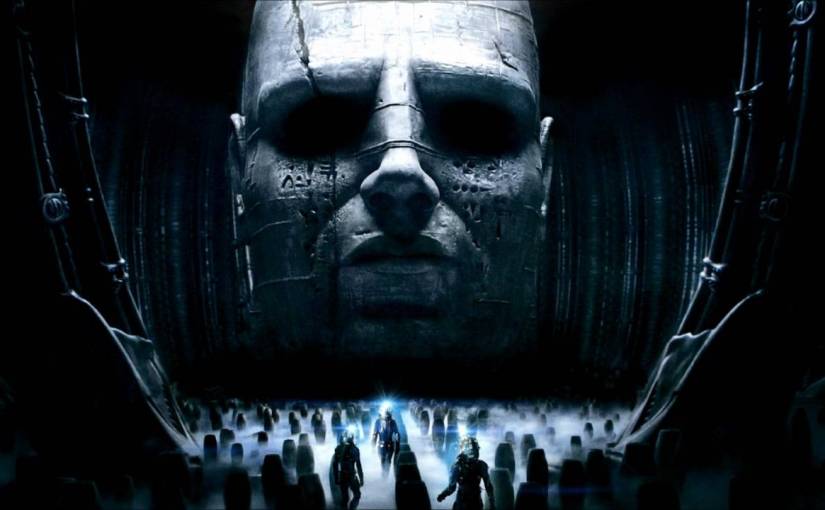
PROMETHEUS

By Marc S. Sanders

In 2012, Ridley Scott was well established as an elite film director that I’d argue could pick and choose what projects he would want to work on.  So, the question is was it worth the opportunity to return to the Alien franchise that had been established back in 1979?  Following its just as magnificent sequel, Aliens helmed by James Cameron, none of the other subsequent installments (including the Predator mish mash stuff) lived up to the first two films. Not even close.  So, was it worth another go at exploring the world of Alien under Ridley Scott’s leadership?  Yes.  I believe it was worth every effort exhausted into making the prequel/side story picture known as Prometheus.

The movie begins with an odd prologue where an unusual looking strong man consumes a black liquid while standing at the precipice of a wild waterfall, while an unidentifiable shadow looms above, darkening a blue sky.  Shortly after his drink, the man seems to violently implode, and a graphic of his DNA strand explodes apart while what is left of him descends into the bottom of the falls.  The natural waters are now contaminated.

Afterwards, in the year 2089, an exploration crew of scientists uncover a hieroglyphic on the wall of a cave in Scotland, and then the film follows Prometheus, a large technologically advanced spaceship (a very cool looking spaceship I might add), on a trajectory into deep space four years later.  An elderly man named Weyland (Guy Pearce) is uploaded on a video and describes the mission to the ship’s crew.  He explains that he is now dead and that the lead scientists, Shaw and Holloway (Noomi Rapace, Logan Marshall-Green), have discovered a link between what they found in Scotland to similar hieroglyphics uncovered in other parts of Earth.  Coordinates lead to this particular planet where Prometheus will make its landing.  Their goal is to research what made them–the human race in other words.

Prometheus works like a sci-fi/monster fest of course, like the other Alien films.  However, I admire the intelligent questions it asks even if it is all based on fiction.  For example, I look at the film as continuously testing whether technology can overcome man, or religion, or even the theory of Darwinism.  A significant character in the piece is an android known as David (Michael Fassbender, doing an uncompromisingly sterile performance).  As the ship embarks on its four-year journey, with the crew resting in cryo-sleep, David continues to collect data including studying the film Lawrence Of Arabia and looking over visuals of Dr. Shaw’s dreams.  Both sources seem to offer a tolerance to live (“The trick…is not minding that it hurts.”) and die.  The latter option depicts a pre-adolescent Shaw inquiring of her father about the death of her mother.  David is a mechanical creation that never stops pursuing advancement even beyond what the science of humanity allows.

Upon arrival on the mysterious planet, the crew enthusiastically approaches a structure to explore.  Finally, they will receive answers to life’s greatest mysteries.  It’s not hard to realize that things will not go as planned, however.  It’s also not worth detailing everything that happens within the confines of this column.  I’ll let you absorb the imaginative visual feast of horrors and effects for yourself.  Most interestingly is that Dr. Shaw shares with her lover/scientist partner that the strong men, which they identify as “Engineers,” possess the same DNA as humans.  That’s an interesting observation.  Is it disappointing though?  Should it be grander for this long hike into outer space?

In many films like Prometheus or Alien, not everything cooperates as the characters expect.  None of that is surprising but it is welcome for the entertainment of suspense and thrills.  However, what I took away from the picture is where technology duals against religion and biology.  A pertinent blink and miss moment occurs following a traumatic event for Shaw.  David the android removes the cross around her neck.  Is there sound reason any longer to believe in God or the biblical teachings she was raised on if Shaw found the origin of herself and fellow humans?  Is her faith now a moot point?

On a scientific level, we learn Shaw is incapable of bearing children.  Yet, through a set of circumstances David informs her that she is suddenly three months pregnant.  The high-tech invention of David may have had a hand in this development by the way, and this is not some normal kind of pregnancy either.  Technology lends to a horrifyingly memorable scene where Shaw “delivers” her offspring. 

I’m sure we all question our beginnings.  Did it begin in six days by God, with Adam and Eve, as initial products?  Was there a big bang that just started it all?  I’d argue these questions will likely never be answered in our lifetimes.  Thus, the debates rage on because we have nothing better to do with our lives.  Cynical, right?  Well movies like Prometheus try to offer suppositions on possibilities.  In fact, there’s one pessimistic crew member on the ship who questions Shaw and Holloway’s goals of undoing a century of Darwinism on some distant planet, billions of miles away from Earth.

As the film reaches its climax, I found it even more interesting that Shaw puts on her cross necklace again, and David asks her if its even necessary at this point. 

The visuals of Ridley Scott’s film are impressive, though the planet surface and space travel doesn’t look any more creative than other science fiction films.  Frankly, it doesn’t need to reinvent the wheel.  The cast is quite diverse in personalities from a space pilot captain portrayed by Idris Elba, to a nothing but business professional played by Charlize Theron.  Other cast members are there for the casualty line up.

How Prometheus relates to the universe of Alien is fun, but the film still stands on its own. This movie does not require knowledge of the other films to follow this storyline.  Yet, if you’ve seen the other pictures, it is fun to uncover a few wink and nods here and there.

Jon Spaihts and Damon Lindelof (writer of the TV series Lost) deserve more credit for the construction of Prometheus because of the subtle debates ingrained in the monster movie themes of the picture.  Would an emergency C-section be considered a natural way of giving birth?  Would a belief in an “Engineer” supersede someone’s faith in a higher God-like power?  Should technological advancement overcome what’s destined for humanity?

As I close this article, you know what?  I’m going to say yes to all those questions.  Whatever put people on the planet Earth to live and occupy, granted us the capabilities to find alternatives to biological functionality.  Alternatives of religion preach a variety of different content that all humans choose to believe (yes even atheism, because if it’s got a name then it is some form of belief).  The science and engineering capability of technology did not arrive and develop without tests and experimentation, and it will forever proceed that way.  Dr. Frankenstein toyed with invention that did not go as expected.  Ridley Scott’s film suggests that the characters of Prometheus had a similar experience.  The point is we never advance unless we try and unless we fail before we hopefully succeed.

MONSTER (2003)

by Miguel E. Rodriguez

DIRECTOR: Patty Jenkins
CAST: Charlize Theron, Christina Ricci, Bruce Dern
MY RATING: 9/10
ROTTEN TOMATOMETER: 81% Certified Fresh Fresh
Everyone’s a Critic Category: “A Movie Based on a True Story”

PLOT: Charlize Theron gives a searing, deglamorized performance as real-life serial killer Aileen Wuornos in Monster, an intense, disquieting portrait of a profoundly damaged soul.


The first time I tried watching Monster, some years ago, I watched it with my girlfriend, but we never finished it.  The scene where Aileen Wuornos (Theron) is attacked and raped, leading to her first murder, was so visceral that my girlfriend had to leave the room before it had finished.  Since that time, she has watched hours and hours of “true crime” documentaries about Wuornos and Bundy and Manson and Speck and so many others.  Go figure.  Having finally finished Monster on my own this morning, I believe she could be ready to give this movie another try, although I’m not sure the version of Aileen Wuornos portrayed in the film will have much resemblance to the one seen in all those documentaries.

In the past, I’ve enjoyed movies like Se7en and Silence of the Lambs and even Zodiac, featuring implacable, inhuman murderers with unfathomable motives and blank faces.  I enjoyed David Fincher’s series Mindhunters far more than I thought I would, despite its disquieting subject matter, partially because the killers portrayed in that series may seem normal at first, but they are eventually revealed to have massive personality disorders, genuine sociopaths with little to no consciences to speak of.  But in Monster, director/screenwriter Patty Jenkins (who wouldn’t direct another film until 2017’s Wonder Woman) denies us the ability to pigeonhole Aileen Wuornos so easily.  She pulls a Hitchcock/Psycho on the audience: getting us to root for the ostensible villain even as she commits one murder after another.

Jenkins accomplishes this by showing how a dysfunctional home life and a sometimes apathetic and cruel society ground down a young girl with the same kinds of hopes and dreams we’ve all had into a damaged woman desperately looking for a connection.  One such apathetic soul in the film says what I’ve thought so many times in my own past about anyone who makes questionable life choices: “Lots of people have bad lives, and they still choose to move towards the light.  Otherwise, we’d all be hookers and druggies.”  Well, sure, that’s easy for me to say, with two loving parents, a private school education, living in a 3-bedroom house and a steady job, etcetera.  But what choices would I have made if my father knew his friend had been molesting me for years and not only did nothing, but beat ME up for it?  What if, in my first job interview, the office manager hadn’t taken a chance on a teenager with no job experience and instead berated me for not having a master’s degree or my own apartment yet?

Monster is not a typical serial killer movie because, while it absolutely does NOT approve of Aileen’s murders, it does not try to pretend she is a mindless, man-hating predator.  She is motivated by hopelessness and, as it happens, love.  Aileen meets and falls desperately in love with a naïve young woman, Selby Wall (Ricci), the first bright spot in her otherwise bleak existence, and will do anything to keep her in her life.  If “anything” happens to encompass hooking and murdering the occasional john, for her it’s a small price to pay for the happiness she has been denied for so long.

Monster has the look of a film shot on a shoestring, much like Henry: Portrait of a Serial Killer, which enhances its authenticity, especially when it’s clear the movie was shot in the real locations visited by Aileen and Selby in real life.  Having lived in Florida for over 35 years, I recognized the feel of the locations, the city streets crowded with convenience stores and car dealerships and seedy motels.  I’m pretty sure I’ve actually been to the “Fun Stop” where Aileen and Selby ride the Ferris wheel.  The usage of these real locations made everything feel legitimate, almost like a documentary.  (Full disclosure: Selby Wall is loosely based on Aileen’s actual girlfriend, Tyria Moore, but Moore refused to allow her name or likeness to be used in the film and divulged little-to-no information about her personal life, so Selby’s character is an estimation at best.)

And then, of course, there’s Charlize Theron’s Oscar-winning performance as Aileen Wuornos.  Anyone familiar with the Wuornos story has seen her most famous photos.  Take it from me: the makeup department used every trick in the book to make Theron look like Wuornos’ double.  It’s uncanny, on par with Rami Malek’s transformation for Bohemian Rhapsody, down to the false teeth that subtly alter her profile.  She even shaved her eyebrows.  But those cosmetic marvels are nothing, nothing compared to Theron’s performance itself.  I recently watched Cate Blanchett in Tár and called that the greatest performance I had ever seen by a woman.  I must now amend that statement.  Theron completely sublimates her famously glamorous persona into a chaotic jumble of nervous speech patterns and a fake swagger and the rambling patter reminiscent of a junkie looking for her next fix.  The only time she ever seems at peace is in the arms of her lover.  This performance is even more remarkable considering how “non-flashy” it is compared to other movie killers like Hannibal Lecter or John Doe.  Sure, she has her outbursts, but rather than feeling like hammy histrionics, they felt raw, like watching hidden camera footage of someone genuinely losing their shit because of some deep personal loss and not because they got the wrong size coffee at Starbucks.  It’s a phenomenal performance.


Attention should also be paid to Christina Ricci’s performance as Selby.  It’s easy to lose sight of Ricci in a film that clearly belongs to Theron, but she pitches her performance just right as another needy soul looking for a connection and all too willing to overlook (initially, at first) the red flags of a girlfriend who comes home in a different car every other night.  Her home life may not have been as scarring as Aileen’s, but she will take any port in a storm offering relief from oppression.

I enjoyed Monster in almost the same way I enjoyed Aronofsky’s Requiem for a Dream.  These people are not the most sympathetic characters ever, or the most relatable, or even the most likable.  But I see how their dysfunctional backgrounds brought them to their desolate situations step by step, and it makes me wonder whether I would have done anything differently in their situation.  I’d like to think I wouldn’t turn to murder and/or drug use in my despair, but Monster made me realize there’s no way to know for sure unless I walk a mile in their shoes.  The last lines spoken in Monster, which I won’t spoil here, lay out the kind of misery Aileen Wuornos seems to have faced at every stage in her life.  Imagine how things might have turned out if she had just been given a chance.


QUESTIONS FROM EVERYONE’S A CRITIC

Best line or memorable quote?
“‘All you need is love and to believe in yourself.’  Nice idea.  It doesn’t exactly work out that way.  But I guess it was better to hear a flat-out lie than to know the truth at 13.”

After watching this film, did you want to learn more about the true story?  Why or why not?
I must be honest and say, no, I did not.  I do not claim that Monster tells the 100% true story from beginning to end.  It’s not a historical document.  It’s a piece of entertainment that strives for truth at the expense of slavish dedication to factual accuracy, and I’m okay with that.  I’m one of those people who believe JFK is a marvelous film, inaccurate though it may be, because it captures the feeling of what it was like during that timeframe.  The same with Monster.  I could watch however many documentaries on the life and death of Aileen Wuornos, and I can’t imagine any other piece of filmmaking approaching truth to any greater degree than this movie did.

YOUNG ADULT

By Marc S. Sanders

Charlize Theron is always an actress who impresses me. Ever since I saw her in The Devil’s Advocate, I’ve been taken with her on screen presence. She simply has a natural way of bringing a character to life, and usually it is with unhinged and complicated women who never escape and overthrow what’s tormenting them. Her Academy Award winning turn in Monster as serial killer Aileen Wuornos is a perfect example, and her role in Jason Reitman’s film Young Adult is a close second best.

Young Adult was written by Diablo Cody (Juno, also directed by Reitman) and depicts Theron as Mavis Gary, a once successful author of a series of novels aimed at pre-teen and teenage girls. When she receives an email baby announcement from her former high school boyfriend Buddy Slade, Mavis wearing her sweatpants and worn-out t shirt packs up her puppy dog and leaves her one-night stand in her Minneapolis apartment and heads back to her small Minnesota town. She’s not there to see the newborn bundle, however. Mavis is under the delusion that she can win back Buddy who is now happily married.

This isn’t going to go well for Mavis, especially while she’s drowning in one bottle after another.

Patton Oswalt plays Matt, a former classmate, who comes upon Mavis’ arrival. Matt knows immediately that Mavis doesn’t have it altogether. She has not endured as well as he has following a terribly violent hate crime experience in high school when he was mistakenly taken for being gay. Mavis recalls this moment but with great insensitivity. She laughs as she reflects on the incident. Her take equates to maybe Matt being victim to a wedgie or being trapped in a locker. It was much worse than that. Matt’s legs and genitals were smashed in the beating.

Oswalt is very good in his role. Matt doesn’t need to have any regard for Mavis, the once popular prom princess. However, he can’t help but see her pitifully make a fool of herself as she attempts to intrude upon Buddy’s life.

Buddy appears naive to Mavis’ sloppy advances. Buddy sees the image of a successful author prim and proper. Matt sees the ugliness of Mavis beneath her makeup and dress clothes that never hang well on her intoxicated stature.

Cody’s screenplay takes place over three days. In that time, she allows her main character to come to the realization that she’s not a happy person and most certainly is alcohol dependent. A baby welcoming party makes evident of this conclusion. It is an event that will be remembered but for all the wrong reasons. Theron is astonishing in this scene. Not a likable character and yet so well performed.

Reitman is a good director with simplicity. He is simple at showing what likely eats at the good, published writer Mavis used to be. When Mavis drives back into town, Reitman shows her car pass by franchise businesses like Chili’s or Staples. There’s no imagination in these locales. No history or depth. There’s no stimulation. It’s all corporate. Just my theory, but I’d say that could drive a successfully imaginative writer into a depression. No wonder Mavis left town. Problem is she moved on with no constants in her life. Consider the fact that Mavis doesn’t even share with her parents that she’s come back into town.

Juno is the better film from Reitman and Cody. There was a broader scope of the characters at play, beyond just Juno herself. Theron and Oswalt are the only ones with multi dimensions in Young Adult. It’s a benefit that the film clocks in at only just over 90 minutes. Any longer and I’d have grown tired of this film. I can’t expect Mavis to overcome her demons in this short period of time. So, we are reserved to seeing how she further undoes herself and nearly destroys the family and people (not friends) she once knew. Basically, Young Adult shows a woman arrive at rock bottom. Therefore, I applaud Reitman and Cody for keeping this film condensed. The high school popularity is but a memory. Success is gradually moving away from her. Despair and depression and the illness of addiction is all that is left for her.

THE ITALIAN JOB (2003)

By Marc S. Sanders

F Gary Gray’s 2003 remake of The Italian Job is crackling with cool and sleek film coverage. It is a blend of wit and fast paced action delivering a solid heist thriller. The cast is terrific as well.

Donald Sutherland plays John Bridger, a near retired master thief and safe cracker. He is ready for one last job with his protégé, Charlie, played by Mark Wahlberg. They assemble a team specializing in different skills like Left Ear, played by Mos Def, who overlooks explosives, Lyle or “Napster”, Seth Green, as a computer hacker, and “Handsome Rob,” Jason Statham, the getaway driver. With another member named Steve (yeah, he’s just called…ahem…Steve) played by Edward Norton, they successfully rip off a safe containing $35 million in gold bars from a home located off the straits of Venice, Italy. However, Steve betrays the team leaving them for dead.

Jump to a year later and the team ventures out to Los Angeles with Stella (Charlize Theron), another safe cracker and daughter to John. They have an opportunity to even the score with Steve while also collecting what’s left of the gold bars. Early on, an idea is conceived to use light weight, speedy MINI Coopers to get in and haul away the booty. However, soon they learn that it’s not so easy to just take it from Steve’s house. They will have to apprehend the gold while in transit.

There’s nothing overly special about The Italian Job. I don’t think Gray was looking to achieve an iconic classic. He just made a solid caper flick that’s pure fun. Sure, the thieves would likely get busted. No, the timing of everything from sabotaging the downtown traffic lights and exploding a precise hole in the street for an armored car to fall through would never occur so perfectly. Who cares? This film is a pitch perfect dance in car chase choreography where we get a kick out of watching sporty little red, white and blue MINIs careen through a subway system, down public staircases and through cylindrical tunnels. It’s all done to get your heart racing.

The players are fun but they aren’t putting in much dimension. I doubt they did much research on the specialized skills their respective characters possess. Maybe Theron researched how to crack a safe. She amps up some nail biting in those sequences as Gray edits between high speed motorcycles approaching while she’s quietly trying to concentrate on the lock’s combination.

There are some cute inside jokes. The best being that Lyle insists he is the inventor of Napster (a little dated by now), and the idea was stolen from him by Sean Parker. The real Sean Parker makes a quick cameo as that scene is told in flashback. Seth Green is quite funny in a nerdy kind of way.

I like the cast. Norton plays a good jerk for villain; a real “Frank Burns.” I appreciate the story behind his character. Early on before he betrays the team, each member shares what they are going to spend their money on. Later, it’s revealed that Steve just used what he ripped off to buy everything the other guys had in mind. He’s a killer and he’s a jerk, but he’s also a guy with no imagination or creativity. I like that angle for a bad guy. He’s only just so much of a genius.

The Italian Job is a fun film that is never too intense, and offers great surprises in the step-by-step process of how to pull off a cinematic heist. If anything, it’ll make you wanna buy a MINI Cooper. I came…THIS CLOSE one time!

THE DEVIL’S ADVOCATE

By Marc S. Sanders

The Devil’s Advocate does not get the accolades it truly deserves, and I’ve never understood why. It is more than just a supernatural thriller or a legal drama. It’s both actually, and most films cannot lay that claim.

Director Taylor Hackford has assembled a brilliant cast that boasts a debut from Charlize Theron in the incredibly complex role of Marienne, wife to Keanu Reeves’ hot shot southern drawled, Gainesville attorney. Theron hits every pulse perfectly beginning with loose, beautiful and cocky to insecure, haunted and victimized. When I first saw the film in theatres, I left believing she’ll get an Oscar nomination. Alas, the powers that be never gave her consideration and they were wrong. Beyond a relishing Al Pacino as the lord’s most infamous fallen angel, Theron’s performance sends the script home into absolute believability. The power of Satan is executed on Marienne, and the visual and audible evidence lies in Theron’s delirious performance. She’s astonishing.

Next up, Reeves is entitled to lots of credit. The role of Kevin Lomax is his best role (Ahem…Sorry, Neo. Sorry John Wick. Sorry Johnny Utah.). He carries a disillusioned swagger that he is as good as his record of trial wins implies. Yet, is he as good as the best of the best New York City attorneys? When you are the son of Satan, maybe so. What works best though are the ongoing tests of will for Reeves’ character. His inescapable hillbilly dialect blends perfectly with a script that questions temptation against instinct, against opting for what is right. At the time of release, Keanu Reeves might have been perceived as his surfer dude Bill & Ted character not be taken seriously enough here. I never let that be an interference for me, however. Reeves doesn’t compromise and he avoids the wholesome, God-fearing kid that Kevin Lomax is meant to be. Instead, his Christian teachings seem like a nuisance for him; an obstacle to a more satisfying life regardless of sin. Reeves balances the dimensions beautifully.

Then there’s the machine behind all this. Al Pacino is John Milton, hardly disguising his true identity. He’s too proud of who he is to do that. Sure Pacino is chewing the scenery. Yet, shouldn’t he? This is Mephistopheles he’s playing here; an entity ready to undo the will of the Lord. He carries no honor for God. However, he maintains a rule book and before he accepts a disciple, he’ll make certain that it is by the follower’s choice alone. He administers the test, but he doesn’t take it. Pacino gets the best lines and the best monologues. He’s treated with an opportunity to two step along to Frank Sinatra. He’s given free reign to operate based on his legendary career. He’s my favorite devil of any and all films.

Taylor Hackford is meticulous in his direction. There’s a great moment near the beginning where Kevin is saying goodbye to his God loving and very Christian mother. He goes to her church. This is the first of many smart choices for Hackford. He does not allow Kevin to step inside the church. Rather, he paces just outside the door. Kevin does not have a relationship with God, thus opening an opportunity for Satan. Other moments are there too, such as Milton always insisting on traveling by subway…underground. Heck, there’s even a moment where a man with a box that says “Halo Industry” walks by Kevin and John; nice subtle nod. New York City is treated like a character boasting its numerous, sky-high cathedrals and angelic artwork. Pacino is the ultimate NYC resident; a creature of the concrete jungle. Hackford also recruits the notorious to boost the lair surrounding Reeves and Theron with appearances from the likes of Don King and Alphonse D’Amato. (Satan’s disciples, perhaps?)

This is one of my favorite films. It carries not one single flaw. It is richly assembled in dialogue, story, cast, set design and direction.

The Devil’s Advocate is one of those films that you want to watch over and over and delight in Pacino’s thought provoking one liners, debate with your conscience vs Satan’s own argument (he makes some good points here) and question the power of free will. It’s a fun, thinking picture.

PROMETHEUS (2012)

by Miguel E. Rodriguez

Director: Ridley Scott
Cast: Noomi Rapace, Michael Fassbender, Charlize Theron, Idris Elba, Guy Pearce, Logan Marshall-Green
My Rating: 10/10
Rotten Tomatometer: 73%

PLOT: A deep-space research vessel arrives at a distant moon, searching for clues to the origins of mankind.  What they find instead threatens their lives and the lives of everyone back on Earth.


I am at a loss to explain the mediocre Tomatometer score for Prometheus, Ridley Scott’s long-awaited return to the universe he created in Alien [1979].  Intellectually, I can hear the arguments:

  • “Where’s the Xenomorph?”
  • “So did the ‘Engineers’ create humans or what?”
  • “Is that planet at the beginning supposed to be Earth?”
  • “Where’s the Xenomorph?”
  • “Why did that idiot scientist approach the snake-looking creature?”
  • “How is the android able to break almost all of Asimov’s Laws of Robotics?”
  • “What’s with the open-ended ending that provides no resolution?”
  • “WHERE’S THE XENOMORPH???”

I get it.  You hear Ridley Scott is making a prequel to Alien and you build up a lot of expectations, especially after watching some of the sorrier sequels that piled up after Aliens [1986].  When you go into a movie expecting one thing and get another, people get hacked off.  I feel you, bro.

But to those people who dismissed Prometheus because it didn’t deliver what they expected to get, all I can say is: your loss.  Because Prometheus is one of the greatest sci-fi movies of all time, in my humble opinion, and it’s mostly for the very same reasons that people disliked it in the first place.

After a brief prologue set in an unknown time in an unknown place, we jump to the year 2093, when a deep-space research vessel arrives at a far distant moon, searching for clues to the origin of mankind.  Dr. Elizabeth Shaw (Noomi Rapace) says they were led to this specific moon by “Engineers”, humanoid beings who are visible in ancient cave drawings from across the globe.  She believes the Engineers can provide an answer, THE Answer, to Life, the Universe and Everything. (Apologies to Douglas Adams.)

Instead of Engineers, Dr. Shaw and her expedition discover miles of underground caverns and a room full of canisters that turn out to contain a horrifying contagion that attack the body at a cellular and/or genetic level, creating painful mutations that, if they don’t kill the host outright, turns them incredibly violent.  We also get a glimpse of the famous “space jockey”, the fossilized alien creature seated in some kind of contraption inside the spaceship in Alien.  So at LAST we’re in familiar territory.

But still no Xenomorph.

The story progresses, the shipboard android turns out to be less than trustworthy, people die in creative and horrifying ways, an Engineer actually turns up, we get a couple more visually spectacular tie-ins to the first Alien…but by the time we get to the end, what gives?  The movie’s obviously over, but we haven’t gotten any answers to the burning questions: Who are the Engineers?  If that was an Engineer in the prologue, was that supposed to be Earth?  If it WASN’T Earth, why even HAVE that prologue?  And don’t try to tell me that was a Xenomorph at the end…

Well, here’s my two cents.

First, of all, expectations are tricky.  They can color and compromise your entire movie-watching experience.  When I went to see Prometheus, I did have my own set of expectations, but as the movie settled in and it became clear that the movie had other designs, I had to consciously shake myself loose of my expectations and embrace what was being presented to me.

Second of all, the visuals are stunning.  I happened to see this in 3-D, and it’s one of a handful of movies where the technology was used PERFECTLY.  No gimmicky shots of spears or harpoons or whatever being pointed out of the screen.  It was used as it should always be used: as a tool to further immerse you into the world of the film without overloading you or being ridiculously obvious.  The gorgeous landscapes during the prologue and during our heroes’ descent to the surface are awe-inspiring.

And then, the story.  I was completely okay with the open-ended nature of the story, and I’ll tell you why.

There are some films out there that play Prometheus’s game of asking questions and not answering them.  One of the most famous examples is Stanley Kubrick’s adaptation of 2001: A Space Odyssey [1968].  If you’ve never read the book, I defy you to provide a concise explanation of the last thirty minutes of that movie.  But that didn’t bother people, because the goal was to get the viewer to ask questions, to provoke discussions about the movie that would eventually get around to some of the same questions asked in Prometheus: Why are we here?  What is our purpose?

And then there are other films that play that open-ended game and fail.  The one that comes immediately to mind is Darren Aronofsky’s The Fountain [2006].  By the end of that movie, my head was locked in a tilted position like a cocker spaniel hearing a strange noise.  If I had been a cartoon character, the word balloon over my head would have been all question marks.  I once read a full description of what was really going on in that film, but to the degree that I understood it, I simply didn’t care.  If I have to go that much work to “get” a movie, the movie didn’t do its job.

There are those who say that’s what Prometheus did, throwing us in the deep end and making us do some mental heavy lifting with no payoff.  But I disagree.

I think, for me, it has to do with the very nature of the questions Prometheus is asking.  “If we could discover the answers to the riddles of our existence, to what lengths would we go, or should we go, to get those answers?  And do we even want to know the answers?  Are we better off NOT knowing?”  These are questions that, almost by definition, can’t be answered in any satisfying way.  So Prometheus presents a possible answer, but then teases it away so there is still some mystery in the story.  If the characters in Prometheus had discovered some kind of document that laid out the Engineers’ plans in detail, I would have felt cheated.  It would have been woefully anticlimactic.  I liked it better that the biggest questions went unanswered, so I could formulate my OWN theories about the Engineers, their plans, their methods, their history, their future, etcetera.  It’s much more stimulating to let my imagination run riot.

(Granted, some of those questions are answered in Alien: Covenant [2017], but that movie still had the guts to leave some things to the imagination by the end.)

Prometheus couches deep philosophical riddles about our very existence within a crackling good thriller with spectacular visuals from beginning to end.  It stands tall as one of the best prequels ever made…Xenomorph or no Xenomorph.

LONG SHOT (2019)

By Miguel E. Rodriguez

Director: Jonathan Levine
Cast: Charlize Theron, Seth Rogen, June Diane Raphael, O’Shea Jackson Jr., Bob Odenkirk
My Rating: 8/10
Rotten Tomatometer: 81% Certified Fresh

PLOT: Secretary of State Charlotte Field (Theron) hires an out-of-work journalist (Rogen) as a speechwriter; when romance unexpectedly occurs, complications ensue.


So, yeah, based on that plot summary, this is not exactly new territory.  We essentially have a gender-swapped The American President, except the President is now a Secretary of State, and Annette Bening is now Seth Rogen, whom the Secretary of State used to babysit in high school.  Sounds kinda kooky, but still nothing earth-shattering, right?

Except that the filmmakers have found a way to take a plot as old as Pretty Woman itself, and as recent as She’s Out of Your League, and inject it with astonishing humor, topical and situational, so that I found myself laughing or grinning through nearly every second of Long Shot.  And that was WITH Talky McTalkerson sitting next to us commenting to himself on the action.  (“How are you gonna say no to that face? … Oh, no, they’re stoned! … Oh, no, he doesn’t understand her!”)  But that’s another story…

I enjoyed so much in this movie, it’s hard to pick it apart for a review.  I’m not sure why.

I liked the gender-bending aspect of it.  It was cool to see a high-octane actor like Charlize Theron deliver the kind of speeches normally reserved for male romantic leads.  And it wasn’t done in an obvious way.  It’s something that only occurred to me after the scene was over.  Most of the time.

I liked the topical aspect.  Seth Rogen’s character is a high-minded reporter working for a liberal newspaper that has just been bought out by a multi-media conglomerate with a reputation for spewing propaganda.  (“Not the good kind, like ours!  The BAD kind!”)  The conglomerate is owned by Parker Wembley, an obnoxious billionaire whose influence extends all the way to the White House.  (I wouldn’t dream of revealing who plays Wembley, but it was a treat once I realized who was under all that makeup.)

The not-so-thinly veiled jabs at Fox News were a nice touch.  Wembley has his own news network, and one of the newscasts asks the question, “Are women smart enough to be in positions of power?  We’ll ask our panelists, Chris Brown, Jeremy Piven, and Brett Ratner.”  (In a movie full of funny lines, that might be the funniest.  Sorry I spoiled it for you.)

I also LOVED a scene between Seth Rogen and his best friend that gets a LITTLE political, but which really made me think about my own attitudes towards people with different political beliefs than mine.  I don’t want to spoil the scene with too many details, but I bring it up just to emphasize how much this movie has going for it besides the obligatory big laughs.

And it has some BIG laughs.  Rogen is an old hand at physical and raunchy comedy, but who knew that Charlize Theron would be able to keep pace with him?  It’s not that she does the same kind of mugging that Rogen does.  It’s the way she underplays her reactions to his behavior, and tries to keep her attraction to him low key for all sorts of reasons that make sense at the time.

Plus, Theron does get her moment in the comic spotlight when, after a hard day at work, she whispers to Rogen, “I want to smoke a molly.”  What follows is something I never thought I’d see: Charlize Theron getting wasted on drugs and dancing at a rave.  I can die happy.

(Trust me, I’m not spoiling too much, because this scene has an AMAZING comedy payoff that had me almost screaming with laughter.)

Long Shot covers some very old territory in very new ways.  There are some amazing insights into the cultural landscape of the late “20-teens” that are fresh and funny and surprisingly thoughtful.  If I had to change one thing about it, I might have tried to come up with a SLIGHTLY different ending, maybe one that didn’t tie everything up QUITE so neatly, but what am I saying?  It’s a romantic comedy.  Like they’re gonna make a rom-com where the girl DOESN’T get the guy, right?

(Yes, wiseguys, I know there are precedents – Roman Holiday among them – but that’s REALLY rare.)