
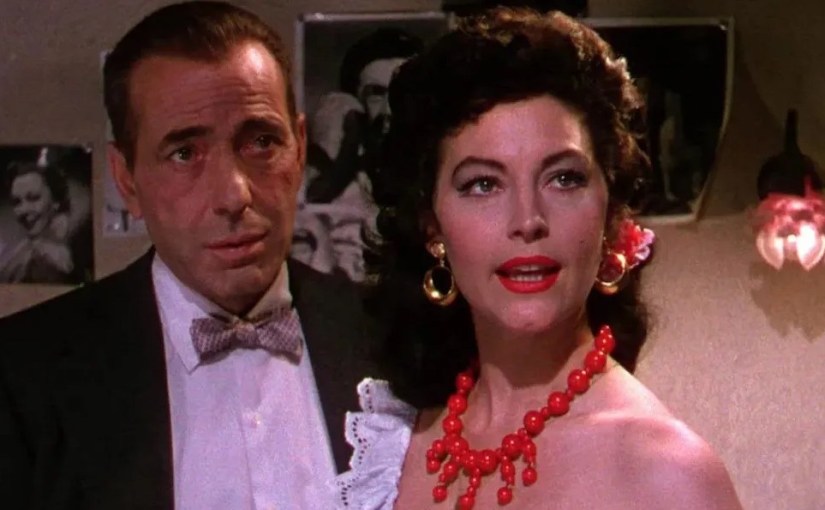
THE BAREFOOT CONTESSA (1954)

by Miguel E. Rodriguez

DIRECTOR: Joseph L. Mankiewicz
CAST: Humphrey Bogart, Ava Gardner, Edmond O’Brien, Marius Goring, Rossano Brazzi
MY RATING: 7/10
ROTTEN TOMATOMETER: 100% Fresh

PLOT: The life of a Hollywood star whose candle burned briefly and brightly is told (mostly) by the writer/director who helped discover her.


Towards the beginning of The Barefoot Contessa, I let my expectations get the best of me, as I tend to do.  There were scenes between movie producers and directors and conversations about actors and the movie business and dialogue about bad dialogue at the movies, and I settled myself in for another scorching “behind-the-scenes” movie like Sunset Blvd. or The Bad and the Beautiful.  Heck, it was written and directed by All About Eve’s Joseph L. Mankiewicz, so how could I NOT expect something similar?  But I was wrong.  True, the film takes potshots at the industry, but later on it all feels incidental, a necessary sideshow to lead us to the main attraction.

The Barefoot Contessa is a character study about a woman named Maria Vargas (Ava Gardner), who is discovered dancing in a Madrid café by B-movie writer/director Harry Dawes (Humphrey Bogart) and kajillionaire producer Kirk Edwards…whose resemblance to Howard Hughes had to be toned down under threat of legal action from Mr. Hughes himself.  They are scouting for new talent along with Edwards’s gofer, Oscar Muldoon, played by Edward O’Brien, who won an Oscar himself for the role.

Maria is convinced to do a screen test, not by Oscar or Edwards, whose wealth has turned him into a spoiled child, but by the gentle persuasion of Harry Dawes, who quickly sizes Maria up as someone who is not to be bullied or cajoled.  One thing leads to another, and she makes three films in America, all directed by Dawes, and she becomes an enormously popular star, beloved by millions…and three weeks after her fairy-tale wedding to an Italian count, she’s dead.  (That’s not a spoiler; the film opens at her funeral.)

There are so many stories of Hollywood stars who achieve overnight success only to die young for one reason or another.  The Barefoot Contessa tries to get into the mindset of one such actress, but only from the outside, as the public knew her.  Not her friends, because she really only had one: Harry Dawes, the only person who really knew what made her tick, thanks to a heartfelt conversation outside her impoverished Spain apartment.  How much of this conversation reflects what really goes in any actor’s head?  Probably a lot.  She talks about childhood fears, a desire to be loved, her unhappy home life with her parents, insecurities, superstitions (she refuses to wear shoes whenever possible)…there isn’t an actor walking this earth who couldn’t identify with at least two of those issues.

We follow Maria as she moves to Hollywood, changes her last name to D’Amata because it’s more exotic, and becomes a superstar almost against her will.  Ava Gardner plays Maria as someone for whom acting is not a dream job, it’s just a job.  If the by-product is fame and fortune, well, that’s just a lucky break.  Maria is looking for the fairy tale, but it doesn’t involve limos and red carpets, nor does it involve finding a prince who’ll put the slippers back on Cinderella’s feet.

The Barefoot Contessa shifts narrators a couple of times, but it all leads to her fateful meeting with, and eventual wedding to, the dashing Count Vincenzo Torlato-Favrini, an Italian nobleman who “rescues” her from a verbally abusive paramour.  The Count, though, harbors a secret that Dawes, with his “number six sense”, is bothered by, but can’t quite pin down…and since I knew Maria would be dead soon, I thought I knew what that problem was, but boy, was I wrong…

This film may not spark and crackle like All About Eve, but it’s chock full of ideas.  There were times when it felt like it was trying just a little too hard to be a “great” movie, and I know that’s vague, but it’s the best way I can think of to describe it.  I think I need to watch it again, now that I know more or less what’s going to happen, and appreciate what it’s trying to say in the context of stars like Jean Harlow, or Heath Ledger, or Marilyn Monroe, or James Dean.

This movie isn’t so much a “at-what-price-fame” kind of story, though, like Walk the Line or [insert title of musical biopic here].  It’s more like a portrait of someone who beat the system, who was able to reap the benefits of stardom without being consumed by it, much to the consternation of everyone around her.  (But it’s not what killed her; write that up to her desire for the fairy tale.)
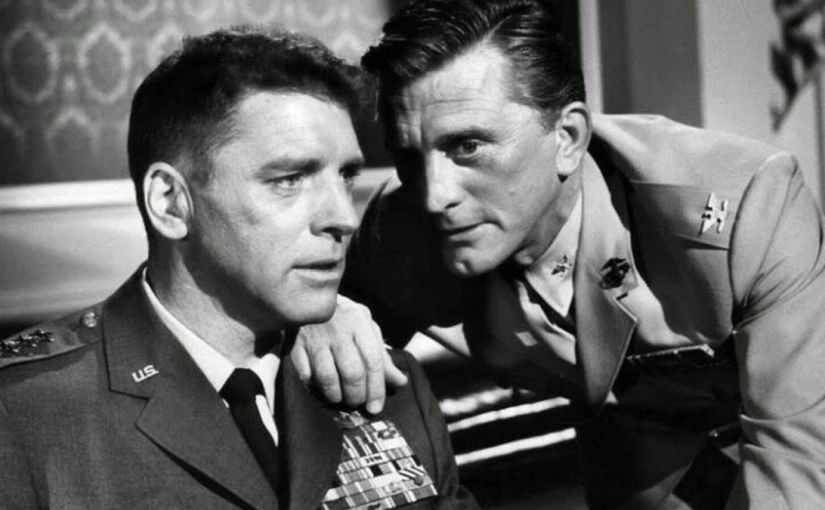
SEVEN DAYS IN MAY (1964)

by Miguel E. Rodrigugez

DIRECTOR: John Frankenheimer
CAST: Burt Lancaster, Kirk Douglas, Fredric March, Ava Gardner, Edmond O’Brien, Martin Balsam
MY RATING: 9/10
ROTTEN TOMATOMETER: 91%

PLOT: United States military leaders plot to overthrow the President because he supports a nuclear disarmament treaty, and they fear a Soviet sneak attack.


Barely two years after The Manchurian Candidate shocked audiences, director John Frankenheimer delivered the goods again with a political conspiracy thriller that is the equal of Candidate in almost every way.  Were it not for some overcooked sermonizing during a transitional scene, I would almost call Seven Days in May a perfect example of the genre.  I’m frankly a little surprised it’s not mentioned more often in the same breath with other similar thrillers like Fail Safe, The Parallax View, and Three Days of the Condor.

The action starts on a Monday and, predictably, spools out over the next seven days.  We learn that the current American President, Jordan Lyman (Fredric March) has just signed a nuclear disarmament treaty with the Soviets, this being the height of the Cold War in the early 1960s.  His actions have brought his approval ratings to a record-setting low, and demonstrators outside the White House express their desire to see someone else in the Oval Office: General James Scott (Burt Lancaster), a hawkish individual who sees no evidence the Russians will ever honor such a treaty.  General Scott’s aide is Colonel “Jiggs” Casey (Kirk Douglas), a soldier who disagrees with Scott’s views privately, but who knows his duties and performs them admirably.

Over the next couple of days, Casey picks up scraps of conversations from senators and other generals critical of the President.  There is talk of the President attending an “alert”, or an exercise in which armed forces are scrambled in a drill; uncharacteristically, he’s attending alone – no press.  A friend of Casey’s mentions something called “ECOMCON”, a secret Army base in El Paso, and a mysterious “Site Y.”  A Pentagon messenger relays a teletype message from General Scott to other members of the Joint Chiefs about who’s placing bets in the Preakness pool…then gets transferred to Pearl Harbor.  Casey wonders why questions about a horse race would be broadcast over Top Secret channels…

Watching Casey piece the clues together is one of the pleasures of this movie.  It never talks down to the audience, depending on them to follow Casey’s line of reasoning while he draws his own conclusions.  Once he brings his suspicions to the President, and the President elects not to attend the alert, things start happening very fast.  It’s here where the height of suspense occurs, as three men are sent in different directions to accomplish three separate fact-finding missions.  As each man got closer to achieving their goal, there was a feeling in the air, a vibe, a tone that felt like disaster was just around the corner, knocking on the next-door window.  A man drives his car into the desert in search of the secret base in El Paso, and I half-expected the sands to just open up and swallow him whole.

Frankenheimer always was an expert at that kind of suspense generation.  Second only to Hitchcock among his contemporaries, he was a genius at creating tense situations with a minimum of flash, depending on strength of story and screenplay, and his actors, to generate a nervous tension in his viewers.  Those powers are on full display here.

It’s odd…Seven Days in May is a political thriller that doesn’t have any real action scenes or sequences.  A plane crash is referenced but never seen, as opposed to today’s films that would make room in the special FX budget to show audiences the crash.  At least in this film, it’s far more effective when it’s revealed but never seen.  That’s pretty gutsy.  There are no pumped-up chase scenes between a guy with crucial evidence and the shadow forces trying to keep it a secret.  It’s all handled very simply, which makes everything more plausible…and, as a further result, much more suspenseful.

I haven’t mentioned Ava Gardner’s character yet, Eleanor Holbrook, a former lover of General Scott’s.  How she figures in Casey’s plans to uncover evidence of Scott’s treason leads to a devastating scene involving old love letters and mistaken assumptions.  It’s some brilliantly incisive writing, and another example of how the movie achieves plausibility through simplicity.

Any further discussion would necessarily involve spoilers, so I’ll stop here.  Seven Days in May is a prime example of a good story told well, with hardly any bells or whistles.  It reminded me, for some reason, of some of those classic ‘80s thrillers where their only reason for existence was to turn up the tension without getting bogged down in subtext (Body Heat, No Way Out, Blow Out).  There is that one sermonizing speech, as I mentioned before, and I cringed a little when it happened, but it’s a minor quibble.  This is a superior thriller that deserves to be seen.