MISSION: IMPOSSIBLE THE FINAL RECKONING

By Marc S. Sanders

The blessing behind Mission: Impossible The Final Reckoning is that it opts not to follow the uninspired routine that was settled for with the previous entry, Dead Reckoning Part I.  With myself included, that film was poorly received overall (look for my review on this page). It performed way below box office expectations as well.  After its release, writer/director Chrisopher McQuarrie and producer/star Tom Cruise were in a quandary.  The hanging thread of a magical key/MacGuffin and the answer to destroying the omnipotent Entity were left unresolved.  A new film had to be made, despite an empty storyline.  Money had to be spent.  So, the guys needed to invest it wisely.  For the most part, the finances were used quite well as the pair learned what worked. More importantly they steered away from what didn’t.

What this movie improves upon is a hearkening back to some of the favorite elements of almost all of the prior films in the series, now on its eighth chapter.  Naturally, some citations cover what occurred in the last film to drive the continuous thin story of Final Reckoning. There are references made to the mysterious Rabbit’s Foot from the third picture, a favorite of mine.  Most notably, is the return of a long-lost character that no one would ever expect to turn up again. The best thing is that he truly serves the mission.  He’s not just a cameo blink and miss it.  Ghostbusters: Frozen Empire repeated that terrible grievance over and over.  The return of this particular guy actually makes you smile, laugh and cheer.  Yes, believe me when I tell you that marketing for Final Reckoning thankfully do not share every detail.  There’s more here than Tom Cruise running and running some more. 

Miguel and I took advantage of an IMAX presentation, and for two guys who normally favor Dolby, this action/adventure should only be seen on IMAX.  Probably the best film I’ve ever seen in this medium and I saw Dead Reckoning Part I this way, but that did not measure up to what’s offered this time.

Tom Cruise is absolutely nuts.  He’s over sixty and he’s doing some of the most daring stunts he’s ever accomplished.  The insurance bill to cover his safety must be at least half the budget to make the movie.  The famed biplane scenes that you likely caught in trailers, even on the marquee poster, is so much more impressive on IMAX.  You are seeing every limb of the actor’s body stretch to their breaking points to hang on to first a red plane and later a yellow plane.  Cruise’s facial muscles stretch against the G-force that is giving him resistance at ten thousand feet in the air.  McQuarrie makes sure to cover every inch of these flying machines from the cockpit to the wings and the tail rutters and the landing wheels underneath.  Cruise’s superspy, Ethan Hunt, has to climb all over these things as they go up and down and upside down and right side up on top of bursting into flames.  This scene is not even over in ten minutes.  It feels like a good twenty-five minutes and it looks like it’s no easy feat for Mr. Hunt.

Midway through the film finds Ethan Hunt deep sea diving to a shipwrecked submarine.  This sequence might rely more on set design, but I was convinced the entire time that Cruise was actually that deep below the surface of the water.  Memories of James Cameron’s The Abyss come to mind, but McQuarrie’s craft of this middle sequence within his three-hour film is so well edited and designed.  On IMAX you feel yourself submerged with the weight of the ocean above you.  The film will cut to the outside of the sub to show it drifting as Ethan Hunt shifts from one side of the interior to the other.  Whatever action the guy takes, the sub works against him leaving you wondering if the vessel is going to topple over an ocean floor cliff to even greater and unescapable depths. 

I will never like this movie as much as when I saw it in the IMAX screening.  It’s impossible to feel the same way on a large in-home flat screen.  This is a giant movie.

Grand set pieces with the sub or the planes had me thinking that Christopher McQuarrie should get a Best Director nomination.  I know it won’t happen but not everyone can accomplish what’s offered in Final Reckoning.  Could Martin Scorsese or Francis Ford Coppola?  I question that, because this is an altogether different kind of beast.

McQuarrie must have done a polish on the violations he committed with the last film.  The story remains to be nothing but a chase with countdown digital clocks and the urgency for all of these tasks to be accomplished by Ethan and his team at the exact same second (a repeat M:I staple), but the dialogue does not drive in literal circles of similar vocabulary this time.  Terms like “the key” and “the entity” are not so exhaustingly uttered over and over in this film.  Esai Morales, as the conniving Gabriel, is much more interesting.  In the last movie he was terribly boring.  No charm.  No anger.  No brattiness.  Here, he at least gleefully laughs at Ethan’s demise.  He’s still far from a great villain and totally forgettable, but at least he’s given something more to do than just stand menacingly behind Tom Cruise. Morales is not just donning a dark tan and a salt and pepper goatee. 

Most of Ethan Hunt’s team is given something to do, particularly Ving Rhames as Luther and Simon Pegg as Benji, always reliable.  Hayley Atwell was the best feature of the last movie and she’s great here too as the pickpocket, and now supposedly a quick learning kick ass superspy.  Kind of—No-VERY ridiculous but I stopped asking questions.  Atwell deserves a franchise series of her own.  She’s charming and lights up the screen.  Great actor too.

Pom Klementieff as the dangerous assassin Paris is now a good guy and other than speaking eloquent French she’s regrettably become a ho hum element.  There are other unnecessary characters including Kittridge (Henry Czerny) and those two guys who were chasing Ethan in the last movie.  One carries a stupid secret that’s more like an unwelcome surprise.  The other joins Ethan’s team to shoot a gun and look panicked. 

It will only frustrate you to follow when Ethan or Gabriel has the upper hand.  Christopher McQuarrie fleshes out his overly long three-hour picture playing games like that, and I stopped trying to pass his impossible SAT exam.  The attractions are a few of the characters who work with Ethan and the great feats of strength that the hero attempts to overcome. 

It is not the best in the series.  It is a huge improvement over the last picture, though.  What’s most significant is that Mission: Impossible The Final Reckoning is a gorgeous, mind blowing and breathless visual opus.

SEE IT ON THE IMAX before it self-destructs on your flat screen in five seconds.

THE SCORE

By Marc S. Sanders

Nothing like a good heist thriller.  Am I right? 

It is hard to believe that Marlon Brando’s final performance was with Robert DeNiro and yet the two were never part of the same cast before.  Finally, though, the Oscar winning actors, who were both recognized for portraying Vito Corleone, teamed up for a little film that contained some daring thrills while also welcoming some crackling good acting scenes together.  Edward Norton joined them, and it worked sensationally.  The Score, directed by Frank Oz, is a forgotten gem, or in this case as priceless as the gold and jeweled scepter the three set their sights upon stealing.

Filmed on location in Montreal, DeNiro portrays Nick, a professional thief who is very disciplined in his work and would never dare commit a heist in his own town where he publicly operates as a jazz nightclub owner.  As the opening scene suggests, he only practices outside of his city and usually outside of Canada.  Yet, a brash cocky kid named Jack (Norton) enters his private life with a proposition too good to pass up.  DeNiro’s handler/investor, Max (Brando), urges Nick to overcome his reluctance and team up with Jack for one last score that’ll rake in thirty million dollars. Once the job is done, six million is earmarked for Nick.  Finally, Nick can get out of this business and move on with his nightclub mortgage paid off.  He can also get more serious with his stewardess girlfriend Diane (Angela Bassett). 

The MacGuffin?  A scepter from the 1600s that was crafted for French royalty.  It is currently locked in a state of the art safe located within the basement of the Montreal Customs Building.  This fortress is equipped with cameras, security guards, sensors, you name it.  Jack is working on the inside, posing as a mentally challenged maintenance man.  He supplies all the intel to Nick with ways to get inside showing him who is doing what, where and how.  Nick then prepares the strategy around what information is collected.

The shakedown of The Score is nothing unfamiliar.  The enjoyment comes from the acting scenes between the actors, especially when it is DeNiro and Brando.  It is as thankful to see these two legends perform on screen as it was to see DeNiro team up with Al Pacino in Michael Mann’s Heat.  This older interpretation of Brando is so entertaining.  He has a lot of fun with Max’ sarcasm and when he curses it just comes so naturally.  Just a huge departure from what the actor did in classics like Streetcar and On The Waterfront.  DeNiro is great at chastising Brando’s character with the risks he’s taking at getting them in trouble.  Their dialogue works beautifully with their performances.

Same goes for DeNiro and Norton.  It’s not so much a mentor/student relationship.  Right from the start, there is friction. Nick is overly cautious while Jack is anything but.  Yet, the film primarily focuses on the thieves’ preparation for the big job and the characters speak as if there is a trust or honor among them, but the skepticism remains.  Often Jack is defiant of Nick’s specific instructions.  Norton is great going at odds with DeNiro.

Once the wheels are set in motion, the pattern of the script is to introduce one unexpected obstacle after another.  At one point the men realize they need a particular access code.  So, an exchange in a public park has to take place. Against Nick’s wishes, Jack plays a potentially dangerous game.  Later, it is learned that the scepter might be moving on from Montreal.  So, the job has to be completed much sooner than planned.  Max seems to be hiding some details as well that leave Nick uneasy.  By the time all these bridges are crossed you have a solid foundation for the first two acts of the film before the heist gets going.  It’s all good stuff.  The epilogue to the picture is very satisfying as well with a couple of unexpected twists thrown in.  When a bag gets unzipped, you’ll likely be nodding your head and applauding.

Edward Norton is a fantastic character actor (when he’s not being a straight lead in other films).  Just like in films such as The Incredible Hulk, Fight Club and especially his debut Oscar nominated performance, Primal Fear, he dons a dual personality for this role.  Norton easily contorts his physicality to portray “Brian” the guy who’s working on the inside of the Customs Building.  When the persona is shed though, Jack is a guy that most need to be careful to trust or go up against.  Edward Norton demonstrates such ease with the transitions from one personality to the other. 

Angela Bassett is terrific actor, but her character belongs in another movie.  The one shortcoming is that Bassett feels more like a prop for DeNiro’s motivation rather than a fully-fledged love interest.  Out of context, the scenes they share are really impressive, but within the framework of the picture, Bassett comes off as an inconvenient detour.  It’s not her fault.  The relationship between Nick and Diane just does not seem to belong here.  I never had any urge for their happily ever after wrap up.  I was only concerned with Nick, Jack and Max pulling off the score.

Another minor shortcoming is Howard Shore’s soundtrack for the film.  It plays with loud horns that scream official action.  Yet, when the scenes are absent of music or only accompanied by soft jazz performances from Mose Allison and Cassandra Wilson does The Score feel like it is in its quiet mood comfort zone.  Howard Shore’s louder pitch just feels a little too intrusive here because these guys operate in whispers and clandestine actions.  I especially get a kick out of how Nick and Jack use their special tools that quietly click and turn and thump with no other sound in the area.  Their hardware work like musical instruments. 

Overall, this is a delicious, sophisticated thriller with an outstanding cast and Frank Oz’ direction thankfully does not get too inventive because he knows he’s assembled an A plus collection of actors.  Oz also has the art design and scenic details within Montreal working to his advantage. The locales are peppered in with a welcome French culture along the cobblestone streets.  DeNiro and Brando seem very comfortable and absorbed in this city that’s rarely used as a backdrop in film. Lastly, the procedure of the actual theft at play is a lot of fun to watch as it all seems plausible but still impressively crafty.

It’s worth your risk to check out The Score on a Friday or Saturday night when you need to get away from the chaos of everyday life.  It’s a quiet, relaxed suspense yarn that’s so very pleasing.

NOTE: If you have not seen the film yet, I encourage you to stay away from the trailer which can be found online.  I believe too many of the twists and surprises contained within the movie are revealed simply to bait an audience.  The less you know about what happens, the more satisfying the picture is.

MISSION: IMPOSSIBLE FALLOUT

By Marc S. Sanders

Mission: Impossible Fallout is the best of the so far seven films in the series.  It is carried not only by the stunts that Tom Cruise insists on risking his middle-aged self to perform, for the sake of his fans. As well, the film’s casting and the puzzle twisting script from Christopher McQuarrie, writing with inspiration from his famed Oscar winning screenplay for The Usual Suspects is a treat for the eyes and mind.  If this were a novel, I’d quickly be turning each page to see what comes next.  Like McQuarrie’s well-known invention of Keyser Soze, this movie questions Who is John Lark?  Is Ethan Hunt (Cruise) John Lark? 

Hunt chooses to accept the mission of locating this unidentified Lark who is interested in purchasing enough plutonium to wipe one third of the world population, likely in and around Pakistan and China.  However, the CIA doesn’t trust Hunt’s cavalier instincts and insists he partners up with a hulking Henry Cavill playing an agent named Walker.  Benji and Luther (Simon Pegg, Ving Rhames) are back for hacking, field work and some clever mask trickery.  Ilsa Faust (Rebecca Ferguson), the dubious British MI6 agent from the prior film (Rogue Nation) is a welcome surprise and just as perplexing with her actions.  The big bad, Solomon Lane (a snake like Sean Harris), also returns.

Like all the M:I films, Fallout operates with the same kind of formula.  We have to accept the promise that there’s a world ending MacGuffin.  Ethan and the team are assigned to find who has it and who wants to buy it and can use it.  All of this is written outside of the lines of planning out the action scenes these pictures are recognized for.  It’s as if Cruise, with his producer hat on, sketches stunts with skydives, cars, motorcycles, trucks and helicopters and then assigns his writer/director to apply words for the donut filling within the movie.  Mustn’t forget a reason to include a running sequence for Ethan to perform on rooftops.  Fortunately, all of it works best here, more than in any of the other films.

What sells these pictures, and again Fallout is the best example, is the photography and editing applied to these scenes.  Two sequential car/motorcycle chases occur throughout the streets of Paris.  (Look!  I see our honeymoon hotel, The Hotel Regina located across from the Louvre, as Ethan races by in a BMW!!!!!)  A smashing three-person fist fight in an impeccably white men’s room is a brawl for the ages. 

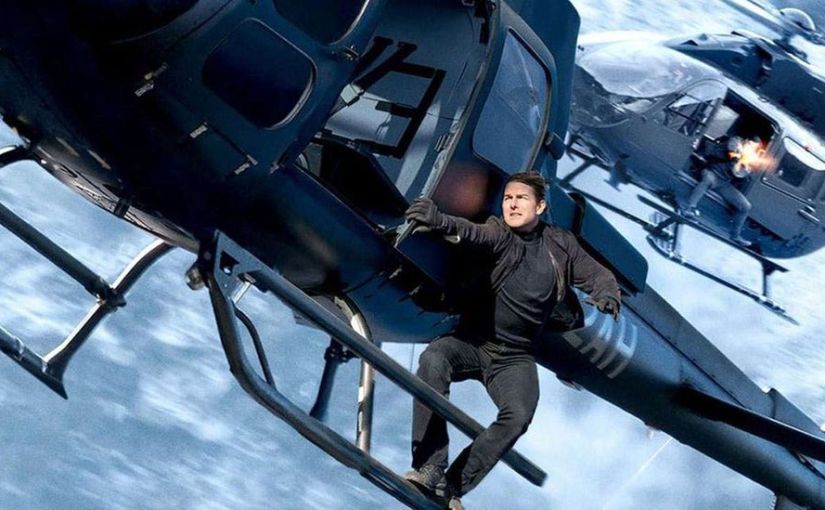
The highlight of this installment is a helicopter chase above and within a mountain valley that first focuses on Tom Cruise himself climbing a rope up, up, up to a chopper and swinging his legs onto the railing to get a foothold.  There’s time dedicated to him falling and inching his way back into the vehicle.  Then it becomes a chopper chase followed by a collision that ends with the remains wedged within a narrow mountain crevice.  What a set piece this is!  Absolutely outstanding camera work.  The wide and close editing, sound and visuals work so perfectly in sync with one another.  I don’t want to watch the making of documentary for this picture.  The trickery of McQuarrie’s camera crew is such a treat.  I’d rather savor the finished product on repeat viewings.

Juxtaposing against this chopper fight are two other scenarios involving Ethan’s teammates.  This is where I’m especially grateful for Christopher McQuarrie’s writing.  Two bombs are rigged in line with each other, and a detonator also must be retrieved by Ethan.  The whole team has to work cohesively, otherwise it is sayonara to much of the Asian continent if both devices explode.  McQuarrie’s “impossible mission” is orchestrated beautifully with suspense cranked way up.  His imagination for adventure allows a magnificently edited third act.  To date, I consider the stakes here to be the highest in the entire series.

The presence of this collection of actors is marvelous with recognition deserving of Henry Cavill donning an untrusting mustache and looking like a brutal, blunt instrument against the superspy Ethan Hunt.  Cavill also plays CIA agent wisely.  He’s got a stoic expression for most of the film but that is because he trusts the audience will assume what a dangerous threat he can be.  Cavill occupies one of the best characters in the seven films.

Mission: Impossible Fallout is truly one of the most thrilling pictures you’ll find.  What’s most important is the action serves the story.  Action just for the sake of action is tiring like in the Fast/Furious films.  There has to be a cost and a tangible feeling to the speed, obstacles and pain that good action scenes serve their characters and the story as a whole.  When Ethan falls from a helicopter or has to jump out a window, I grip both arm rests and let out a collective bellow with the audience.  Films with the grandest of adventure must draw out responses like that.  Otherwise, it’s all just a ho hum journey to the end credits.  Fallout is anything but a stroll.  It’s an absolute balls to the wall, explosive crowd pleaser.

BLACK PANTHER: WAKANDA FOREVER

By Marc S. Sanders

Marvel does it right.  DC doesn’t.  Black Panther: Wakanda Forever  is not a perfect film, but it’s not Black Adam.  The latest Marvel production offers sharp visual effects and action scenes, along with thought provoking moments that reflect on loss.  Black Adam offers a crusty, yellow lightning bolt on the chest of The Rock.

Director Ryan Coogler was faced with a terrible challenge to make the follow up to his smash hit, Black Panther.  The star at the center of the film, Chadwick Boseman, unexpectedly passed away from colon cancer.  A screenplay for the film’s sequel had to suddenly be rehashed.  A unified cast had to work with a hole in its structure.  Coogler opted not to recast the role of T’Challa, the King of the fictional African nation, Wakanda.  That was a smart choice.  Boseman’s portrayal was so embraced in that film, as well as three other Marvel chapters, that he was seemingly irreplaceable.  T’Challa was not just another James Bond or Batman.

I liked most of Wakanda Forever.  First and foremost, the primary cast is mostly female and Marvel’s early reputation with female characters left a lot to be desired when all they would do is flirt with the action star and scream for help.  As well, none of the women characters were very diverse.  The African influence of the Black Panther characters demonstrate that the Marvel universe is unlimited in appearance and style.  (Star Wars productions of late prove that as well.) 

The design of the picture is also gorgeous.  I still yearn for Wakanda to be a real locale that can be toured.  I’m sure Disney is already giving this some thought.  At times, it was hard to know what overhead locations were mere CGI and what was real.  The backdrops are seamless.  The whole movie is gorgeous. 

The sensitivity to the loss of Boseman is especially handled beautifully.  The opening sequence is a ceremony we have all been waiting for since the actor’s death two years prior to the release of the film.  Some of the customs and practices might be fictional, albeit inspired by what has been researched in other factual nations and observances, but it is also endearing.  The silence of the Marvel logo montage will especially grab you.

Wakanda Forever is carried primarily by Letitia Wright as Shuri, T’Challa’s sister.  The film takes place one year after T’Challa has passed away from a disease and she is not ready to burn the funeral garb she wore when his soul was sent off to the ancestors.  However, while Wakanda was once thought to be the sole resource of Vibranium, the most powerful element in the world, a new character is introduced from under the ocean.  Namor (Tenoch Huerta) is the mutant who leads a nation of underwater dwellers with their own source of Vibranium.  He proposes that his nation works in conjunction with Wakanda to protect what they possess from other nations (like the United States and France; though why must Marvel show these countries in a bad light?) who could potentially use this commodity for nefarious purposes. 

From this seed in the storyline, subplots are branched out.  They just don’t work, though.  Wakanda’s American ally, Agent Everett Ross (Martin Freeman), is brought back into the fold.  He only adds unnecessary running time to a very long film.  First, he provides a lead on to a new character, that’s expected to fill the hole left by Robert Downey Jr’s Iron Man.  A character named Riri Williams (Dominique Thorne) who I have learned becomes the super hero Iron Heart with a new Iron suit.  After that Ross is left to watch Anderson Cooper on CNN as we have already seen the plot unfolding for ourselves, and have conversations with a character named Valentina Allegra de Fontaine (Julia Louis Dreyfus, looking at her most uninteresting and boring).  I know. This character serves as teaser fodder for what the MCU promises in future installments, but why is it necessary?  I believe this is her third appearance between the films and Disney + shows.  All she does is drag the stories down.  Wakanda Forever is a 2 hour and 40-minute film, that could have saved thirty minutes without the characters from Freeman and Dreyfus, and likely Thorne as well.  Let’s just stick with the Wakandans and forget about advertising what’s coming next from the Marvel factory, please.

Another issue with the film is the delay of showing the new Black Panther.  That’s what we ultimately paid for.  The middle section of this long running time had me yearning for when I could see the new suit in action, and who was going to wear it.  When it finally arrives in the third act, I gotta say I was let down.  While there’s a newly inventive design, like each time there was with Iron Man, we don’t see much of what’s new in action and there’s hardly anything that’s novel about it.  Does this Black Panther suit offer any new tricks? 

What’s fortunate for the film is the cast.  Letitia Wright has a good balance of youth segueing into maturity as she toils with loss.  I love this angle in the same way I appreciated the cancer storyline written for Natalie Portman in Thor: Love And Thunder.  Superpowers do not shield us from what slowly dwindles our lives away.  Angela Basset remains a very strong actor after an over forty-year career as the surviving Queen of Wakanda.  She commands a powerful presence of authority.  Danai Gurira as the spear wielding acrobatic Wakandan warrior Okoye is absolutely cool in action scenes.  She also has well written scenes to perform with the other two leads, as her character’s commitment to country is tested. 

Ironically, the Namor character is one of the oldest Marvel characters in print, introduced long before Spider-Man or the Hulk came on the page.  I was never a fan of the character though.  He just didn’t have a cool enough costume for me as it was only a bathing suit and he had wings on his ankles.  Meh.  I feel the same way here.  The back story of the character is altered to fit the mold of the script, and that’s okay, but I didn’t feel for this antagonist’s plight.  In the prior film, I was more on the side Eric Killmonger’s (Michael B. Jordan) cause than I was on T’Challa’s.  In this film, Namor is just a guy to do battle with while he flies and swims.

Ryan Coogler is a detailed director.  When I’m in Wakanda, I want to explore every building and hop aboard each vehicle that hovers overhead.  He leaves no stone unturned.  I would have chosen for some of the action scenes to be shot in the daytime so I could get a better look at what goes on.  I feel that way about all action and adventure films.  However, a darkened action scene in nearly any Marvel film is much more articulated than any scene, daylight or otherwise, in Black Adam from DC.

Black Panther: Wakanda Forever is a good film, but not great, mostly due to its overstayed running time.  What should have been cut from the final reel is obvious.  Yet, good writing and acting allows for the film that many Marvel fans needed after one of their heroes left us.  Losing Chadwick Boseman likely equates to how we lost our Superman, Christopher Reeve.  It seemed so unfair that someone who offered such heroic optimism and joy could be taken from our reach so early in life.  At least, the loss of Boseman was thankfully not washed over with a replacement that could never fill his void.

BLACK PANTHER

By Marc S. Sanders

Ryan Coogler’s Black Panther is a stand out film among what has become an overpopulated Marvel Cinematic Universe.

It is a super hero film for sure, complete with the standard gadgets, super strength and abilities, action and over the top science fiction. Yet, this film did not have to be a superhero narrative to drive home the message of its story. This could have been an Oliver Stone film rooted in political quagmire. It could have been a John Hughes teen rip off film that takes place in a typical Wasp suburban school.

A question embraces this film. Simply, when is it appropriate to share?

Chadwick Boseman plays the title character also known as T’Challa, and following the recent death of his father he becomes the next king of the fictional African based country of Wakanda, a location hidden from the rest of the world so that no one else can take advantage of its most precious resource, Vibranium, which has allowed for the most sophisticated technology, weaponry and even medical advancements ever known. How it’s all lumped together, who knows? Pick up a Marvel Comics Encyclopedia for that answer. T’Challa is tasked with whether it is a moral obligation to share the resource with the rest of the world. However, if it is provided, will the Vibranium be taken advantage of for nefarious purposes?

(SIDE NOTE: Reviewing all of these Marvel films is getting to be trying, as I feel resorted to using the same terminology some times; words and phrases like “hero,” “villain,” “nefarious purposes” and “also known as.”)

His nemesis is Eric Killmonger played by Michael B. Jordan; this guy is going to get an Oscar one day. Killmonger is an educated, skilled soldier and cousin to T’Challa who was abandoned by Wakanda following his own father’s betrayal of the country. He grew up in the projects of Oakland, California. Killmonger returns to Wakanda with the purpose of becoming king and allowing the tech and resources Wakanda possesses to be used by the outside world, particularly by populations of African descent and people of color who have endured a history of suffering. Once again, Marvel Studios scores with a villain you want to root for and endorse. Just like Jeff Bridges’ Obidiah Stane in the first Iron Man film, you have to recognize the stance that Killmonger holds on his side of argument. That’s great writing. It’s not so much that Killmonger is a slaughterer. He really isn’t at all. Once he overthrows the hero, the mission is only just beginning as he wishes to right the wrongs of Wakanda for never providing in the first place. It’s ironic really. This guy sides on the fact that he doesn’t want a wall, while the protagonist is doing all he can to maintain a divider to the outside world. In 2018, was there another film that really reflected the sign of the times so succinctly?

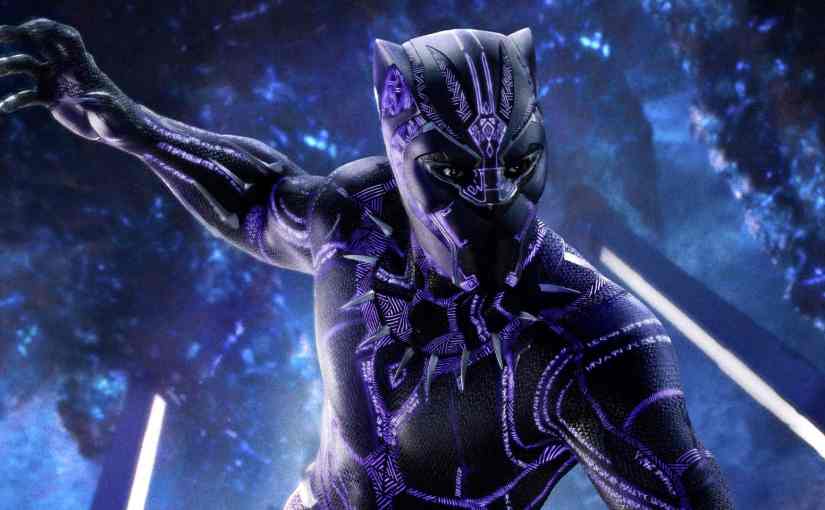
Coogler makes a beautiful sweeping film of country and special effects. The Wakandan ships are very cool. Overhead shots of Africa and the camp bases of various tribes are astonishing. One particular tribe resides on a winter like mountainside and the leaders room is spectaculary decorated in horizontal lumber hangings. T’Challa’s staff of mostly female combat warriors and scientists led by Lupita Nyong’o are really exciting. At times the film takes inspiration from some of the best standards of the James Bond films, as his sister introduces her latest inventions for the Black Panther suit. Naturally, the Black Panther costumes are stand outs in the film, black with glowing power enhancements of purples and yellows.

Is Black Panther worthy of a Best Picture nomination and an abundance of awards attention? I’m still not sure. It’s a very strong piece that is light years ahead of any DC Universe film, but it has great characters and messages like most of the Marvel films and even some of the more recent Bond films featuring Daniel Craig. Maybe it is one of the best films of they year, and maybe it should be a Best Picture nominee, but perhaps only because 2018 did not offer a wealth of extraordinary film achievements to begin with. I found merits in all of the 8 Best Picture nominees in this particular year, but I also found problems with many of them too (don’t get me started on A Star Is Born); shortcomings that in another year with better films would keep many of these nominees from ever being considered for the grand prize.

Yet, as I document these thoughts, I think about Black Panther again. Truly, it does not have anything negative in its feature. Ryan Coogler directed and wrote a very focused and thought provoking film. Yup! It was truly one of the year’s best films.