
BEFORE THE DEVIL KNOWS YOU’RE DEAD

By Marc S. Sanders

When it comes to crime – New York crime – few directors come as close as Sidney Lumet to make an audience feel the authenticity of its trappings.  Maybe only Martin Scorsese can stand next to Lumet.  Either with crime on the streets (Dog Day Afternoon, Serpico) or within the courtrooms (Find Me Guilty, 12 Angry Men), or both (Night Falls On Manhattan), Sidney Lumet hones directly upon how the plans should operate and when everything should unfold or derail.  

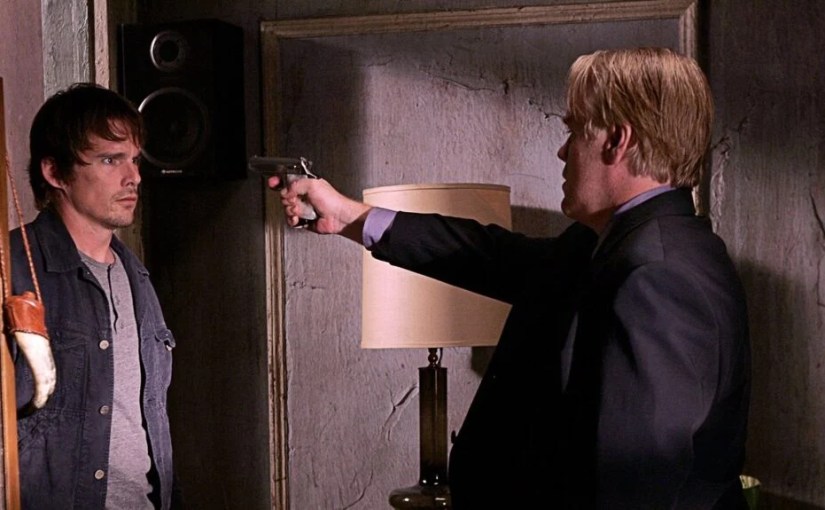
With the last picture before his death, Before The Devil Knows You’re Dead zeroes in on crime within an educated Irish family nucleus.  Andrew (Phillip Seymour Hoffman) has it laid out perfectly for his younger brother Hank (Ethan Hawke) to commit the perfect robbery. No one will get hurt and the insurance company will cover any loss.  The approximate take is around six hundred thousand. These guys carry their own desperate reasons for even considering such an idea, but Andy knows nothing can go wrong.  Hank has some trepidation though, because the target is mom and dad’s jewelry store.

Kelly Masterson’s script shows how quickly everything comes undone with bloodshed and unaccounted for details that could lead straight back to the two brothers.  It’s all told through three different perspectives – Andy, Hank and their father Charles played by Albert Finney.  Often, Lumet will return to the very same scene you saw moments earlier to show two sides of a phone call or in what direction one character goes versus that of another following a particular action that has occurred.  The timeline even jumps back in time a few days to show the direct perspective of any of these three particular characters ahead of showpiece scene – the robbery. Charles was retaking his driver’s license test. Elsewhere, Hank was struggling to pay spousal and child support with an angry ex-wife (Amy Ryan). Andrew was scheming and committing other clandestine acts both at work and in his free time.

However, Masterson’s script weaves all of these side details into how much more complicated this botched robbery becomes in the aftermath. All of what they commit following the robbery compounds into potentially making it worse for everyone involved.

Some of the breadcrumbs don’t carry enough water at times though. You might have to tolerate the characters being more intuitive than they likely should be.  Andrew leaves a business card with a side character.  When the film circles back to this item, it seems a little too easy for someone else to get wise about what has transpired.  I just chose to go with it.

Marisa Tomei is also part of the cast, caught in a love triangle as Andy’s wife and Hank’s mistress.  Tomei is really good, lending some authenticity with unscrupulous nudity in scenes with both Hoffman and Hawke.  This storyline serves as character exposition and only briefly scrapes against the crime drama at play.  It could have been excised from the film, but because the dialogue and scenario is written and performed so well, it effectively held my attention.

Albert Finney is magnificent as the patriarch owner of the store.  Simply his devastated, echoey breathing and the way he fumbles to put his eyeglasses on to learn more about what has occurred is absolutely genuine.  A late middle-aged man discovering horrible truths.  Finney plays it beautifully.  That being said, I wish the film offered more backstory to his character.  There are few hints suggesting how he regarded Andy as the first born who needed be thrown to the wolves and learn to fend for himself.  Contrarily, Hank is the younger and more disappointing son.  Yet, the script is short on material that further explores the relationship between the father and his sons.  I felt the film demanded more because Charles is quite significant to the conclusion of the story, which carries an unexpectedly abrupt ending.  

The acting and assembly of time and perspective are so finely tuned by the whole cast under Lumet’s direction.  Still, Before The Devil Knows You’re Dead needed another twenty to thirty minutes of storytelling.  One character runs out of frame with an unfinished storyline.  Another, seems too hasty in making a final decision with an easy convenience.

Don’t get me wrong.  I strongly recommend this last effort from Sidney Lumet.  It’s a unique crime yarn with an especially conniving Phillip Seymour Hoffman doing some of his best work.  The set up had me riveted and I couldn’t wait to see how all these terrible scenarios were going to fix themselves or make things horribly worse.

GONE BABY GONE

By Marc S. Sanders

Ben Affleck’s directorial debut, Gone Baby Gone, is crime drama mystery thriller that never offers easy answers and concludes with great debate.  You’ll ask yourself if right decisions were made.  You will argue with your best friend or significant other about the endings.  What’s undeniable though is that the film, adapted from Dennis Lehane’s novel, is full of an array of characters, most operating with the best of intentions, and yet they wind up doing everything wrong or against their sworn principles.  In order to work the problem, these people will have to betray themselves. 

One of Affleck’s many best decisions was casting his brother Casey Affleck in the lead role of private detective Patrick Kenzie.  With his girlfriend, Angie Gennaro (Michelle Monaghan), they specialize in tracking down missing persons in and around the Southeastern Boston area.  The brothers’ pairing is especially effective as Boston, Massachusetts is where they were born and raised.  They know this setting intimately. Unpolished multi-floored tenement neighborhoods near seedy watering holes are where the crimes of Gone Baby Gone occur.  Casey can ensure that his character, Patrick, can speak the slang, use the thick dialect, and feel comfortable amid a crowded and overpopulated area. As director, Ben ensures the setting is captured in great detail from Red Sox caps to beat up cars and dirty unkept apartments and secret hang outs.

In the middle of the night a little girl has gone missing and her deadbeat, drug addicted, careless mother Helene (Amy Ryan) is unmotivated to offer the police much to go on. Helene’s brother and sister-in-law (Titus Weliver, Amy Madigan) take it upon themselves to hire Patrick and Angie to find their niece.  The only leads that Patrick, Angie and the police (Ed Harris, John Ashton and occasionally Morgan Freeman) have to go on are Helene’s contacts within the drug peddling underground.  Someone within that community might have taken the girl or know someone who did.

Gone Baby Gone may feel like a Law & Order episode where red herrings are offered early and then dismissed for the actual truth.  However, Lehane’s story twists much deeper beneath the surface.  Not one character is wasted in this film.  Each serves a purpose to how and why this crime ever occurred.  Mysteries get resolved but the answers are not simple because they are multi-layered with many different people spinning twice as many plates.

Ben Affleck seems nothing like an amateur director here.  He does not always rely on dialogue to describe a scenario because he films quite a bit of a disheveled room or kitchen, or an outdoor area.  A daylight scene will take place in a darkly lit bar where only people need to hide from their troubles on an ordinary workday, or maybe they are in there to suppress something uglier.

The cast is outstanding.  While the characters belonging to Freeman, Harris and Ashton seem familiar from much of their other career films, they look like they lived within this environment of three-story houses bordering the harbor, across town from Fenway.  You believe these guys know every alleyway, street corner or contact among the city’s small-time deadbeats. 

Amy Ryan was nominated, and perhaps should have won, for her trashy Bostonian performance as Helene, the missing girl’s mother.  This actress is buried so deep in this role, from her worn out facial features to her New England dialect that blends so well.  She is completely believable, which is why you would not be able to stand sharing the same space with her.

Titus Welliver dons a thick, wide Irish mustache.  I read he had to keep it because he was shooting his HBO series, Deadwood, at the same time.  Nonetheless, it builds his character into the blue-collar working man whose greatest achievement is getting out of the life of small-time crime in order to put food on the table, while his sister could not.  His wife played by the great Amy Madigan, an actress that does not get enough coverage, is perfect.  Just her facial expressions with a pale, freckled complexion, tight chin and pinched lips show her biting her tongue while in the same room as her loser sister-in-law.  It sickens her that a sweet little girl like her niece is missing.  Everything is read on her face.  I know Madigan best as Kevin Costner’s midwestern cheerful wife in Field Of Dreams.  She played this role almost two decades later and she absolutely hides herself.  You forget you are watching her.  An outstanding character actress.  (I’m glad she’s getting new recognition with 2025’s hit horror movie Weapons.)

Michelle Monaghan as the girlfriend Angie is the sidekick to Casey Affleck’s Patrick.  Yet, she makes the horror of this movie convincingly real.  Early on, Angie is reluctant to accept the case because she doesn’t “want to find a kid in a dumpster.”  Now this isn’t some Dirty Harry or Lethal Weapon cop showcase.  It’s not glamourized with Hannibal Lecter glee.  This has not become much further materialized.  I don’t want to see a horrifying outcome for a child either, but Ben Affleck’s direction does not make any promises.  There are some repulsive, scary people in this world, right outside the front doors where people listen to the game on the radio and kids play stickball in the street.  Monaghan seems like that young woman who came from another place in the country with a fine upbringing and fell in love with Affleck’s character. With her brains, instincts and empathy, Angie took up the cause as a fellow crusader.  None of this is spelled out in the film and I have not read Lehane’s books, but I can see it in Michelle Monaghan’s performance.

Casey Affleck is a perfect surprise.  He dons the appearance of a thin, shrimpy kind of kid (supposedly age 31), and yet no matter who he is coming face to face with he never shows any sort of apprehension.  I truly believe that Patrick is not afraid of his work or the people he has to confront while trying to solve his various mysteries.  If a large gun is introduced into a scene, Patrick’s reaction is an act of “whoa, what’s this?”  Another character in another film would tighten up and hold their breath, or they would knock the weapon out of the way for an action scene.  Patrick has put this kind of act on before to outlast a situation.  Angie has definitely seen it before. 

Casey Affleck is great at just listening.  Shortly after he accepts the case, Patrick and Angie are in one of these darkened bars trying to collect information.  Ben Affleck shoots his camera above Casey sitting in a booth with a beer.  The actor keeps his head tilted as if he is listening to nothing spewing from a possible lead sitting across the table.  When a gun is pulled though, Casey stands three feet taller than his posture implies and controls the scene.  That is Dennis Lehane’s character Patrick Kensie completely defined because Casey Affleck has a full understanding of this guy.  Someone like Patrick knew that if he was going to take this kind occupation on full time, he had better be aware he would not survive on brawn that he cannot show.  It’s a confidence that has to come through. 

Gone Baby Gone is a gripping and engaging thriller shown with varying degrees of light and perfect cinematography to offer genuine on-site locations of Boston and the surrounding areas.  Ben Affleck chose not to compromise any of his set pieces.  With handheld cameras, when a missing person’s search is happening, it feels like a documentary of procedure is being shown. 

The various directions and endings are entirely unexpected and yet very, very plausible.  This is a smart, sensational crime drama that deserves a resurgence of attention nearly twenty years after its release.

WAR OF THE WORLDS (2005)

By Marc S. Sanders

There’s a harsh reality to science fiction in the 21st century.  When the aliens arrive on Earth, a little girl will ask her dad “What is it?  Is it terrorists?”  Steven Spielberg’s interpretation of H.G. Wells’ War Of The Worlds covered that territory when it was released four brisk years after 9/11.  All these years later and there’s still some legitimacy to that sadly reasonable question.  I find it interesting that one of the most pioneering novels in sci fi was published just ahead of the twentieth century paving the way for endless approaches to alien arrivals and attacks on Earth.  When Spielberg approaches it on his third try, the trope may have been done to death, but now the reality of the response is updated and all too real, and brutally disturbing.

Tom Cruise is the lead in this adaptation, and he is arguably in the most vulnerable role of his career.  He plays a storage bin dock loader, only regarded as a half caring deadbeat and divorced dad to his teenage son (Justin Chatwin) and 10-year-old daughter (Dakota Fanning). After his ex-wife (Miranda Otto) drops the kids off for the weekend, there’s an uncomfortable game of catch in the backyard followed by the beginning of the mayhem.  What appears like a lightning storm evolves into dead batteries and no electricity along with odd wind currents and hammering echoes.  When the people all around the main characters in their New York neighborhood get vaporized, then naturally their first instinct is to think it’s terrorists.  In today’s science fiction, terrorists are real and aliens are not.

Later, once the extra terrestrials (not the friendly kind who consume Reece’s pieces) have viciously introduced themselves, Spielberg’s film resorts to demonstrating mass exodus of the people of Earth.  Military units advise folks to “keep movin’.”  When the attacks happen, people scatter in different directions.  When a ferry is leaving the mainland, helpless folks rush for the dock, desperately climbing over the gates and leaving loved ones behind.  Spielberg hasn’t forgotten about the unlawful occupations from world history.  He simply applies it to a Tom Cruise action piece.

Tim Robbins shows up as a crazed man hiding in a farmhouse basement with a shotgun ready to begin a one-man revolution.  Cruise tries to contain the hysteria.  A scene like this could have had Nazis or aliens circumventing on the floor above, as the central characters remain as quiet as the Jews used to do in the basement below.  The parallels are eerily the same. 

Still, I respect the reality of the piece.  For one thing, much of the film, scripted by Josh Friedman and David Koepp is pulled right from H.G. Wells’ pages, including the nice and tidy ending that eventually arrives.  Don’t knock it.  That’ how Wells wrote the story to begin with.  Spielberg and crew don’t invent their own new image of the invaders.  They are still the tall three-legged tripods towering over the people of Earth and blasting them with their “heat rays.”  My favorite touch of this film is using Morgan Freeman’s vocals as the bookended narrator reciting Wells’ novel text, nearly word for word.  It’s a welcome salute to the memorable radio show that Orson Welles lent to the story decades before. 

I consider this adaptation of War Of The Worlds to be an observational picture or a reactionary film.  Cruise is not super skilled with fighting techniques and weapons handling.  All he can do is watch and react.  He’s an everyman here, which is actually quite unusual for him when you gloss over his resume.  This is not Maverick or Ethan Hunt: Superspy.  His purpose is to watch and return his kids to their mother in Boston, assuming she is still alive.  The success of the mission here only depends on getting the kids back to mom. 

Dakota Fanning and Justin Chatwin go against the grain of so many other Spielberg kid characters.  They are not intuitive or inventive.  Especially for Fanning’s character, she is just a scared little girl.  Not a Goonie and not like Gertie, who is scared for the sake of humor with precocious one liners.  If aliens were attacking the Earth, this is how my kid would react. 

Once it is established that this movie is a Spielberg running man film, then you may be grateful for the realistic mentality of the story’s community.  You’ll also appreciate the amazing set pieces accompanied by John Williams’ original score that plays like a drive-in monster movie or a Twilight Zone episode.  The aftermath of a plane crash on a Jersey suburban neighborhood is very convincing.  A runaway train set ablaze intrudes upon the cast with great surprise.  A cracked piece of concrete that gets swallowed up below only to immediately vomit a tripod in the air for instant attack is eye popping. 

War Of The Worlds is a well-crafted film, and the thought was definitely invested in its approach ahead of making it.  Yet, I won’t say it’s fun escapism.  It’s a reminder of the unrelenting realities we live in now.  Sadly, it’s not reaching to say that maybe we live in a time where it is in fact every person for themselves.  Even Cruise’s son insists on going off on his own, abandoning both him and his sister with nary a care at all.  Unlike Close Encounters or E.T., there’s not much to laugh or grin at in this Spielberg alien film.

The 2005 adaptation of War Of The Worlds is certainly loyal to H.G. Wells.  It may be realistic in the human nature of its science fiction, but in the end, it is also a very bleak film.  There’s much to marvel at, but once the movie is over, as my colleague Miguel and I often recommend to one another, it’ll likely be best that you get outside and bathe in the warm sun under a blue sky, roll around in the grass with your dog, and taste an apple for the first time all over again.  It’s about all we have left to embrace what little is left of our sanity.