TRAP

By Marc S. Sanders

The devil is in the details and when you are watching an M Night Shyamalan film it’s transparent enough to know the writer/ director has a penchant for disregard.  He’ll put the two by fours together but he doesn’t hammer the nails into place treating his structure with less sturdiness than a house of cards.

His latest thriller Trap gains from a respectable, though nothing great, performance by Josh Hartnett as a psychotic serial killer named Cooper, also known as The Butcher.  However, Shyamalan takes away the actor’s credibility by allowing his portrayal to make unbelievable escapes while also being granted an ability to eavesdrop on people while attending a loud pop/rock concert with his pre-teen daughter, Riley (Ariel Donoghue). 

Cooper and Riley have a great father/daughter relationship.  She’s beyond thrilled to see her favorite singer, Lady Raven (Saleyka Shyamalan, the director’s real-life daughter), live on stage.  He’s thrilled to accompany her while munching on stadium snacks and granting the dutiful empathy she needs from middle school drama. Cooper only gets alarmed though when he sees an overwhelming amount of police officers and FBI agents roaming all over the stadium.  He asks some questions and learns that this event is being used as a means to capture the infamous killer on the loose known as The Butcher.  Now Cooper must play a game of cat and mouse by evading the authorities while not alarming Riley.

Once again, Shyamalan has an enticing set up, but then he doesn’t deliver.  First it’s hard to swallow Hartnett’s character listening in on conversations happening yards away down hallowed hallways, or even backstage where Lady Raven’s voice is blaring through stadium speakers while she’s dancing and singing in front of thirty thousand fan girls.   Reader, I saw Sting in concert performing one of the quietest songs imaginable, “Fields Of Gold,” and I still could not hear my wife ask me to get her a Coke when she was standing right next to me.

Midway through the film it only gets more ridiculous and even corny as Lady Raven ends up at the family home where Cooper’s wife (Alison Pill) and children become enamored with the celebrity playing piano in their living room.  Then there is an overly long scene meant to offer terrifying suspense when a character locks herself in the bathroom.  Then it’s back to Raven’s limo and then onto a new house and then back to the first house.

The structure of Shyamalan’s script seems to always paint itself into a corner.  So what does the writer do? If he’s trapped with no idea, well he just deepens the corner further and further.  He defies his blueprint, and pushes those two by fours further and further out.  

All of it is hard to digest.  Cooper needs to escape a limousine surrounded by swarms of both fans and police officers. Cut to the next shot and Josh Hartnett’s character is walking away from the commotion unbeknownst to everyone else who stayed glued to the doors and windows of the limo.  Excuse me but none of the car doors ever opened.  I didn’t even see the sunroof open.  Yet, the film insists the guy escaped from the vehicle.  So just go with it.  OKAY??? 

The irony of a film called Trap is that the filmmakers could not even figure out the traps they devised.  Therefore, they’ll just disregard offering up the sleight of hand and move along.

No good magician insists his audience trust him when he says that his assistant who stepped in the box has disappeared.  A good magician, or even a bad magician, is at least smart enough to know that we need to see it for ourselves.  

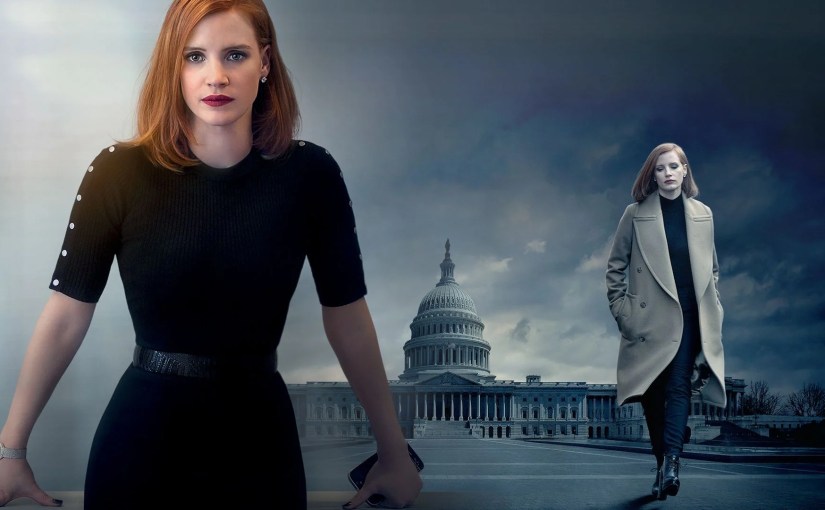
MISS SLOANE

By Marc S. Sanders

Jessica Chastain is an aggressive actress. The talent is on par with Meryl Streep or Katherine Hepburn for sure, and the Oscar trophy she won earlier this year is evident of that. Actually, she’s worthy of more than just one. My question, though, is if she is too aggressive. Films like Zero Dark Thirty, Molly’s Game, and Miss Sloane, put her in characters that never stop to react and smell the roses. That wears me out. Could you just slow down Jessica, so I can take this all in, please? You’re talking faster than I can think.

In Miss Sloane, Chastain portrays an impenetrable lobbyist. Nothing gets past this woman and despite her shortcomings, nothing will harm her either. Elizabeth Sloane will always be one step ahead of the game. This is a fierce chess player in the political arena. She’s omnipotent and admits to hardly ever sleeping. Maybe the pill popping helps with that. Like the Faye Dunaway character from Network, she also has no time for personal relationships or sensitive sex. So, she’s a high paying client for a male escort who will wait for her to come home to satisfy her fix.

Elizabeth is first employed with a wealthy private law firm who wants her to head up a bill in favor of the gun lobby. She declines, walks out the door with one long speech, a way over the top laugh (this is where there’s too much Jessica in my morning coffee) and over half her staff. She goes to the other side of the aisle to lobby aggressively against the gun bill.

From there it’s one aggressive maneuver after another and Elizabeth more than proves that she’s got the balls for this game. Only thing is, as Elizabeth proceeds to countermeasure and attack from her side, is she losing sight of the subject at play? Will her soul swim to the surface showing any sense of morality?

The film begins where Elizabeth is being questioned at a hearing headed by a state Senator (John Lithgow, always a pleasure to see). Then it moves on to show us how Elizabeth finds herself at that hearing.

Miss Sloane has no limits to what she’ll do to protect the integrity of a client’s argument for the bill even if it means embarrassing a traitorous teammate, putting another teammate in an unwelcome limelight of political journalism or maybe even employing a cockroach of the sort to use as a listening device. Miss Sloane won’t hesitate to take risks for the lobby she’s been hired to pursue, even if it risks someone’s life or their reputation.

A twist presents itself at the end and yeah, it could work assuming you believe Elizabeth Sloane, the brilliant lobbyist, can telegraph about fifty different actions that could take place amounting to that one moment. The math adds up, but were the numbers fudged to allow the arithmetic to work? That’s why a film like Miss Sloane is hard for me to swallow.

Does this woman have ESP? The final card she plays would require not only her own personal endurance, but that of a colleague as well. A lot of factors all have to be in sync to make this story work out the way it does. So my suspension of disbelief was really tested with this film.

I go back to Jessica Chastain. Zero Dark Thirty remains my favorite of hers. She was a great underdog against a male oriented governing body in the pursuit of Bin Laden. After that, Miss Sloane released a few years later and Chastain got bit by the Aaron Sorkin bug, I think. Endless talking works as an intellect that’s hard to challenge. Problem is, I’m the viewer and I’m wondering for the first thirty minutes what in the hell you’re talking about. Miss Sloane isn’t an Aaron Sorkin film, but Jessica Chastain will have you convinced she wants it to be.

Fortunately, writer Jonathan Perera with director John Madden ease up on the brakes allowing much more realistic and human characters to invade the film including Lithgow, Alison Pill and an especially riveting performance from Gugu Mbatha-Raw (recently seen by me with a subpar script called The Whole Truth) who becomes Elizabeth’s trusted sidekick both behind and in front of the cameras for political jockeying. This is an actress ready for some lead roles.

I described Miss Sloane as omnipotent earlier and that’s a problem for the first act of the film. This character never shuts up early on. There’s next to no impact on anyone around her. She just talks and talks and talks and she convinces me that she’s the smartest one in the room, but she also makes me want to turn the movie off. The film saves itself with the able supporting cast eventually.

To watch Miss Sloane is not to take any position on gun lobbying especially seriously. I’m not sure the filmmakers have a stance to play. I’m not sure the filmmakers know whether to even regard the titled character as a hero or villain. Actually, I just think the purpose of the film is to show corner cutting and how aggressive a made-up lobbyist can actually be, devoid of any determining factors. We are privileged to see how far a woman with stiletto heels, a cinched up red head ponytail and a tight business suit will go to win at any cost. It’s intriguing, but I guess I just felt unfulfilled by the end. It was all there. It just seemed to work itself all out too conveniently by the end. 

MIDNIGHT IN PARIS (2011)

by Miguel E. Rodriguez

Director: Woody Allen
Cast: Owen Wilson, Rachel McAdams, Marion Cotillard, Kathy Bates, Adrien Brody, Tom Hiddleston, Alison Pill, Léa Seydoux, Michael Sheen
My Rating: 10/10
Rotten Tomatometer: 93% Certified Fresh

PLOT: A nostalgic screenwriter travels with his fiancée’s family to Paris where, every night at midnight, he inexplicably finds himself going back in time to the 1920s.


The best of times is now / As for tomorrow, well, who knows?
La Cage Aux Folles

It’s currently 11:05 at night on a Sunday evening.  I’m getting older, so if I’m smart, I should get off to bed, owing to the fact I have to get up early tomorrow to get ready for work.

But I can’t.  I have just re-watched Woody Allen’s Midnight in Paris for only the second time in my life, and I have revised my original rating of 9 up to a 10.  And I am just bursting to write about how wonderful this movie is.  I’m hoping that I can reach someone who has not seen it before, so I can convince them that, even if they’ve never seen a Woody Allen movie before, this is the one they should start with.  Yes, even over Annie Hall or Manhattan or even Match Point.  In my mind, Midnight in Paris captures the voice of the artist as he is reaching a certain age and has something important to say about nostalgia, and how sometimes it’s not always what it’s cracked up to be.

Gil Pender (Owen Wilson) is a Hollywood screenwriter trying to complete his first novel.  He and his fiancée, Inez (Rachel McAdams), travel to Paris with her family so he can perhaps get inspired by one of the all-time great cities of the world.  He is immediately smitten with the atmosphere of the place; the movie opens with a wordless montage of static shots of Parisian cafés, streets, museums, statues, apartment buildings, and, of course, the Eiffel Tower.  The sequence sounds simple on paper, but the effect is – I don’t know how to describe it.  It captures the ineffable romance of the place.  More so than any other movie set in Paris, Midnight in Paris really, REALLY makes me want to go there.

Gil and Inez seem happy enough, but he is a little more antisocial than she is.  He is star-struck by Paris, but Inez is not incredibly fond of it.  They bump into an old friend of Inez’s, a pleasant enough man who turns out to be a bit pedantic; during a museum tour, he presumptuously corrects the tour guide on details of the life of Auguste Rodin.  This is not the kind of guy I would want to be stuck with on an elevator.

One night, Gil goes walking by himself on the Paris streets and gets a little lost.  Long story short, he inexplicably finds himself transported back to Paris of the 1920s, when the cafés were full of American expats and frequent visitors like Ernest Hemingway, F. Scott and Zelda Fitzgerald, Cole Porter, Gertrude Stein, T.S. Eliot, Pablo Picasso, Salvador Dalí, etcetera.  As a writer, Gil is over the moon; it just so happens his unfinished novel is about a man who runs a “nostalgia shop”, so this pleasant turn of events is a welcome tonic to his vaguely unhappy days back in the present.

Watching the scenes of Gil rapturously conversing with Hemingway, or goggling at Cole Porter playing the piano, I was swept away by the audaciousness of this movie.  It’s illogical and steeped in fantasy and seems to be begging not to be taken too seriously.  But it is a pure joy to watch.  I immediately identified with Gil.  I found myself imagining how I would respond if I were somehow transported back to a time and place when some of my own idols walked the Earth: Hollywood, the 1940s, walking around and conversing with Orson Welles, Alfred Hitchcock, Jimmy Stewart, Katharine Hepburn.  Or even not so far back: the 1970s, having lunch with young Spielberg and Coppola and Lucas, and Pacino and Streep and DeNiro, discussing film and life and getting insight into their inner workings.

From our perch in the present, it’s easy for us to look back at the past and say, well, those were the days.  Just earlier today, I was having an online discussion about the difference between CGI and practical effects in movies like Star Wars or The Lord of the Rings and even Honey, I Shrunk the Kids.  We tell each other that older movies felt more real because the effects were made with real props occupying real space, whether they were miniatures or matte paintings or what have you.  And we say, “Man, they just don’t make them like that anymore.  They knew what they were doing back then.”

That’s Gil.  He looks around at the shimmering jewel of Paris in the 1920s and he’s convinced that this is “where it’s at.”  What can today’s world offer in comparison to sitting in a café and discussing art with Salvador Dalí and Luis Buñuel?  Or the pleasure at hearing Ernest Hemingway tell you he’ll hate your book, even if it’s good, because that would make you a better author than him?  Or getting constructive notes on your novel from Gertrude Stein?

The story progresses.  Gil becomes infatuated with a beautiful woman from the past, Adriana (a luminous Marion Cotillard), and it becomes harder and harder for him to go back to his own present each night.  Inez’s father gets suspicious and hires a private detective to follow Gil during his midnight strolls.  You may ask how a private detective can follow someone who is traveling back in time.  Well, my friend, that is an EXCELLENT question, one which the movie answers in satisfying and gut-busting fashion in the final reel.

But the heart of the movie lies in the touching, revealing segment when Gil and Adriana go even further back in time, this time in a horse-and-carriage, back to the Belle Époque, the “Beautiful Age” of Paris, which lasted from about the 1870s to the 1910s.  Adriana, who lives — lived — in the ‘20s, is entranced with this even more bygone era.  She feels about the Belle Époque the way Gil feels about the ‘20s.  To her, the ‘20s are slow-paced, a drudge.  But, oh, to be back in the 1890s!  Dinner at Maxim’s, the Moulin Rouge, meeting Toulouse-Latrec and Gauguin and Degas!  How wonderful those days must have been compared to the Boring Twenties!

And there’s the message of the movie.  We can grouse and grumble about the modern world all we want.  The movies are dime-a-dozen.  The books even more so.  The music is crap.  Cell phones have turned us into tiny-screen junkies.  But, oh, to be back in the good old days of the 1980s, when the music was gnarly, and the movies were iconic, and the books were amazing, and everything was just better.

But we forget that, in the ‘80s, people were grousing and grumbling about THAT era, and they longed for the more sedate and rosy era of the 1950’s.  And in the ‘50s, people said the ‘30s were the BEST.  DECADE.  EVER.  And so on and so on.

It’s human nature for us not to realize what we’ve got going for us until it’s gone.  We are living in glorious times.  (Coronavirus and politics notwithstanding…gimme a break, I’m trying to make a point here.)  Look around.  Really SEE it.  Embrace it.  We don’t need a time machine to go back to our glory days.  We’re IN our glory days.  Just wait.  In 20 years, you’ll look back on the 2010s and say, “Man, wasn’t that a time?”

If you take nothing else away from the above review, remember this: Midnight in Paris is pure charm, is laugh-out-loud funny, and is the best Woody Allen film since Match Point.  So if you haven’t seen it, you really, really, REALLY need to make a point to do so.