THE RUNNING MAN (2025)

By Marc S. Sanders

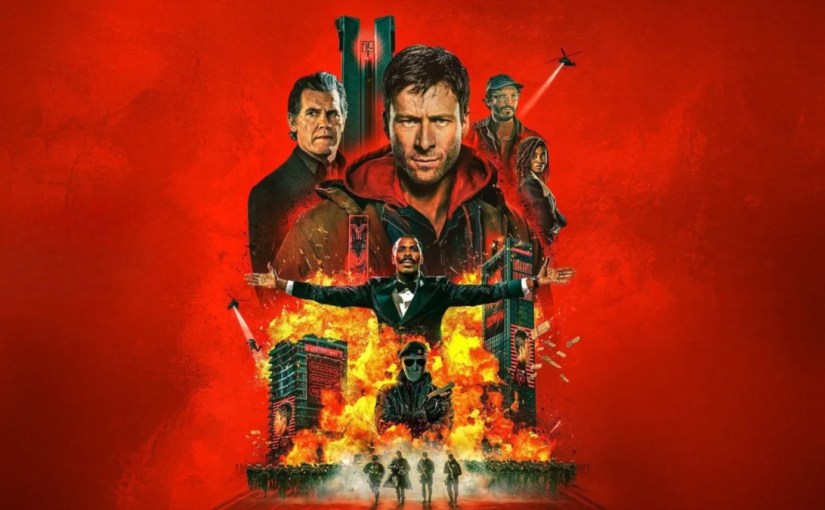
Everything you see in the remake of The Running Man belongs.  So why doesn’t any of it work?  I think director Edgar Wright needs to have his feet held to the fire.  He made this movie with his eyes closed and his ears muffed.

Like the Stephen King (or under his pseudonym, Richard Bachman) story and the original 1987 picture with Arnold Schwarzenegger, a violent game show called “The Running Man” occupies the airwaves in a dystopian future.  Modifications from the first film are done to separate this picture from that one.  In the last film, contestants were violent criminals on the run to win freedom from incarceration.  Here, anybody can try out to win the cash prize of a billion dollars.  I’m not sure which is more faithful to King’s novella.  

Ben Richards (a name which always gets me thinking of The Fantastic Four; Ben Grimm, Reed Richards) is played by Glen Powell with a handsome athletic build but not the muscular physique of Schwarzenegger.  Powell looks more like an Everyman who auditions for one of this future’s various twisted game shows, hoping to win cash prizes that will rescue his wife and sick baby girl from poverty.  He never intended to get thrust into the ultra-violent “Running Man” though.  The object is to outlast and survive for thirty days while sadistic headhunters attempt to find him and deliver a gruesome televised slaughter.  The producer, Dan Killian (Josh Brolin), foresees a ratings bonanza with Richards as his most wanted runner.

Glen Powell needs to enhance his career with his sudden popularity.  Between this film, Twisters and Top Gun: Maverick he is playing pick-up sticks on resurrected franchises, and he ends up being completely unmemorable and uninviting.  Other than a square chin, there’s nothing special about this guy and I never once felt empathy for his role here.  He does not convey fear or anger or humor like a Bruce Willis, a Tom Cruise or even an Arnold Schwarzenegger.  He’s boring.  Edgar Wright’s script with Michael Bacall does not help the actor either as The Running Man is neither quirky or offbeat like a dystopian action picture or a standard Edgar Wright piece (Scott Pilgrim Vs The World) should promise.

The most exciting ingredient is Coleman Domingo, one of my favorite actors working today.  He is so magnetic in anything he does that I can practically guarantee whatever pizzazz he brings as the larger-than-life game show host, Bobby T (Yes!  That’s his name!), carries no impact.  This script gives him nothing to do other than wear a purple sports jacket while belting out “WELCOME TO THE RUNNING MAN!!!”  If he was simply given all of Richard Dawson’s dialogue from the first film, Domingo could have elevated this drippy picture into something engaging and fun.

Lee Pace (The Lord Of The Rings) is fully masked until the third act and has little dialogue as he’s the hero’s main hunter.  Why waste such a charismatic actor?  He’s dressed in black with a black mask.  What’s fun about that? Josh Brolin sits behind a desk as the puppet master producer.  He plays his part like Josh Brolin on a press tour stop on The Today Show.  He’s really not acting at all.

It’s an eye-opening surprise to see Sean Hayes (Will & Grace) make an early appearance as another game show host for a different show.  This should offer magnificent promise.  Brilliant casting for an over-the-top comic performer.  I was waiting for Hayes and Domingo to get into a sparring match of egos for attention in this television world.  You know what happens, though? Sean Hayes is never seen again following his appearance ten minutes after the film begins.  Another overlooked waste of talent.

William H Macy is a good character actor for this kind of film.  Too bad he’s also given little to do other than to tell the hero to go see the guy played by Michael Cera.  Why not cut out the middle man and let Ben Richards just deal with Macy’s character? The Running Man is far from the leaner film it could have been.

Some of the action scenes in this violent tale work, and some don’t.  When Ben Richards catches up with Cera’s character, a run/hide shoot out in a two-story house plays like a video game with bannisters that come apart and rapid machine gun fire.  It’s edited quite well.  Later though, there’s a battle that occurs in the cockpit of a jumbo jet.  Gravity is disabled while gunfire and fisticuffs are at play and everything shakes and bounces so much that it’s hard to tell who gets the gun and who is shooting who.  This looks like the filmmakers were pressed against a deadline and just didn’t clean up or tighten the scene into something coherent.  I just stopped trying to focus on the film and waited for the scene to end with another escape by the dashing Ben Richards.

This screenplay feels like it was made up on the fly.  Glen Campbell is awarded several scenes to speechify melodramatic gargle.  Is there a noble cause that we are to learn about from The Running Man? Just as the third act is about to start, he hitches a ride with a young girl who we have never seen before.  Nor has she been referenced anywhere thus far.  Yet, she’s got something to say with some kind of cause on her mind as well.  This nameless sidekick takes over the movie for the next twenty minutes and then parachutes into open sky never to be seen again.  What was the point of this detour? Moreover, what the hell was she ever talking about?

This Running Man had all the ingredients to work with a stellar collection of fine actors who were up for the task of wit and satire amid ridiculous violence and totalitarianism.  With Edgar Wright at the helm, the new Running Man could have been a harkening back to Paul Verhoven’s ultra-violent tales of gonzo media silliness found in his movies like Robocop, Starship Troopers and Total Recall.

Sadly, Glen Powell is uninteresting, and the more amazing talents of the supporting cast were handed lackluster and witless material.  

The Running Man marches at a speed of sluggishness.  Better to turn off the TV and read Carrie or Misery.

BOBBY (2006)

By Marc S. Sanders

There’s the distinguished doorman who is retired now but returns each day to play chess with a colleague in the hotel lobby.  There’s the open-minded girl who is inspired to prevent a young man from getting drafted into the Vietnam War by marrying him.  Her hairdresser is married to the hotel manager, who happens to be having an affair with the beautiful switchboard operator.  As well, the dining manager is a bigot who will deny his Mexican employees enough time to leave work and exercise their right to vote.  A busboy will have no choice but to miss what will likely be Don Drysdale record breaking sixth shut out game in a row.  A drunken night club performer can hardly stand up straight while she is completely dismissive of her caring husband.  A wealthy man is ready to introduce his trophy wife to an eventful evening in modern politics.  Two young campaign workers sneak away to drop acid for the first time.  A black man is at a loss following the recent assassination of Dr. King. Though he has hope that at least Bobby Kennedy will uphold his faith for a promising future in America for African Americans to carry equal rights. 

So, what does any of this have to do with Robert F Kennedy?  Not much I’m afraid.  Writer/Director and star Emilio Estevez tells us that all of these stories occur in the Ambassador Hotel on the fateful night when the Senator was assassinated in the hotel kitchen by Sirhan Sirhan.  In Bobby, the only character that is not a character is Bobby Kennedy and that is unfortunate.  More to the point, all of these short stories and other characters are precisely boring.

Estevez committed himself to grinding out stories that occur in the Ambassador that would lead up to Kennedy’s tragic death.  He’s admitted that they are all fictional. Based on his research and photographs, these characters are very loosely inspired by those that were there that night.  Before gathering in the ballroom to hear Kennedy’s victory speech after winning the California primary, these people were going through own personal ordeals.  If Emilio Estevez was not so personally inspired and researched in Robert Kennedy’s purpose to American history and politics, then perhaps Arthur Hailey (Hotel, Airport) would have pieced together this script of anecdotes and vignettes.

I commend Estevez’ efforts here.  The film looks great and even though the Ambassador was being demolished at literally the same time as this film was being shot, the scenic designs are very authentic.  The cast is even more impressive as the director reunites with many co-stars that he’s worked with before including Demi Moore, Anthony Hopkins, Christian Slater and his real-life father Martin Sheen, a lifelong loyalist to the Kennedy family.  The “importance” of this movie seems to sell itself.  Yet, everything is incredibly mundane and of little interest.  When your cast and your characters are just items on a grocery list to check off, there’s not much that’s interesting beyond the coupons.

The juicy gossip that surrounds the real-life actors is more captivating. Estevez cast Ashton Kutcher (Demi Moore’s real-life husband at the time) to play the drug dealer who provides acid to the campaign workers (Shia LeBeouf, Brian Geraghty).  Moore is also Estevez’ ex-girlfriend.  Yet, to watch Kutcher, LeBeouf and Geraghty experience an acid trip with weird visions they see when they open a bedroom closet is unfunny and not captivating.  Emilio Estevez is not living up to the Coen Brothers (The Big Lebowski).

A tryst with the boss (William H Macy) and his young, attractive and naïve switchboard operator (Heather Graham) is nauseatingly hokey.  The aged wife who works in the hotel salon (Sharon Stone) turns it all into squeamish soap opera tripe.

Bobby has an alarming opening.  A false alarm fire call is wrapping up at the Ambassador Hotel and you may feel like you are entering the middle of a panic storm, but things quickly calm down and the film resorts to cookie cutter editing to introduce its all-star cast.  None of what they say matters.  This is a game of who you can recognize.  Joshua Jackson, Nick Cannon, Harry Belafonte, and eventually the guy with the most significant role, Laurence Fishburne, is given his moment, the best scene of the whole film.  Fishburne is the kitchen chef who allegorically uses his creations in cuisine to compare the black man’s experience to the brown man’s, or Mexican. 

Having finished a trip to Martha’s Vineyard, I wanted to show my wife the under-the-radar and captivating film, Chappaquiddick, which covers Ted Kennedy’s personal story of controversy.  (My review of that film is on this site.) To continue on the Kennedy parade, we were motivated to follow up with Bobby.  Yet, this picture offers very little to the significance of Senator Robert F Kennedy.  There are samples of news reports complete with Cronkite.  Plus, the Senator’s own words ring through the epilogue of the picture.  Yet, I felt cheated of learning nothing new about the historical figure. 

Reader, you may tell me to kick dirt and go find another movie or read a book.  Fair!  However, this is film is called Bobby, and if I’m not going to learn about Bobby Kennedy from the man himself, then allow me to get to know the man through the eyes of these individuals.  Who hates him?  Who loves him? Who has a crush on him?  Who is inspired by him?  Who wants him dead and why? 

Estevez’ script does not allow enough material to describe what Kennedy meant to these campaign workers or hotel workers or guests.  They are primarily self-absorbed in their own personal battles to think enough about the fact that Bobby Kennedy is expected to make an appearance later this evening.  Again, their personal concerns for each other is very dull.  I don’t want to be around a drunk and obnoxious Demi Moore.  I don’t want to drop acid with some guys who hide behind a façade for caring about the candidate they are supposed to be serving.  I feel sorry for the busboy who will miss that big game, but that’s not enough to get me engaged in the entirety of the picture.

Bobby lends very little to the confusing times of the late sixties when an unwinnable war was persisting and championed leaders were being killed for others’ agendas.  Any of these stories could have been yanked from this script and slotted into a disaster flick like The Poseidon Adventure or The Towering Inferno

Bobby only picks up momentum when it arrives at its end that many of us learned about in school or witnessed firsthand in documentaries or directly from that very sad and unfortunate evening, June 4, 1968.  This day in history is so much more important than a Helen Hunt character trying to convince her Martin Sheen husband to let her buy a new pair of black shoes.  Bobby Kennedy deserves more recognition than what Emilio Estevez offered.

AIR FORCE ONE

By Marc S. Sanders

On the day I write this article, July 12, 2024, the new trailer for Captain America: New World Order premiered and Harrison Ford (whose birthday is tomorrow; Happy Tiding Dr. Kimble, Dr. Jones, Captain Solo, Mr. President, Dr. Ryan) is back in the Oval Office playing the President of the United States.  Don’t know what kind of Commander In Chief he’ll be this time around.  He might be as heroic as James Marshall from Air Force One. Then again he could be a challenge of hulk like proportions.  However, let’s at least fantasize that we have Mr. Marshall running for the top job this year against both the criminal buffoonery and geriatric disqualifications we are left to choose from.  Just look at James Marshall’s qualifications. 

Following an American Special Ops capture of a Russian radical, Marshall is bestowed an honor from the Soviet government. His acceptance speech insists his administration will never negotiate with terrorists.  Now that the line has been drawn, away he goes with his staff, his wife (Wendy Crewson) and pre-teen daughter aboard the most protected and safest plane in the world, Air Force One.  Yet, an element of careful process does not go according to plan and Gary Oldman’s team of Russian radicals hijack the plane with demands to free their leader from captivity.  Oldman’s screaming hysterical character, Ivan Korshunov, won’t have it so easy though because his team of men failed to capture the President.  As well, it requires the Vice President (Glenn Close) and Secretary of Defense (Dean Stockwell) who are on the ground to coordinate with Russia to free the prisoner.  Oldman’s response is to kill a hostage every half hour and if that does not work, then just blow up the plane.

This is not good.  BUT WAIT!!!!!  Is that…?  Could it be???  Is the President alive, sneaking around the bowels of the plane while taking out one terrorist at a time?  Raise your fist for Harrison Ford!!!!

‘Murica!!!!!!

There are two narratives going on with Air Force One.  One is the standard Die Hard formula action onboard the plane.  Then there is the endless debates of authority between the Vice President, the Secretary of Defense and the military leaders about if the President is in a proper state of mind to lead and act upon his aggression with a high level of threat to the country at stake, and more personally his wife and daughter in harm’s way?   None of this is nothing new.  It’s all familiar from the likes of many late 80’s and 90’s action pictures.  The politics are much more simplified than what you’d find in a Tom Clancy novel.  There’s even time for a which color wire to cut scene.  Yet, the movie is entertaining.

Director Wolfgang Peterson is best at showing the real star of the picture and that is Air Force One itself.  He’s got long shots down endless corridors and aisles. Within the underbelly, as well as the hollowed-out cockpit, there’s more for us to explore amidst the gunfire.  We see where the weapons are stored as well as the luggage and food supply.  We get to watch the football game in the President’s office too.  Heck, before the terrorists reveal themselves they are given a tour of the massive plane as their guide boasts that it is even impervious to a nuclear blast.  Color me impressed in Patriotic Red, White and Blue.

I think some of the acting is a little overdone at times. Not by Ford, but by almost everyone else.  Watching the debates within the government conference room, I’m seeing a little too much melodrama around the table.  A little too much hand clasping, pacing around the room, whispering,  and deep sighing.  On the plane, Oldman goes over the top but he’s one of our best character actors and its expected from him.  He’s the evil villain after all.  On the ground though, Dean Stockwell has done better work elsewhere, with much more complicated material. 

I like the idea of including political debates and a response to an unfathomable crisis like this, but a lot of the dialogue from guys like Stockwell, Phillip Baker Hall and Bill Smitrovitch comes off as textbook boring.  Same goes for Close, but she fits the role perfectly.  Let her be Ford’s running mate and they got my vote.  The only thing that upholds these scenes are due to Peterson’s hyper Steadicam.  So, when one more person in a suit makes a mad dash into the room, the director sweeps his camera right over there to get the latest news. 

Harrison Ford is doing his standard everyman/tough guy routine, always knowing how to stay one step ahead of the bad guys. President Marshall is much more capable than his entire trained Secret Service Squad and it’s fortunate that he gets the convenient shard of broken glass to cut the tape that binds his hands.  How often do we see that in movies?  The film definitely belongs to Ford, but it’s also nice to see some familiar faces participating like Xander Berkley, William H Macy and Paul Guilfoyle. 

The most unforgiving moment of the film occurs in the final minutes.  I don’t spoil everything by saying the plane nosedives into the sea, but this crash has to land at the top of some of the worst CGI ever assembled.  Yes, I know this was back in 1997, two years before what George Lucas accomplished with, at the time, pioneering effects on his return to Star Wars.  However, the final climax to Air Force One looks so obscurely animated and unfinished, it begs for the screenplay to find another way to wrap up its simplistic story.  It is downright terrible.  I recall it looking terrible on the big screen.  It looks just as bad on a 65” flat screen.  A toy plane crashing into a bathtub would look more convincing.

Air Force One is solid action.  Nothing more.  It’s not a thinking picture or one needing deep concentration and analysis. It does make you yearn for Harrison Ford to at least consider a run for the Oval Office, though.  He’d still be better than what will be on the ballot this year.

KINGDOM OF THE PLANET OF THE APES

By Marc S. Sanders

The revival of the Planet Of The Apes films within the last decade and a half remain impressive.  Moreover, the first film, Rise Of The Planet Of The Apes, led to a global epidemic that wiped out most of humanity, well before we ever heard the term COVID, or used the word pandemic in our everyday vernacular.  That first film was guided by James Franco with fast food science summarization, but it was a thrilling film in context of storytelling and most especially in the visual effects delivered by WETA (who worked on Peter Jackson’s Tolkien films) convincing audiences that apes inherited a superior intelligence to overthrow the dominant human species.  A chimp character named Caesar led the rebellion and he was masterfully played by Andy Serkis.  Caesar did for the retelling of Planet Of The Apes what Wolverine did for X-Men.

In this 2024 fourth installment titled Kingdom Of The Planet Of The Apes, Caesar has now passed away and this universe jumps many generations into the future.  The new ape hero is Noa played by Tampa native Owen Teague.  The mannerisms of Noa are just as convincing as what we saw in Caesar, even if the character is not written with as much nuance or magnetic care that we found in Serkis’ performance over the prior three films.

In this film, practically all of humanity is wiped out.  This ape population, Earth location unknown, has formed a bond with the bird community and Noa and friends find adventure while retrieving eggs from high birds’ nests to be used for a symbolic ceremony within their village.  

However, just as real-life human history teaches us, other ape factions adopt man’s nature to control and conquer.  Noa finds himself on a horseback sojourn to rescue his village members who were harshly taken from camp.  Along the way he meets wizened orangutan Raka (Peter Macon) who apprises Noa of the legend of Caesar.  Curiously, a mute teen girl (Freya Allen) is found as well.  They engage in a united trek that will test them as encounters with danger present themselves.  In particular, they come upon the sadistic tribe overruled by the mighty gorilla Proximus Caesar (Kevin Durand).

All of these ape portrayals are marvelous to observe.  The expressions and change in facial features plus the flex of limbs and torsos with involuntary motion are unbelievable to see as the characters deliver their dialogue and converse or debate with one another.  The hand-to-hand combat interactions are perfectly enacted. You remain impressed through the course of the entire film, even if the picture is unnecessarily longer than it needs to be.

Kingdom moves episodically through Noa’s eyes.  The movie begins with one story.  Then as additional characters are introduced it moves on to something else until it gets to a mildly sinister (PG fare, really) telling of Proximus forcing his chimp followers to heed his command by opening a large steel vault door of a beached ocean cruiser from the long-lost days of human occupation.  What’s in the vault?  Well, I was never expecting much, but Proximus believes the contents to be revolutionary. By commanding under a misleading guise of what the original Caesar stood for, he’s a vicious figurehead to the apes he holds hostage.

The interesting aspect to Kingdom is by this fourth film we know who the real Caesar was.  Though, Noa was never educated on the messianic purpose of that leader.  So, we find Proximus to be a deceitful evangelist to his underlings. While it’s not a major requirement to know what occurred in the prior films, it helps to know what Caesar stood for versus how he is regarded in this further future.  Ministers deceive biblical teachings and the figures within the holy text to capture their congregations’ impressions.  Proximus functions in a similar way.

The prior films kept a divide between the apes and the few human survivors as a means to set up conflicts.  With Kingdom, we witness beyond what Caesar oversaw generations later, and how divisions within the ape species serve only to live quietly or govern with a domineering crown and the symbol of a legend to deliver an updated mantra.

Socially speaking, like the best Ape films and going back to the French novel adaptation from Pierre Boule (known for also writing The Bridge On The River Kwai), these stories work when they explore new aspects of intelligent developments within the ape communities.  Some function with selfishness and a need for power.  Others lean towards love, friendship and a moral compass.  Blend these ideals together and in turn comes conflict – the nucleus of effective storytelling.

Kingdom Of The Planet Of The Apes is perhaps the weakest of the four most recent films.  The film is too long with unnecessary exposition.  Noa is not the hero that Caesar was. Though some turn up, humans are primarily absent from the whole film, and they are still the best opponents against the ape communities.  

The cliffhanging ending keeps me excited for more subsequent tales because I’ve not grown tired of this franchise yet.  These films are more dazzling than James Cameron’s two Avatar films combined.  

I must confess I was hoping this movie would address some hanging threads that stem all the way back to Rise Of The Planet Of The Apes.  Still those topics have regrettably not been addressed and I hope those moments were not just some random wink ‘n nod.  Specifically, I’m referring to the rocket that astronauts launched in the direction of Mars just before the virus spread across the planet and Caesar’s band took over Earth.

There’s a good story in Kingdom Of The Planet Of The Apes.  I was just hoping for a few other angles than some of what were offered up this time around.

HOMICIDE (1991)

by Miguel E. Rodriguez

DIRECTOR: David Mamet
CAST: Joe Mantegna, William H. Macy, Ving Rhames, Rebecca Pidgeon
MY RATING: 8/10
ROTTEN TOMATOMETER: 88% Fresh

PLOT: A Jewish homicide detective investigates a seemingly minor murder and falls in with a Zionist group as a result.


Homicide is one of those movies where the lead character experiences just one damn thing after another until he winds up in a situation that is not even barely hinted at in the film’s first half hour.  If I didn’t think it was being a little pretentious – and maybe if I understood the term just a little more – I’d call it Kafkaesque.  It reminds me a bit of Martin Scorsese’s After Hours, where that lead character is drawn unwittingly into the unexplored jungles of New York City at night.  Likewise, Detective Bobby Gold (Joe Mantegna) starts the film on a manhunt, searching for a wanted killer, and thirty-six hours later winds up begging Zionist activists to let him be involved in blowing up a storefront suspected of printing Nazi pamphlets.

In other hands, the events of the film leading up to Gold’s digression into racial/social activism could come off as comic.  First, he’s put on the manhunt case, searching for a man named Randolph.  Then a weirdo booked for killing his family wigs out at the station and attacks Gold, ripping the strap off his holster, and giving him a bump on the head that’s visible for the rest of the movie.  (I was unavoidably reminded of Jake Gittes’s nose in Chinatown.  Both wounds serve as constant reminders of either the odds the characters face or of the unpredictability of the world they inhabit.)  On their way to interrogate Randolph’s mother for his whereabouts, Gold and his partner, Sullivan (William H. Macy), randomly run into what looks like a hostage situation which turns out to be a cop cornered by a vicious dog in a candy store.  In the store is a dead woman.  The commanding sergeant arrives at the scene and gives Gold the dead woman case.  Turns out the dead woman is Jewish.  Her family shows up at the scene, learns Gold is Jewish, and insist he be their personal liaison for the case.  Meanwhile, Sullivan has to carry on with the Randolph case on his own.  A recurring theme will be how Gold keeps missing out on important events with the Randolph case while babysitting the family of the dead woman, a case he considers unimportant.

What happens next unfolds so naturally and surprisingly that I will not spoil it for you.  What I will say is that Mamet turns a standard police procedural into a searing character study of a man who has never really considered who he is in terms of his heritage.  At one point, he speaks with a Jewish scholar who shows him a page of Hebrew text.  Gold says, “I can’t read it.”  The scholar tells him, “You say you’re a Jew and you can’t read Hebrew.  What are you then?”  This is a question that Gold will try to answer for the rest of the film.

On a personal note, that bit of dialogue resonated quite a bit with me.  I’m full-blooded Puerto Rican on both sides of my family.  Yet my knowledge of Spanish is barely passable.  When faced with reading Spanish text, I can sound out the words, but my comprehension level is probably only 60 to 70%.  My conversation with fluent Spanish speakers is halting, at best.  I just never took the time to learn it as thoroughly as my parents or my sister did.  Does that make me any less Puerto Rican?  I don’t think so, and I might feel resentment towards a stranger telling me that I’m not Puerto Rican just because I don’t speak Spanish.  I know who and what I am, and my identity is not tied to what language I speak.

But things are different for Detective Gold.  Earlier in the film, he talks to his partner, Sullivan, on the phone and talks about how the Jewish family he’s now working for, or with, are high-strung, crying wolf (they claim someone is shooting at them from the building next door, but there are no bullet holes to prove it), how they saved ten bucks a week by letting the old lady work at the store herself, how they’re “not MY people, baby.”  Only after he realizes he’s been overheard does he feel immense guilt and obligation to help the family.  Not to just solve the case, but to “find the killer.”  So, he’s experiencing all sorts of new emotions that may or may not be interfering with his ability to do his job impassively.

The people in Homicide sound as if they are speaking in subtext only, using Mamet’s unique writing style to bypass what we think of as “normal” speech and deliver lines that are almost poetic, even when laced with racial epithets and curse words.  This makes the overall tone of any Mamet-scripted film seem hyper-stylized, as if the characters are one level removed from reality, but not in a bad way.  It elevates the film somehow.  I’m at a loss to describe it more accurately.

One bit of dialogue exemplifies what I’m talking about.  Gold is being thrown out of a building.  The gentleman at the door tells him, “Don’t bother to return.  The next time you come, there’ll be nobody here.”  Don’t bother to return?  That’s unnecessarily decorous.  “Normal” conversation would be something like, “Don’t bother coming back.  If you do, we won’t be here.”  However, Mamet’s signature word choices here suggest an almost Shakesperean construction, as if the words are being shoehorned into a buried structure or pattern that operates subconsciously.  Based on what happens with Gold throughout the film, I could theorize that Mamet is trying to create a mood reminiscent of Greek tragedy, and the actors are reciting dialogue that has been translated from Greek or some other language.

But that’s just me.

The experience of watching Homicide will never be quite as exciting or kinetic as other superlative crime dramas like, say, Heat or The Departed, movies that also examine their characters in detail, sending them on similar journeys of self-discovery.  Those other movies are defined as much by their action as by their intelligence.  In Homicide, any “standard” action scenes are purely incidental, or sometimes accidental, intended not to thrill but to move the plot forward with a minimum of fuss.

In any event, the action is not the linchpin of this film.  We watch Homicide, not to see who Gold kills or who tries to kill Gold, but to see if he is capable of resurrecting the person within himself that he thought he had killed long ago, a sacrifice he made on the altar of being a good cop.  He has a painful conversation where he realizes that everything he’s done to suppress his own self has been, “Not for me.  All for someone else.”  He must decide whether to act in service of his conscience or his sworn duty as a cop.  The choices he makes have consequences he never anticipated, as with all good tragedies.  Homicide reminds us of that inescapable fact, not with a bang or a whimper, but with the calm, flat gaze of an impassive Greek god who lets us draw our own conclusions.

FARGO

By Marc S. Sanders

The seeds of a crime begin in the dead of winter, in a saloon, located in Fargo, North Dakota.  A car salesman requests two thugs kidnap his wife so that they can demand an eighty-thousand-dollar ransom from his wealthy father-in-law.  The salesman will split the monies with the crooks and all will be well.  Hold on there!  It’s not as simple as it looks.

The Coen Brothers (Joel and Ethan) completed some of their most legendary work when they opted to “adapt” a supposedly true story that sheds blood over the snow-covered plains of northern Minnesota when all of the characters involved choose not to cooperate with one another.  The unpredictable is what keeps their film Fargo so engaging.  With each passing scene, you ask yourself “What next????”

Jerry Lundegaard (William H Macy, in my favorite role of many good ones from him) is the salesman who gets in over his head.  This cockamamie scheme of his stems from a need to land a get rich quick investment, but he doesn’t have the money and his father-in-law Wade Gustafson (Harve Presnell) certainly won’t lend it to him.  Steve Buscemi and Peter Stormare are the hired criminals, Carl and Gaere.  As quick as the agreement is made, Jerry wants to call off the arrangement, but things are already set in motion.  The kidnapping occurs, albeit sloppily, and a late-night pullover on a dark, snow covered back road leads to the bloody shootings of three people. 

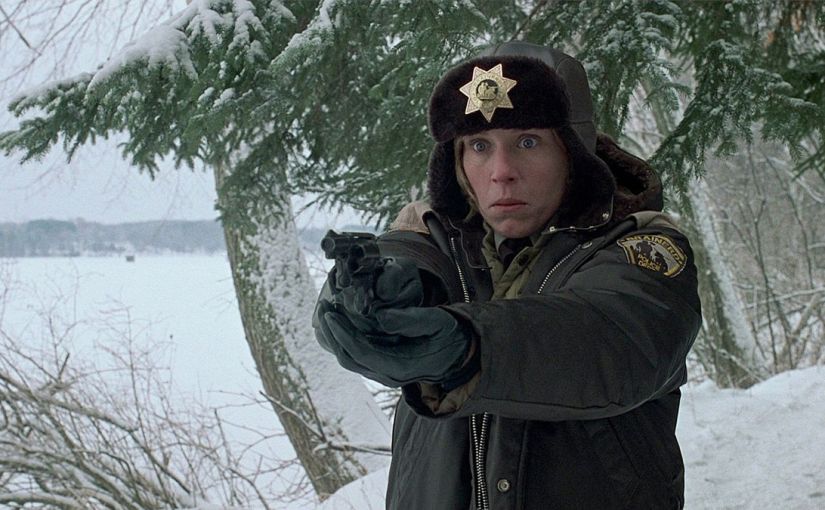
Marge Gunderson (Frances McDormand, in her first Oscar winning role) is awoken early in the morning.  Her sweet husband makes her a quick breakfast and she’s off in a jiff to inspect the crime scene of the three murders.  She is seven months pregnant, but she’s got a job to do.

Murder, kidnapping, fraud, and embezzlement piece together the Coens’ Oscar winning script.  What makes Fargo special though is how out of frame it all seems among these odd and quirky characters.  The Minnesotan dialects and vernacular (“You betcha!!” “You’re darn tootin’!” “Oh, for Pete’s sake!!!”) from Marge and Jerry do not seem standard in a story like this.  Even their names – Lundegaard and Gunderson – seem totally out of place here.  However, the pregnant, sweet natured police officer should not be underestimated, and the puppet master behind this plot should have known better.  In fact, other than Marge, no one should be doing what they’re doing, and yet that’s exactly what spins everything off the rails.

The Coens humanize the characters of their film.  Marge must stop inspecting the grisly crime scene because her morning sickness is about to overtake her.  “No, I think I’m gonna barf!” It is not the blood or the cold winter that’s holding her back.  Natural pregnancy gets in the way.  When clues lead her to Minneapolis for an overnight stay, she takes advantage of meeting with a high school friend.  Their meet-up has nothing to do with the central plot, but the writers insist on showing Marge during her off hours.  It’s a hilarious scene and Frances McDormand’s timing is naturally comedic with a guy who just has an overenthusiastic way about himself.  Marge is not just a smart cop.  She’s got a life outside of her career as a loving wife, friend and soon to be mother.

As well, Jerry insists to Wade not to contact the police and let him deal directly with the kidnappers when they call.  Wade isn’t just going to sit by for long though.  He got to the top of his powerful pyramid by taking things head on.  Jerry just doesn’t have the instinct to realize this is how the cards will fall.  Wade was not to be involved, under any circumstances.  Yet, that’s exactly what is happening.  This is not good Jerry.

Carl and Gaere (These names!!!!  I’m telling ya.), as crooked hoods, have no honor among themselves.  One might betray the other and that could lead to another gory, very gory, yet inventive moment. 

Other than Marge, either no one is particularly smart in Fargo, or they are just not seeing the possible outcomes all the way through.  Still, even the dumbest of folk can make a turn of events gone awry so fascinating.  When one tiny detail gets out of place, then the players improvise. That only twists several other expectations to go off kilter and the dominoes begin to tumble.  Very quickly, as everything has unraveled, it is any wonder how this all began in the first place. 

Fargo demonstrates that crime is hardly committed with a perfect plan.  Fortunately, the imperfections are at least as entertainingly curious as the perfections found in so many other films.  Oh, you betcha!!!!! 

JURASSIC PARK III

By Marc S. Sanders

Jurassic Park III.  What’s to say?  Well not much.  The third film in the dino franchise plays like an extension of the first two.  Sam Neill is brought back as paleontologist, Dr. Alan Grant.  Sadly, the rest of the cast is terrible.  Yet, the dinosaurs remain marvelous.

Following an opening sequence parasailing adventure gone wrong, an enormously wealthy couple, the Kirbys (William H Macy, Tea Leoni), recruit Dr. Grant and his apprentice Billy (Alessandro Nivola) for a vacation excursion to the restricted island of Ilsa Sorna as a twentieth anniversary celebration for them to see the exotic, resurrected animals.  Grant and Billy are to be their tour guides.  The offer is too good for the doctor to refuse and off they go. Once on the island, the mayhem we’ve all grown accustomed to commences.

The intelligence of the Jurassic films only comes from one source, and that is the special effects makers of these animals.  The attention to detail in skin texture, eye movement, teeth, roars, claws, limbs and facial expressions are sensational.  You truly believe these are actual living creatures.  These wizards reinvent themselves with a new dinosaur known as the Spinosaurus.  Bigger than a T-Rex and at least as fast as the velociraptors.  This is a BEAST!!!!!! 

Director Joe Johnston takes the director chair from Steven Spielberg. While the magic is lacking this time around in some of the thrills and scares, at least the new director has some fun with a couple of gags.  A cell phone (the new novel household item at the time of this film’s release) plays for some laughs, especially when the Spinosaurus appears on the scene.  There’s also a magnificent sequence in the Pteranodon bird cage.  Love the Pteranodons.  Finally, we get to see the winged dinosaurs in action as they lift the various members of the cast into the air with their claws and snap their beaks for a couple of nips.  There’s a great close up of one Pteranodon that is one for the ages.  He turns his sinister head over his shoulder towards the camera with a “Wanna fuck with me?” expression.  It’s like it was modeled off of Robert DeNiro.  Great stuff.

Raptors are back, and while we may have seen all of this before, I don’t get tired of it.  It’s like seeing a thrilling car chase for the fiftieth time.  As long I’m thrilled, I guess I’m satisfied.  Nevertheless, being that this is the third chapter, I was hoping for something more with some insight in the film.

My colleague, Miguel Rodriguez, notes that this installment as well as the prior one serves merely as amusement park fun rides.  All true.  I think I’ve backed that up here.  However, there are so many unexplored elements within the franchise originally conceived by novelist Michael Crichton.  For example, there’s the secret scientific research and development company known as InGen – the party responsible for discovering how to resurrect dinosaurs in the modern age.  Three movies in, and we’ve barely gotten to know InGen.  I think it’s time we do.  There’s gotta be a CEO at the top who is twirling his mustache amid his or her dominance.  That would really play for some good storytelling.  At best, in all three films to this point, we just get the InGen logo printed on the side of some motorized vehicles and laboratory doors. 

Much like the Alien franchise (with Weyland-Yutani), these puppet masters are never fully realized.  One of the three (THREE????) co-writers of Jurassic Park III is director/writer Alexander Payne (Election, About Schmidt).  With a genius mind like that couldn’t we have been treated to something that had more depth than just jaws, beaks, teeth, claws and roars?  What we are left with is an annoying William H Macy (one of his worst career roles) and an even worse Tea Leoni (feels like I’m watching Chrissy from Three’s Company) as the Kirbys.  They quickly provide a twist to their purpose in the movie.  It’s a dumb twist.  It’s hard to believe a doctorate mind like Alan Grant is supposed to have never seen this unexpected turn of events coming and it takes up space where the writers could have spent time bringing more back story to the Jurassic Park universe.  Crichton lined it all up!  Why didn’t the filmmakers pounce on these golden ideas?

That’s all there is to say.  Jurassic Park III is a popcorn movie.  Nothing else.  It’s only just a somewhat satisfying popcorn movie, though.  You miss the Spielberg touch, and you wish for just a little more dimension.  You don’t get it, but you do get the “don’t fuck with me” attitude of a nasty looking Pteranodon.  That alone is worth ninety minutes of your time.

A CIVIL ACTION

By Marc S. Sanders

In A Civil Action, writer/director Steve Zaillian allows John Travolta to demonstrate the workings of a remorseless ambulance chasing lawyer with a pride for the finest in men’s wear and the title of one of the most eligible bachelors in Boston, Massachusetts.  Then, all of that crumbles apart when a self-effacing acknowledgment breaks through. 

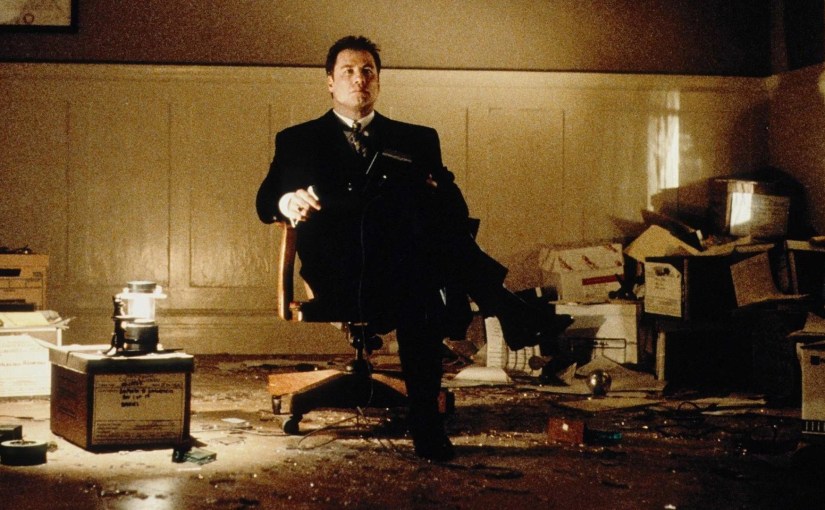
Travolta portrays real-life attorney Jan Schlictmann, who heads a small personal injury law practice with three partners (Tony Shalhoub, William H Macy and Zeljko Ivanec).  They go after the cases that promise large settlements from hospitals, insurance companies and multi-million-dollar corporations.  The best cases are where the mid-30’s breadwinning male of the household has suffered irreparable damages.  The victim is not deceased, but permanently handicapped, unable to work and provide for his family.  A dead victim is not as theatrically attractive.   Better to put the poor soul in the wheelchair on stage for the winning cash settlement. 

When Jan is boxed into a corner to meet with the residents of a small New England town, he dismisses their case as an unwinnable nuisance.  The townsfolk believe that their children have taken ill, with some not surviving, due to locally contaminated drinking water.  Kathleen Quinlan is one mother who wants an apology and explanation from whoever is responsible.  An apology holds no tangible value for Jan though, until he observes who the primary suspects are likely to be; two large corporations that own well known brands like Peter Pan Peanut Butter, Tropicana Orange Juice, and Samonsite Luggage.  Now the pockets to collect from could go on forever, and Jan does not realize until it’s too late how much of a personal gamble he is undertaking with himself and his partners in tow.

A Civil Action has always left me thinking on so many different levels since I first saw it in theaters.  The value of a life, especially a child’s life, is not very significant when corporate America profits on dollar bills.  The priority of environmental protection and its most precious resource, water, is just as minimal, maybe more.  Zaillian uncovered a fantastic character arc from a very frighteningly sad and true story.   Jan Schlictmann proudly dons an appearance of false care for victims of botched surgeries and car accidents to advance his ego and materialistic nature.  However, then he found a conscience, as he realized that money doesn’t win cases for his clients.  Instead, the acceptance of responsibility triumphs.  That surrendering admittance, though, is not expected to come from these companies.  Not when the burden of proof only comes from a measly platoon of four small town attorneys, who could never bear the expenses of proving such gross negligence and wrong doing.  This is a David & Goliath confrontation. 

Beyond a cast of recognizable faces, there are scenes in this film that just stay with you.  Most especially for me is the unforgiving nature of Quinlan’s suffering maternal character.  She no longer has any care in the world for whatever sacrifices are made by the lawyers to reveal the truth of what happened.  I didn’t think that was fair of her, frankly.  Zaillian demonstrates what these four guys endure as the case prolongs itself.  However, people are unfair.  Sometimes they are unreasonable because they have been pushed down to a bottom they’ll never climb up from.  This movie and the circumstances at play are not here to please me and make me feel good with a tidy ending wrapped in a bow, however.  The script is brutally honest in its characterizations.

What’s also disturbing about this case is simply water.  Countless times, Steve Zaillian gets close up shots of glasses and pitchers of clear, crisp water.  Children are drinking water.  Water is spilled on tables.  Jan’s enemies in trial will indulge in a refreshing gulp from a glass as they finish a scene with him.  The movie reminds you time and again that water is the silent killer.

Robert Duvall is the shining talent on the other side of the aisle from Travolta as an attorney in a fifty-dollar suit with a beat up fifty-dollar briefcase representing one of the large companies that is being sued.  Duvall makes his shark of an attorney appear effortless.  He falls asleep in court.  He tucks away in a corner to listen to the Red Sox play on his transistor radio.  Yet, he’s wise enough to know how to derail an opposing counsel’s case with just his quiet, unspoken presence at the table.  He isn’t even so much a villain or an antagonist as he allows the hero of the film ample opportunity to settle rather than charge on.  His urgencies don’t work however because Jan has changed.  Where he once saw money, he now sees something much more valuable that is beyond any variance of negotiation.  The scenes shared between the handsome, fit and well-dressed John Travolta against the older, short, hunched yet astute Robert Duvall play beautifully here.  There is top notch stage performance work happening here.

It amazes me that A Civil Action is not available on Blu Ray or 4K.  Look at this cast and its direction.  It’s magnificent.  Zaillian’s film moves with a fast pace of easy-to-follow courtroom theatrics.  Additional performances from Sydney Pollack, James Gandolfini, Dan Hedaya, and John Lithgow are so engrossing.  William H Macy is very good too, as the desperate man trying to keep Jan’s cause afloat.  Why is this film not being granted the accessibility it deserves?  I actually had to pay for a streaming rental watch.  No matter, it was worth it.  For like Jan Schlictmann, money is not the most important commodity known to man.  Morality and decency will stretch further than money that’s been spent, never to be replenished.  A noble and most human thing you can do is to experience Steve Zaillian’s film, A Civil Action. Then you will understand what an unjust world any one of us could fall victim to.  Then maybe you will understand the loss a loving mother endures far outweighs any financial liability from a grocery food company.

SEARCHING FOR BOBBY FISCHER

By Marc S. Sanders

In a game of chess, if your queen is taken, it might mean a permanent loss of what was thought to be a god given talent. Seven year old Joshua Waitzkin does not realize that, and thus it allowed him to become the greatest chess champion in the country.

Josh (Max Pomeranc) is not a chess player. Josh is a boy who plays chess, as well as baseball. He also builds Legos, plays Clue and does just about anything else including fishing with his dad. He knows this about himself. The problem is the adults in his life only see chess, and nothing else. Writer/Director Steve Zaillian assembles a film that turns the world’s most historic board game into a means of recognizing self-worth and the limits of talent with its correlation to identity.

Josh gains influence from a cutthroat formal chess instructor named Bruce (Ben Kingsley) who doesn’t just teach chess but also offers guidance in manners of contempt and dislike for your opponent. It helps that he recognizes Josh’s talent but is Bruce coaching with the best intentions?

Contrary to Bruce is a city park speed player named Vinnie (Laurence Fishburne) who reminds Josh to always play on offense. Play the board, not the opponent. Josh’s father (Joe Mantegna) only sees victory through beautiful trophies. When Josh loses interest in champion accomplishment, his father only sees nothing but failure. His mother (Joan Allen) sees the boy losing his boyhood.

These are all good people and necessary for Josh. The conflict lies in the clash of their different ideals. I love that. There isn’t a villain here. There’s a debate.

Zaillain devotes time to footage of renowned champion Bobby Fischer who eventually went into seclusion probably due to the lack of any worthy challenger beyond himself. The worry of the film lies in whether Josh will end up with the same sad fate of Fischer. Everyone is on the hunt for the next Bobby Fischer. Does everyone want to be the cruel, cold and isolated Bobby Fischer, though; a man with talent yet also hates his talent?

Zallian films very effectively in a majority of close ups, hardly showing the surroundings of the settings. He wants his camera to maintain a tunnel vision to only allow Josh, and those that discover and observe him, per se, to see what’s directly in front of him. Nothing else. Nothing but the chess pieces on a board and how many moves until check mate arrives are all that matters.

The film edits beautifully in sound as the speed play pounds the chess pieces in an aggressive music accompaniment. Pieces are KNOCKED onto the board, and when a queen is taken it is SLAMMED on to the table. A person has ultimately been disabled and weakened. When check mate eventually comes, the king piece weakly drops over.

Josh is not proud of his ability to conquer. He’s proud of his ability to play.

BOOGIE NIGHTS

By Marc S. Sanders

Boogie Nights was director Paul Thomas Anderson’s second feature following a very different and very quiet film debut with the gambling addiction piece Hard Eight.

Heck, it’s fair to say all of Paul’s films are very different; here is the seediness of porn while later in his career he will focus on the ruthlessness of a wealthy and angry oil man and then an obsessed dressmaker devoid of care for the models who parade his accomplishments. (See There Will Be Blood and Phantom Thread.). Paul was definitely striving for recognition with his familial depiction of life in the California pornographic film industry.

What I’ve always liked about Boogie Nights was Anderson’s intent to show the naive innocence of this large cast of characters. Filming blatantly oblivious awful porn scenarios can still be regarded as very proud efforts by its talent.

The main character is Eddie Adams (aka the amazing Dirk Diggler) played with macho pathos by Mark Wahlberg. It’ll likely be the best role of Wahlberg’s entire career. Dirk is proud of his natural talent in front of the camera. He’s even more proud of what God has gifted him. Don Cheadle is another porn star named Buck. He’s also proud of his accomplishments and simply a kind fellow looking to make country cowboy a trendy look for a black man while selling the “Hi-est Fidelity” in stereo equipment on the side. Julianne Moore is Amber Waves, the maternal porn mom of the bunch; very affectionate, very comforting and very reassuring when Dirk shoots his first porn scene. The one individual who really holds all of these misfits together is Burt Reynolds as Jack Horner, the porn film director. He’s the paternal one who believes in his artistic merits of shooting porn but with a story, and only with the integrity of film, and never the cheapness of videotape. So, Jack is like any artist who insists on a certain type of canvas. It might be smut, but he has principles, and he has pride.

Anderson is wise in how he divides up the developments. The film begins in the late 1970s during evening night life and decadence and everything seems fine and innocent and right despite the endless debauchery of reckless sex and drug use on a Disco backdrop. Wahlberg’s character is welcomed lovingly into this world, and nothing appears wrong. It all seems to stay that way for Dirk until New Year’s Eve, 1979. The 80s begin with a gunshot and then Anderson’s cast must pay for the revelry of their sins. A great moment presented on this night is where Amber Waves introduces Dirk to cocaine. Dirk has been thriving, making money, developing a following and now it is jeopardized in one moment thanks to his naivety. Julianne Moore is superb in this particular scene against Wahlberg. She’s the mentor with the peer pressure to pass on her high and keep it running.

Drug addiction, violence, sexual abuse and even changes in pop culture lead to hard times for these likable people.

It’s a hard life. It’s a complicated life. Yet it’s not all necessarily illegal. Morally, it might appear wrong, but it’s a life nonetheless.

Anderson was wise to use (at the time, relatively new) filming techniques of Martin Scorsese with rocking period music and fast edits along with savored moments of great steady cam work. One long cut especially works when the film first begins on the streets of Reseda and on into a crowded night club. This industry doesn’t sleep. So, neither will the camera that follows it. The music must also be celebrated. I do not listen to Night Ranger’s Sister Christian without thinking of firecrackers and a dangerously drug addled Alfred Molina playing Russian roulette. Though I know which came first, I also wonder if Three Dog Night’s Momma Told Me Not To Come and Spill The Wine by Eric Burton & War was written to enhance the celebratory introduction for Dirk when he attends his first party at Jack’s house. It’s another great steady cam moment from a driveway, followed by steps in and out of Jack’s house to simply a bikinied girl’s dive in the swimming pool. As a viewer I was absorbed in the California haze. Superior camera work here.

The cast of unknowns at the time were a blessing to this film. Anderson writes each person with care and attention and dimension. They have lives outside of this world like Amber’s child that we never get to meet, thanks in part to her lifestyle. She might be maternal but that doesn’t make her a good mother. Julianne Moore should have won the Oscar she was nominated for. Burt Reynolds’ own legacy seems to carry his role. His distinguished silver hair and well trimmed beard earn him the respect of every cast member and he performs with a quiet grace of knowledge, and insight, even if he will inevitably be wrong with how things turn out. Phillip Seymour Hoffman plays the dumb kid Scotty insecure and unsure of his homosexual attraction to Dirk. It’s not easy to play a dumb character when you are not doing it for laughs. Hoffman makes a huge impact with little dialogue but Anderson is wise enough to capitalize on him.

Boogie Nights offers one of the best cast of characters and assembled talents in any film ever made. An individual movie could be made about each of these people, and it’d be interesting and entertaining.

Try to avoid a blush and mock at the industry depicted because then you’ll see how another walk of life truly lives day to day. It might be porn. It might be smut. Yet, it’s still a thriving industry.