
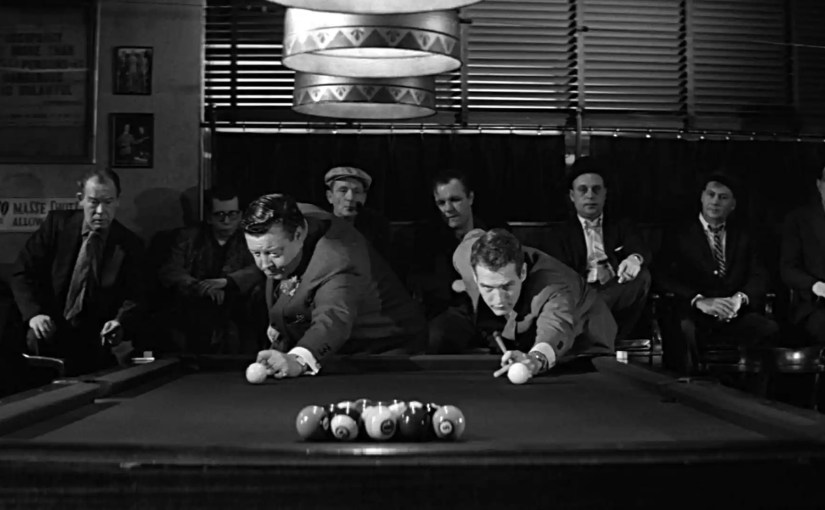
THE HUSTLER

By Marc S. Sanders

To get inside the turmoil that Fast Eddie Felson feels requires witnessing his highs and lows, all within a forty-hour time span, which equates to about thirty minutes in movie time.  Fast Eddie is The Hustler, and he was famously portrayed by Paul Newman, arguably his breakthrough role as a top billing super star.

Felson is a cocky, hard drinking pool player.  He’s got talent, but no matter how much he wins he’s always the loser because he has no discipline.  Eddie and his partner Charlie (Myron McCormick) travel from town to town, entering pool halls and setting up a bait and catch for some quick cash.  Charlie keeps his cool and treats the act like a profession.  Eddie has no subtlety.  Because he’s so how high on his expertise and what it earns him, he now only has his eye on dethroning the best in the country.  Eddie wants to take on Minnesota Fats (Jackie Gleason, in his only Oscar nominated role).

Fats sure looks intimidating.  Gleason handled his extra weight beautifully throughout his whole career, whether it be with his outrageous Ralph Kramden comedy, or when he was just being stand up Gleason for a live audience.  As well, his large frame appears kingly when he enters the pool hall.  He’s dressed to the nines with his hat, overcoat, silk tie, cuffs and studs, a cigarette in his hand, and the red carnation confidently tucked in his lapel.  The movie is in black and white, but that little flower had to be red if adorned by Minnesota Fats.  No question about it.

Newman versus Gleason in the first section of Robert Rosen’s drama is stunning to witness.  Like the actors who portray these characters, the antagonist was already a legend, while the up and comer was on the brink of higher class.  Both are the best of the best at pool, but as this scene progresses, with the regulars at Ames Pool Hall watching with their burning cigarettes and stained whiskey glasses in hand, the competition becomes a fierce and eerily quiet test of endurance.  Fast Eddie can keep on winning and winning, round after round, hour after hour, taking thousands of dollars out of Fats’ pockets, but if the fat man doesn’t surrender, has anyone really won or lost?

The Hustler isn’t so much about pool playing as it is about being a hustler or a con man who has no way to be genuine with himself or others in his life.  After the showdown between the two has finally concluded, Eddie gets acquainted with a woman who frequents the nearby bus depot.  Her name is Sarah (Piper Laurie), another hard drinker and someone who is not looking for love or companionship but will get trapped in Eddie’s charm.  What’s at play though is if their relationship, based initially on sex and booze, has anything more substantial to uphold their quick connection.  That is about to get tested by another member of this cast.

Bert Gordon (George C Scott) is the high stakes investor ready to front Eddie with a lot of money to go on the road and clean up on other wealthy players at the table.  Bert recognized a thoroughbred when Eddie went against Fats.  Now he wants to use him, but will Sarah serve a purpose or become a distraction in Bert’s plans for himself first, and Eddie second?

There’s a lot to think about when summing up The Hustler.  It’s not a typical sports film with the standard training montages.  The protagonist doesn’t necessarily get a beat down, only to triumph by the end.  Rosen’s film goes deeper than the pool playing that rests on the felt table surfaces.  Rosen co-wrote this script based on a novel by Walter Tevis, about a man overcoming the demons pecking at his attributes and skills.  When he’s not the trickster, he must ensure that he’s not getting tricked.

I was first introduced to Fast Eddie Felson with Martin Scorsese’s follow up picture called The Color Of Money, released twenty-five years after this film.  I like the coolness and rhythm of that film, but it’s mostly an exercise in Tom Cruise machismo.  It was only later that I saw The Hustler per my dad’s advice.  I didn’t care for it the first time I saw it.  Once the first act was over between Newman and Gleason, I found the picture to be slow moving and devoid of much energy.  I could not relate to the long sequence of Eddie getting involved with Sarah.  Unlike Scorsese’s film, Rosen does not rely on much music and quick edits to keep you alert.  It felt more like a movie drowning in the characters’ own drunken stupors.

Now that I have seen the film for a second time though, many years later, I can’t help but recognize the themes that carry over to The Color Of MoneyThe Hustler works better than its sequel because it functions as a character study in maturity and endurance.  The Color Of Money sets itself up that way for the Cruise character. Yet, I’m not sure it reaches a conclusion to any of the arcs or transitions for either an older Eddie Felson or for the hot shot 1980s kid, Vincent, the Tom Cruise character that Eddie mentors.

The Hustler has triumphs, but it has some shocking heartache for several characters as well.  Eddie has much to overcome internally as well as physically throughout the course of its narrative.  This fictional story had to be captured within this certain section of time (six months to a year, I think) to show how these appealing, yet cursed, individuals forever change one another.  After the film has closed, Rosen brings up the closing credits in the quiet pool hall allowing his characters to pack themselves up and walk out of frame.  There is something open ended to when the film chooses to stop. The viewer may think for a while after it’s over.  Rosen allows the viewer to take his last gulp of whiskey or bourbon and put out his cigarette and throw on his overcoat before stepping out into the cold late hours on the wet sidewalk below.

There are many impressive pool shots on display, thanks especially to the professional Willie Mosconi.  Shots are also done beautifully by Newman and Gleason.  Absolutely amazing to watch what they accomplish with a cue stick.  However, you don’t watch The Hustler for just trick billiard shots.  Rather you look at this intense drama to see a man struggling to be a winner or remain a loser.  What you realize very early on is that the outcome is never measured by how much money is wagered or what lines a man’s pockets.  Instead, The Hustler is assessed by what these people choose to do next.  Play or not play.  Bet or not bet.  Hustled or not get hustled.

DEATH WISH (1974)

By Marc S. Sanders

I never saw the original Death Wish before.  Never felt I needed to having already watched Death Wish II and Death Wish 3.  Yes!  The inconsistency in the numbers (Roman vs numeral) is how the “saga’s” films are titled.  Sometimes self-described writers and studio marketers do not pay attention to the minute details.  If you’re gonna be stupid with your five film franchise, then be sure to strive for a complete lack of intellect.

Now before I get back to discussing the original film which I finally watched last week, I offer you this confession.  In 1985, there were two films I saw five times each in theaters.  Oh God, You Devil and Death Wish 3.  I guess Out Of Africa and Prizzi’s Honor did not appeal to my twelve-year-old mentality.  Death Wish 3, however, had a hideously violent gang making social progress because they consisted of whites, blacks and Hispanics.  A couple of punk girls too.   A welcome melting pot of deranged animals operating under an equal opportunity philosophy.  They were all pals and they pillaged, robbed, vandalized, murdered and raped the helpless neighbors of the destitute projects in New York.  Happy times.  More importantly, have you ever seen that shootout that occupies the last thirty minutes of Death Wish 3?  It is one for the ages and worth your time to watch on repeat.  Dare I say it’s as good as anything in a Stallone, Schwarzenegger or Eastwood actioner.  

Here’s where my endorsement stops with this article, though.  Skip the first two trashy Death Wish films. Unless you want to see Laurence Fishburn try to shield himself from a Charles Bronson bullet by covering his face with a boom box and then drooling blood and radio parts out of his mouth before collapsing dead on the pavement.  That glorious moment occurs midway through the second installment.

Stay with me, now.

Having experienced the happy bloodshed of the third of five films in the Charles Bronson franchise, I am surprised to learn his city architect character Paul Kersey begins the original film as a “bleeding heart liberal” who would prefer to stay away from guns.  What a departure for Bronson’s most famous role.  All that being said, director Michael Winner likely started filming this piece with a need for a message about justifiable homicide or vigilantism, but unfortunately it very quickly drowns in repulsive ugliness.

I’ll say this for Michael Winner.  He’s keen enough to show Paul and his wife (Hope Lange) vacationing in beautiful Hawaii.  Then as they return home, an overhead shot of a bloody sun-soaked New York City appears on screen with the title of the picture DEATH WISH in big block letters, accompanied by some sinister sounding music.  Hawaii is heaven.  Home is hell.  John Milton was never this poetic.

Paul Kersey’s wife and adult daughter are attacked in their home.  Interesting tidbit! One of the slimeballs is Jeff Goldblum in his first film role.  Though there’s nothing for him to be proud of here.

Kersey’s wife dies.  The daughter is brutally raped, and I mean brutally.  It’s a disgusting scene that offers no sense of sadness or fear or awareness.  It also looks as if Winner and his crew and cast never even rehearsed the scene.  The poor girl’s clothes are ripped off of her, she’s pulled against one of them from behind by her throat, and then the attackers spray paint the center of her bare anus in orange as a “target” for where to penetrate.  Another thug paints a swastika on the wall. What is that supposed to tell me? Then we are treated to seeing Goldblum and company baring themselves and mounting the actress who was awarded this unfortunate role.  Reader, I’ve seen just about everything there is to see in films.  When I consider the point of delivery that Jodie Foster offered in her Oscar winning role in The Accused, what is smeared across Death Wish is exploitative garbage. Any shred of cinematic artistry is entirely devoid in this picture.  In this case it was not just another movie.  It’s just truly sickening.

Anyway, Bronson has never been a great actor.  Nor has he been charismatic.  Yet, there’s a tough guy and dark presence to what the camera found in him.  A client gifts Paul a modern-day Colt handgun and considering the high level of violence that occurs within the streets of New York, he takes it upon himself to seek out or bait would be muggers and criminals.  He never catches up to the hooligans that tormented his family, but he takes on the mission of cleaning up the streets while a useless police force amounts to little results.

After Paul’s first shooting, he comes home to vomit.  I can only guess the liberal cannot stomach what he’s committed.  This is about the only dimension we get out of this guy.  Paul has boring conversations with his son in law.  Poorly acted scenes with actor Steven Keats; poorly acted, poorly directed, poorly written, poorly filmed.  Paul hardly ever shares a scene with his traumatized daughter who goes in and out of catatonic states when she appears in the film.

As the body count piles up, a detective played by Vincent Gardenia starts the investigation around town and wrangles up his police force posse to be on alert. Hey, look who is giving a run down on a progress report.  It’s Gardenia’s Moonstruck wife, Olympia Dukakis.  Pretty neat to see this. Still, Death Wish is not recommended for your Vincent Gardenia/Olympia Dukakis movie marathon.

Death Wish is tone deaf.  I’d be interested to see how a liberal, who shutters at violence, transitions into a vigilante.  That’s a story with an eccentric transformation. However, Michael Winner and his writers are not even aware or interested in talking to you about that.  I only know Paul Kersey starts out as a liberal because his co-worker mockingly calls him one, and again he vomits after his first shooting.  How humane of Paul.

I won’t disclose the entire ending, but I’ll share this with you.  Paul relocates to Chicago and upon arrival, Michael Winner freeze frames on a grinning Charles Bronson pointing a finger gun at a couple of harassing punks who are tormenting some citizens in a train station.  What do I gather from this hint of subtly?  I guess Paul Kersey registered with a different political party when he became an Illinois citizen.  Quite the message!

MOONSTRUCK

By Marc S. Sanders

Moonstruck has to be one of the most delightful romantic comedies of all time thanks to an outstanding cast, an intuitive director (Norman Jewison) and a script full of brilliant dialogue and set ups from John Patrick Shanley.

Loretta Castorini (Cher in her Oscar winning role) is a 37 year old widow. Her husband of two years got hit by a bus. So, naturally when her father, Cosmo (the hilarious Vincent Gardenia), hears the news that Loretta got engaged to the boring schlub Johnny Cammareri (Danny Aiello), he knows this is a bad omen and she should not get married again. Sure, her husband got hit by a bus, but that can only mean that marriage is no good for Loretta. When they wake up Rose (Olympia Dukakis in her well-deserved Oscar winning role), Loretta’s mother, to share the news, she just opens her eyes and asks, “Who died?” This is an adorable Italian family living in Brooklyn and somehow an Irishman wrote the script which was then directed by a Jewish mensch, and everyone is working on all Italian cylinders.

Two minutes into the film and I’m laughing. I’m laughing at Johnny’s wimpy proposal in the local Italian restaurant. I’m laughing at Rose and Cosmo who’ve seen enough of life to know that you don’t get married for love anymore. Rose is for Loretta getting married though. Cosmo doesn’t wanna spend the money.

Just after Johnny proposes, he flies off to Sicily to be by his dying mother’s bedside. He requests that Loretta invite his brother Ronny (Nicholas Cage), who he hasn’t spoken to in five years, to the wedding. Ronny is upset with Johnny. Ronny got his hand chopped off in the bread slicer at his bakery when Johnny was talking with him and Ronny looked the other way.

When Loretta approaches Ronny, before you know it, they are sleeping with each other. Ronny then invites Loretta to see La Boheme at the Met that night. Loretta knows it’s wrong and can’t keep this up. It’s a sin. She goes to confession, but then she also goes to buy a new dress and dye the greys out of her hair.

As well, Cosmo is stepping outside of his marriage, only Rose is not so stupid. She knows what’s going on. When Rose is dining alone, a college professor who strikes out with one attractive student after another joins her table. Rose isn’t gonna do anything. Instead, she asks the question on everyone’s mind “Why do men chase women?” Then she answers it. “Because if they don’t, they think they’ll die.” But they’re gonna die anyway. Right?

It sure looks like my column is just summarizing the film but my breakdown of Moonstruck simply celebrates all that’s good about it. Here’s a film that doesn’t stereotype a New York Italian family. Instead, it shows how they regard one another as well as the people within the neighborhood from the eager to please waiter in the restaurant to the mortician that Loretta works for. The mortician spills butter on his tie. Loretta takes the tie off of him and says she’ll get it cleaned.

Life in the home of Castorini family is shown beautifully with natural humor to display its atmosphere. Cosmo’s quiet elderly father with five yappy dogs on leashes is only a part of every passing day. Like I’ve made claim on other films, the best movies offer smart characters. Everyone has a way of carrying themselves in Moonstruck, and they’re not dumb. They might be cheap like Cosmo or wimpy like Johnny or a little dim like Ronny, not dumb, but they’re all wise to how they handle themselves.

This might seem like a relatively easy, untechnical little New York comedy. Norman Jewison, however, uses a great approach that makes each setting feel like you’re watching the most alive stage play you’ve ever encountered. I’m actually surprised this film has yet to be adapted for the stage. Maybe, just maybe, Moonstruck hasn’t made it to live theatre yet because it’d be damned near impossible to recapture the harmony of this magical cast.

I love Moonstruck.