BATMAN FOREVER

By Marc S. Sanders

Last month, upon hearing the news of Val Kilmer’s unfortunate passing, Joel Schumacher’s Batman Forever actively swept the social media rounds.  Fans of Kilmer praised his one and done occupation with the costumed role.  Some declared the film their favorite of all the superhero’s cinematic adventures and expressed their immense appreciation of the Juilliard graduate as Bruce Wayne and his vigilante persona.  He’s good.  Yeah.  I’m not going to say he’s great though because the film doesn’t offer much meat for Kilmer to chew off the bone.  As for the film, well, it’s a Joel Schumacher movie.  Should it be good?

The director took over the reigns from Tim Burton.  Michael Keaton opted not to return following two films and thus Kilmer was contracted.  The villains of the week are a very miscast Tommy Lee Jones as Two Face and Jim Carry doing a misbehaved class clown interpretation of The Riddler.  Unlike Burton’s noir approach, Batman Forever is gleefully campy and colorful with overly apparent winks and nods to Batman’s butt, codpiece and notorious chest nipples.  None of it necessary because it’s all wrapped in vinyl and plastic.  Buy the action figures if you want to cop a feel.

Akiva Goldsman was the head screenwriter.  His script carries no reluctance in delivering cliche dialogue.  “It’s the car right? Chicks dig the car!”  or “I’ll get drive thru.” (McDonalds was a proud sponsor.) Worse though are the two halves of the picture.  Kilmer’s Batman endures his ongoing traumatic psychosis of losing his parents, while Jones and Carrey go for a reiteration of the beloved Adam West slapstick TV series.  These two languages never speak to one another.  The hero and the villains hardly confront or challenge each other and never hold a substantial conversation during the course of the film.

Jim Carrey and Tommy Lee Jones try way too hard to duplicate what Jack Nicholson’s Joker portrayal memorably did the first time.  There is no backstory to Jones’ character except a brief news clip.  Otherwise, the middle-aged actor looks like he’s exhausting himself out of breath while trying to match Nicholson and Carrey.  As a Batman fan, he’s entirely wrong for this role.  The Two Face alter ego is the handsomely vain district attorney Harvey Dent.  According to comics lore, when Dent gets half his face grotesquely disfigured, he develops a deep-seeded anger to losing his looks and it leads to his ongoing villainy.  Tommy Lee Jones is a fantastic actor, but he is not the Adonis that Billy Dee Williams (Burton’s Harvey Dent) carried his charming career on.  The makeup job with Estee Lauder pink and purple is awful craftsmanship.

Jim Carrey is doing his usual schtick that skyrocketed his career with Ace Ventura and Dumb & Dumber, but it’s overly abundant here.  Goldsman, Schumacher and Carrey take equal blame.  This Riddler only offers three or four puzzles.  Otherwise, we get Carrey doing the Nicholson gags that should never have made the final print; a baseball pitcher tossing a curveball bomb in the Batcave and a mad scientist routine that drives the bad guy’s stupid plot line of using television waves to absorb the collective intelligence of the people of Gotham City.  The more this side story carries on the more mind numbingly stupid it becomes.  The Riddler’s device is nothing more than a kitchen blender that glows neon green while it hardly maintains balance on anyone’s head.  Junky production value.

Nicole Kidman is radiant as the next romantic Bat gal in line.  She’s so much better than this insubstantial material, though. She consists of zero significance.  Nothing else I can say.

Chris O’Donnell makes his first of two appearances as Dick Grayson, Batman’s sidekick known as Robin.  O’Donell actually has the most interesting storyline as a daredevil kid who tragically loses his family but can’t sit still when adventure awaits.  He gets into all kinds of mischief on his motorcycle and within the confines of Wayne Manor before he finally dons the famous costume. Yet, even when he’s standing in the same frame as Kilmer, both actors look like they are performing in different films.  One guy is hyperactive.  The other is morose and neither seems to be reading from the same script. Their chemistry is begging. Did these guys ever stop and develop an appreciation for one another?

Joel Schumacher applies a candy-colored polish to his Gotham City with black light graffiti, bright lights and more glow, glow, glow!!! Even the street gangs use neon glowing fighting sticks and Two Face’s henchmen work with neon red machine guns.  Oy!!! Enough.  Willy Wonka’s factory was not this sugary sweet.  Batman Forever is one film that can give you diabetes just by looking at it.

Other than an impressive opening scene with a helicopter and a cylindrical bank vault, none of the action sequences are worthy of postponing your bathroom break.  Batman’s fighting prowess and his ugly car and jet look like they are being run by an eight-year-old with his action figures.

So, as I noted before, I took another look at Batman Forever to explore what Val Kilmer did with the role.  He would have been a good Batman if he was given some things to do.  Ultimately, his dashing good looks complement Bruce Wayne’s suits and ties quite well and his square jaw fits perfectly in the mask.

What else can I say except I can’t imagine any chicks loving the car because this Batmobile has a pointless fin sticking out of the chassis and the wheels glow white, plus there’s an odd rib cage of lights on the sides of the vehicle.  Oh, and it drives up the wall of a building.  Is this where people are supposed to be impressed with Val Kilmer?

JFK – DIRECTOR’S CUT

By Marc S. Sanders

Oliver Stone’s JFK is told through perspective, not necessarily history.  It’s not a biography and I do not believe Stone would ever claim it to be so.  It’s a thinking person’s picture that gives viewers entitlement to question what occurred, how it occurred and why it occurred.  It might guide you not to trust what anyone says, sees or hears, but let’s face it.  Probably the day Kennedy was shot, November 22, 1963, could we ever completely trust anyone ever again? 

(Forgive my cynicism.  I must backtrack a little.  I still trust my wife and daughter.)

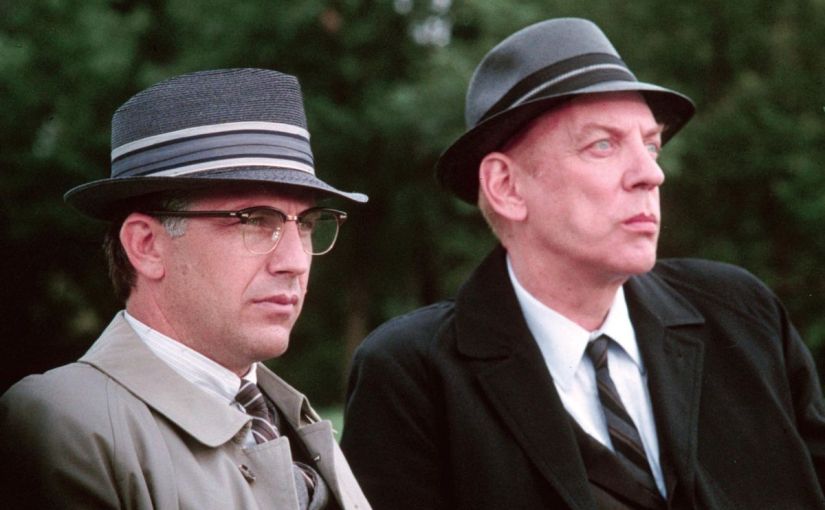
Oliver Stone works through the eyes of New Orleans Prosecutor Jim Garrison (Kevin Costner, in what may have been his most challenging role to date at the time).  Garrison sees a little too easily that there are circumstances out of place, or maybe too neatly in place to satisfy the ultimate resolution that a known American defector to the Soviet Union, like Lee Harvey Oswald (Gary Oldman), acted alone in the assassination of the President.  Stone wrote the script for JFK with Jim Marrs and used Garrison’s input from his own novel. Nearly every scene builds into another possibility of how that fateful day came to be.  Stone even questions if a famous photo of Oswald on the cover of Life Magazine is real.   Too many cover ups with a building list of body count witnesses and too many coincidences keep Garrison up at night.  So, he assembles a crack team of investigators and fellow attorneys to reopen the case and question the official Earl Warren Commission.

Firstly, JFK is magnificent entertainment with a hair raising and unusual original score from famed film composer John Williams.  His notes on percussion with dings and harpsichord strings cue in at just the right moments when Stone introduces another one of many scenes that point out what seems cagy and suspect. The music of JFK works as a narrator.  This narrative keeps you alert.  Maybe you should look in each corner of the screen at times for some subtle clues.

It was also wise of Stone to go with a well-known cast of actors.  The Oscar winning editing from Joe Hutshing and Pietro Scalia moves at a breakneck pace.  Yet, because I recognize fine performers like Ed Asner, Jack Lemmon, Kevin Bacon, Tommy Lee Jones, Brian Doyle-Murray (Bill’s brother), John Candy and Joe Pesci it is easy to piece together who is playing who and what significance they lend to the many theories Garrison and Stone question next.  

My admiration for the casting continues with the Garrison team that performs with Costner – Michael Rooker, Laurie Metcalf (especially impressive), Wayne Knight, and Jay O. Sanders.  There’s also a clandestine trench coat guy named X portrayed by Donald Sutherland.  Who even knows if this guy ever existed?  He’s more secretive than Deep Throat, but Mr. X has a hell of a lot of information to justify Jim Garrison’s suspicions.  That is an especially marvelous sequence between two men strolling through Washington D.C., eventually concluding a disturbing realization on a park bench.

Sissy Spacek brings out another dimension to the Jim Garrison character.  She’s his wife and the mother of five who suffers the loss of her husband’s attention which is entirely focused on this compounding investigation.  I like Costner’s take on the Garrison character.  Early on he politely asks one of his associates to stop cursing.  He does not like that kind of talk.  Later, it is Garrison who is dropping a number of eff bombs in front of his wife and young children.  This conundrum of a case, a very puzzling detective story, is unraveling the investigator. 

JFK was instrumental for further Congressional consideration following its release.  Files were reopened.  Additional research was executed, and soon many of those secret documents pertaining to the assassination will be revealed in 2029.  Back in 1991, of course that appeared to be a lifetime away.  It’s time we know everything, though.  Arguably, most of who were involved in this incident are dead by now.  Let us know our history.  Still, Garrison was bold enough to point skepticism at not just the adversarial relationship Kennedy may have had with Castro, the Cubans and their Communist allies, but also the people within the CIA and the FBI.  Lyndon Johnson is not even free from scrutiny after he’s sworn in.  Some on Garrison’s team went so far as to factor in culpability from the mafia.  Garrison was not so keen on that theory, actually. 

The construction of Oliver Stone’s film is unparalleled.  I think it’s his best film to date and I can find few others that even compare to how he assembled the picture.  It begins with the voiceover of Martin Sheen laying out many news cycles that were occurring ahead of Kennedy’s murder such as the Bay Of Pigs and the President’s supposed efforts to withdraw from Vietnam.  Sheen’s narrative comes at you very fast with Stone incorporating real life home movies of Kennedy along with his brother Bobby, as well as Castro, and television news footage from Vietnam and anywhere else events were happening.  By the end of the roughly five-minute opening, your head might be spinning. 

Thereafter, though, Stone goes through Garrison’s day on November 22, 1963, watching the outcome following the momentous event and the writer/director works his way into the drama beginning with Asner and Lemmon as two drunk old guys walking through the rain and getting into an argument. 

Three years pass by and so begins Jim Garrison’s motivations to follow multiple trails of breadcrumbs that lead to a lot of different places, all unlike what Earl Warren surmised. 

The scenes work quickly from that point on, and cuts of theoretical reenactments occur.  Who knows if any of these scenes are factual?  Stone and Garrison want you to at least consider their reasonable likelihood.  Moments happen where Joe Pesci and Tommy Lee Jones’ characters appear to be lying about even knowing one another while Stone will depict a sexual role play encounter between them which also includes Kevin Bacon as someone with no more reason to lie. 

Episodes are deeply focused on Lee Harvey Oswald depicted as an infamous and suspected patsy in association with others who may have a reason to want Kennedy dead.  Gary Oldman hides so well in the role.  Oliver Stone even lends focus to how different witnesses describe Oswald.  In some scenes it is Oldman, but then there are other times where a shorter, more overweight man may have been the real Oswald. Later, there’s an Oswald who is taller and more slender. 

A few years ago, I was visiting Dallas, and I was able to spend a some time walking around the crossroads where Kennedy was shot in the convertible while seated next to his wife Jackie.  Watching JFK again lent more clarity to all of the locales such as where Oswald was supposedly shooting from the top floor of the corner book depository.  Kevin Costner and Jay O. Sanders go through the motions of Oswald firing the three shots from his rifle in the short amount of time span.  The script also questions why Kennedy was taken out by Oswald after the turn off the corner of Elm and Houston. There appears to be a better wide-open clear shot long before the turn with the car only going ten miles per hour.  The men question if it was Oswald, then why didn’t he take advantage of the clearer shot.

I know.  I could go on and on.  I have to stop myself.  There’s a ton – A TON – of information in JFK.  It becomes addicting to watch.  You don’t even want to pause the long film for a bathroom break.  I watched the extended Director’s Cut by the way. 

Many common critiques of JFK lean towards how many of these scenes did not even happen.  People are happy to point out there’s no evidence to truly say any of Oliver Stone’s enactments occurred.  I agree, but that’s not the point of this director’s piece.  This is primarily told through the eyes of Jim Garrison.  Kevin Costner is great as the listener, the observer and especially at the conclusion, the describer.  Watch him physically respond to anyone he shares a scene with.  There’s a memorable twitch he offers while at the scene of the assassination that works perfectly with a jarring echo of a gunshot edited into the film.  He’s also great at turning his head down as the thinker while Mr. X lays out an enormous amount of information that comes from several different directions.  Because the film comes from Garrison’s perspective, it does not have to be true.  It only has to be what the investigating prosecutor reasonably believes, and what he absorbs from suspects, witnesses, and his devoted team. 

A final speech of Garrison’s is told at the trial of suspect Clay Bertram, aka Clay Shaw (Tommy Lee Jones), who was the only man tried by Garrison for Kennedy’s murder.  First, it’s important to note that during this fifteen-minute sequence, when Stone cuts back to Garrison in the courtroom, Costner is wearing different suits.  So, while it is assembled as an ongoing rundown, it is not meant to all be in one instance.  Garrison lays claim to an endless amount of possibilities and circumstances that at times have no correlation with each other but could possibly all merge together towards November 22, 1963.  Critics argued this speech of Garrison’s never took place.  That’s correct.  However, this is a movie and for the efficiency of information to come out, a funnel must be opened up to learn what is being pursued and what has been uncovered.  This is the strategy that the script for JFK adopts and it works, leaving you thinking and rightfully doubting what our governing bodies and history books have told us.  Most famous of all of these nonsensical happenings delivered by Garrison is the “Magic Bullet Theory” made extra famous by Jerry Seinfeld with Wayne Knight on the comedian’s sitcom.  It’s silly but it is also a response to the impact that came from JFK.

JFK has a very glossy appearance from the Oscar winning cinematography.  Reflections and natural glares come off of Jim Garrison’s glasses.  The exasperation, along with the shiny persperation of John Candy’s sleazy lawyer character is undeniably noticed as his integrity is being questioned.  Staged reenactments are shown in black and white, clear color or grainy distressed output (such as recreations of the known Zapruder Film).  Nothing is clear about what led to Kennedy’s murder.  So, Oliver Stone’s filmmaking team will ensure that nothing should look consistent.  There are no straight answers; only endless amounts of reasons to ask another question after another.

Oliver Stone does not make JFK as complex as some will have you believe.  It’s quite easy to piece together who represents what in this story.  Many theories are offered at lightning speed, but they hardly ever intersect with each other until a probability is completely laid out on the table and then the film moves on to the next one.

JFK may have a long running time and a large cast with a lot to say and ask, but it’s an exhilarating thrill to behold.  Who knows what is true?  The importance of Oliver Stone’s masterpiece demonstrates that much of what we were told as truth may not consist of the entirety of facts. 

Again, question your governing bodies and ask the hows and whys and whos.  Oliver Stone reminds us that we have that right as the citizens of America. 

What really happened to our President, and who was really responsible?

THE BOURNE SUPREMACY, THE BOURNE ULTIMATUM, THE BOURNE LEGACY, JASON BOURNE

By Marc S. Sanders

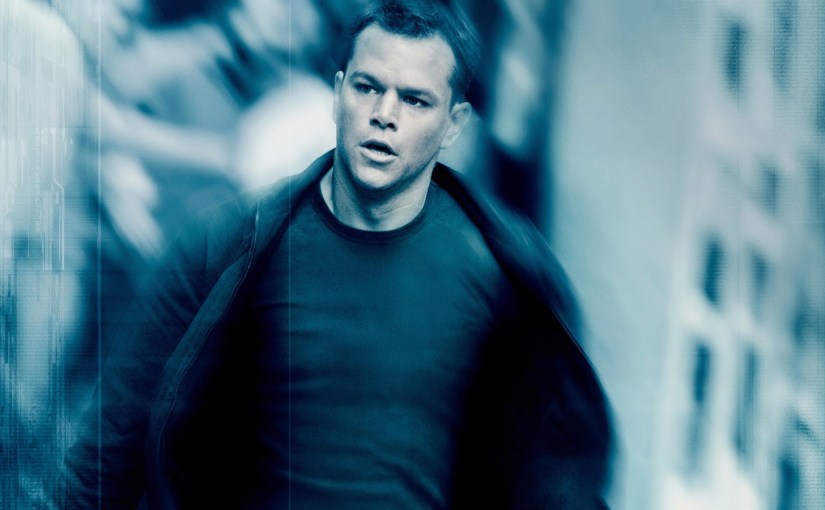
Sometimes the same old thing is all we want, right?  It’s like comfort food.  That’s what the Jason Bourne films offer.  The first time (The Bourne Identity) it is original.  The second time (The Bourne Supremacy) it is familiar.  The third time (The Bourne Ultimatum) it is what we expect.  When you get to the fourth and fifth time (The Bourne Legacy and Jason Bourne), well then perhaps you’ve overstayed your welcome.

The second and third films in the Matt Damon action series function as one long four-hour film.  They are absolutely gripping in high octane, fast cut editing, pulse pounding music from James Newton Howard, and taut direction from Paul Greengrass.  They work because at least two thirds of the material is shown through the eyes of the former assassin Jason Bourne who is trying to learn of his past and who he worked for and why.  Plus, though he may hide deep undercover on the other side of the world in places like populated India, he only resurfaces when he discovers someone is trying to kill him.

The other third of these two pictures function on the other side of the coin with clandestine departments within the CIA who only consider Bourne being alive as a threat to the integrity of their black operations.  He must be eliminated.  There are great acting scenes with Joan Allen first up against an intimidating Brian Cox, and later she’s going toe to toe with David Strathairn.  If you are not part of the chase for Bourne, then you are engrossed in the cause these three supporting players offer with government politics and debate.  With each passing film, it’s an old, grey haired white gentleman in a suit who is insistent on eliminating Bourne and anyone who he associates with.  This started with Chris Cooper in the first film followed by Brian Cox (my favorite) over to David Strathairn.  The baton is then passed to Albert Finney.  A new film moves over to Edward Norton and then Tommy Lee Jones.  Scott Glenn and Stacy Keach are in the recipe too, but they are not as prominent.  All these guys start to look alike and when you watch the films in succession, one after the other, like I recently did, you start to question when this actor and this actor entered the fold.  Best way to describe it is that it is a ladder climb.  There was one guy in charge, then another above him and so on.

The appreciation for the Bourne series comes mostly from its action and the absolute cleverness of its hero.  Jason Bourne functions with ease about staying one step ahead of those trying to kill him.  They think they have a lead on him, but in reality, he has the lead on them.  Do you know how satisfying it is when he calls these people to talk to them and they play dumb? Jason will simply say “If you were in your office right now, then we would be having this conversation face to face.”  Moments like this are what gets an audience to clap and cheer.  The old white guy has been duped.

The action works because, once again I lay claim to the lack of CGI.  So, the overabundance of car chases seems nerve wracking like they are supposed to.  That door on that car is actually getting bashed in.  That taxi cab is really getting t-boned and turning into a 360 tailspin.  Jason can grab a seatbelt, lie down on his side and when the car careens over the barrier onto the landing fifty below, upside down, I’ll believe he gets out with only just a slight limp and a dribble of blood on his brow.  Only Jason Bourne can drag a wrecked rear bumper on a stolen police car through a busy Times Square and bash an SUV into a concrete barrier.

Fight scenes are not just fight scenes in the Bourne films.  It’s not just fists and punches and karate kicks.  Creatively speaking, the films construct their fight scenes to have the hero arm himself with a ball point pen or a magazine that’s wrapped up ready to wallop an opponent in the nose.  I’ll never forget when my colleague Miguel and I saw Ultimatum in the theatres and witnessed Jason punching a book into the face of a dangerous bad guy.  How many times have you seen a guy get punched in the face?  How many times have a seen a guy punch a book into the face of another guy?  There’s a difference. 

Matt Damon has been quoted as saying he believes the Bourne films carried the least amount of dialogue for him to memorize.  Yeah.  That’s likely true.  These films are visual feasts.  They rely on watching Damon move.  They are paced by how he walks, drives a car or tinkers with props.  Even how he listens and observes move with a kinetic progress. 

The locales are spectacular, spanning the globe from India, to Russia, to London, to Morocco, to the Philippines, and on to New York City and Las Vegas.  Following the first film, Paul Greengrass directed three of the next four.  (Writer Tony Gilroy directed the fourth film, The Bourne Legacy with Jeremy Renner taking the lead while Damon’s character was only talked about.) Each film takes every advantage of the atmosphere, using the overpopulated extras as obstacles and means to hide and weave away from the antogonists while on foot, behind a steering wheel or saddled upon a motorcycle.  Greengrass practically invents the concept of putting the viewer so much within the environment, you can almost smell the diesel or the food trucks within the area.  Zoom in overhead shots offer quick glances of the playground and traffic we are engrossed in.  Approximately twenty-five minutes within the center of The Bourne Ultimatum go by with no dialogue as Jason Bourne pursues a bad guy through a labyrinth of apartment tenements and rooftops, while the bad guy pursues actor Julia Stiles.  Finally, when all three catch up to one another, with a leap through a window, do you let out the deep breath you never realized you were holding on to. 

The first three films in the series (Identity, Supremacy and Ultimatum) work as a tight trilogy.  Each film ends with hanging threads to consider and lend to the next film.  By the time Ultimatum concludes, you feel as if all that needed to be told has been covered.  The next two (Legacy and Jason Bourne) function as cash grabs for the studio.  Legacy is entertaining and it boasts a good cast with Jeremy Renner and Rachel Weisz trying to outrun the government adversaries.  It hinges on operating as parallel material that occurs in the prior Damon installment.  While Jason Bourne is being pursued, this is happening over here.  It’s not unwatchable, but it is also truly unnecessary as it doesn’t advance the universe of the series at all.  A thrilling motorcycle chase closes out the film, but it’s a retread of what we’ve seen before.  It gets old quickly.  The film demonstrates that guys like Jason are trained to become dependent on drug enhancements for their highly trained arts of warfare and instinct.  Renner’s character is just another kind of Jason Bourne.  I was more impressed when I thought Jason was just a highly skilled fast learner to all that he’s capable of.  If you tell me blue and green pills lend to what he’s capable of, well then, he’s not much of a superhero in my eyes anymore.

With the final film, Jason Bourne, Greengrass returned to the director’s chair and Damon agreed to come back (paycheck had to be right, I’m sure), though he was significantly greyer and older than his prior films.  It was a weak return.  Just when we think Bourne has learned everything he needed to know and he could now live comfortably underground as a street brawler for bucks, he is informed that his deceased father knew and did some things for these secret agencies that put Jason on this path of special operations.  It doesn’t hold much weight and the payoff is nothing special.  Another car chase occurs in Vegas that appears nearly shot for shot similar to what we already saw in Damon’s prior installments. 

I wrote in an earlier review of The Bourne Identity, that Matt Damon works so well in the role because he’s such an unexpected surprise.  He’s not the muscle guy like Stallone or Schwarzenegger.  He comes off common.  In the first three films, he’s simply a kid.  When you place him in action or see how he gets the drop on a bad guy who is surveilling him, it is so satisfying.  The Bourne films work best with the locales they choose to shoot from.  Bourne will spy on his pursuers from a rooftop building across the street from where they are.  This is inventive filmmaking not just found in the pages of the script.  Paul Greengrass strategically shoots his players.  Director Doug Liman planted the seeds for this series’ potential (The Bourne Identity), very loosely based on the Robert Ludlum novels with creative adaptations from Tony Gilroy, primarily.   Greengrass enhanced the characters and their motivations by use of scenic locales, skillful shaky cameras to make it look like the audience is running at the same pace of Bourne and his adversaries, and quick cut, real time editing.  He applied this approach to his 9/11 film United 93.  The last two films are good even if they seemingly peter out the series, but overall, the four sequels hold up very well. 

If you’re asking, the best of the series is The Bourne Ultimatum, followed very closely by The Bourne Supremacy.  Either way, no matter which film you’re watching, you’re in for a good time when Jason Bourne shows up on the grid.

CAPTAIN AMERICA: THE FIRST AVENGER

By Marc S. Sanders

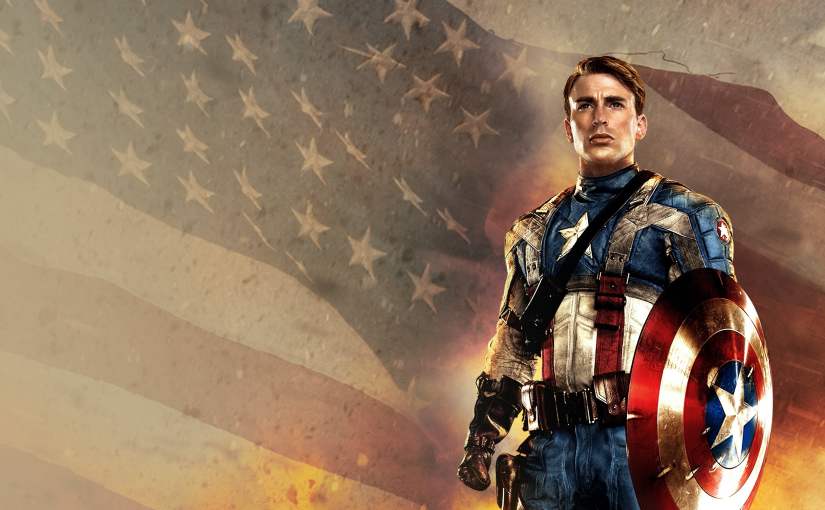
Admittedly, as a kid I read about the star-spangled hero, Captain America, on a frequent basis. In the ‘80s, to me he was nothing special; a guy with a shield, dressed like the flag who was very agile. Not many surprises were left for him to discover on the page. However, in his first MCU installment, Chris Evans, as Steve Rogers the weakling yearning to join the US Army during World War II and kill Nazis, is inspiring.

Director Joe Johnston ably introduces a character before revealing all the goodies. A fantastic special effect of downsizing Evans to a gaunt 95 pounds allows the motivation to become a hero all the more convincing. Following a series of being bullied and being rejected for service, Rogers is given the opportunity to become a lab rat for a “Super Soldier” experiment that will award him with instant fighting skills and strength. Stanley Tucci plays the doctor looking for the right candidate. Why Rogers? Because he sees he has the heart of a man only wishing to do well unto others. The experiment is a success before it becomes sabotaged, but Tommy Lee Jones, representative of the Army, is not entirely convinced. So, Cap only elevates himself to the role of a character logo, forced to sell the idea of buying war bonds across the country and entertaining the troops overseas. A rescue mission finally comes calling, and the boy in blue dons the shield and shows the world who he is and what he stands for.

Chris Evans is great in this part as a guy always on a path of “do good.” Never emoting cockiness, never in service for himself and never one to surrender to illogical and immoral mindsets. This is how Captain America should always be portrayed, a man who stands for the good of country and as the MCU films continue on, the good of the world and, well heck, lets just say the good of the galaxy. With his perfect haircut and clean shaven face, Evans never shies away from that platform.

Tucci is so good in a role that will never define his career. His brief appearance shows no hint of him being in a comic book movie. That’s a huge compliment. He takes the role of a German doctor seriously. He’s the scientist, but the film allows a nice scene for him with Evans showing that he is more so a friend. When his part exits the film, you miss him.

Finally, the MCU gets the female role right following the dismissive nature of characters like Pepper Potts (Iron Man), Betty Ross (The Incredible Hulk) and Jane Foster (Thor). Special Agent Peggy Carter played by the awesome discovery of Hayley Atwell makes the role her own. She plays the part like it is written, never relying on the title character for her cues. Atwell shows determination to stand out as a woman among a sea of men and never regarding herself as any different from those said men. She has some great scenes with Tommy Lee Jones debating the purpose and importance of Rogers. By the end of the film, you are not just paying attention to the fate of Evans’ character, but Atwell’s as well. Peggy Carter is written so well, you could write a TV series about her. Wait….hold on…. anyway I digress. Hayley Atwell remains the best female character of the MCU above those we’ve seen already at this point, as well as ahead of those to come in future installments.

The villain is really just a villain with Hugo Weaving as the Red Skull. The character looks great; looks just like the source material. He’s one bad dude, but not much to him. He stands to be more powerful than Hitler, yada yada yada.

Joe Johnston directs a film with a salute towards director Steven Spielberg. Try to convince me that the opening scene is not reminiscent of the opening to Close Encounters of the Third Kind. Indiana Jones seems to sprinkled about as well. Johnston doesn’t try to get cute with experimental camera shots and blurry CGI action. I think because he follows a paint by numbers approach to this film, it is all the better. He offers lots of good back story to Steve Rogers role, he gives a large cast of characters their own moments to stand out (like Bucky Barnes and the Howling Commandos) and he keeps Captain America likable and a guy to cheer for; a guy to be thankful for.

So, let’s give it up for Captain America!!!!

NO COUNTRY FOR OLD MEN

By Marc S. Sanders

Joel and Ethan Coen have an odd collection of films under their belt. No Country For Old Men, an adaptation of Cormac McCarthy’s novel is no exception. You’re likely to meet the oddest hit man you’ve experienced in a film. (Reader, I’m going under the presumption you’ve never encountered a normal or odd hit man in real life. If you survived long enough to read this passage, you are truly blessed.)

Anton Chigrh follows a discipline that likely no one ever taught him. His code is to continue until he finds what he’s looking for and dispose of any lead in his ongoing quest. His weapon of choice-an air gun hose connected to an oxygen tank. It’s instant in serving its purpose. Its sound is quick and jarring.

Javier Bradem delivers an Oscar winning performance as Chigrh in search of $2 million when Llewelyn Moss (Josh Brolin) takes possession of it after coming upon the sight of a drug deal gone bad.

Tommy Lee Jones is perhaps one of the old men in the title. A Texas sheriff not surprised by the carnage he comes upon, but not of much use either. I think he regrets that he can never do more or better and simply can only surmise what’s already been done. I gathered that especially from a scene depicted in a hotel room during the third act of the film. His approach on the scene and his need to sit down translate that for me. His periodic anecdotes during the course of the film seem to say so as well. This sheriff has likely never rescued anyone from harm despite how intuitive he may be.

The Coen Brothers are never shy with blood. A lot of directors are not, really. Yet with the Coens, it seems the bloodshed is disturbingly honest. The instant splatter and flow following another act by Chigrh couldn’t be more truthful. They tell this tale very well, never concerning themselves with how unsettling they can be. Sun filled deserts are not comfortable. Evenings are sleepless. Blood is dark, thick, sticky, messy.

Moss is a hunter who has no idea what he’s up against. Brolin plays him with quiet reservation. He could not resist the urge to take the bag of money, but he also knows he’ll pay for it as well. When he realizes there’s no way to escape, by even crossing the border, he can only try to kill the devil incarnate. He’s likely aware of how this will all play out though.

Among this trio of fine actors (with Woody Harrelson also briefly in the fold), the film is nevertheless celebrated for Bardem. Whenever the story returns to Chigrh, you sit up in your chair a little more alert. He’s got disturbing dialogue exchanges with those he encounters and Bardem’s method makes you wish you never have to decide your fate with a coin toss.

No Country For Old Men is not an action film. The pace takes its time, invested in three men with respective histories who cannot change what their meant for. No incident will change their lifestyles. They are meant to be an assassin, a washed-up lawman, and a poor country hunter. Until they die, no moment in time will alter their caricatures. That’s what I took from the Coens’ Best Picture winner.

I appreciate its honesty.

THE FUGITIVE

By Marc S. Sanders

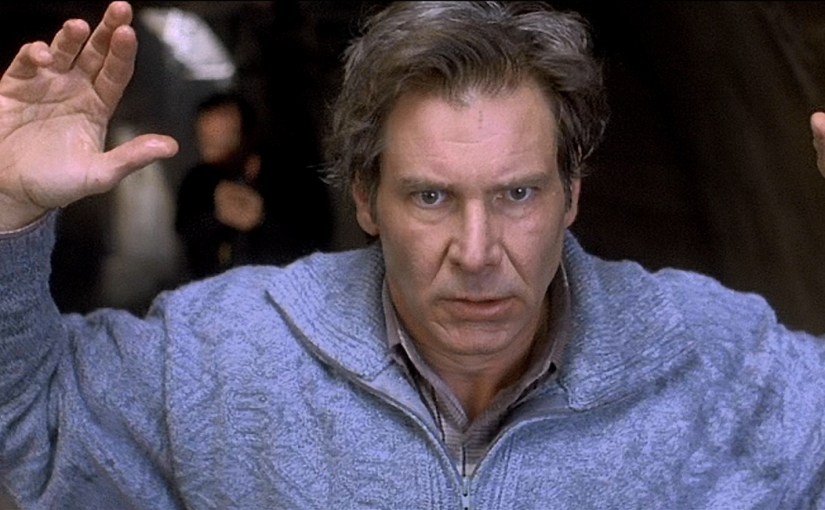
In 1993, Andrew Davis directed the best Alfred Hitchcock film that was not directed by Alfred Hitchcock. The Fugitive with Harrison Ford being pursued by Tommy Lee Jones was a runaway smash. As we now live in an age of cell phones and the World Wide Web, you’d think this film might be somewhat dated but it is the last thing on your mind while watching. This is a tense, taut thriller that never, ever lets up. Another favorite picture of mine.

The opening credits serve as a prologue, showing Dr. Richard Kimble struggle with a one armed man in his home after his wife (Sela Ward) has been assaulted and killed. Kimble becomes the accused and eventual guilty party who is sentenced to death.

Davis is now ready to show his first of many wonderful set pieces. As Kimble’s prison bus careens off the road landing on railroad tracks, an oncoming train collides with the bus. Kimble and another prison inmate now have the opportunity to escape and go on the run. Enter Tommy Lee Jones as Deputy Sam Gerard and his team of smart, intuitive misfits to catch up to Kimble who has made a mad dash into the dense Illinois woods. Because Kimble and Gerard are depicted to be incredibly smart, Kimble only remains a few steps ahead throughout the picture. Later in the film, Kimble makes his way back to Chicago to search for the one armed man and uncover exactly why his wife was murdered.

Location shots are masterfully done in The Fugitive. From the woods to a sewer system (a manufactured set I believe), to the streets of Chicago and Cook County Hospital.

The train crash is one of the all time best moments in film. No miniatures. No CGI. This is a fully loaded train crashing into a bus, and this is where you can not deny the craftsmanship of great filmmaking. Cameras were positioned at multiple angles to capture the mayhem in one take.

The other great set piece occurs during the actual St Patrick’s Day parade in Chicago. Gerard once again gets Kimble in his sights and Kimble manages to blend in with the parade marchers. The quick editing of improvisational camera work is spectacular here. Kimble and Gerard are literally in the same frame and yet Gerard can’t see what’s under his nose. Moments like these can’t be storyboarded. Andrew Davis’ production could not stop the actual parade for another take. It all had to be done on a now or never basis.

I watch The Fugitive and I always think back to Alfred Hitchcock’s best work like The Man Who Knew Too Much and North By Northwest. An innocent man is unexpectedly swept up in a conspiracy where he becomes the target and his adrenaline and instincts must kick in to save himself. The only thing he’s armed with is his mind. There’s also an unusually creepy antagonist, The One-Armed Man. This makes the film incredibly foreboding. I know the film stems from the legendary television series, but Davis treats this villain as if he’s among the ranks of Hitchcock’s use of Martin Landau or James Mason.

Harrison Ford is great at never glamorizing his role. He doesn’t suddenly become Rambo. He becomes a man of convincing desperation. Ford shines in roles like these such as his other films like Witness, Air Force One, and Frantic.

Tommy Lee Jones gives one of my most favorite performances on film. He plays Gerard with non stop adrenaline. He has exquisite chemistry with his team, including Joe Pantoliano. As well, Gerard is only interested in fetching what has escaped. He has no interest in guilt or innocence, until he realizes that Kimble has no interest in the consequences of escape. Kimble is interested in his innocence. Even Gerard becomes attuned to Kimble’s drive. Here is where the script is wise. There is no dialogue to imply what Gerard is thinking. Tommy Lee Jones has a way of giving a great close up to show what he’s thinking. He trusts the audience will presume what’s driving his intuition.

Davis pulls out all the stops with this film. There’s magnificent action shots of Gerard’s helicopter quickly flying over the ambulance that Kimble is racing away in. A great cat and mouse maze sequence happens within a sewer system. Lighting is perfect, there. Nothing is overly dark. There’s also incredible overhead shots of the dam and ravine that Kimble makes for a getaway with an absolutely surprising dive from an enormous height.

The Fugitive is smart and action packed to the teeth. You are in full focus while watching the ongoing pursuit. This film was nominated for Best Picture. Rare for an action film, but also a testament to its greatness. Tommy Lee Jones deservedly won the Oscar for Supporting Actor.

No doubt for me that The Fugitive is a must-see film for any kind of moviegoer. There are moments to feel scared, to laugh, and to cheer. When it is finally over and the story arrives at its satisfying conclusion, you cannot help but let out a deep breath. You feel like you’ve run a hundred miles, or at least as long as Richard Kimble ran towards his innocence. Your time will be well spent investing in the The Fugitive. An absolutely fascinating picture of great, mounting suspense.