MAGNOLIA

By Marc S. Sanders

Ernie Anderson was the cool voiceover for the ABC television network that would introduce upcoming programs for years. He was a staple of the television industry from the 1970s through the ‘90s. I promise that you or your parents know his sharp, recognizable tempo. So, it makes sense that his son Paul Thomas Anderson would center his multiple story crossover film Magnolia around the television industry, within a 10-block radius in the Hollywood Area. Magnolia presents the off-chance coincidences that somehow happen and the unusual phenomena that can occur when never expected.

Anderson’s three hour epic offers storylines centered around former and present day game show quiz kids (Jeremy Blackmon, William H Macy), the game show host stricken with cancer (Phillip Baker Hall), the drug addicted daughter he’s estranged from (Melora Walters), the dying game show producer (Jason Robards), the producer’s son who is a motivational speaker for men to sexually conquer women (Tom Cruise), and the producer’s gold digging wife (Julianne Moore).

Because the narrative of the film has a biblical theme specifically referencing Exodus 8:2, there are also two good natured guardian angels involved. John C Reilly as a sweet but clumsy police officer proud of his work, and a sentimental hospice nurse played beautifully with bedside sympathy by Phillip Seymour Hoffman.

Anderson’s film opens with three stories of random coincidence that resulted in the deaths of three different men. More than likely most people would say these tall tales of legend could only occur in a movie. Yet, the voiceover narrator , Ricky Jay, says they did not, and thus begins one specific day with torrential downpours of rain, where all of these random characters will come in contact with a personal experience of monumental impact that will change their individual lives forever. Oddly enough, all these people are somehow connected to one another and are within blocks of each other located near Magnolia Blvd in the Hollywood Hills.

Like Boogie Nights, Paul Thomas Anderson directs a film of very weighty emotions that thematically focuses on the sins of fathers that carried over to the futures of their children. The game show is titled “What Do Kids Know?” which likely symbolizes what they didn’t know while at the behest of their parents during their youth. What they know now about their fathers is a burden to bear in insecurities, drug abuse and outright cruelty for the opposite sex. Every character represents some aspect of this ongoing theme during Magnolia. It’s a lot, a whole of information, but fortunately it moves at a very swift pace with an energetic steady cam and dramatic notes of instrumental soundtracks.

Anderson consistently shows different references to Exodus 8:2 by either using the numbers in clocks or decks of cards or temperature readings of the weather or on marquee signs. It’s almost like a scavenger hunt when seeing the film on a multiple viewings.

MAYBE A SPOILER ALERT:

“But if you refuse to let them go, behold, I will plague all your country with frogs.”

Sure. Most recognize the Bible verse as Moses’ decree to Pharaoh to release the Jews from Egypt. I like to think Anderson used Magnolia to release his beloved, but damaged, characters from their own sins or the sins of their fathers. Set them free even if it could be by means of confession, judgment, offering and begging for forgiveness, or journeying towards a personal salvation.

The smart device that Anderson uses is the angelic music of Aimee Mann. Often I talk about how I love when film characters would spontaneously dance. In Magnolia, the cast surprisingly breaks into song with Mann’s confessional number entitled “Wise Up.” It more or less summarizes each individual plight that all the various characters must endure. Magnolia is only an even better film because of Mann’s music.

Magnolia is a beautiful film that I draw many personal parallels from, especially having now lost both of my parents and being by my father’s bedside during his difficult final days of illness.

It is very touching, sometimes funny, and sometimes a difficult film to watch with a belief in random coincidence that is only stronger after watching it.

Like the film insists “we may be through with the past, but the past ain’t through with us.” After Magnolia finishes, you won’t be through with Paul Thomas Anderson’s film. It’s a film that will stay with you.
LIONS FOR LAMBS

By Marc S. Sanders

Robert Redford directed a huge, glossy looking misfire of a political thriller in 2007 with a film called Lions For Lambs, written by Matthew Michael Carnagan.

Preachiness is never fun when it labors on for an hour and a half. I don’t care if it’s Tom Cruise or Meryl Streep or even Robert Redford doing the preaching. If these powerhouse celebrities called me up and asked if they could come to my house for coffee and talk, and when they got there, all they did was spew in circles a political platform of “right and wrong” and “why” and “don’t” and “can’t” and “yes and no,” I’d call the police and have them arrested. Time for you to leave, Meryl! Tom, it’s been real.

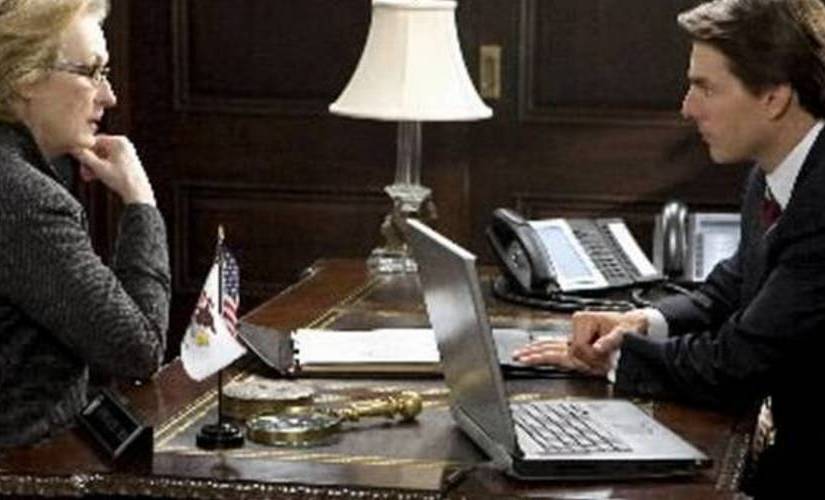
In 2007, during the late half of Bush 43’s second term, questions of war with the Middle East was at the forefront during a post 9/11 age. Redford, with Cruise producing, thought it’d be interesting to show three different stories (actually two long winded conversations set around desks, and two stranded soldiers) occurring. A political professor (Redford) tries to open the eyes of a student (Andrew Garfield) with great potential but no drive to make a difference. A Republican Senator (Cruise) sets up his own interview with a liberal leaning reporter (Streep) to boast of a new secret mission he’s championing, and two special forces ops are left stranded (Michael Pena & Derek Luke) in the cold of Iraq, the most interesting of three narratives.

Carnagan’s script goes in circles and it’s likely the politics he questions all lean left. Yet the conversations (Redford & Garfield; Cruise & Streep) become just a lot of back talk. A character makes a point, and the other character makes a counter point. I was hoping for a line like “Meryl, you ignorant slut!” Where are we going with all of this?

The soldiers are the mission planned by the Senator that has now gone awry and follows their outcome as they are left wounded and surrounded by Iraqi forces in the snowy darkness. We learn they were students of the professor who wanted to make a difference by enlisting in the Army. See the connection now; the very thin uninspired connection?

Here’s something for ya. In case, you can’t recognize easily enough, Redford dresses his characters in either shades of Red or Blue. Nice touch with Garfield’s frat boy wearing a RED Hawaiian shirt while Redford has the BLUE denim button down. Cruise gets the shiny RED coffee mug for a prop. Does the film have to be THIS transparent? If so, couldn’t the dialogue have been as well?

Lions For Lambs talks A LOT and tells me nothing. Streep’s reporter is a disappointment. Yet Redford portrays her as noble. She loathes the platform of the Senator she just interviewed and is adamant about not writing the quite revealing story he just laid out for her. How can she be that way? She’s a reporter!!!! Tell the truth. Inform the public, even if it’s not pretty, and yet Redford will have a viewer believe it is righteous of Streep to figuratively break her pencil and unplug her computer while she gripes to her editor in chief. No! This is an absolute betrayal of journalistic integrity. What is Robert Redford, the once producer and star of All The President’s Men, thinking here???

You wanna talk about betrayal? The final moments with Streep really had me puzzled. She takes a thought-provoking cab ride that drives past the Capital, Arlington National Cemetery, the Supreme Court, and The White House (right, dab, in front of it no less). Reader, I’ve been to Washington DC a number of times as recent as this past summer. Where the hell is this cabbie driving to, and what route was he taking????

A FEW GOOD MEN

By Marc S. Sanders

A Few Good Men really does hold up.

Anyone with even minimal movie going experience can predict how it is going to end almost as soon as it starts, but that doesn’t take away from Aaron Sorkin’s first screenplay based on his original stage play.

It is well cast. For the film, no one else could ever play the intimidating and terrifying Colonel Nathan R Jessup other than Jack Nicholson. It’s not that it is just him in the role. It’s really Nicholson’s whole career legacy against the arguably still ripening careers of Demi Moore, Kiefer Sutherland, Kevin Bacon, Kevin Pollack and Tom Cruise. Nicholson’s timed grandstanding is necessary for the role to work.

Cruise on the other hand left me feeling a little too overplayed. The role calls for cockiness, yes, but is Cruise too cocky? Some of the gags he does work. Some don’t, like impersonating Nicholson momentarily (leave that for the guys on SNL, Tom), or when he’s poking fun at Moore’s character to his own delight. It’s a little too much. Still, his courtroom scenes are like watching the best in live theatre. Those scenes play like great sport, notably thanks to Tom Cruise.

Major props go to JT Walsh as a conflicted witness. When I say conflicted, I mean he authenticates a seriously valid and personal dilemma beautifully. Had it not been for Jack Nicholson, Walsh might have had an Oscar nomination. A shame he didn’t come close to such recognition while he was alive. He was such a great character actor.

Recognition also goes out to Kevin Bacon as a well versed prosecutor/Marine. His timing exudes the experience his character has, despite his youthful appearance.

Demi Moore might be caught trying too hard, I think. Kevin Pollack is the wise mentor sitting quietly waiting for his great moments. Kiefer Sutherland is great in almost anything he does. He doesn’t ever steal the spotlight like Cruise, Nicholson or Moore but he makes a great presence; conniving and bold.

The direction is nothing special really. Rob Reiner does fine but honestly Sorkin’s script sells itself.

Yeah, yeah. “You can’t handle the truth.” Great line, but I got news for you. I’d argue there’s even better lines in this 1992 film. It’s worth revisiting.

RISKY BUSINESS

By Marc S. Sanders

It’s telling of how happily cash rich people were all to proud to carry themselves in the 1980s Reagan era.  It was not a time to focus on emotions and sensitivity.  War was over.  Shopping malls were all over the place.  Credit cards were easy to get and use.  Forget about what happens later.  Heck even the music was happy and fun with acts from Wham! The Go Go’s and Katrina And The Waves.  Maybe it was not as apparent, compared to today’s “Me Too”/”Black Lives Matter” themes, to focus on the minorities or even basic charity.  Free enterprise was the theme.  Profits and prestige were the goals.  It was even taught to be that way in high school.  Love was not important.  Making money was the all rage.  Making money and spending money-including your savings bonds from grandma and grandpa.  Paul Brickman’s Risky Business was evidence of that mentality.  Long before, it ever became transparent that well to do parents could buy their kid’s Ivy League education for a promising future, just the idea of mounting pressure to get into a school like Princeton University was a terrible ordeal for a 17 year old kid.

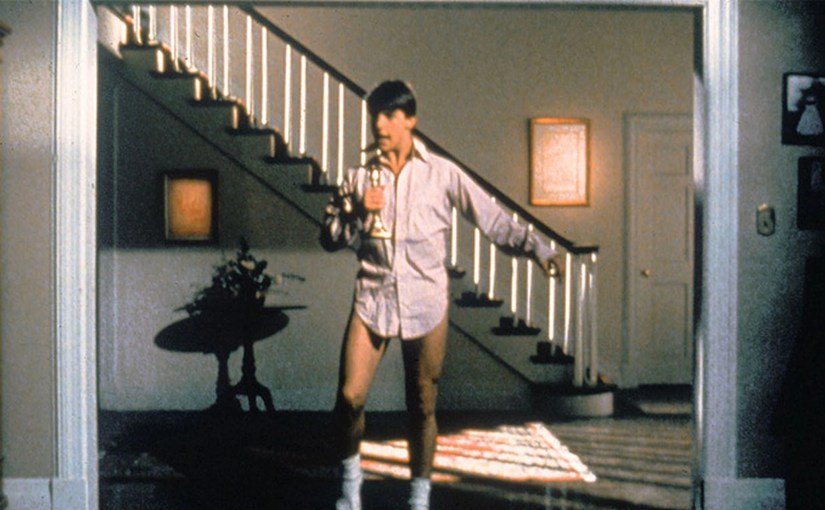
Tom Cruise’s breakout role of Joel Goodson, with his sock covered feet, pink polo shirt and BVD white underpants faced this issue, and yet it was not Joel’s most important problem to contend with.  Risky Business showed us the first couch that Cruise jumped up and down on with help from Bob Seger.  Cruise’s career was never the same ever since this 1983 film.  It only got sexier and better and outrageously more successful following this film.

Brickman’s script which he directed was one of the first commercially successful 80’s teen flicks to adopt the concept of the parents are out of town, so let’s party approach.  Only thing is beyond joyriding in dad’s Porsche, Joel is not as obsessed with popular jock/cheerleader parties, as he is with getting laid. He dreams of gorgeous naked girls in the shower and on his bed, or who is on the other end of the line when he calls an escort personal ad.  Yet, paranoia takes over for Joel.  His WASP parents seemed to have instilled Joel with fear of a S.W.A.T team nightmare if he even dares to make out with a strange and exotic woman in their beautiful suburban home. Through a set of circumstances that disrupts Joel’s comfortable fantasies and strait-laced activities, a high priced and ravishing call girl named Lana (Rebecca DeMornay) enters Joel’s life and his dad’s Porche, and his house and then, doesn’t leave. Joel gets his cherry popped, but things go awry like in most 80s teen comedies.  The Porsche needs to be towed out of Lake Michigan, his mother’s precious crystal egg needs to be recovered from Lana’s pimp (Joe Pantoliano), and Joel has to remember to interview well on Friday night with a Princeton admissions advisor. 

All of this sounds familiar.  These themes have been copied countless times over.  Yet Paul Brickman goes in an extraordinary direction that remains original nearly 40 years later.  His characters of Joel and Lana are smart.  They are portrayed with great instinct by Cruise and DeMornay, who are never playing for laughs and allow the gradual situations of the script to deliver the humor.  Joel is the student.  Lana is the teacher.  By the end, they’ll likely be on an even playing field. 

SPOILER ALERT:  The third act is the true highlight, as the world’s oldest profession becomes a business of free enterprise to make Lana money and rescue Joel from impending doom on a hundred different angles.

As I’ve written before, I love character arcs in all kinds of stories.  Brickman writes Joel as a rigid and by the book kind of kid with his shirt neatly tucked in, a preppy chestnut brown haircut, docksiders and well pressed jeans and khakis.  This kid will not even get a speeding ticket, regardless of the Porsche’s horsepower.  Only after experiencing sex and the possibility of going outside the lines like Lana demonstrates, does Joel realize the value of throwing caution to the wind; more specifically, as the script proudly reminds us “Sometimes you just have to say What The Fuck!”

To sidestep for a moment, when I finally saw James Dean in Rebel Without A Cause, all I walked away with was a very cool looking guy with a red jacket, white t-shirt and blue jeans.  Not much dimension there.  Pretty flat if you ask me.  Then, I’m reminded of Risky Business.  Here is a hallmark film of teen angst.  Joel’s episodes in one week, while mom and dad are away, are not likely to happen in real life.  Yet, Brickman doesn’t aim for farce.  The laughs come in clashing the sons of Chicago white suburbia WASP culture with the nightlife these boys only dream about. 

With Tangerine Dream offering up a cool dreamlike soundtrack, Risky Business is exotic and sexy and dangerous and then it’s funny.  Very, very funny.

RAIN MAN

By Marc S. Sanders

It may surprise some people that I don’t find Dustin Hoffman’s performance of autistic savant Raymond Babbitt to be the best feature in Barry Levinson’s Rain Man.  On the contrary, the best thing about the film is Tom Cruise’s cynical, hyper active portrayal of Raymond’s younger brother Charlie.  I’m not knocking Hoffman.  He’s absolutely memorable, authentic and brilliant.  It’s so brilliant though, that it overshadows what Cruise accomplished with his part. 

Those of you who have read some of my reviews before, may recall how much I praise the best character arcs to be found in stories.  The character starts out one way and by the time the conclusion arrives, this person is completely different; practically unrecognizable.  Hoffman did this in Kramer Vs Kramer and Tootsie, Al Pacino did this in The Godfather.  Bryan Cranston used five seasons of television to do this in Breaking Bad.

Before I ever saw Rain Man for the first time, many years ago, I never knew what autism was.  I don’t even think I ever heard the word autistic before this film arrived.  I guess I was wrapped in my naïve bubble.  Now watching it years later, I see the special talents that autism can present for a person living with it, as well as the challenges that come with a person nearby who cannot comprehend the diagnosis, and carries no patience for it. 

Screenwriters Barry Morrow and Ronald Blass are wise to show an odd pairing of brothers in this film.  The movie begins when Charlie, deep in debt with his high-performance sports car dealership, learns that his estranged father has passed away.  Dad only leaves him with a gorgeous 1949 Buick Roadmaster convertible.  A $3 million estate is awarded to a trust fund meant to support Raymond; the autistic brother Charlie does not recall ever having.  Charlie’s arrogance and desperation to cover his insurmountable debts drive him to yank Raymond out of his care facility and embark on a cross country road trip back home where he intends to settle the estate by how he thinks he deservedly sees it.  During the course of the trip, Charlie gets a quick education about himself and Raymond’s condition. 

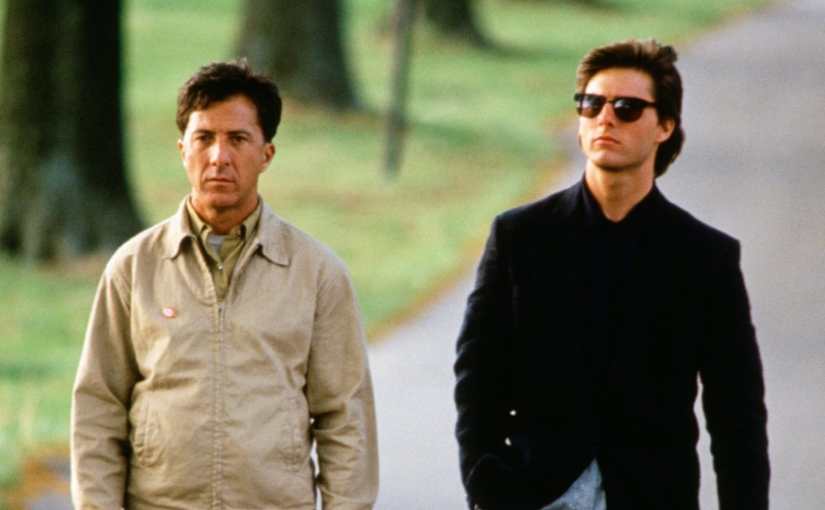
Tom Cruise might look like late 1980’s cool and stylish in his linen suits and button up silk shirts with sunglasses, but his glamour does not overshadow how bitter of a guy Charlie really is.  That’s what I embrace in his performance here.  It should have been nominated for an Oscar; definitely a glaring oversight by the Academy.  Charlie looks like a guy always moving at super speed, about to collide with a wall.  He bosses around his assistant salesman with outbursts and disruptive clapping hands.  Levinson is good at showing close edits of that.  He gives no attention to his girlfriend, Sussana (Valerie Golino), even when she is trying her best to have him stop for a second and realize the special condition and attention that Raymond needs.  As Charlie’s journey continues down the back wood roads of western America, he has no choice but to uncover a realization in his own hyperactivity, and even recognize a different kind of hyperactivity that Raymond possesses. 

Raymond is the autistic person whose mental capacity must follow strict guidelines of watching The People’s Court and Jeopardy.  He has to have to certain meals on certain days.  He can not ride in a car when it is raining.  He can not fly on airlines that carry historical statistics of crashing.  Fire alarms and hot faucet water are violently upsetting.  There is a rigid, uncompromising pattern to Raymond’s behavior and lifestyle.  Because he can’t compromise, Rain Man carries some humorous and outrageous scenes where Charlie must adjust to Raymond’s limitations.  I still feel sorry for the woman who has no choice but to surrender her television and living room in the middle of day so that Raymond can watch his program, while her children are deprived of their cartoons.

Hoffman is great in focus and concentration.  Much like when he adopted the persona of a woman in Tootsie, you never see him sway from the performance of severe autism in his Raymond character.  Because he is so straight down the line here from beginning to end, I have to really admire Cruise’s change in character over all.  Rain Man really is a story about Charlie Babbitt.  Not so much Raymond Babbitt. Charlie changes during the course of the film.  Raymond does not. 

There are a lot of eye-opening moments in Levinson’s film.  You get an education in what autism really is, or at least the unique case that Raymond possesses.  He can memorize a phone book in one night or count the number of tooth picks that have fallen on the floor with simply a glance.  Complex multiplication can instantly be done in his head.  It’s fascinating.  Charlie even discovers a way for Raymond to resolve his financial crisis, thereby leading to an energetically satisfying jaunt in Las Vegas. 

Barry Levinson has assembled two fantastic actors for an engaging film that avoids preachiness and sorrow.  Yet, Rain Man is rewardingly sensitive.  Levinson says a million words with simply a close up moment of Hoffman gently leaning his head on Cruise’s temple.  Quiet moments like that which arrive following scatter brained moments earlier make for a range of emotions I treasure in a picture like this.

I look at Rain Man or Magnolia or Born On The Fourth Of July, and I wish Tom Cruise would take a break from the endless Mission: Impossible films.  Heck, there’s even another Top Gun film on its way!  Why doesn’t he focus on the roles that welcome his skills as a very effective actor?  (American Made was a recently oddly different kind of character for him. Great film by the way!)  I have an affection for most of his films, regardless of the category. I really do.  If only his action pictures could take a rest for a change, and allow the acting scenes to come back into play.