
By Marc S. Sanders
Christopher Nolan’s Memento was Oscar nominated for his screenplay, adapted from a short story by his brother Jonathan, as well as for editing. You’d be hard pressed to find a better example that lives up to the merits of these categories because without the inventive storytelling and how it’s cut together, Memento would not be so memorable.
Guy Pearce plays Leonard, but he distinctly remembers that only his wife called him Lenny. We observe him in two different narratives. A black and white collection of scenes has him in a hotel room chatting on the phone with an unknown caller. In modern color, Leonard is wearing a tan suit and driving a dusty Jaguar while traipsing from one place to another. He’s trying to make progress with uncovering who murdered his wife. The scenes in color though must be shown in reverse. In other words, a scene is shown, then it will cut to Leonard back on the phone, and then another scene is revealed showing what occurred literally just prior to the last color scene we saw.
It must be done this way so we can be just as discombobulated as Leonard. He suffers from a condition where he has no short term memory. Therefore, if Leonard learns something or meets someone or arrives at a location, he’ll soon forget anything he just encountered minutes ago.
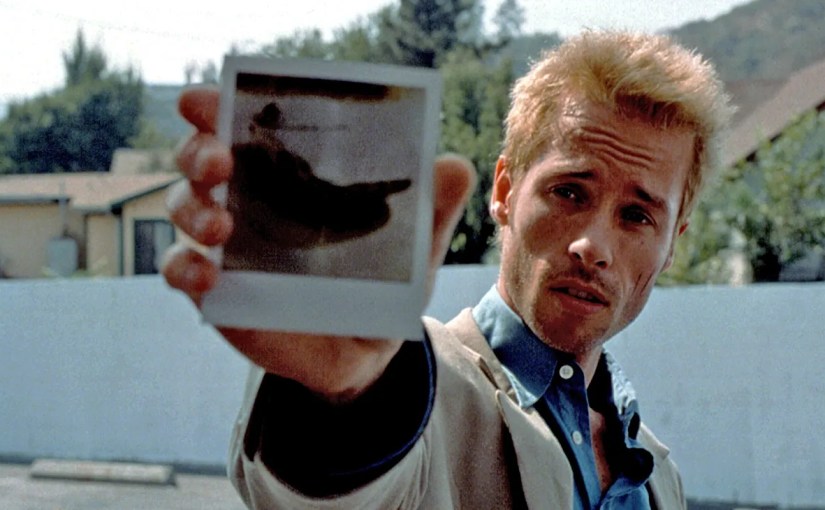
While he pursues the mystery of his wife’s killer, Leonard tattoos his flesh with notes to help guide him when his short attention span can’t. He also takes instant Polaroids of people he meets and the places he goes. As quick as he can, he’ll jot a note on the photos to aid him as he carries on.
Memento starts at the end of the story and when the film concludes, the viewer arrives at the beginning. Perhaps the beginning will explain the end that was shown almost two hours before.
Christopher Nolan had a small budget to work with and the California city locales are nothing dazzling. There’s little to offer with special effects as well. So, it is impressive that he uses Jonathan’s idea to create a mystery we want to see resolved where the information we get seems to erase itself as quickly as it is told.
Leonard can’t remember anyone he’s recently met, but oddball cases like Teddy (Joe Pantoliano) and Natalie (Carrie-Anne Moss) certainly remember him. Are these folks working with Leonard or against him? Even with seeing the ending first, I could never spoil anything, and you’ll find it hard to decipher what these are these characters’ best interests.
Nolan exercises some neat visuals to keep you on track. We see a broken car window before we see how it got shattered. Leonard can’t recall how that happened. Leonard is also unable to remember why a bar patron is chuckling at him. Christopher Nolan maintains well placed book marks to aid the viewer in this story that makes an effort at throwing off its protagonist as well as the audience.
What also helps is that when all the secrets are revealed, at least to the viewer, it’s a pretty solid crime set up that does not come off like a stale Murder, She Wrote episode. It’s clever, tricky and unexpected.
Guy Pearce is really good in his role that eventually reveals some duality, but that’s where I’ll stop. Carrie-Anne Moss always seems questionable, but what’s her agenda? Joe Pantoliano is the sleazy guy with the mustache. So why is he always turning up in Leonard’s way?
Like his future efforts to come, Christopher Nolan layers his films in great depths of dimension. It never stops thinking. Often, he answers a riddle with one or two or three more conundrums. What’s especially appreciative is that he eventually reaches a final answer to all of his questions. Still, that doesn’t mean he ever would want you to stop thinking about what you ascertained from Memento.
 2 UNPAID MOVIE CRITICS!!!!