RAMBO: FIRST BLOOD PART II

By Marc S. Sanders

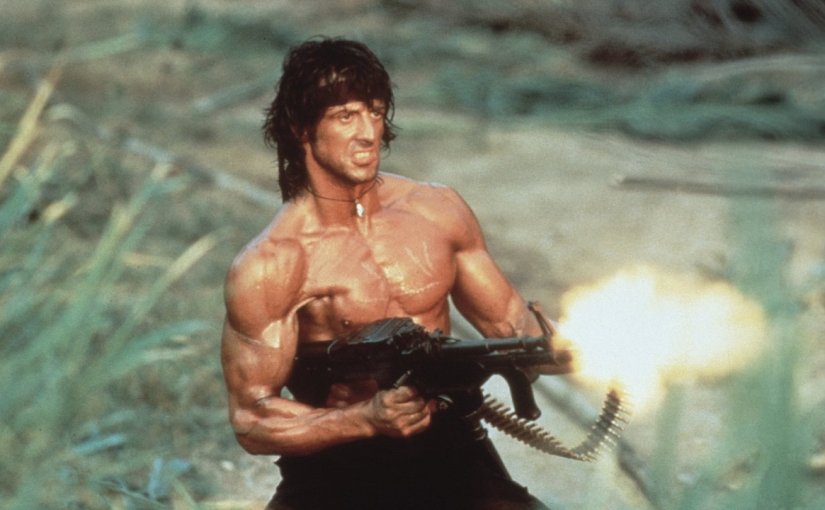
David Morrell’s literary character Rambo (no first name in the book, First Blood) cinematically survived his first post Vietnam adventure to spill buckets of bloodshed for many more follow ups.  Sylvester Stallone hit box office gold when he signed up for Rambo: First Blood Part II.  The Vietnam War was long over leaving an endless supply of storyline threads for Hollywood.  Who better to go back there with a ripped upper torso, a bow and arrow, a bayonet knife that won’t carve your steak but will hack up the cow, and a lot of firepower?

Green Beret John Rambo is specially recruited by his former C.O., Colonel Trautman (Richard Crenna) for a solo mission into a Viet Cong camp where American POWs might be held captive.  He’s got thirty-six hours to get in and out.  There’s a catch though.  A mercenary led operative named Murdock (Charles Napier), who hides behind a desk, a white collar and necktie specifically instructs Rambo to only survey the area and take photographs.  Under no circumstances is he to engage the enemy or escort any prisoners back to his rendezvous point.  Thing is that Rambo is not much of a photographer.  

James Cameron is credited as one of the screenwriters and apparently Stallone modified the script from there.  This bloody sequel is entertaining but I always found it a little mundane despite all the action.  

Just as the movie is about to grow a brain and intelligently debate with itself about how so many American soldiers were disregarded following the war, it stops talking and only resorts to one action set up after another.  Crenna and Napier potentially engage in a worthy debate focusing on government mistrust and moral servitude before the moment is cut short.  Trautman is the easily assumed ally of Rambo.  Murdock is the antagonist, but truly I have to ask why.  What is the motivation not to side with Rambo’s efforts to literally rescue half a dozen abandoned soldiers?  First Blood Part II cuts the argument short and never returns to settle the discord. 

There is perhaps only 5 or 6 lines in the last forty-five minutes of the picture.  There’s a melodramatic closing monologue from Stallone’s morose character.  Otherwise, this movie would prefer not to think.  Sadly, there is a lot to consider here, but the explosives and machine-gunning filibuster, insisting on holding the floor.

The action is categorized in a series of episodes.  A five minute section offers a variety of ways Rambo covertly takes out Russian military soldiers who are maintaining a stronghold with the Viet Cong.  It’s clever how one guy is taken by surprise when a mud caked Rambo guts him with his knife.  For another stooge, he’s literally sucked away into the mouth of a cavern.  You don’t even see Rambo.  How does the hero get around with enough time to set up these sophisticated traps?  This is all cool to look at but I would have liked to have learned more about how the Russian General (Steven Berkoff) formed an alliance with the Vietnamese.

Later, Rambo uses his endless supply of arrows to blow away acres and acres of marsh and tall grass.  I buy one man army tropes in movies.  Yet, I still question how a guy on two feet can set ablaze the equivalent of five football fields worth of territory.  How does he always manage to get in range? 

A war copter hovers over a river.  The henchman riddles the surface with bullets, and Rambo LEAPS from the depths INTO the chopper.  I mean he flies up like Superman.  Another moment has him submerged and then he pops out of the water with perfect aim to mow down a mob of men.  How did he know where to shoot?

I guess all of this is entertaining.  I just don’t relish it like I’m expected to because I’m asking too many “how does he…” questions.  My suspension of disbelief doesn’t have a high level of tolerance for what Rambo is apparently capable of.  David Morrell’s character was somehow blessed with superpowers, practically!  

With Rambo serving our country, how in the hell did we ever lose the Vietnam War? Seems damn near impossible.

First Blood embraced a common problem with veterans who were disregarded by the institutions they swore to defend and serve.  It’s a terrible blemish on our country’s patriotism.  An awareness was offered in that film amid all of the believably capable action scenes.  Part II clearly shows a lack of concern.  POWs get rescued but they are not even given an opportunity to reflect and speak.  Their bearded and malnourished figures speak for them in close ups.  I didn’t think enough was delivered for any semblance of a message that was asking to be heard.  Instead, we get a Stallone showing off a bronze, ripped chest, red bandana and a slew sophisticated weaponry. Rambo looks sexy here, and that does not sit right with me.

I can rewatch Rambo: First Blood Part II.  I just can’t feel for any of it.  I think I was entitled though.  Moreover, those that served in this awful conflict are deserving of a product that would better honor their sacrifices.
ROCKY III

By Marc S. Sanders

By the time a series of franchise films reaches its third installment there better be something interesting for the characters to encounter.  Otherwise, it is the same old show.  Not many talk about it, but Rocky III actually does have something new to offer even if the story still feels like the same kind of tread.  What’s new?  Mr. T!

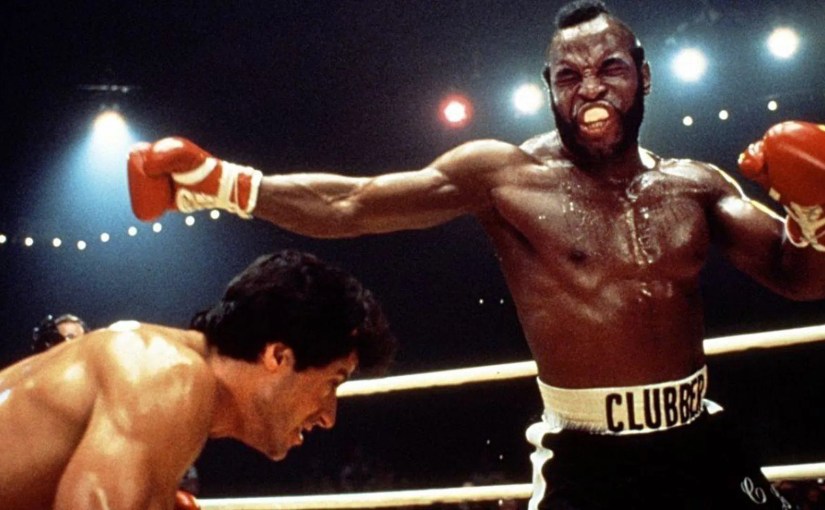
In the lexicon of greatest villains of all time Mr. T’s introductory role of Clubber Lang, the fierce boxer who lacks pity for a fool, should be included within these tabulations.  Reader, I challenge you to find him listed anywhere.  I don’t think you’ll be successful.  Not even as a runner up. That is a terrible oversight.

As Rocky III opens with a quick flashback of Rocky Balboa (Sylvester Stallone who also writes and directs) winning the championship away from Apollo Creed (Carl Weathers), quick cuts of the hero show him knocking out one fighter after another with debonair ease.  When he’s not boxing, he’s posing for commercials and magazine covers, or he’s riding his custom-designed Italian Stallion Harley with his wife, a glamorous Adrian (Talia Shire) on the back.  Juxtaposed within this montage, played against one of the greatest songs in film history (Eye Of The Tiger by Survivor), is Clubber Lang executing bloodletting beatings on his own opponents.  He’s angry and he threatens to kill Balboa in the ring. Rocky’s mainstay coach Mickey (Burgess Meredith) attends these fights and grows fearful of this new menace.  Clubber will not give up on this campaign until he has his shot in the ring with Rocky.

Rocky III has a glossy finish the first two installments deliberately withheld.  The photography is sharper. Stallone is quite handsome, rich and fit.  Adrian has abandoned the meek bashfulness and nerdy, wing shaped eyeglasses.  Their furnished house sits on a gorgeous estate complete with servants, a golf cart, and a little boy all their own.  The filth-ridden areas of Philly are behind these protagonists.  Welcome to the materialistic and decadent 1980s.  Frankly, I like how nice and put together everything feels in Rocky III.  It truly is a window into what much of the 1980s looked like.  Stallone and Shire’s characters have evolved amidst their wealth, and I continue to like them. 

The one ingredient that carries over is the alcoholic slob, Paulie (Burt Young), whose grumpiness hasn’t changed.  He is a given a substory in the first ten minutes of the film where he shows his resentment for Rock.  Then, the slugger bails him out of the drunk tank, gives him a job, and he only remains through the film for a few laugh bits.

(SPOILER ALERT) Following accepting the challenge to fight Clubber Lang, Rocky loses in terrible defeat just as Mickey suffers what will be a fatal heart attack.  Not only does he lose, but he cannot overcome his sorrow, and fear has intruded upon his psyche.  Apollo volunteers to train Rocky and encourages him to do one last fight against this new opponent, now champion.  Only now, Rocky has to get that “eye of the tiger” back and he needs to move light on his feet like Apollo originally learned.

Everyone in Rocky III has an energy about them.  These actors are used to one another even if Stallone and Weathers were on opposite sides for the last two films.  Stallone’s script experiments with testing his boxing character to lose what he earned organically in his earlier films.  He also sketches the guy with conceited fault ahead of the film’s first fight when he showboats his training and does not take this new fighter seriously enough.  This is good material for a third follow up piece.  It’s certainly more exciting than what Rocky II offered.

However, the film belongs to Mr. T who became a pop culture icon of the 1980s with gold jewelry, the mohawk, a TV action series, cartoons, toys and guest appearances on telethons, Johnny Carson, Diff’rent Strokes and Silver Spoons.  Forty years later, he deserves some recognition for the impact he had on the American psyche.  This guy was a big influencer.  No one has ever replicated what Mr. T delivered.  If you watch Rocky III again, you can’t help but get caught up in how hostile his Clubber Lang is.  I doubt this guy was written this broad or aggressive in Stallone’s script pages.  Clubber Lang is a villain that owns this picture anytime he appears on screen.  Mr. T is not a diverse actor by any stretch but the personality that was introduced here is unforgettable.  During both training and boxing montages, his muscular physicality is an astonishment, and he’s a terrifying new kind of monster with every threat he screams at this cast of likable heroes.  This guy would burn the whole happy village down if given the chance.

I’m also impressed with Talia Shire.  She’s not given much to do here.  For the most part she is sitting in the audience, cheering on Rocky, or watching from the sidelines while he trains.  However, there is one special scene that Stallone wrote for them that turns the tide of this ninety-minute film ahead of the inevitable, pulse racing training montage.  Her scene of truth-hurting candor with Stallone’s character on California shoreline where all of the pain and anguish surfaces is carried by her against Sylvester Stallone, the superstar.  It’s a reminder why the Rocky films were never anything without Adrian.  The love of Rocky’s life has to always be there to rescue the lug from his despair and lack of confidence.  I love this scene.

I would never argue with anyone who said this franchise became a sad joke upon itself by the time Rocky III rolled around.  The formula is very recognizable.  It’s not a tremendous sequel like The Empire Strikes Back, The Godfather Part II, or even Superman II demonstrated ahead of its release.  Yet, there is a vigor to Rocky III, and the highs and lows are told efficiently at a very comfortable pace. 

I saw Rocky III before I saw the prior two films and at age ten, this had my attention from beginning to end. It’s likely when I left the theatre, I wanted to be a boxer and pound someone’s flesh into a bloody pulp amid a cheering crowd.  I recall the whole audience in the theater applauding as soon as Rocky triumphed again.  I also recall the tears and sniffles I heard at the midway point when poor Mickey’s life suddenly ends.  These are beloved characters that we only want to remain happy and healthy.

Rocky III is not accurate to how it really is for professional boxers.  I do not think the well edited cuts of the fights are genuine either.  A lot of the footage looks like an action movie more than a sports picture.  When Clubber Lang swings with a jab, there’s a whooshing sound.  However, Stallone as a writer/director knew how to touch on the melodrama effectively with laughs, sadness, fears and cheers. 

With that amazing Bill Conti soundtrack, Survivor’s rattlesnake opening chords of their Oscar nominated song, Mr. T and, oh yeah, a giant named Hulk Hogan as a beast of a wrestler named Thunderlips, Rocky III is outstanding, pure escapist entertainment.

M*A*S*H

By Marc S. Sanders

Forgive me.  I’m not sure my position on Robert Altman’s film will be fair.  All my life, I think I deliberately eluded seeing the motion picture of M*A*S*H as I have been so accustomed to the classic television show that ran for eleven seasons on CBS.  As I expected the two properties couldn’t be further apart from one another.

Altman’s movie still carries a zippy kind of perspective to the horrors of war.  With their hands and surgical scrubs in the thick of gory, blood red surgery, the characters are so much more apathetic to the turnaround of wounded that arrive at the 4077th American mobile army hospital, located three miles from the explosive front lines of the bloody Korean War.  The well-known characters were first given live action roles here following the published novel by Richard Hooker.  

Most surprising is near the end of the film when two doctors realize they are being sent home. One surgeon who is in the midst of operating on a head injury actually instructs a colleague to take over.  This guy has his hands covered in brains and blood and chooses not to finish saving his patient’s life.  Alan Alda of the television show, as a writer, director or while portraying Hawkeye Pierce, would never respond in such a manner. Yet, this is the approach that Robert Altman chose to follow, having infamously always despised the TV series that eclipsed his film in popularity.

Altman’s movie is a slap in the face to the famed oxymoron called “military intelligence.” In 1970, we say bravo for finally saying something frank and honest while a Vietnam War has carried on far too long for not necessarily any of the right reasons.  It’s not so simple to declare war is hell.  It’s much more complicated and horrifying than that.

The film’s opening bylines are quotes by celebrated military leaders of the time, like MacArthur and Eisenhower.  However, these championed commanders are lampooned as we watch shlubby Hawkeye Pierce (Donald Sutherland) arriving in Korea.  He heads directly towards a General’s jeep and steals it, plain as day.  From there on, M*A*S*H operates like a precursor to Animal House with a series of hijinks and a lack of care for military leadership or the U.S.’s purpose in this conflict.  

About the only time, there is any care or forthright anger from anyone is when the jerky Major Frank Burns (Robert Duvall) chastises an underling.  Trapper (Elliot Gould) and Hawkeye punch his lights out and the schmuck ends up in a straightjacket.  Nonetheless, these guys could care less about criticizing and exposing the truth about the institution they have been drafted to serve.  Their purpose is not to make an ironic statement like a Doonesbury comic strip.  They just punch the commanding officer in the face and drink.  The TV show was at its strongest when it relied on the wit and delivery.  Trapper and Hawkeye never use irony or intelligence to belittle a buffoon.  They punch, or they embarrass an authority who’s taking a shower. Regretfully, it’s the dialogue that’s lacking. Robert Altman encouraged much improv on the set and overlayered conversations within his scenes. He found nothing organized or neat and pretty about war, including daily functioning. Chaos did not only reign on a battlefield.

The pace of M*A*S*H moves episodically, and it is likely what led to the idea of a half hour TV show that dominated the airwaves for the better part of eleven years.  A character called Painless contemplates suicide and so a Last Supper reenactment before he sends himself off is inserted. It’s a funny caption from these halfwits, but a storyline focused on deliberately ending a life does not connect with me in a humorous way here. Burt Reynolds, the dark comedy Heathers, and even more recently Tom Hanks toed the line of humor to be found in death by suicide. I think it worked better in those examples. With the somber, well known theme song of “Suicide Is Painless” that is forever linked with M*A*S*H, I just could not muster the laughs for this bit.

There’s also time to build comedy against another regular army brat like Major “Hot Lips” Houlihan (Sally Kellerman, also the best and most memorable of the cast).  The iterations of shower hijinks has been duplicated so often since the release of this picture. Therefore, this gag is dried up. It does not hold its impact fifty years later after dozens Porky’s movies. As well, there’s golfing off the helicopter pad, heavy drinking and a long, drawn-out final act of an overstayed football competition which leads to one of the first times the F-word was used in a mainstream American film.  

In 1970, Robert Altman delivered a bold, risky and daring film to counteract against a losing Vietnam War and the heroism of John Wayne’s bravado in war pictures.  The chutzpah to lash out against American politics likely felt relatable to many who saw different and more realistic images when they understood their young sons and daughters were not coming home and were thus forever changed.  Richard Hooker’s properties and stories lent an understanding to the animosity of those who forced the war on America’s children and loved ones.  War has never been consistent with the short film propaganda asking you to buy war bonds. M*A*S*H negated the heroism of Hollywood sensationalism found in machine gun fare and overtaking a hill while draped in green fatigues with shiny bronze ammunition hanging off their shoulders. These soldiers of war deserve our country’s utmost respect, but they did so much more than what John Wayne demonstrated. They offered up parts of themselves they would never get back.

M*A*S*H deliberately left out the heroes.  However, seeing the film for the first time, over fifty years later, I wish that at least we could follow the escapades of doctors who also directed a bed side manner to the pawns who were dying while upholding their leaders’ cause.  The doctors of Robert Altman’s interpretation hardly emulate a reason to care. 

The film interpretation of M*A*S*H is outdated of its time of release and the period in which it takes place.  I like to think we live more humanely than not just how our military leaders functioned.  I wished these physicians used their scalpels with a much less obtuse absence of empathy.  Hate the puppet masters, yes. Yet would it kill these guys to still care about the puppets? 

FAREWELL, MY LOVELY (1975)

DIRECTOR: Dick Richards
CAST: Robert Mitchum, Charlotte Rampling, John Ireland, Sylvia Miles, Anthony Zerbe, Harry Dean Stanton, Jack O’Halloran, Joe Spinell, Sylvester Stallone
MY RATING: 9/10
ROTTEN TOMATOMETER: 71% Fresh

PLOT: When a giant ex-con fresh from prison asks Philip Marlowe to find his missing sweetheart, Marlowe winds up entangled in multiple murders, prostitutes, and a sultry trophy wife.


Because it was released only a year after Chinatown (1974), it is tempting to compare Farewell, My Lovely to that landmark film noir, but although they are in the same genre, the two films are apples and oranges…or at least apples and pears.  Both feature hard-nosed private eyes accepting cases that turn out to be more complicated and far-reaching than they appear, both feature multiple unexpected deaths, and both feature curvy, smoky-eyed dames with dangerous secrets and aging husbands.  All true to the genre.  But Chinatown breaks (successfully) with film noir in several key areas, while Farewell, My Lovely achieves its lofty heights while still remaining faithful to the bedrock tropes of vintage film noir, right down to the tired voice-over narration from the hero.  I have no idea how faithful it is to the Raymond Chandler novel by the same name, but if the book is half as entertaining as the movie, I may have to track it down and give it a read.

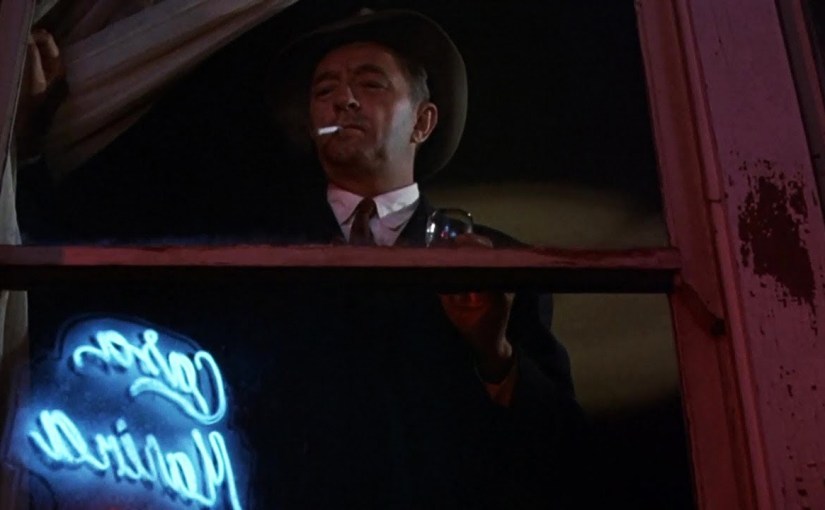
Robert Mitchum plays legendary gumshoe Philip Marlowe, the third version of the character I’ve ever seen after Humphrey Bogart (The Big Sleep, 1946) and Elliott Gould (The Long Goodbye, 1973).  Compared to the other two, Mitchum is by far the most shambling version, but I mean that in a good way.  We first see him staring out of a rundown hotel room in downtown Los Angeles, some time in 1941.  We know the timeframe because of a calendar here and there, and because Marlowe is obsessively following Joe DiMaggio’s progress, as he is on the verge of breaking the record for hits in consecutive games.  That’s a nice touch.  Marlowe’s world-weary narration plays over Mitchum’s sagging face and drooping cigarette, and the spell is complete: we are in the hands of one of the great genre pictures, from a story by one of the greatest mystery writers of his generation.

Marlowe’s story starts as a flashback, a story he’s relating to similarly-weary Lieutenant Nulty (John Ireland).  See, it all began when Marlowe was tracking down a rich family’s runaway daughter.  Soon thereafter, “this guy the size of the Statue of Liberty walks up to me.”  This is Moose Malloy, an ex-con fresh out of the slammer after serving seven years for armed robbery and making off with $80,000, which was never recovered.  Moose is played by Jack O’Halloran, whom cinephiles will recognize immediately as the overly large/tall man who played Non, the mute superpowered henchman in 1980’s Superman II.  To see this man actually string words together into sentences was a strange experience, but I eventually got used to it.

Moose wants Marlowe to find his sweetheart, Velma, who hasn’t written to him the last six years of his stretch.  Next thing you know, someone takes a potshot at Moose on the street, Moose winds up killing a guy in a bar, and Marlowe follows Velma’s trail to an insane asylum, and that’s still just the tip of the damn iceberg, because now there’s this guy who wants Marlowe to help deliver $15,000 in ransom to some other guys who stole a jade necklace…and we STILL haven’t seen the rich trophy wife yet.

And round and round it goes.  I have seen other films that attempted to combine this many plot threads and they wound up a jumbled mess.  Not this movie.  Farewell, My Lovely skillfully walked that tightrope and held my interest all the way through.  I was never lost, never confused…except for a couple of places where the soundtrack obscured a word or two, but I don’t know if that’s the soundtrack’s fault or the actors for mumbling too much.  Plus, this movie contains one of the single greatest interrogation sequences I’ve ever seen, starring Marlowe, two thugs, and the madame of a whorehouse.  It starts semi-normal, escalates with a shocker, then tops the first shocker with something I didn’t think even a hardcase like Philip Marlowe would do.  But the more I watched this movie, the more I got the sense (whether it’s true or not, I don’t know) that this Mitchum version of Marlowe is truer to the literary Marlowe than we ever got previously, in terms of Marlowe’s principles.

I should also mention the dialogue, which contains some of the best one-liners and comebacks I’ve ever had the pleasure of listening to.  For example:

  • Marlowe describing a large house he’s driving up to: “The house wasn’t much.  It was smaller than Buckingham Palace and probably had fewer windows than the Chrysler Building.”
  • Marlowe on his billing practices: “I don’t accept tips for finding kids.  Pets, yes…five dollars for dogs, ten dollars for elephants.”
  • Marlowe describing the obligatory femme fatale (Charlotte Rampling): “She had a full set of curves which nobody had been able to improve on.  She was giving me the kinda look I could feel in my hip pocket.”
  • Marlowe when the femme fatale asks him to sit next to her: “I’ve been thinking about that for some time.  Ever since you first crossed your legs, to be exact.”

Dialogue and lines like this are dangerous because they have been the targets of so many parodies for so long that modern audiences may have forgotten how to take them at face value.  But in Farewell, My Lovely, it comes off perfectly as a tribute to the classic noirs of the 1940s and ‘50s, a tip of the hat to the giants of the past.

Conversely, this movie also reminded me of many of the best eighties thrillers I remember watching, which is ironic considering it was released in 1975.  Movies like Body Heat and Jagged Edge and Silverado, whose purpose for existing seemed to be just to tell a freaking awesome story, unburdened with subtextual layering but laden with style and wit and intelligence, paying homage to their cinematic ancestors by emulating them without plagiarizing them.  There are no doubt film historians who could analyze this film scene by scene and explain exactly what the filmmakers were really trying to tell us underneath the ingenious dialogue and intricate plotting.  But even if I knew or understood all of that, I maintain the best reason for seeking out and watching Farewell, My Lovely will always because it’s just a damn good movie.

(…if for no other reason because of that interrogation scene…I had to rewind it a couple of times just to get my shocked laughter out of my system…)

COP LAND

By Marc S. Sanders

You need look no further than the HBO series The Sopranos to see that the state of New Jersey is often regarded as a red headed stepchild in comparison to the empires of crime found in New York.  In fact, two years before that series debuted, many of the varied cast members (Edie Falco, Frank Vincent, Robert Patrick, Annabella Sciorra, and Arthur J Nascarella) appeared in writer/director James Mangold’s second film Cop Land, which carried the same kind of regards for the two thirds of the known Tri State area.  Tony Soprano always had to surrender to Johnny Sack and his crew if you know what I mean.  There’s Jersey…but then there is New York!

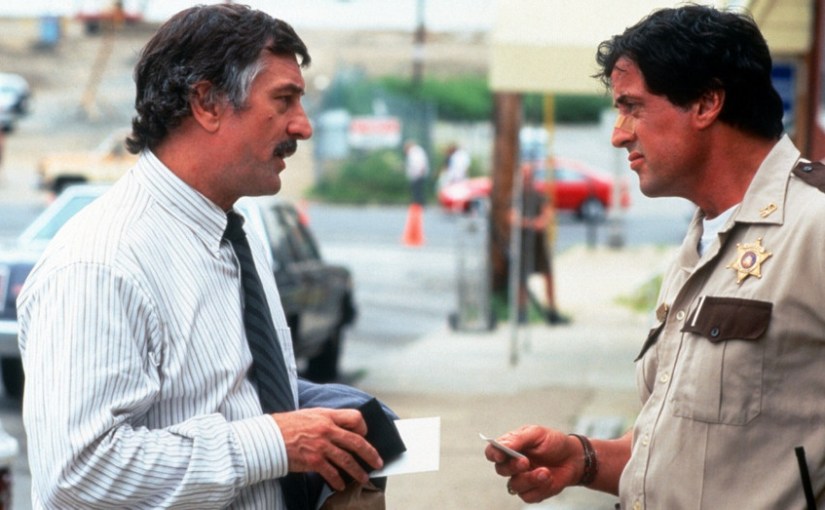
A whose who of staple actors for New York crime and corruption films take center stage including Harvey Keitel, Ray Liotta, and Robert DeNiro.  Yet, the spotlight belongs to Sylvester Stallone in what is arguably the most unsung and best role, next to Rocky Balboa, of his entire career. 

Stallone portrays the pot-bellied schlub Freddy Heflin.  He is the Sherrif of small-town Garrison, NJ where the cops who work within the city, across the bridge, reside comfortably here.  Freddy aspired to be one of those celebrated officers dressed in pressed blue uniforms, but he could not get past the physical due to a loss of hearing in his right ear.  He got that when he was kid and rescued someone from a sinking car that crashed in the river.  Perhaps Freddy wished that never happened.  Maybe his life would have been much more colorful like these New Yorkers.  I can understand the poor guy’s self-reflection.    

An internal affairs investigator named Moe Tilden (another of many convincing New York variations for Robert DeNiro) brings reasonable suspicions of corruption to Freddy’s attention.  How do these guys live so well based on the salary they earn on the police force?  Too often they have been connected with reputed mobsters, and incidents are quickly swept under the rug and kept quiet.  It stands to reason that the cover ups they commit happen in the home state of Jersey, outside of Moe’s jurisdiction.  Moe needs Freddy to quickly offer up anything he knows or witnesses. 

In particular, the leader of these guys, Ray Donlan (Harvey Keitel), might have something to do with the disappearance of his nephew Murray (Michael Rapaport) who was regarded as a young hero cop but is now at the center of a shooting incident gone wrong while driving across the bridge.  Donlan and gang fake a suicide for the kid, but with no body turning up in the river, it’s not so far-fetched to believe that perhaps he’s still alive and hiding out somewhere.

Cop Land works like an Us vs Them observation.  Freddy is the pawn for these guys to keep up appearances while this friendly town operates on other levels.  He’s the guy they can rely on to look the other way and mind his own business.  What I like about Mangold’s script is the dilemma with Stallone’s character.  Who could ever intimidate Sylvester Stallone after Rocky II?  He’s one of the biggest muscle men in film history. Yet here he is the weakling.  Most importantly, he’s utterly believable in this role that’s nowhere in the same league as Rambo or Rocky. 

The cast is as magnificent as you would expect.  Harvey Keitel looks like the family man but he’s got other nefarious ideas bubbling under his exterior.  Robert Patrick fills a role as Keitel’s heavy in a frazzled departure from his anal-retentive evilness that premiered in Terminator 2.  Ray Liotta is the second star of this picture sharing some good scenes with Stallone.  You’d think Liotta was the more seasoned actor even though Stallone came on the scene a few decades before.  Liotta is playing a guy who maybe once lived with a good soul but is now checkered and weary.  How I wish Ray Liotta had more significant screen time during his film career.

The setting works like an intimidating character here. The other supporting players flesh out the environment of Stallone’s sheep herding through a bed of wolves.  Those actors consist of Cathy Moriarty, Annabella Schiorra, Peter Berg, John Spencer and of course Frank Vincent who is a regular in these kinds of pictures.

Cop Land teeters on what Martin Scorsese or Sidney Lumet might have done with this picture.  It only falls short due to a wrap up ending with an unsurprising shootout.  What works so well as a pressure cooker crime drama devolves into blood and bullets and that is a letdown because it’s an easy way out.  In Lumet’s hands for example, the film would have taken advantage of at least an additional half hour to drive the piece into the arena of the public court system (a welcome opportunity for another all-star cameo from the likes of Al Pacino or Sean Penn.   I think the film would have been even smarter for doing so.  The avenue that James Mangold takes with his film is not terrible.  It just feels a little unrewarding or worthy of everything that was wisely executed before.

Cop Land should be seen for the dilemmas it hinges on and then for the various acting scenes among this terrific all-star cast.  Usually, actors will boast that they got to share screen time with Robert DeNiro.  I’m sure guys like Robert Patrick and Michael Rapaport place those experiences high on their mantles.  However, I bet all of these guys said what an honor it was to share the screen with Sylvester Stallone in a performance uncharacteristic of his usual criteria. 

James Mangold’s Cop Land is a terrific crime drama.

FIRST BLOOD

By Marc S. Sanders

1982 was a significant year in Sylvester Stallone’s career.  He helped popularize a rock anthem from Survivor (Eye Of The Tiger) and he ushered in the pop icon figure with the mohawk and gold chains, known as Mr. T, when the third chapter of his Philadelphia sad sack boxer, Rocky,  became a huge hit at the box office.  More importantly, however, he initiated another, bloodier, franchise character.  

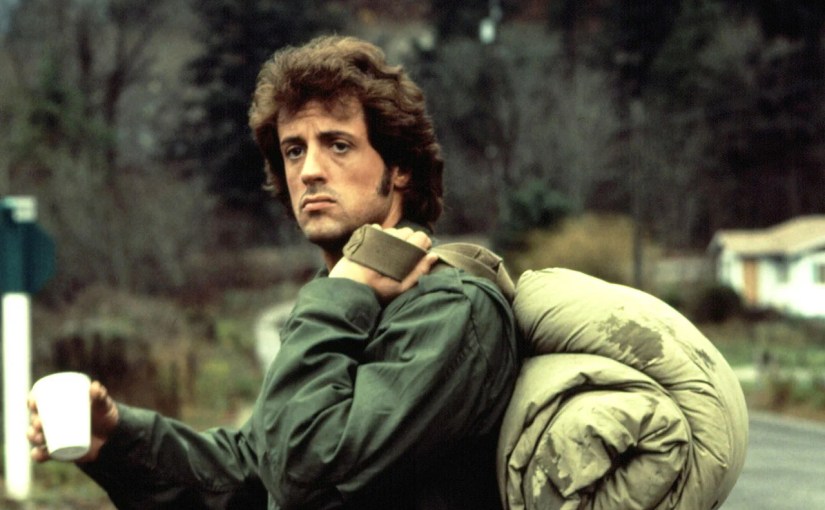
Vietnam Veteran John Rambo entered a small northwestern town to catch up with an old war buddy and grab a bite to eat in First Blood, based on a bestselling novel by David Morrell.  The film, with a screenplay co-written by Stallone, contains a simple plot.  The well-liked Sheriff Teasle (Brian Dennehy) of this community takes notice of Rambo, the drifter with an American flag patched on his army coat, and immediately does not take a liking to him or his appearance.  Teasle attempts to peacefully escort the stranger beyond the city limits.  As soon as he drops Rambo off on the other side of the bridge, the former Green Beret turns around and starts to walk back into town.  A conflict is now set off that will carry the rest of the picture.

After Teasle arrests Rambo, an abusive jail search and frisk awakens the post traumatic stress that the veteran appears to be haunted by from his experiences when he was held captive by the Viet Cong.  A thrilling action sequence is welcomed by Rambo’s escape into the wintery cold mountains.  Now a personal war pitting the tormented man against Teasle’s local law enforcement has been waged.  Perhaps the only way this will end peacefully is if Rambo’s former commander, Colonel Trautman (Richard Crenna), can reign the soldier in before there’s loss of life or any further injury.

The irony of First Blood, Rambo’s first cinematic adventure, is that there is only one fatality in the whole picture.  Rambo is not necessarily a cold blooded killer.  Just don’t push him.  Otherwise, the picture hinges quite a bit on the inventive booby traps that he sets up with only what accompanies his multipurpose six-inch bayonet knife and what can be uncovered within the dense woods.  The traps are quite daring and believable, and as an action picture, it makes for good entertainment.

First Blood may attempt to demonstrate the residual effects of returning home from a tortuous war, but I do not think it sends the best message.  I could never truly understand Teasle’s  immediate abhorrence for Rambo.  This is just a guy who’s walking on by.  Where does the alarm stem from in the Sheriff’s mind?  Maybe a reader can give me some insight that I have failed to recognize after repeated viewings of the film.  

The best part of First Blood is the ending which likely offers one of the best acting scenes in Sylvester Stallone’s enormously long career.  As the adventure is wrapping up, a well written and heartbreaking monologue is delivered that unleashes the terrible trauma the Veteran carries.  Stallone gets to such a manic state of tears and anxiety that it seems so natural.  His voice gets convincingly hoarse.  His face contorts into believable anguish.  At times it is hard to comprehend what he’s describing to Colonel Trautman, but it’s easy to see the distress the character has been living with.  It’s also a perfect summation of the film.  

In this first film, before the subsequent sequels focusing on sensationalized violence, it is apparent how John Rambo contains his heartache and resorts to release what he’s coping with by fighting back against a higher power and refusing to surrender.   The closing monologue perfectly demonstrates that.  It’s as if this man has been holding his breath under water and now, once all the ammunition is expended and the town is in flames, he can finally release what’s been buried in his gut, in his subconscious, for so long.  

1982 was an appropriate time to release First Blood.  It had been ten years since the United States pulled out of a long, losing war in Vietnam.  During the Reagan years, it is fair to argue that life had become quaint and peaceful in this country.  There were remnants of a Cold War still brewing, but there was not a violently long conflict any longer to report.  Pop culture and materialism were being embraced.  Cost of living was working well for the middle class.  Sadly though, there were plenty of people who served who could not put behind the mental scars they took home with them.  Many of these men and women remain forgotten.  Some never returned and some are still unaccounted for.  David Morrell’s story attempted to bring attention to these oversights.  Though the ending to the film adaptation is far different than Morrell’s book, the message is consistent.  

I do not think First Blood is a more effective narrative than The Deer Hunter or Oliver Stone’s well received Vietnam pictures to come out later in the decade.  After all, this is by and large an action adventure.  However, due to the popularity that Stallone carried with the Rambo character, it may have garnered attention for those that never should have been neglected.  

DEMOLITION MAN

By Marc S. Sanders

In the years since the Sylvester Stallone/Wesley Snipes futuristic action picture Demolition Man came out in 1993, bloggers have been giddy to post about how brilliant the satire is, especially since much of its fictional future set in a totalitarian San Angeles (formerly Los) in the year 2032 ended up becoming real to some degree.  Okay, fine.  I’ll go with what they say.  However, Reader, this is not on the same level as Paddy Chayefsky’s prophetical film, Network, and the legacy it has bestowed.  Demolition Man remains just as stupid as it was when it first came out.

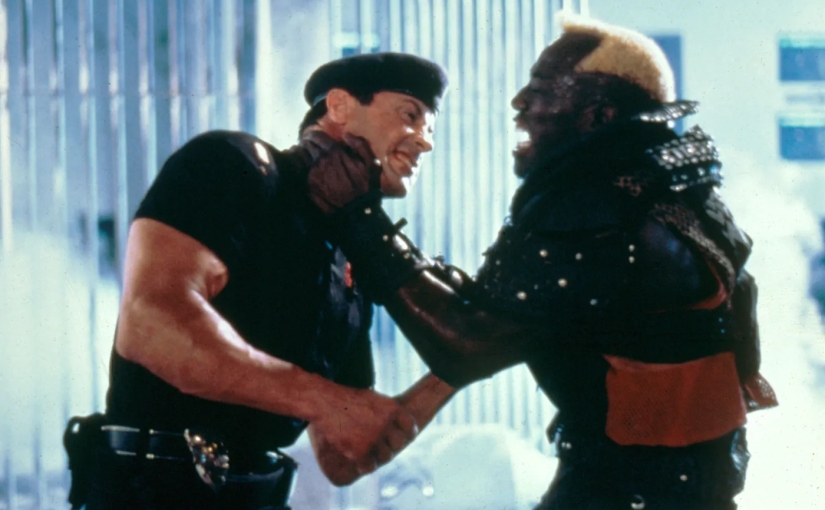
In a mid-1990s prologue of fire, gunfire, and flames, a vicious killer named Simon Phoenix (Snipes), with a happy go lucky habit of giggling through the mayhem he unleashes, is apprehended by decorated cop John Spartan (Stallone).  However, both men are sentenced to decades of cryo-freeze imprisonment because the hostages that Phoenix held had perished and Spartan was found neglectful.

The film jumps to 36 years later. Phoenix has been released and immediately returns to his old habits.  The problem is the law enforcement of this period is not equipped to contain the crazed criminal.  So, Spartan is defrosted as well to go up against Phoenix.  This future is occupied by the cute smiles and charms of Sandra Bullock, Benjamin Bratt and Rob Schneider as the cops who happily sing the melodies made famous by radio and television ads.  Guns are entirely outlawed along with drugs, alcohol, spicy food, and obscene language.  Say a curse word and a machine is nearby, quick to charge you with the offense.  Touching and the exchange of bodily fluids are forbidden as well.  A high five with no contact was an uncanny precursor and is now reminiscent of the early days of the Covid crisis when it was strongly urged that people not even shake hands.  About the only favorable improvement of this future is that toilet paper is no longer used, and people resort to solving their hygiene problems with three seashells.  Regrettably, the technique is never demonstrated.

This film invests a lot of time in its satire, and I appreciate the attempt to find its humor.  The problem is the humor is delivered by Sylvester Stallone and he’s not Bill Murray or Aaron Eckhardt (check out Thank You For Smoking).  Satire is not a wheelhouse for Stallone to reside in.  Sandra Bullock on the other hand is cute in her response.  A memorable scene could have been so much better had Bullock had a more appropriate scene partner.  Lovemaking takes on a whole new method in this 2032 future.  Head devices are used to stimulate the mind.  Oddly enough, you could say that’s the direction that virtual reality has taken.  I appreciate the intuitiveness, but Stallone’s performance doesn’t.  What was intended to be a foreign experience for sexual gratification, comes off very clunky with Stallone.  Imagine what Ben Stiller or Paul Rudd could have done here.  Bruce Willis would have been marvelous in a scene like this.

Wesley Snipes is just as good an action star as Stallone or Willis or Schwarzenegger.  Unfortunately, his Simon Phoenix is so one note as a villain.  He’s a got a bleach blonde crew cut and a giggle and nothing else.  Stallone’s character describes Phoenix as a dirt bag, and the dastardly bad guy shoots guns and does quick kicks.  There’s nothing to know or learn about this guy.  He’s just a target for Sylvester Stallone to do his typical Sylvester Stallone with a shotgun and a handgun and his signature rahhhhhhh bellow that he’s provided in Rambo and Cliffhanger and Cobra and most of the rest of his career.  (Don’t get me wrong though.  Stallone does have a good repertoire of movies.  This one in particular is what doesn’t work.)

Denis Leary lends to the thin plot for a time.  Back in ’93, Leary was known for a few MTV ads where he did his infamous ranting monologue while popping a cigarette.  Because the script for Demolition Man is so nil, the angry comedian is granted opportunity to do his schtick here…twice!  It didn’t amuse me in ’93.  Now it’s just terribly outdated.

Back to the satire, I question the response of the players.  This film takes place only 36 years after a time of violent crime and cursing and smoking and drinking and all the debauchery that we were tolerated.  When Rob Schneider and the police look shocked and terrified at Simon Phoenix’ measure of violence, they are completely oblivious to what’s occurring.  I dunno.  Should they be that gullible?  This guy is only from a time that’s just over thirty years ago.  It hasn’t been that long.  Bullock even has a poster of Lethal Weapon 3 hanging in her office.  The response was hard for me to swallow, and that’s what killed the satirical attempts.  You can’t be that dumbfounded or naïve, can you?

There was a good idea here, but any kind of semblance of thought went out the window once that was jotted down.  The right player was not inserted into the main slot.  Stallone is miscast.  That’s the biggest problem.  Demolition Man hinges on the ho hum gunplay of any Sylvester Stallone actioner and stands on a sliver of irony with how dynamics have played out since the film’s release.  That’s not enough to consider it a fun kind of popcorn flick, though.  Demolition Man needs to remain frozen in time.

CLIFFHANGER

By Marc S. Sanders

It’s an action picture.  What’s common?  Sylvester Stallone, the MacGuffin is money, and the villain has a European accent.  What’s uncommon?  The setting is a Colorado snow covered mountain. 

The movie is Cliffhanger directed by Renny Harlin.

This film deserves much praise for the photography it offers of Stallone and his sidekicks (Michael Rooker, Janine Turner) scaling steep rock formations while trying to evade brutal, but moronic, thieves who have foolishly lost their booty in midair. Now the bad guys must recover the stolen Federal Reserve bills which are scattered in three different locations within the mountain range.  When their plane crashes they force the heroes into leading them on an expedition to locate the money before they will surely kill them.  John Lithgow leads the villains.  Thanks to his slithery English dialect, he’s not bad in the part.

For a pinch of character depth, Gabe (Stallone) is haunted by the opening scene of the film where he failed to rescue the girlfriend of his buddy, Hal (Rooker).  Gabe and Hal will be awarded the opportunity to make amends thanks to this unexpected adventure.  Cliffhanger is not just a thriller.  It’s also a chick flick for guys. 

On a modern flat screen TV, it is quite discernable to recognize the CGI and handcrafted sets that make up much of the scenes.  However, the thrill of it all still holds up and as noted before, the overhead shots really look spectacular.  Stallone really is hanging from these bottomless heights with just one hand; at least that’s what it looks like.  If there is an illusion at play, then there are moments where I can’t tell if I’m being deceived.

The opening scene is the highlight of the picture as Gabe must zip line himself upside down over a wide crevice while attempting to save a hapless climber whose harness has given out.  It’s impossible not to sit still during a well edited and directed moment like this.  This is a masterful scene of terror and suspense.  Renny Harlin is certainly an undervalued director in the action genre.  (I wonder what he’s been up to these days.)

The bad guys are quite hapless though, as they freely bicker among themselves and give away how they’ll happily kill the heroes quickly, allowing one to warn the others.  They are dumb right from the start by killing the pilot of the plane they’re on before fully completing their mission and idiotically losing the money at play.  Then again, as my Unpaid Critic colleague would say, “Then there’d be no movie.”  True Mig!  Very true.

Still, the atmosphere of Cliffhanger is what works.  Blustery snow and wind come off convincingly as Gabe is forced to freeze and shiver with no layers to keep him warm while executing some daring escapes.  Rescue helicopter stunts and collisions are sensational.  There are obligatory shootouts and bloody slashes of skin from climbing tools.  There’s even a bat cave, with no superhero in sight, but it will give you the willies.

I’m hot and cold on many of Sylvester Stallone’s films.  Don’t get me started on Assassins with Antonio Banderas or The Specialist with Sharon Stone.  Those movies required some nuanced acting that the action star just wasn’t offering.  However, here the adventure makes the piece thanks to the director, and Stallone fits right into this environment where the role demands strength, stamina, and outdoor intuition.  Renny Harlin is the top hero here, allowing the marquee actor to look really good on screen.

GUARDIANS OF THE GALAXY VOL. 2

By Marc S. Sanders

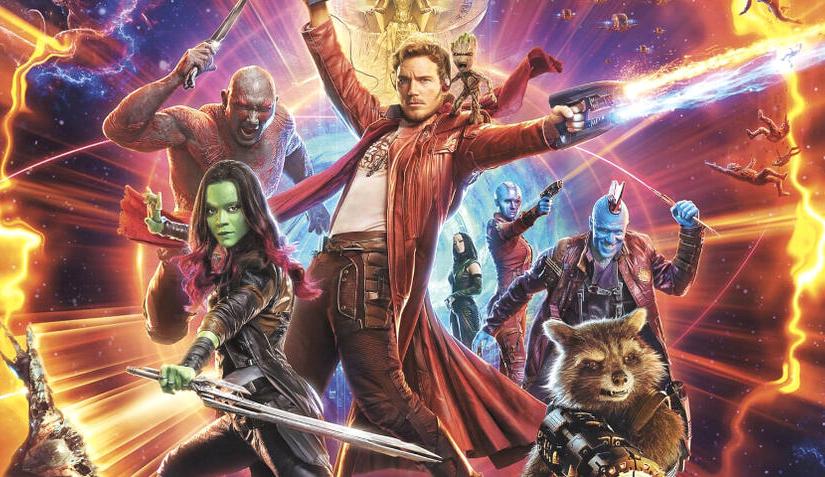
James Gunn continues his Looney Tunes odyssey helming Guardians Of The Galaxy Vol. 2. The silliness is grander, the story is weirder and the characters are now comfortably fleshed out.

Vol 2 is probably not better than the first installment. However, it is more inventive as Gunn takes his film along the hanging thread left over from before. Peter “Star Lord” Quill (Chris Pratt) meets his father at last in the persona of Kurt Russell who goes by the moniker Ego. This is all enthralling to Quill, though his love interest, Gamora (Zoe Saldana) sees beyond the facade.

Ego has invited them to his planet that he created. It pops with colors, serenity and cheer. This plays for a good story; maybe as a better and more developed Star Trek episode.

What differentiates this film from other Marvel films comes out in the third act. This does not consist of just space battles, laser swords and shootouts. The end is something else, something new, entirely. Thus, you are given the film’s greatest strength. I found it to be very imaginative.

Gunn however falls a little bit into his own trap along the way. There are too many relationships and characters that work as filler for side stories. Gamora vs her bitter sister Nebula. Drax (Dave Bautista) with a new, weird antenna on the head character named Mantis and Rocket Racoon and his big mouth with Yondu (Michael Rooker, in a bigger more significant role this time). Oh yeah! There’s also Yondu vs Sylvester Stallone (huh? why? how?) and Yondu vs his mutinous army, The Ravagers. It’s all a little too much for an already busy looking film.

I found it funny that The Ravagers reminded me of the motorcycle gang, The Black Widows, from Clint Eastwood’s Every Which Way… bare knuckle comedies. Those guys were much funnier than these Ravagers. Gunn overstays their welcome as they randomly cackle and heckle poor Baby Groot, the toddler tree thing. That gets old quickly.

Gunn approaches a special kind of humor here. Repeatedly, because these are outer space characters, it’s apparently funny to lend them explaining the punchline of a gag. So if Drax realizes that Peter has the hots for Gamora, he’ll belly laugh and explain literally how Peter feels and do it bigger and louder. Variations of that gag occur quite often among most of the characters. Sometimes it works. Sometimes it gets old.

GOTG Vol 2 is a fun watch. I don’t foresee this installment carrying the legendary status the first one did or even standing out among the best of the Marvel series, but I will give props to the outcome of what Ego truly is and what his intent depends on. (I won’t spoil that here, of course.)

The cast is great. Saldana is one of the stronger female characters in the MCU. She captures a background to Gamora that is blatantly absent from other Marvel ladies. Bautista has become a great character actor as well. He’s a smart guy with good timing. With his extensive child and adult film resume Kurt Russell is perfectly cast as Pratt’s father. Their personalities lend to some good chemistry.

James Gunn owns the Guardians films. No one else can capture his blend of humor and pop culture salutes. Yet, he overreaches a little trying to incorporate so much story and so many gags into one film. His vision is well defined, though.

Plus, Gunn stages another dance scene for Pratt and Saldana, and it’s great. As I noted in my Vol 1 review, that’s how you get to a viewer’s heart. Everyone loves to dance.

As well, Gunn accompanied his sequences with some tunes both fresh and familiar from Fleetwood Mac, Electric Light Orchestra and George Harrison to name a few.

James Gunn was always going to make sure never to take his films seriously. So, when you see a baby tree groove along while trying to detonate a bomb, I defy you to be so serious as well.

ROCKY

By Marc S. Sanders

Rocky is a story about a bunch of losers.  It really is. It’s actually a film that does not represent or follow the standard ho hum formula that so many other well-recognized sports films that are so familiar, since it premiered on screens in 1976. 

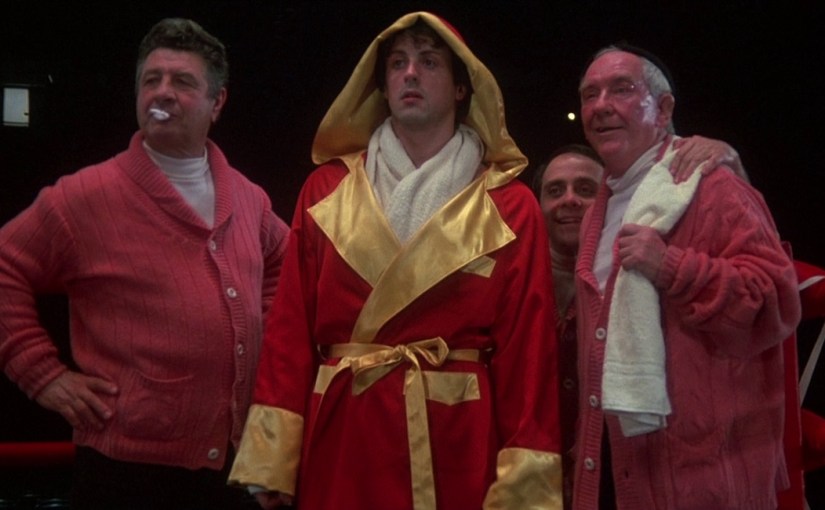
If you examine Rocky, what you’ll find is a story about a boxer by the name of Rocky Balboa (Sylvester Stallone in a role that broke through everything for him), who is not shown doing much boxing or even training.  Instead, the southpaw boxer known as The Italian Stallion, is displayed as a heavy collector for a loan shark in and around the south side of a dirty Philadelphia.  Early on in the film, Rocky delivers monies to the loan shark and his driver asks Rocky “Did ya get the license plate?”  Rocky asks for what, and the driver snaps back with “For the truck that ran over your face.”  It’s delivered with a little humor but it’s also sad.  Is there anyone to uplift poor Rocky’s spirits?  His one-time trainer, Mickey (Burgess Meredith), kicks him out of the gym because he’s tired of Rocky at age 30 wasting his life with the scum of the streets.  Rocky lives in a filthy apartment barely making scratch from underground fights.  About the only redeeming quality Rocky seems to show is his tender loving care for his two turtles, Cuff and Link.  So, it is surprisingly charming when he sweet talks a mousy, petite woman named Adrian (Talia Shire, truly in an underrated performance) for a date. 

Adrian is also a loser, or at least she’s treated like one by her brother, Paulie (Burt Young).  He’s constantly putting her down for her looks and lack of men in her life and any other opportune moment he can find.  It’s the only way that Paulie can build confidence in himself; by putting his sister down.  Beyond that, all he has going for him is his job in the meat locker.  His one dream is for Rocky to give him a job working for the loan shark.  Such aspirations.

By luck, Rocky is called upon by the Heavyweight Champion of the World, Apollo Creed (Carl Weathers), to fight him in the ring.  Anyone else would jump at this chance.  For Rocky, it’s just a way to earn a fast $150,000 and use his face as a punching bag for Creed on live television.

All of these characters within this circle come out of their shells once Rocky is given the opportunity of a lifetime.  The first win for Rocky is when he wins over Adrian on an adoring, near penniless date when he takes her ice skating on Thanksgiving night.  They’re only given ten minutes to skate together.  The transition thereafter is quite revealing.  Director John G. Avildsen transforms Adrian’s appearance by removing her ugly glasses and hat.  Rocky is pleasantly surprised by the red winter coat she wears later in the picture.  Adrian becomes more talkative and expressive.  Initially, she couldn’t even look Rocky in the eye.  When Rocky gives her a shout out at a press conference on TV, Adrian laughs and cuddles up next to Rocky.  Someone has finally treasured her and she adores it so appreciatingly.  Shire really demonstrates a nice character arc, where she comes out from under the strong arm of her brother to find her independence and make choices for herself.  An amazing scene occurs near the end between Shire and Young.  The pent-up frustration the siblings have for one another finally boils over.  This scene is what won both of these actors their Oscar nominations.  It’s a moment in all of the Rocky films that doesn’t get enough recognition.

Mickey is the one who gives tough love to Rocky.  He shares with Rocky his own battles in the ring during the first half of his near 50 years in boxing.  All of the blood and sweat didn’t amount to much beyond the gym he has for the local fighters.  What he earned as a fighter was a cauliflower ear and no family except the poor kids who go in and out of his southside gym.  Now he has a chance at the big time and he has to win over Rocky’s affections so that he can train him properly for the fight that’s coming up.

The biggest loser of course is the title character.  Credit must first go to Stallone for an outstanding insightful script that looks much deeper than any of the numerous sequels that followed this film.  The original Rocky is not about punches.  The script eventually transitions into determination with Rocky giving a sorrowful monologue to Adrian acknowledging he’s a loser with no chance at beating Creed.  At the very least, all he wants to do is settle for going the full 15 rounds with the champion and never falling down on the mat for a count of 10.  Only then can Rocky triumph with a personal victory.

Rocky won the Oscar for Best Picture and Avildsen won Best Director in 1976, beating out incredible films like Network, Taxi Driver and All The President’s Men.  I’ve thought about this endlessly over the years.  Why did it win?  I mean look at the competition it had.  The script for Network is one of the most admired and amazing scripts in Hollywood history; now it’s regarded for how prophetic it has become.  The other two films gave brutally honest, yet cynical portraits of the lack of innocence in the United States.  These other films rightfully question if America is the greatest and most thriving country in the world.  Just writing this, I think I answered my own question, though I will endlessly ponder anyway.  Rocky is the one positive entry of nominated films that year.  Rocky Balboa put aside the differences he had with others and overcame the adversity of those that would antagonize and guide him down the wrong paths. 

It’s totally cliché now to say this but Avildsen’s film, Rocky, is an awe-inspiring triumph.  It’s still okay to identify the picture as such, because it was the first to do what only so many imitations thereafter tried to duplicate.  The outcome of the fight within the film was not about winning the belt and the fortunes of money.  It was a breakthrough from a wasted life – the life of a loser; the lives Rocky, Adrian, Paulie and Mickey were all sadly living before the chance opportunity of supporting one another came to pass.  As Bill Conti’s unforgettable soundtrack closes out the picture, you are not just crying for Rocky and Adrian as they profess their love for one another in the middle of a crowded boxing ring.  You are crying because you realize you can believe in changing your life with will, stamina, endurance, personal strength, confidence and then…finally…love.