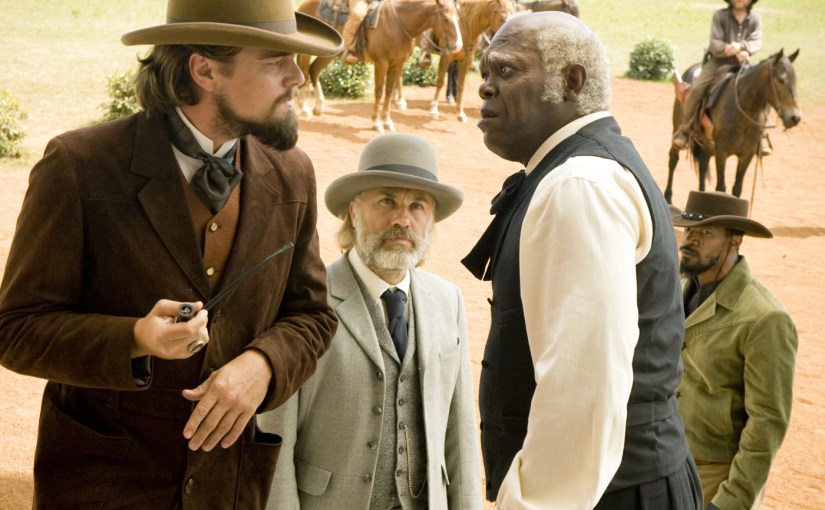
DJANGO UNCHAINED

By Marc S. Sanders

Quentin Tarantino’s scripts have never been shy with using the N-word or any other colorful terminology.  He turns harsh and biting vocabulary into rhythmic stanzas of dialogue.  When he films these scripts, he’s not bashful with the buckets of blood splashed all over the set either.  His interpretation of violence works in a kind of slapstick fashion among his seedy one-dimensional characters.  Normally, I never get uneasy with his approach.  I know what to expect of the guy.  Yet, as well cast, written and formulated his Oscar winning film Django Unchained may be, I wince at both his word play and physical carnage.  I think Tarantino gets a little too comfortable with his slave era storylines and the African American actors he stages in his set ups.  A good portion of this Western may be thrilling, but it’s also cringy like watching a drunk uncle at a three-year old’s birthday party, and I defy viewers not to squint at the movie if they so much as live day to day with even the smallest shred of kindness in their hearts.

Django Freeman (Jamie Foxx) is released from slavery by the former dentist now bounty hunter, Dr. King Schultz (Christoph Waltz, in his second Oscar winning performance cast by Tarantino).  Django is a good man, though uneducated and mostly illiterate.  Once he assists the doctor with locating and collecting a bounty, the two make an arrangement to stick together through the winter collecting further ransoms.  In return for the former slave’s help, Dr. Schultz will assist in rescuing Django’s wife, the German speaking Broomhilda (Kerry Washington).  She is believed to be held at the infamous Mississippi slave plantation known as Candyland, owned by the ruthless Calvin Candie. He is played by Leonardo DiCaprio in one of his best roles while also delivering one of his most unforgiving portrayals.  Calvin Candie is a mean son of a bitch slave owner who has too much fun with investing in slaves for brutal Mandingo wrestling matches that don’t finish until the loser is dead in bloody, bone cracking fashion.  

All of these figures belong at the top of Quentin Tarantino’s list of sensational character inventions, particularly Django.  He has more depth than most of the writer’s other creations.  This guy goes from an unkempt, nearly naked, tortured and chained slave to a free man proudly wearing a bright blue court jester costume on horseback.  His third iteration places him in a gunslinger wardrobe comparable to a Clint Eastwood cowboy and when the conclusion arrives, Django is meaner, more confident and instinctively wiser, glamorously dressed (purple vest with gold inlay designer seems) like a graphic novel superhero ready to take on an endless army of redneck slave abusing outlaws.  Django is taught everything he needs to know from Doc Schultz.  Christoph Waltz and Jamie Foxx stand as an impressionable mentor/student pair.  They are the spine of Django Unchained.

The villainy of the piece belongs to DiCaprio and his head slave in charge, known as Steven, played by the director’s go to player for happy street slang and N-word droppings, Samuel L Jackson.  Steven is Jackson’s best career role because as an old, decrepit and frightening individual it’s this portrayal which looks like no other part the actor has ever played.    Both actors are funny, and you can’t take your eyes off of their unlimited grandstanding, but they will leave you feeling terribly uncomfortable.

I think what is most unsettling about Django Unchained is that the cruelty persists for nearly the whole three hour run time, and it is more so at a shameless attempt of comedic, pulpy entertainment, rather than just insight and education.  A Schindler’s List finds no glee in the torment that kept the Holocaust alive.  Tarantino didn’t even go to great heights with Inglourious Basterds because that film featured ongoing grisly heroics with his assortment of vengeful protagonists.  The Nazis were never celebrated in that film at the cost of innocent Jewish lives that faced peril and threat.

In Django Unchained, it’s hard to watch the Negro characters and extras getting brutally whipped while bound by inescapable chains.  Kerry Washington’s nude character is yanked out of a sweat box on the Candyland plantation and while I’m watching it, I ask myself if I’m too much of a prude.  No.  I don’t think I am.  This teeters on torture porn. The N-word is now being used way too freely to stab at the slaves for gleeful poetry. It grows tiring and, yeah even for a Quentin Tarantino picture downright ugly and offensive. I imagine Tarantino grinning behind the camera every time DiCaprio or Jackson happily drop another N-bomb.

Quentin Tarantino has been applauded time and again for his excessive abuse and tortuous murders committed by his characters.  Because he’s courageously gone so far before, the line of acceptance is either pushed out farther or maybe in the case of Django Unchained it is entirely erased.  

My compliments to a well-known humanitarian like Leonardo DiCaprio for energetically acting through this bastard of a role that requires a twisted pleasure in watching two husky black bruisers beat the bloody tar out of each other in a formal drinking parlor.  Later in the picture, a weeping slave is shredded to pieces by ravaged, bloodthirsty dogs.  These fictional scenes staged by Tarantino and his filmmakers come off a little too real and even by the director’s standards much too over the top for the temperature of this film’s narrative.  

What could these extras cast to play these slave and Mandingo roles have really been thinking while shooting this picture?  Did these men recognize the racially poetic humor in Tarantino’s verbiage? Did they find a commitment to demonstrate a once historic atrocity for a lesson learned? I doubt it. Did these actors simply succumb because they needed the work?  Believe me.  I empathize.  Yet, Tarantino took this film to a very uncomfortable extreme for a movie intended on following his reputable and always admired lurid material.  Here, despite my reverence for his work, I think Quentin Tarantino goes unnecessarily over the line.  The whippings and dog torture are quite uneven from what The Bride commits in Kill Bill when a Crazy 88 henchman gets spanked with a sword and there’s nothing to compare to whatever sick, graphic novel atrocities occur in his later western, The Hateful Eight – both are PG rated compared to what is offered in Django Unchained.

Much of Tarantino’s signature comedy works.  The Ku Klux Klan of the late 1850s are represented with brilliant stupidity by a cameo appearing Jonah Hill and a racist, foul speaking, plantation owning charmer played by Don Johnson, known by what else but Big Daddy.  The filmmaker turns these guys into bumbling stooges who can’t even wear their hoods properly. And yes, they also freely drop the N-word in cruel like fashion. I get it, Mississippi and Southern Plantation owners were not the Mickey Mouse sort, and I’m not asking for whitewashing what the real-life despicable characters stood for or how they carried themselves. Still, when all of this compounded together, it goes too far. In a drama like 12 Years A Slave, I see an authenticity to an ugly slave era. In Tarantino’s world, I see a kid who learned a bad word and dad said go ahead son, play with the machine gun but make sure the vocabulary ammo will riddle the entire script to pieces.

Django Unchained is a gorgeous looking picture.  Tarantino goes to the outdoor plains following the interiors of Pulp Fiction and Jackie Brown.  Jamie Foxx and Christoph Waltz’ cowboy antics look marvelous riding on horseback or even simply camping by the fire as well written exposition is revealed on cold moonlight evenings.  

I can watch this western on repeat and feel a free-spirited energy when Django steps out in his cowboy outfit with boots, spurs, the hat, and a brand-new saddle to ride off on his steed while Jim Croce’s uplifting “I Got A Name” cues into the picture.  I love how Jamie Foxx appears as a super heroic action star, especially in the final act of the movie.  I can absorb the sadism of DiCaprio’s downright mischievous evil, particularly when he uses a bone saw and skull prop to make a point.  I feel like I’ve gained a comforting friend in Christop Waltz’ kindly sensible Doc Schultz, and I welcome a very funny and altogether different Samuel L Jackson that finally arrives.  

It’s the filling within these strong moments and characterizations that is very hard to swallow.  Django Unchained is that great picture that still should have been made but with a modicum of caution. Perhaps one of the Weinsteins, or maybe even these powerhouse, marquee actors who led this piece should have shared some constructive input with the writer/director.

Django Unchained is fun, but it’s not entirely fun.

PATRIOT GAMES

By Marc S. Sanders

You may remember Patriot Games as a tense thriller featuring the favorite hero Jack Ryan doing the wherewithal action that is demanding for the adaptation of Tom Clancy’s best-selling novel.  Harrison Ford (taking over the role from Alec Baldwin) plays the guy who will thwart an assassination attempt on the Royal Family or punch out a terrorist thug invading his home or on a speed boat during a dark and stormy night.  Only a small bit of the action sequences are flawed, but that doesn’t take away from what makes the picture truly special.  In the follow up to The Hunt For Red October, Jack Ryan goes back to the CIA to investigate who wants revenge against him and who was responsible for that assassination attempt.  What the picture serves as the covert halls of the Central Intelligence Agency is what is especially convincing and most fascinating.

On the surface, the Irish Republican Army appears to be the scapegoat for attempting to murder members of the Royal Family as they are pulling out of the front gates of Buckingham Palace.  Jack Ryan is in London vacationing with his wife Cathy (Anne Archer) and daughter Sally (Thora Birch) when he comes upon the incident just in time to foil the crime.  In the process, Ryan takes a bullet to the shoulder and kills the younger brother of the most dangerous squad member, Sean Miller (Sean Bean).  A quick trial puts Miller behind bars and Jack is recognized as a hero.

However, Sean Miller escapes with his surviving comrades and vows revenge on Jack and his family.  An attempt is made on the Ryans’ lives and Jack insists on getting back into the CIA to locate Miller and his team.

The revenge plot is the main thread and its pretty ho hum.  We’ve seen all that many times before.  However, what branches off are the conflicts within Irish politics and how Jack Ryan gradually uncovers who and where this small faction of terrorists may be.  Cold War commentary is delivered by an under the radar performance from one of my favorite character actors, Richard Harris.  He attempts to deny responsibility of these attacks and offer an olive branch to Ryan.  Ford and Harris have three good scenes together, two of which are minimal on dialogue but effective in sending their messages to one another. 

As well, Harrison Ford occupies another great heroic role.  I agree with a majority who believe he was too old to play the novice Jack Ryan described in Clancy’s early novels.  Many insist casting Baldwin was perfect.  It was. Yet, I am able to look past that as the character does not have the rookie appearance or regard in this picture.  With Harrison Ford, Jack Ryan is now at a point where he looks seasoned and experienced like the character eventually becomes in the book series.

Director Phillip Noyce is good at using the mysterious and quiet orchestral accompaniments of James Horner to follow Jack as he studies photographs or reflects on the day of the assassination attempt in order to piece together random clues.  In other films, this might get boring and tedious.  However, the director captures good closeups of Harrison Ford and quick flashbacks are edited to help identify what were important blink and miss it moments necessary to assemble the puzzle.  A simple visit to the restroom for Jack Ryan and a glance at a woman’s ponytail lead to a solid conclusion.

Sean Bean has the physical and quiet intensity to his role.  He’s the muscle of the terrorist group, not the leader (played by Patrick Bergen).  Bean serves the revenge element and his physique and weapon handling work well as a nice threat to the hero of the picture.

As the story progresses, the audience follows along with Ryan.  Satellite photographs are studied and zoomed in seeking some semblance of an image in a blur.  Sometimes Jack Ryan is moving in the right direction but in other times he’s unsure.  Even though we always know how the bad guys are doing and where they are, we empathize because Harrison Ford’s character does not.  Still, it’s a thrill to witness him eventually make his discoveries.

A nice approach occurs when the CIA sends in troops to what they believe is an enemy base camp.  We watch Jack Ryan and all of the government officials stare with intensity on a big screen as little black pixels drop down and move at a running pace from an overhead satellite shot.  We don’t have to endure one more machine gun battle.  This kind of intensity is much more interesting where lives are taken as a means of protection, but still a principled man like Jack Ryan does not feel good about what has to be done.

Patriot Games works well with its plays on espionage, spy activity, traitors, and government relations between America, Great Britain and Ireland.  The select action scenes are done well and hold their suspense for quite long.  However, the final sequence is challenging to sit through. 

As the enemy prepares a covert attack on the Ryans’ Virginia home where the Royal Family are guests, there is much running around upstairs and down, in the basement, and outside the roof and so on.  It’s pouring rain with the standard thunder and lightning in the middle of the night as well.  Once the villains and the hero make their way to some getaway boats, the film unravels.  The picture shakes like crazy against the waves and rain.  There’s little light on any of the shots as well and the sound goes loud due to the boat engines and the storm setting.  All of these elements make it challenging to get absorbed in the movie’s climactic ending. 

Hollywood pictures fall back on this approach often in films like Ang Lee’s Hulk and the first installment of The Hunger Games.  It’s dark and wet and shaky and rainy. So, it is hard to decipher who is hitting who and who is shooting at who and who is driving which boat and where are they now.  It’s a shame really because Patriot Games is a taut thriller that holds your attention for nearly two hours, but then you give up in the final few minutes to simply rely on your instincts for how the story is going to wrap itself up.

Jack Ryan’s second adventure is worth watching but oddly enough, maybe wait for your restroom break until the last ten minutes of the picture.

THE HATEFUL EIGHT

By Marc S. Sanders

Quentin Tarantino’s eighth film, The Hateful Eight, has the signature director’s fingerprints all over, but it still stands apart from the rest thanks to a lurid, foreboding soundtrack from Ennio Morricone with an Agatha Christie narrative approach.

During a post-Civil War period, near the mountaintops of Wisconsin, an image of a crucifixion post is blanketed in snow as a stagecoach races past.  The cold symbol spells doom.  The coach is stopped by a curious, well-dressed man in the middle of the road.  This is Major Marquis Warren (Samuel L Jackson), a legendary black Union veteran, now bounty hunter.  With a fierce blizzard on its way, the Major convinces another bounty hunter, who has paid for the coach, to hitch a ride.  That man is John Ruth (Kurt Russell) and he’s escorting his ten-thousand-dollar bounty, a black-eyed unsavory Daisy Domergue (Jennifer Jason Leigh), to her hanging in the nearby town of Red Rock.  A would-be sheriff of that town eventually hitches a ride as well, Chris Mannix (Walton Goggins). The coach has to take shelter from an oncoming blizzard at Minnie’s Haberdashery, where four other men are already holed up.  They are Confederate General Sandy Smithers (Bruce Dern), the charming British hangman Oswaldo Mobray (Tim Roth), Cowboy Joe Gage (Michael Madsen) and the giant like Mexican Bob (Demian Bichir).  Tarantino has invented another collection of seedy two-dimensional characters whose unique appearances and vocal inflections set them apart from the rest of the gang respectively. Still, they are interesting enough.

The first celebrated performer of the piece is Morricone’s Oscar winning soundtrack which is totally eerie, sinister and immersive.  I go back to that carved out wooden image of Christ hanging from the cross and covered in snow.  Morricone’s music replays the same notes but with more intensity each time it starts up again.  It’s as if the Devil is luring us into his hellish lair.  If the famed Conductor’s chords could speak it would start with “Once upon a time, on a dark and stormy night…”

Twists of fate await all of these men and the one woman.  Like a mystery from Dame Agatha, the characters are set up for introduction to each other, with a little bit of back story.  The ones that especially stand out belong to Major Warren who possesses a personalized letter from President Abraham Lincoln himself.  The curious question of what could possibly merit a ten-thousand-dollar bounty for a small woman like Daisy is the other mystery I initially take notice of.  Once everyone is gathered at Minnie’s Haberdashery, how will these people intersect with one another?

The Hateful Eight plays like a short story you might find in a Reader’s Digest.  Taratino might correct me and insist that more specifically it would be found in a magazine of lurid subject matter – pulp fiction.  Go figure.  It is a theme he sticks to and continues to reinvent himself with each passing film.  The creativity comes in the new situations he constructs for his players.  He’s placed his figures in another kind of western by this point already.  He’s applied them to an alternate kind of Nazi occupied Europe during the second world war.  He’s updated swordplay in a zippy Dojo.  Now, he inserts his personalities into primarily a single setting, like Christie did time and again. 

Clues are uncovered as the film moves on to indicate that something may have happened here, before the stagecoach arrived.  There’s a broken door that needs to be nailed shut each time it is crashed opened.  A jellybean?  A chess board sits in front of the General and appears to be in the middle of a game.  And where is Minnie and Sweet Dave, the caretakers? The Major positions himself as the detective and within the small confines of this log cabin suspicions will reveal more about how the men and Daisy are connected and why they are here, now, while a harsh, unforgiving blizzard rages on outside.

The dialogue of The Hateful Eight is not as memorable as other Tarantino scripts.  Yet, the characters are just as colorful, and there are a couple of zips in time to keep you alert when a new development surfaces.  Tarantino is not shy about the bloodshed either.  The violence plays like most of his other films with a kind of slapstick twist.  A character gets violently ill and vomits blood all over Daisy.  That’s after a couple of wallops to the nose and jaw, plus a face full of stew that she’s had to endure as John Ruth’s handcuffed prisoner.  Later, someone’s brains splatter all over her. 

None of the guys are standard cowboys of the Old West either.  Goggins plays a good-natured dimwit.  Jackson is impervious to the racial name calling.  Russell is a cranky old grunt.  Your grandfathers did not take your fathers to Saturday matinee “ride ‘em into the sunset” westerns like these.  This is the most garish of material, and as in your face as it is, it’s also quite entertaining.

Tarantino has definitely graduated from the simplicity of his first films, Reservoir Dogs and Pulp Fiction.  The production value of The Hateful Eight is phenomenal.  Originally, I saw this movie in theaters with a couple of my Cinemaniac buddies.  Tarantino was proud to present it on 70mm Panavision film, complete with some intrusive lines and occasional burn spots.  Don’t tell me if this was not shot on location.  I don’t want to know.  I treasure the illusion. The deep snow-covered Wisconsin mountains are glorious to look at.  I feel completely absorbed in the setting with the harsh whispers of chilly winds happening outside as the dark blue of the snowstorm can be seen through the cabin windows.  This may be Quentin Tarantino’s most atmospheric film to date. 

This movie has a running time of three hours, but I strongly recommend to watch it without stopping.  The blu ray was a Hanukkah gift from my wife, and I tried watching the night before, but I kept having to pause it to struggle with a cold I’m currently fighting.  I only made it to “Chapter Four: Domergue’s Got A Secret.”  The next day, I told myself to start it from the beginning while everyone was out of the house and the experience was very fulfilling as Tarantino’s wintery day moves into night and then finally reaches its bloody conclusion. 

The Hateful Eight works like a graphic novel come to life.  It’s a great late-night rainy-day kind of picture.  If you haven’t seen it or it’s been a while since the last time, like it was for me, then I recommend checking it out during this winter season.  Trust me.  It just wouldn’t play as well on a hot summer night in July.  Quentin Tarantino and his cast work better when they are at their most cold blooded.

SEA OF LOVE

By Marc S. Sanders

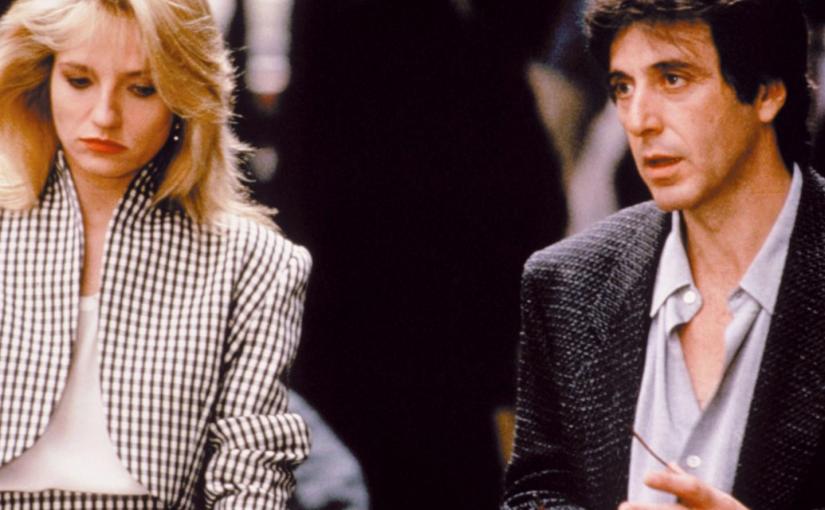
Al Pacino is a twenty-year veteran New York City cop, working out of Manhattan, on the trail of a serial killer in Sea Of Love.  The profession is nothing new to Pacino’s repertoire of roles, but the portrayal is unique thanks to a smart and suspenseful script from Richard Price and intense directing from Harold Becker.

The killer leaves a calling card.  A 45 LP record of Phil Phillips ’50s classic crooner, “Sea Of Love,” spinning on the turntable.  The victims are naked men lying face down in bed with a bullet to the head.  Turns out that a cop from another precinct played by John Goodman has uncovered a similar crime scene in Queens.  So, the two team up.  They believe the murderer is a woman.

All the victims have posted a Lonely-Hearts Club blurb in a magazine. The invitation for a date stands out because the text rhymes.  The detectives decide to post their own ad in the same kind of format, meet the women who respond and hope to nab the killer.  It gets complicated when Pacino encounters a breathtaking and sultry woman played by Ellen Barkin. 

Pacino’s cop is a smart guy.  He’s got instincts.  Yet, perhaps due to his constant drinking, insomnia, and the bitterness he carries now that his partner (Richard Jenkins) has hooked up with his ex-wife, he’s also quite vulnerable.

The mystery is strong, and the tension builds as Sea Of Love moves on.  Barkin has Pacino and the audience convinced that she’s the prime suspect.  Still, he lets his defenses down because he’s easily getting seduced by her advances.

Whether you’re watching Al Pacino share scenes with John Goodman or Ellen Barkin, the execution is fantastic.  Great performances from the three.  Pacino and Goodman have a natural exchange with one another. Often humorous, but the guys always talk like cops.  When Pacino admits to tossing away a fingerprinted glass from Barkin, Goodman suggests lifting the prints from something- ahem – more personal of his.  A cute wink and nod exchange.

More important to the film is the erotic chemistry between Barkin and Pacino.  Harold Becker uses a late-night supermarket visit in the vegetable aisle to evoke the risky and irresistible nature the two characters develop for one another.  Other scenes build well on the relationship between these two lonely strangers who’ve only recently met. 

Moments of isolation and drunken stupors also work towards fleshing out Pacino’s burned out cop.  He’s got a schleppy posture to him and an exhausted expression with his sullen eyes and shaggy black hair.  At the same time, his character’s twenty years of experience seem to uphold his alertness.  This cop knows he’s letting his guard down. Without any dialogue, you see the internal struggle Pacino has with what should be done against what he is deliberately neglecting.

This film was Ellen Barkin’s breakthrough role.  She received rave reviews as someone who takes care to uphold a New York City trendy appearance by day as a shoe salesperson in contrast to a woman looking for some carefree lust in the evening.  For Pacino, Sea Of Love reinvigorated a career slump following a series of poorly reviewed films.  Together, they make for a sexy yet untrusting pair.

Circumventing this relationship is the mystery.  Is Barkin the culprit? She seems to have a dark way about her that may not surprise you.  Price, Barkin and Becker designed the character quite well for her to at least have the potential to be a killer of men.  Is she setting Pacino up to be the next victim?

New York City from the late 1980s looks great, even though interiors were shot in Toronto.  Trevor Jones offers a nail-biting soundtrack to keep the suspense heightened at just the right beats of the picture with Becker’s camera pointing down dark hallways or when new clues are discovered.

I’ve seen Sea Of Love a few times and even with knowing the surprise ending, the film still holds up thanks to the performances from its three stars, along with its taut editing, well-paced writing, and smart direction. 

This is a good erotic murder mystery.

THE MARVELS

By Marc S. Sanders

If you just want to join your family to have fun at the movies then go see The Marvels

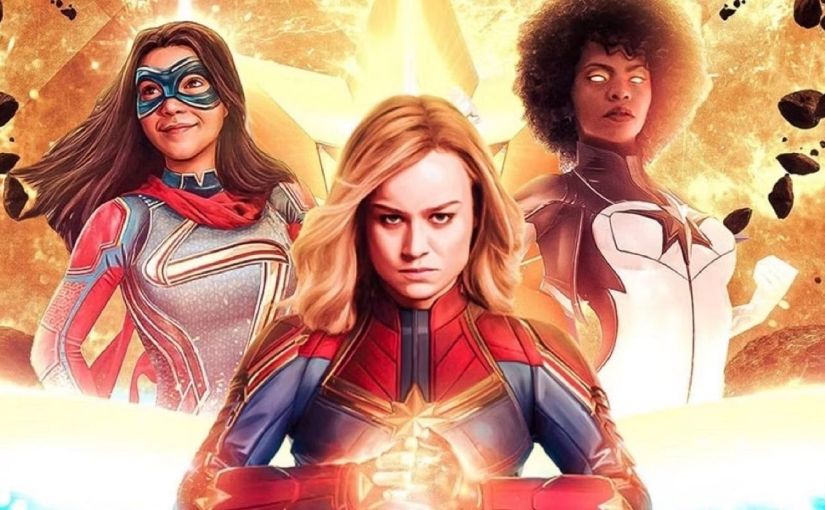
The thirty third installment in the Marvel Cinematic Universe (33???????? Wow!!!) follows a trio of women donning the superhero costumes and getting caught up in an exchange of bouncing around their respective presences with one another.  One second Ms. Marvel (Iman Vellani) is in her Jersey City home with her family and then suddenly she’s in an astronaut uniform, floating through space, previously occupied by Monica Rambeau (Teyona Parris).  Another minute, Monica is in that uniform and then suddenly she is occupying the space once held by Captain Marvel (Brie Larson).  This happens a lot within the first twenty minutes and its edited so well for laughs and hijinks as the three main characters of the film are constantly having to switch adventures on a dime.

I have not watched the Ms. Marvel Disney Plus TV series yet.  I won’t lie.  This guy who grew up on Marvel comics, cartoons, and toys is getting MCU exhausted and I just have needed a break.   I’m told there are some elements of that show that lead to some things going on in The Marvels.  Didn’t bother me though.  While I like wink and nod subtleties, it is not why I go to the movies.  I’m not watching War And Peace.  I’m watching superheroes who wear spandex and capes and fly.  I trusted myself to pick up on who was who and what was what.

The Marvels works for the most part as a stand-alone story from the rest of the MCU stuff.  Ms. Marvel, aka teenager Kamala Khan, is a diehard fan of Captain Marvel aka Carol Danvers.  Her room is adorned with her idolized hero in various poses and flights.  Kamala finally gets to meet Carol when they share an adventure together.  Her parents and brother are the strangers in a strange world who give poor Nick Fury (Samuel L Jackson, who I think holds the record for most MCU appearances) a hard time for the sake of comedy.  Monica is the niece by friendship connection to Carol Danvers.  Monica was a child the last time she saw Aunt Carol.  Since that time, her mother has passed away from cancer while she disappeared during Thanos’ blip.

A new Kree villain is mounting an offence.  Dar-Benn (Zawe Ashton) has recovered a wristlet of power (meh…it’s a MacGuffin).  Kamala has the other wristlet (meh…another MacGuffin).  Dar-Benn is going to fight the trio and then another MCU film will have been completed.

The Marvels is not a perfect movie.  At times the characters are speaking in their own science fiction scientific speak to tell me what is happening next and honestly I have no idea what in the hell they are talking about.  Meh!  I didn’t care.  Just get to where you need to go.

What serves the film is the set ups of scenes.  Kree bad guys wreck Kamala’s house while the family looks on as one dining room chair or another dish gets bashed.  Holes get smashed through the ceiling as well.  Three Stooges kind of stuff.

There’s also a planet The Marvels travel to for help where the citizens are dressed in pastel colors and ribbons and only communicate in song and harmony.  This could have been a season 3 episode of the original Star Trek series.

The most inspiring and memorable scene is especially catered for lovers of cats and Barbra Streisand.  This sequence that comes late in the film gives new meaning to the phrase “We are herding cats now.”  As silly as this moment is, it should remind you that producer Kevin Feige and his squad of MCU writers have not run out of inventive ideas yet.  This is on the level of the best Saturday Night Live skits you can find. 

Everything is still good in the MCU.  I still enjoy most of what has come down the pike.  The products are just oversaturating themselves by releasing so soon after each other. The MCU is not so enjoyable when it feels like homework to know who and what everything is and where it all left off.

With this installment, the cast is having fun.  The writers are having fun.  The visual effects are having fun.  The story and the bad guy really don’t matter.  The Marvels is simply a kaleidoscope of rainbow color sci-fi silliness and that’s enough to satisfy me.

What would have been a nice touch though is if Babs herself made a cameo appearance.  Then again, the reference joke made in the film during that cat scene left the teenage guys sitting next to me dumbfounded as to why I was laughing so hard at the inclusion of a Streisand number in the film.  Guys, have you not heard of Broadway?????????

THE MARVELS (2023)

by Miguel E. Rodriguez

[Phase Five, #3, for those keeping track]
DIRECTOR: Nia DaCosta (the first African American woman to direct an entry in the MCU, incidentally)
CAST: Brie Larson, Teyonah Parris, Iman Vellani, Samuel L. Jackson, Zawe Ashton
MY RATING: 8/10
ROTTEN TOMATOMETER: 62% Fresh

PLOT: Captain Marvel, Monica Rambeau, and the fledgling Ms. Marvel get their powers “entangled” with each other, forcing them to work together to save the universe.


I’ll get to the actual review in a minute, but first:

The MCU is now so vast – and it’s only getting vaster – that even diehard fans are starting to experience what I’ll call MFS: Marvel Fatigue Syndrome.  The newest entry, The Marvels, is the thirty-third film in a franchise that began in 2008 with Jon Favreau’s Iron Man, not to mention the nineteen streaming and broadcast TV series, starting with Agents of S.H.I.E.L.D. in 2013, with more on the way.  With those hundreds or even thousands of hours of viewing time that are required (more or less) to keep up with current events within the franchise, it’s no surprise that some members of the Marvel fandom are already blogging and writing op eds proclaiming that The Marvels may be the movie that finally sends the MCU into a death spiral, due to its relatively low box-office grosses in its opening weekend.  Enough already, they’re saying.  The people have spoken.

My opinion?  Well, if you were to ask me which two movies were the least fun of the franchise in recent years, I’d have to go with Black Panther: Wakanda Forever and Ant-Man and the Wasp: Quantumania.  That one-two punch of mediocrity would have been my choice of theoretical MCU-killers.  And yet here we are.

I say all this because I think we should all give the MCU a break.  They have no fewer than eleven films in development through 2027 and beyond.  The Marvel Cinematic Universe will be remembered as THE most profitable film franchise in the history of franchises.  They’re gonna keep cranking them out as long as we keep plunking down the money for tickets.  So, if you’re experiencing Marvel Fatigue Syndrome, allow Dr. Rodriguez to offer his expert advice: Don’t go.  Save the hate-watching for the new Aquaman movie in December.  (God knows he’ll need all the help he can get.)

Now, with that in mind:

The Marvels does indeed depend PARTLY on your knowledge of the events in the TV series WandaVision and Ms. Marvel, so if you haven’t watched either of those series, you may want to consider setting aside some binge time before heading to the movie theater.  Otherwise, yes, you may be a little lost.

Given how some of the movies in Phase Four were not exactly sensational (looking at you, Eternals and Thor: Love and Thunder), my expectations were toned down a bit.  However, speaking as someone who did his homework and watched all of the required TV, The Marvels turned out to be far more entertaining and fun than I expected.

Most of the unexpected fun comes from the “entanglement” of powers experienced by three powered individuals: Captain Marvel (Brie Larson), Monica Rambeau (Teyonah Parris), and 16-year-old Kamala Khan, aka Ms. Marvel (Iman Vellani).  For reasons that have something to do with the “cosmic bangle” worn by Ms. Marvel, they switch places whenever one of them (or only two of them?) use their powers at the same time.  I’m at a loss to explain it logically, but the movie deftly handles the transitions visually, so we’re never confused about who is where and why.

No superhero movie is complete without a villain.  In this case, it’s a Kree warrior, Dar-Benn (Zawe Ashton) who has somehow come into possession of the giant hammer first wielded by Ronan the Accuser way back in the first Guardians of the Galaxy movie.  Building on the ancient civil war between her race and the shape-shifting Skrulls, she intends to do whatever it takes to bring her desolate homeworld back to life, even if it destroys a Skrull planet/refugee camp or two in the process.  To do this, she’ll need two quantum bands.  She finds one near the beginning of the film, but where’s the other one?  Why, wrapped around Kamala Khan’s wrist, of course.

(One might wonder how Dar-Benn’s planet was desolated in the first place, and the movie does answer that question, but I’m not saying.)

There is great chemistry among the three leads, although I must confess it felt a little forced near the beginning.  However, they definitely clicked in two sequences: when they start to figure out how to work together and make their “entanglement” an asset instead of a liability, and when they visit a beautiful, almost water-covered planet to warn the population of an impending attack.

If I had my way, this world would be called “Planet Bollywood” forever and ever, amen.  The inhabitants can only communicate through song; plain old atonal speech is indecipherable to them.  Thus, when the Marvels arrive, they are greeted by an elaborate song and dance number with mundane lyrics accompanied by the most dizzying array of dance and colorful costumes outside of a Julie Taymor film.  I’ve never seen a Bollywood movie, but I have to believe this is what they’re like.

Other developments take place involving Nick Fury, Kamala’s family, a giant space station in Earth orbit, and Chewie/Goose, the Flerken cat introduced in Captain Marvel (2019).  There is a scene onboard the space station that absolutely must be seen to be believed involving Chewie, an emergency evacuation, and…Broadway.  ‘Nuff said.

I laughed a lot during The Marvels, and that’s a good thing.  With entangled powers, Bollywood, a sixteen-year-old girl with a bad case of hero worship, and an entirely unexpected “marriage of convenience” …with all that bizarre subject matter, striking a humorous tone works for the film.  Plus, it was, I must admit, refreshing that, with only one minor exception, the story didn’t include any of the three female leads dealing with a crush or a boyfriend or kids back home.  These were just three women kicking ass and taking names.  (The final battle with the villain was amazing, setting up a cliffhanger I didn’t see coming…make sure you stick around for the credit cookie!)

Am I experiencing MFS myself?  Not yet.  Sure, I groan with everyone else when a film doesn’t quite live up to expectations, going all the way back to Iron Man 2 and 3, but for every mediocre sequel, there’s a Black Panther, or an Avengers: Endgame, or…The Marvels.  Movies like this one keep me coming back to the MCU, for better or worse.  It was fun, witty, exciting, and pretty damn smart.  What more could I ask for?

EVE’S BAYOU [Director’s Cut] (1997)

by Miguel E. Rodriguez

DIRECTOR: Kasi Lemmons
CAST: Jurnee Smollett, Samuel L. Jackson, Lynn Whitfield, Debbi Morgan
MY RATING: 9/10
ROTTEN TOMATOMETER: 83% Certified Fresh

PLOT: What did little Eve see–and how will it haunt her? Husband, father, and womanizer Louis Batiste is the head of an affluent family, but it’s the women who rule this gothic world of secrets, lies, and mystic forces.

[Author’s note: this review ended up being vaguer than I intended, due to a pivotal moment that, the more unexpected it is, the more effective it becomes.  Apologies in advance.]


Eve’s Bayou is one of the most self-assured, naturalistic directorial debuts I’ve ever seen.  Director Kasi Lemmons (you may remember her as Ardelia, Clarice Starling’s roommate at the FBI Academy in The Silence of the Lambs) has created a movie that feels less like a movie and more like a recreation of someone’s memories, not quite like a documentary, exactly, but it feels…real.  It’s melodramatic, but it’s not pumped up with overwrought hand-wringing and dramatic close-ups.  It’s fiction, but with a ring of truth that I usually only see in the best biopics.  I was delightfully and unexpectedly engrossed from beginning to end.

Let’s talk about that beginning, to start with.  The time is 1962, in a little Louisiana town called Eve’s Bayou.  (There may be white folk in this town, but the movie stars no Caucasian actors whatsoever, kind of like the Black Cinema equivalent of the Bechdel test; it’s just one more surprising and refreshing quality of this wonderful movie.)  Over the course of a lively evening party hosted at their house, we meet and learn a little bit about each member of the Batiste family, just like the opening sequence of The Godfather, which I didn’t realize until just this moment…neat.  There’s Louis (Samuel L. Jackson), the town doctor and rakish charmer, husband to the gorgeous Roz (Lynn Whitfield) and father to three children, 9-year-old Poe (Jake Smollett), 14-year-old Cisely (Meagan Good), and 10-year-old Eve (Jurnee Smollett [Black Canary in Birds of Prey, my GOD, I’m old!]), named after her hometown.  This opening scene establishes that very specific tone I mentioned earlier, one of matter-of-fact realism somehow combined with entertaining cinema.

There’s also Roz’s sister, Mozelle (Debbi Morgan), a woman twice widowed at the top of the film, and who later worries she may be cursed by God.  In an emotional monologue later on, she wonders why God has seen fit to bring so much misfortune to her life, and also wonders how terrible it might be to discover there was no purpose to it at all.  Mozelle has a side business in telling fortunes, and she is quite good at it.  (This will come in handy later, but no spoilers.)

In a nutshell: Eve wanders out to the toolshed late that night and witnesses her father being WAY too friendly with another man’s wife.  The protective Cisely urges Eve not to tell anyone what she saw.  A local voodoo priestess, Elzora (Diahann Carroll), tells Roz to “look to your children”, so she forbids her children from leaving the house unattended for weeks.  Louis continues his womanizing ways as the town doctor.  Roz finally lets her kids out of the house when…well, again, no spoilers.  Life continues at a leisurely pace without ever being boring.

I love how the setting is established and mined for its mood in Eve’s Bayou.  I know there have been countless other films set in and around swamps, Louisiana and otherwise.  But Eve’s Bayou is one for the books.  There is something about the way the cypress trees and dark waters and Spanish moss are photographed that made me almost smell the swamp.  Maybe the intent was to give a visual hint or cue to the secrets being kept in the Batiste family, especially later in the film.  I don’t want to get all “film theory” on this topic, but it’s just something I noticed specifically as the movie progressed.  It’s masterfully done.

I enjoyed the little details that, again, made everything feel like real memories of a real family.  What does a kid do in a large house in the early ‘60s when they can’t leave?  No Nintendo, no Netflix.  Just bouncing a ball against the wall.  Or teasing your siblings.  Or getting mad when someone won’t get out of the damn bathroom.  The Batiste house has a large spreading tree in their front lawn, and one of its huge branches grows just low and long enough for Eve to use as a makeshift hammock.  I liked that.  There could just as easily have been a bench or a chair, but no, she sits on the tree branch, and that feels exactly right.

Mirrors are put to interesting and innovative use in Eve’s Bayou.  Mozelle tells Eve a story about how she once took a lover, and he confronted her husband with a gun.  As she tells the story, she approaches the mirror, and in its reflection, behind her, we see pieces of the story taking place, all done practically with no fancy special effects.  It’s simple, and it may have been done before or since, but I can’t recall this effect ever being so…effective.  It was downright spooky at times.  At one point, she even walks into the scene that we are watching in the mirror, an elegant visual representation of someone getting lost in their memories.

The opening narration gives us a hint of what must, or may, eventually happen in Eve’s Bayou: “The summer I killed my father, I was 10 years old.”  There is a key moment later in the film when, because of that narration, the inevitable outcome of a particular situation is perhaps easy to see, but the film is so effectively constructed and edited that I was still wondering how it would happen.  That’s not easy to do.  Kudos to the screenplay and the director once again.

Eve’s Bayou was an exceedingly pleasant surprise, a movie told from an unfamiliar perspective that still feels familiar in many ways, because human emotion is universal.  When Roz and Louis fight downstairs, and Eve can hear them through her upstairs door, and she covers her head with her pillow, I was taken back to memories of my own parents’ divorce and their heated arguments, things I never really talk or even think about, but this movie captured that vibe perfectly.  While the movie does have its own mission and ultimate destination, it remembers something very important: the more specific you make a scene with its details, the more universal the appeal, regardless of your race, color, or creed.

JURASSIC PARK

By Marc S. Sanders

Michael Crichton’s best-selling novel, Jurassic Park, is my favorite book of all time.  I recall reading it in one Friday night a week before the Steven Spielberg adaptation was released in theaters.  It was the easiest book to breeze through and I never stopped thinking about Crichton’s approach to a what if scenario where dinosaurs are resurrected in the name of scientific discovery and profitability.  Ideas related to chaos theory and DNA experimentation were considered against the mayhem of people running for their lives in an amusement park attraction.  Amid the action, there was opportunity to think and consider.  Spielberg’s film doesn’t offer enough time for ponderance.  It starts out that way, but it doesn’t finish its thought.  That’s always been a hinderance for me.

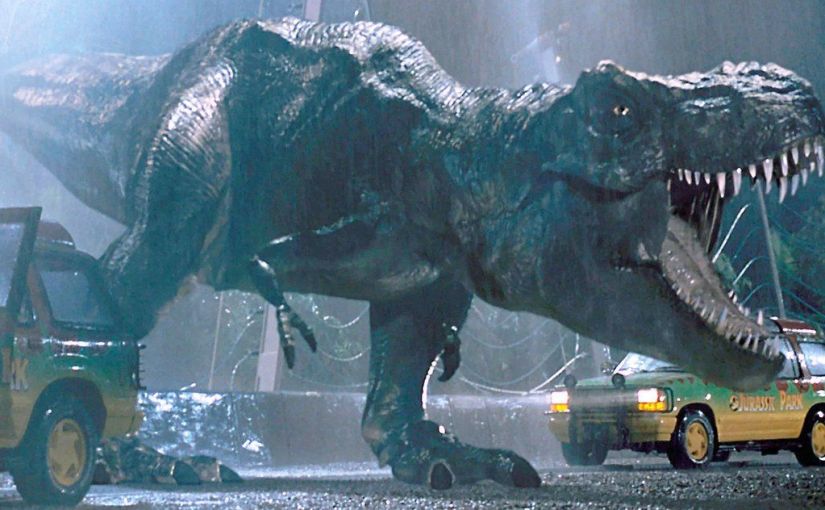
There’s no question regarding the immense thrills the film brings, even thirty years later.  Effects and puppeteer wiz Stan Winston (how I wish he hadn’t passed away so soon) outdid himself following memorable recreations from films like Aliens and Predator.  The centerpiece of the blockbuster is of course the T-Rex.  Spielberg follows his age-old approach of not showing the monster right away, though high publicity and massive merchandising of the early 1990s never kept this cat in the bag anyway.  Oh well!  Yet, when the humungous, twenty-ton dinosaur puppet makes its grand entrance midway through the film, it still holds as a spectacular scene, especially because two fine child actors (Ariana Richards, Joseph Mazzello) with high pitched screams heighten the terror.  Look, you should know by now.  If Steven Spielberg is aiming for the rafters of box office thrills, he’s gonna put the kids in danger first and foremost.

Velociraptors are the other big stars of this creature feature and the behavior of these CGI animals is magnificent as we observe them communicate with one another.  Like the T-Rex, we don’t get an immediate first glance of them either, but their squeals and screeches as they leap in for a monster mash smorgasbord get us to jump in our seats.  When the veil is lifted on these guys, Spielberg and his effects crew go further by granting them with quick agility.  Before all this, we are told by the science experts of how they are strategic pack hunters with cheetah like speed and how they tear away at flesh as they pounce on live prey.  You wince as you imagine.  They are also smart too.  These dogs can open doors! 

Again, all good stuff here.

The best character is the sarcastic mathematician, Ian Malcolm (Jeff Goldblum), who insists resurrecting dinosaurs is a terrible idea for the modern age.  Goldblum is so good with the script written by David Koepp that my favorite scene in the picture is when the main characters sit around the dinner table to discuss what has surprisingly been thrust upon them.  I yearned for more scenes like this.  Ian Malcolm offers up a new iteration of “Matt Hooper” (Richard Dreyfuss in Jaws) that I just didn’t get enough of.  Only the surface is scratched on the argument of intelligence versus stupidity.  In Jaws, we got nearly a full hour of this welcome back and forth.

What lacks is what Jaws provided over a decade earlier.  The debates of how to live (or die) with dangerous animals begins, but doesn’t finish in Jurassic Park.  It merely gets started, and then the argument gets abandoned to allow for unending carnage.  Don’t get me wrong.  I love carnage in my movies.  However, Crichton illustrated an even amount of attention to chaos blended with intelligence (or ignorant lack thereof) when he wrote his book.  I got a textbook education from Michael Crichton.  From Steven Spielberg and David Koepp, I just got a thin dog eared comic book.

Goldblum is third in line in the cast credits behind Sam Neill and Laura Dern as Alan Grant, a paleontologist, and Ellie Satler, a paleobotanist.  They, along with Malcolm, are cordially invited by billionaire entrepreneur John Hammond (Richard Attenborough) to visit his private island that is soon to be converted into Jurassic Park, a zoo/amusement park consisting of live dinosaur attractions.  The dinner sets up the debate of Hammond versus the three scientists.  Is anyone being responsible with the potential to act upon breakthrough discoveries?

Granted, if Hollywood was going to make a dinosaur movie, then it was going to be catered to children age 10 and up.  Kids and families of four or more sell tickets.  The novel doesn’t aim towards that demographic, however.  It is darker and the Hammond character is more sinister and greedier.  He’s not a fleshed-out villain in the film.  He’s lovable.  The film simplifies itself too much as it devolves into a run and chase and chew and chomp adventure of screams and outstanding John Williams music.

I watch the film over and over again because visually it remains magnificent, but I still remind myself that it is not enough.  Steven Spielberg’s film is admired and so well regarded and perhaps it is deserving of its legacy, thirty years, five sequel films and a couple of Universal Studios attractions later.  On the other hand, I wish it allowed its brain to develop a little bit more. 

Steven Spielberg’s interpretation of Jurassic Park could’ve been as smart as a velociraptor.

STAR WARS EPISODE III: REVENGE OF THE SITH

By Marc S. Sanders

Star Wars Episode III: Revenge Of The Sith is the best installment in George Lucas’ prequel trilogy of his epic space opera saga. However, that is where the line is drawn.

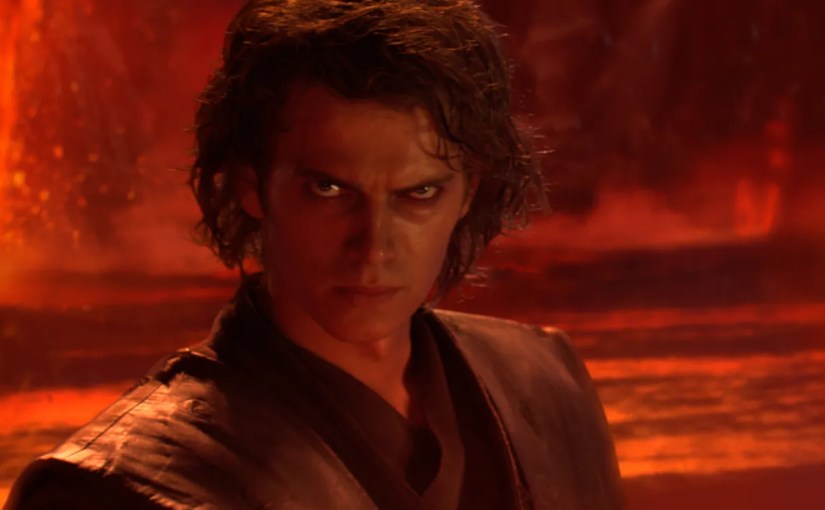
It carries a heightened drama thanks primarily to Ian McDiarmid as the eventual Emperor Palpatine. Shakespeare might have been proud of the character and performer. Much like Alec Guinness received an Oscar nomination for his portrayal of Ben Kenobi, so should McDiarmid have been honored playing an antithetical influence (of Kenobi) on the student and Jedi in Training, Anakin Skywalker (Hayden Christensen in a much more improved performance).

War within the galaxy is rampant and there’s no end in sight. The Jedi Order is overwhelmed. Anakin is used as a pawn to spy on his new mentor Palpatine who in turn insists that the young Jedi occupy a chair in the Jedi Council to spy on them. In addition, it’s hard for Anakin to come to grips with his secret wife Padme (Natalie Portman) dying from childbirth as his nightmares continue to remind him. A deal with the devil himself in Palpatine is offered as an option. Can a manipulation in the Force rescue Padme from death?

There’s a lot of weight on Anakin here. Sith departs from the politics discussed in the prior entries as it focuses primarily on Anakin’s personal struggles. The film really needed to take this direction. After all, it’s time to witness Anakin’s transformation into Darth Vader. Everyone has been dying to see that.

George Lucas’ scene set ups work on occasion. A great performance of dialogue occurs in an alien opera box between Palpatine and Anakin. This is where McDiarmid really comes through. He’s subtle and deliberate in his influence. Fortunately, Christensen just needs to listen mostly.

Later however, a scene works only so much when Samuel L Jackson as Jedi Master Mace Windu duels with Palpatine, having just revealed his secretly evil Sith side. Through all three of these films, Mace Windu has been one of Jackson’s least exciting roles. He’s bland and never doing much. Christensen comes upon this scene and doesn’t give me the genuine anguish I was hoping for. McDiarmid, again, is hitting home runs in surprise and development. This turning point scene is not as strong as it should have been thanks to Lucas’ stilted direction and writing, along with Jackson and Christensen lacking any true depth.

Episode III also has a handful of so what moments that continually frustrate me in this trilogy. We have to watch Yoda and Obi Wan watch a video of what Anakin has done. Why? We’ve seen this already. Bail Organa (Jimmy Smits; I wish he had a larger role) needs to be informed of an upcoming meeting. Honestly, I don’t need an update on a character’s calendar. Just make sure he arrives on time. Moments like these don’t drive towards anything.

Natalie Portman is not served well as a pregnant Padme. Her dialogue is worse than ever, and it hinders her performance. Padme is torn between her affection for Anakin and her passions for democracy. We see next to none of the latter. How does an intelligent woman like Padme suddenly become so unaware? Ironically, opportunity for her political nature was filmed but remains only as deleted DVD features. These scenes would have enhanced the movie as they imply the foreshadowing of the upcoming Rebellion, while a petition attempt is mounted to usurp the Emperor’s administration. Here, Padme is trying to be instrumental in Luke & Leia’s (her own children) future. Really good material here. Nevertheless, George Lucas opted to leave it all on the cutting room floor. Oh well! I’m still holding out hope for a “special edition” cut one day, inclusive of this storyline.

Lucas’ lava planet, Mustafar, is quite grand as the arena for the much-anticipated dual between evil Anakin and noble Obi Wan. Still, again, it could have been better. There’s too much CGI and flashing lightsabers that hide the acting among the swordsmen. Compare this to the duals in Empire and Jedi and you see what I mean.

I know my commentary on the prequels is quite pessimistic, but I do have an (maybe a biased diehard fan) appreciation for the films. The stories work. The execution falls short however in dialogue, performances and visual artificialness.

George Lucas had all the right make up for a trilogy as epic as his original films that began in 1977. Maybe because he didn’t have the monies and technology at that time, his imagination had to work overtime back then. In these later films, however, his hubris got in the way of his craft. So, we have to settle for his next great technological discovery in CGI efficiency. Therefore, we get cartoons with no depth like Jar Jar Binks, General Grievous, and lame, clicking battle droids.

Lucas always defended the position of his writing by insisting these films are aimed for kids. No. I don’t accept that. Star Wars was aimed for kids and the kids that remain in all of us as we continue to grow into adulthood. George Lucas needed to write with that in mind.

STAR WARS EPISODE II: ATTACK OF THE CLONES

By Marc S. Sanders

Star Wars Episode II: Attack Of The Clones is a vast improvement on the prior installment of George Lucas’ prequel trilogy from a galaxy far, far away. Lucas made an attempt to bring his characters out of their shell a little bit. I mean at least they laugh among each another. You need that if you are to believe that Jedi In Training Anakin Skywalker and Padme Amidala (Hayden Christensen and Natalie Portman) are to fall madly in love. So at least have them romp around in a Naboo meadow.

There’s some curious political intrigue in Clones; delving deeper than what Episode I only began to imply. As stilted as some of the dialogue may be, there are ingredients here that allow to me correlate with real life government powers and to date current events. That’s a compliment, but it’s also a shortcoming.

Ian McDiarmid remains the MVP of this trilogy as Chancellor Palpatine, the puppet master with a faux innocent exterior. Anytime he’s on screen you sit up in your chair with a little more focus. He’s brilliant as the manipulator who keeps a short distance on Anakin, the supposed chosen one, while also pushing Padme away from government interference, and yet still managing to prevent the Jedi Order from detecting his true nature. It takes a heck of an actor to pull this off.

At the same time though, the politics take up a large amount of the entire trilogy. While it holds my interest, I still question if this is what a Star Wars film should be comprised of. Where’s the force, and where’s a more defined explanation of what “the chosen one” is to offer, or what the “balance of the force” really means? Some heavy vocabulary in this terminology, maybe, but is there any dimension to any of this? Regrettably, the answer is no.

New characters and planets are introduced. Jango Fett (Temura Morrison), an armored bounty hunter, is the initial antagonist who is part of an assassination attempt on Padme, followed by a revelation that he is the source of a new discovered clone army on a secret water planet known as Kamino. (As a diehard franchise fan, I have a lot of issues with Jango and his pre-teen son Boba, but that is for another discussion.)

Eventually, the antagonism shifts to Christopher Lee as the former Jedi Count Dooku, found to be keeping conference on another secret planet known as Geonosis, where life size dragonflies reside. Lee was legendary by the time this film was released in 2002, but he’s not exactly aggressive enough for me. He was an old man with little convincing agility to be engaged in a lightsaber fight with a very bouncy Master Yoda. In Lord Of The Rings, he commanded from the perch of his tower. Here, Lee is in the mix of the action and he’s a far cry from Ray Park’s appearance as Darth Maul.

Yoda is another issue. Now friends will be quick to remind and tease me over how excited I got when I saw Yoda engage in a climactic lightsaber dual for the first time. My tune has changed though. As The Empire Strikes Back showed way back in 1980, Yoda was convincingly powerful without ever having to prove how powerful he ever was. Here, it comes off gimmicky to me as an excuse to draw a crowd or make a new kind of toy to sell. Just Yoda’s appearance alone should be enough. Now, he’s just like the rest of them. Yoda’s greatest feature was his philosophy, never his combat skills.

I don’t take much issue with the romantic dialogue between Anakin and Padmé. An actor like Leonardo DiCaprio or Billy Zane would sell the “sand monologue” into the stratosphere. Remember, those guys performed James Cameron’s hammy Titanic script. Hayden Christensen could not do that though. His temper, which Anakin is regarded for at this age, is never convincing. It’s terribly overacted. He screeches his dialogue. Darth Vader never had to yell or scream or screech. So why is Anakin? This is also partly Lucas’ fault. Where’s the misuse of the force with Anakin? At one moment, Anakin is upset and throws an object? Why throw an object? Why not “force throw” an object? Anakin demands answers from a captive bounty hunter by screaming at her? Why only scream? Why not “force choke her” or mentally torment her? Don’t you think these ideas, these familiarities we’ve seen with Vader would have held much more dramatic weight and depth?

Lucas stretched himself further than he did on The Phantom Menace. Still, he just didn’t take his second episode far enough. It’s as if he opted not to apply too much effort. There are no twists to Attack Of The Clones. No surprises. We easily have a general idea of where all of this is going long before the opening crawl even begins. So, like its predecessor, Episode II lacks a wow factor that placed the original three films into the greatness they still hold.

There still needed to be more in these films. I’m not gonna even talk about CGI. I’m talking about story, and what makes a saga a Saga. So… WHERE’S THE SAGA?????